Vushtrri Stone Bridge: A Historic Route Crossing in Kosovo
Site at a Glance
- Popularity
- Medium
- Country
- Kosovo
- Primary era
- Medieval
- Eras represented
- Medieval
- Civilizations
- Serbian
- Site type
- Infrastructure
- Remains
- Bridge
On this page7 sections
History
The Vushtrri Stone Bridge is a stone crossing in Vushtrri, Kosovo. Its construction date is uncertain, although stylistic analysis favors the late 14th or early 15th century. Proposals have also placed its origins in Roman or Ottoman times, or in the early Middle Ages. The bridge is regarded as one of the oldest of its type in Kosovo and as Serbia’s oldest surviving stone bridge.
Dating and attribution
Local tradition credits the bridge to the Vojinović brothers, who are portrayed in epic poetry as nephews of Serbian Emperor Dušan, the sons of his sister. The Vojinović family were nobles in the first half of the 14th century, but Vushtrri lay outside their territory during the periods of power associated with Vojislav Vojinović, about 1355–1363, and Nikola Altomanović, from 1366 to 1373. The traditional attribution therefore remains uncertain.
A Branković court, the ruler’s household and administrative center, was at Vushtrri in the early 15th century. The Branković and Vojinović families were related through marriage: Ratoslava, sister of Branko Mladenović, married Altoman Vojinović, Nikola Altomanović’s father.
Routes and written references
The bridge carried a caravan route between Dubrovnik and Skopje, linking the wider Balkan region. It also connected Vushtrri with villages at the foot of Çyçavica, and linked the Kosovo Plain with Drenica through Klysyrë Gorge. Another road crossing the bridge led to the railway station at Shtruerë. In 1573, French traveler Philippe du Fresne-Canaye referred to Vushtrri’s large stone bridge. Ottoman records from 1873–74 describe two bridges over the Sitnica at the town, one wooden and one stone.
Investigation and local traditions
In 1977, Albanian archaeologists Aleksandra Mano, Zhaneta Andrea, and Ali Muka investigated the bridge with Kosovo professor Qamil Gegja. Researchers from Belgrade removed several Latin inscriptions that had been on the bridge. Kosovo lists it as a monument under permanent protection, while Serbia classifies it as a cultural monument of exceptional importance.
After NATO’s 1999 military campaign against the Federal Republic of Yugoslavia and the arrival of the Kosovo Force, an international peacekeeping force, and the United Nations Interim Administration Mission in Kosovo, the bridge and its arches were used as garages for carts, tractors, cars, and buses. They were also used for dumping and burning rubbish. Local belief associated touching the stones with health, strength, and harmony in marriage. Newlyweds visited the bridge and made vows of love.
Remains
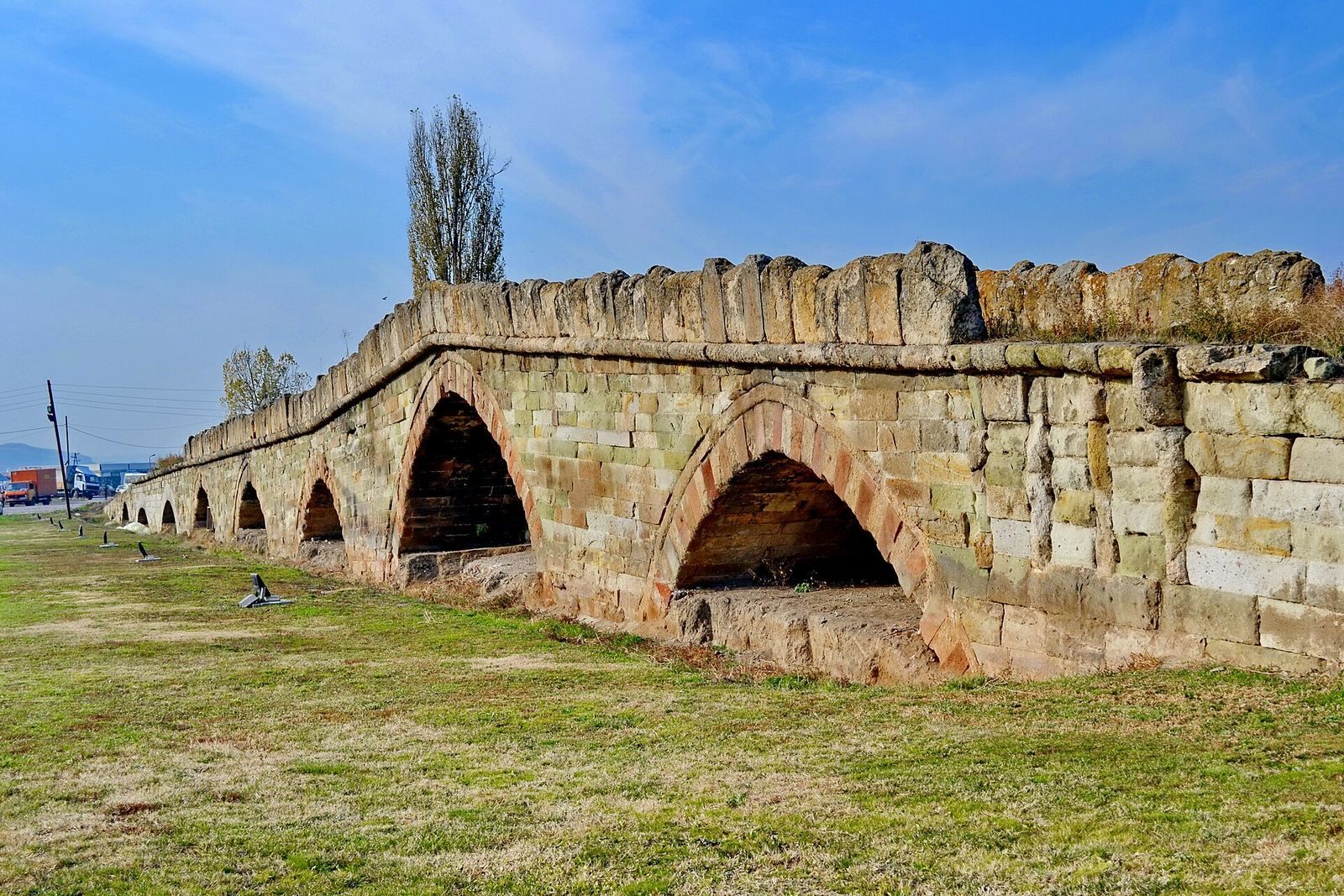
The bridge crosses the former bed of the Sitnica. Its length is about 135 metres, including side additions thought to be later, although river deposits have reduced its overall extent. The roadway is almost five metres wide. The Sitnica changed course at least two centuries ago and now runs about a kilometre to the west. The exact date is unknown; the change is believed to have resulted from natural factors, including the soil, increased silt, and the river’s curved course.
Arches and span
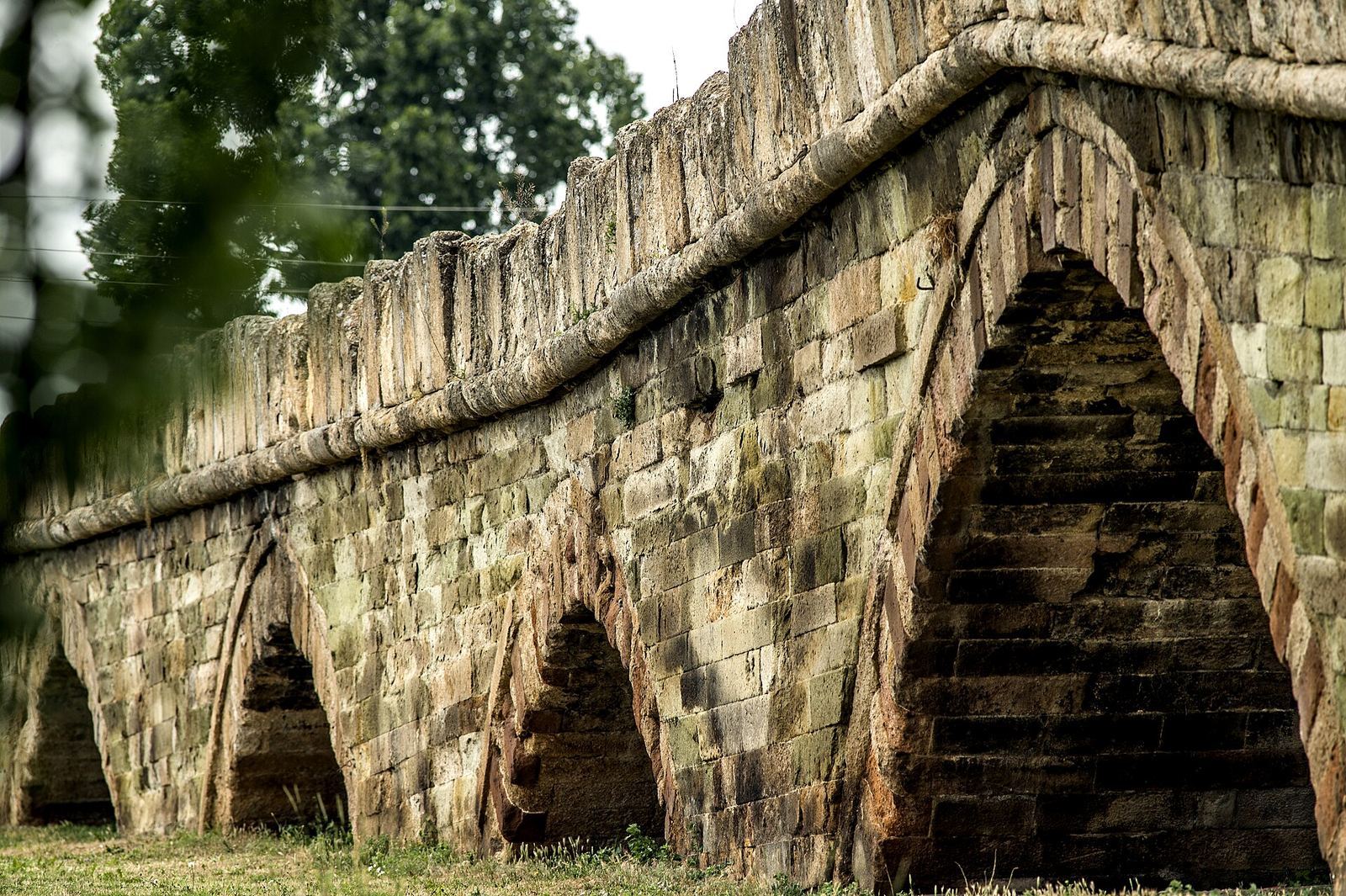
Nine asymmetrical arches form the crossing. Five pointed arches make up the earlier central section, while four smaller, semicircular arches were added later. The largest arch is almost 13 metres wide. The central openings once had enough clearance for hay carts. The bridge’s middle section stood about 7.5 metres high until 1902, while only about 3.7 metres of that height is visible today. Local tradition holds that the bridge once had twelve arches, with three buried beneath layers of earth.
Masonry and parapet
Carefully dressed stone blocks, about a metre long and 30–40 centimetres thick, are laid in parallel courses. Red and grey stones alternate across the masonry, while the arched vaults use red and white stone. Molten lead in the joints helped bind the blocks together. The finished side walls have a long, curved stone cornice that marks the level of the paving on the front walls. The parapet, about 90 centimetres high, consists of blocks seated in sockets and fixed with metal pins secured in molten lead. Another local tradition says that stones from the bridge and the public bath were ground, mixed with a binding material, and placed in casings.