Tlos: An Ancient Lycian City and League Center
Site at a Glance
- Popularity
- High
- Country
- Turkey
- Primary era
- Classical
- Eras represented
- Classical, Medieval, Modern
- Civilizations
- Byzantine, Lycian, Ottoman, Roman
- Site type
- Settlement
- Remains
- City
On this page24 sections
History
Tlos is an ancient Lycian city on the eastern side of the Xanthos valley in present-day Turkey. Its foundation is placed more than 4,000 years ago, and occupation in the city and surrounding territory reaches back to the Neolithic. The hilltop center was occupied by at least the Late Bronze Age.
Early settlement and Lycian traditions
Caves at Girmeler and Tavabaşı were used from the Neolithic, while the acropolis, the city’s elevated center, was occupied by the Late Bronze Age. The name Tlos descends from the earlier Lycian name Tlawa, which appears in local inscriptions. Hittite texts refer to a place called Dalawa, often identified with Tlos, and describe it as a country. If the identification is correct, the texts suggest that Madduwatta, ruler of Arzawa around 1300 BC, took Dalawa out of Hittite control. The Hittite king Tudhaliya IV restored that control roughly half a century later. References to Tlawa and Dalawa indicate that the settlement was known in the Late Bronze Age.
Greek tradition explained the city’s name through Tloos, a son of Tremilus and the nymph Praxidike. A version of the story is associated with the fifth-century BC poet Panyasis and was later repeated by the Byzantine writer Stephanus of Byzantium. The family relationships vary among tellings. Greek myth also connected Tlos with Bellerophon and his winged horse Pegasus. Local legends linked the acropolis rock to a throw by Kronos, a Titan in Greek mythology, and nearby rocks to Skylakeus, said to have survived the Trojan War.
A defensive wall across the valley upstream of Xanthos, built in the late fifth or early fourth century BC, has been interpreted as evidence of rivalry between Tlos, Xanthos, and other cities in the middle valley. The Lycian regional ruler Arbinas claimed to have conquered Xanthos, Pinara, and Telmessos. Tlos may have served as his capital because of its strategic position. An inscription from about 370–360 BC calls Izraza “king of the Termiles,” a name the Lycians used for themselves. It concerns worship of Tarqas, the Lycian storm god, and the Mother Goddess.
Persian rule and Hellenistic powers
Persian commander Harpagus led the conquest of Lycia around 540 BC, bringing Tlos under the Achaemenid Empire, the Persian imperial state. The city prospered under Persian rule from the fifth century into the late fourth century BC. Alexander the Great conquered Lycia in 334/333 BC. After his death, the region passed among successor powers during the Hellenistic period, including the Ptolemies, the Seleucids, who held it briefly in 197 BC, and Rhodes.
Around the time of the Galatian invasion of Asia Minor in 279 BC, a statue at Tlos commemorated the general Neoptolemos’s victory over Galatians, Agrianes, and Paeonians. An account also mentions Pisidians, but it is uncertain whether they helped resist the invaders or joined them. Raiding in the coastal districts is considered the likelier explanation for their involvement.
The Lycian League and Roman rule
Rome recognized Lycia’s independence in 168/167 BC, when the Lycian League, a confederation of Lycian cities, was formalized. Tlos was one of its six principal cities and held three votes, placing it among the League’s most influential members. An agreement probably made after 167 BC regulated tolls at Tlos and Cadyanda along an important route between Oinoanda and the coast. It assigned the highland district of Masa to Tlos while permitting people from Oinoanda to graze animals and cut timber there, but not to plow the land or establish permanent buildings. Boundary markers were to be set. Masa has been identified with present-day Hacıosman Mountain. A Lycian road network connected Tlos with Xanthos, Pinara, Telmessos, Kadyanda, Araxa, Oinoanda, and Choma; the routes served travel and trade.
Under Emperor Claudius, Rome incorporated Lycia into its province in AD 43. Tlos retained its status as a major city and used the title “very brilliant metropolis of the Lycian nation.” Inscriptions divide its citizens into demes, or civic districts, named in part for legendary heroes including Bellerophon, Iobates, and Sarpedon. A first-century BC inscription names Antiochis, a woman physician. In the following century, the city’s archive was held by an enslaved person whom Apollonios of Patara had given in exchange for 300 drachmas.
Tlos also had a Jewish community with its own magistrates. Its distinctive religious life included a cult of Kronos, the Greek mythological father of Zeus, and a festival in his honor called the Kroneia, attested in the second and third centuries AD. These traditions existed alongside the local worship of Tarqas and the Mother Goddess.
Earthquakes and Christian Tlos
An earthquake in AD 141 destroyed many monuments. Opramoas of Rhodiapolis and another wealthy benefactor paid for substantial rebuilding during the second century. A further earthquake caused extensive damage in AD 240. Inscriptions record repairs to the baths after both disasters.
Tlos became a Christian bishopric under the metropolitan see of Myra, a regional church center, and remained an important Christian community at least into the twelfth century. Its bishops or representatives took part in councils and synods in 451, 536, 692, 787, and 879. In 458, Bishop Andreas signed a provincial letter to Emperor Leo I concerning the murder of Proterius, patriarch of Alexandria. In AD 542, Emperor Justinian settled a property dispute between the bishop of Tlos and a deacon of Telmessos; the decision became part of Byzantine legal precedent. Tlos remained a settlement of some importance in the thirteenth century.
Ottoman occupation and rediscovery
The site was occupied again during the Ottoman period. In the early nineteenth century, the local feudal governor Kanlı Ali Ağa established a castle on the acropolis, reusing ancient remains. The settlement was later abandoned, and the modern village of Yaka was built over the ancient city. The Catholic Church established Tlos as a titular see in 1732, an ecclesiastical title for a former diocese without a resident bishop.
Charles Fellows’s exploration in 1838 is associated with Tlos’s European rediscovery. Thomas Abel Brimage Spratt and Edward Forbes also explored and described it during the nineteenth century, when dense forest covered the site. An Austrian excavation led by Otto Benndorf and George Niemann was published in 1884. Regular excavations by an interdisciplinary team have taken place since 2005.
Remains
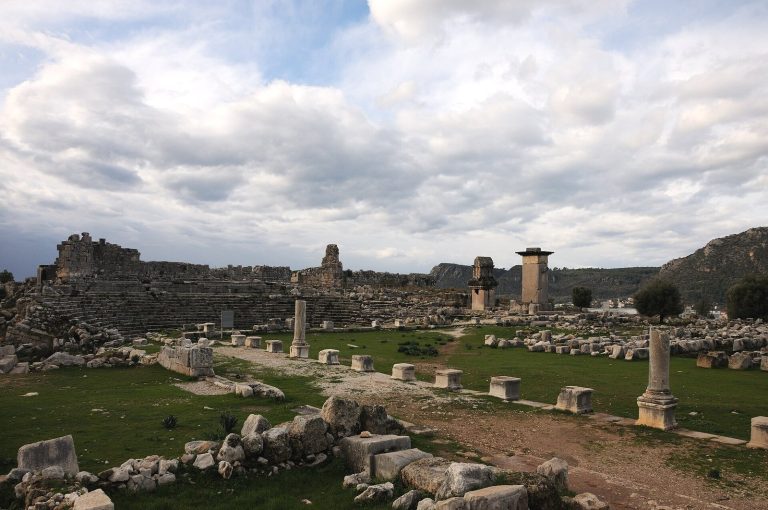
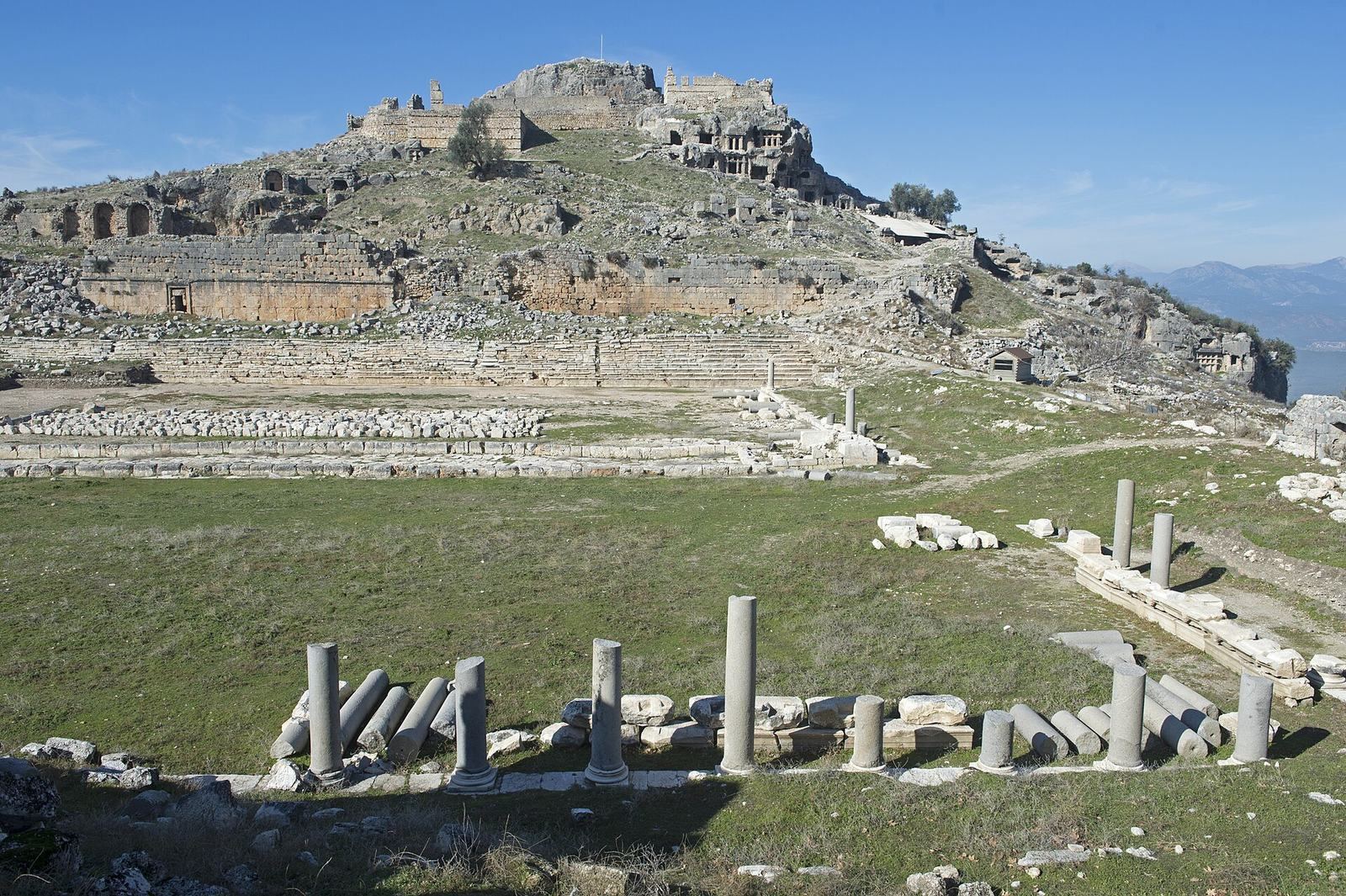
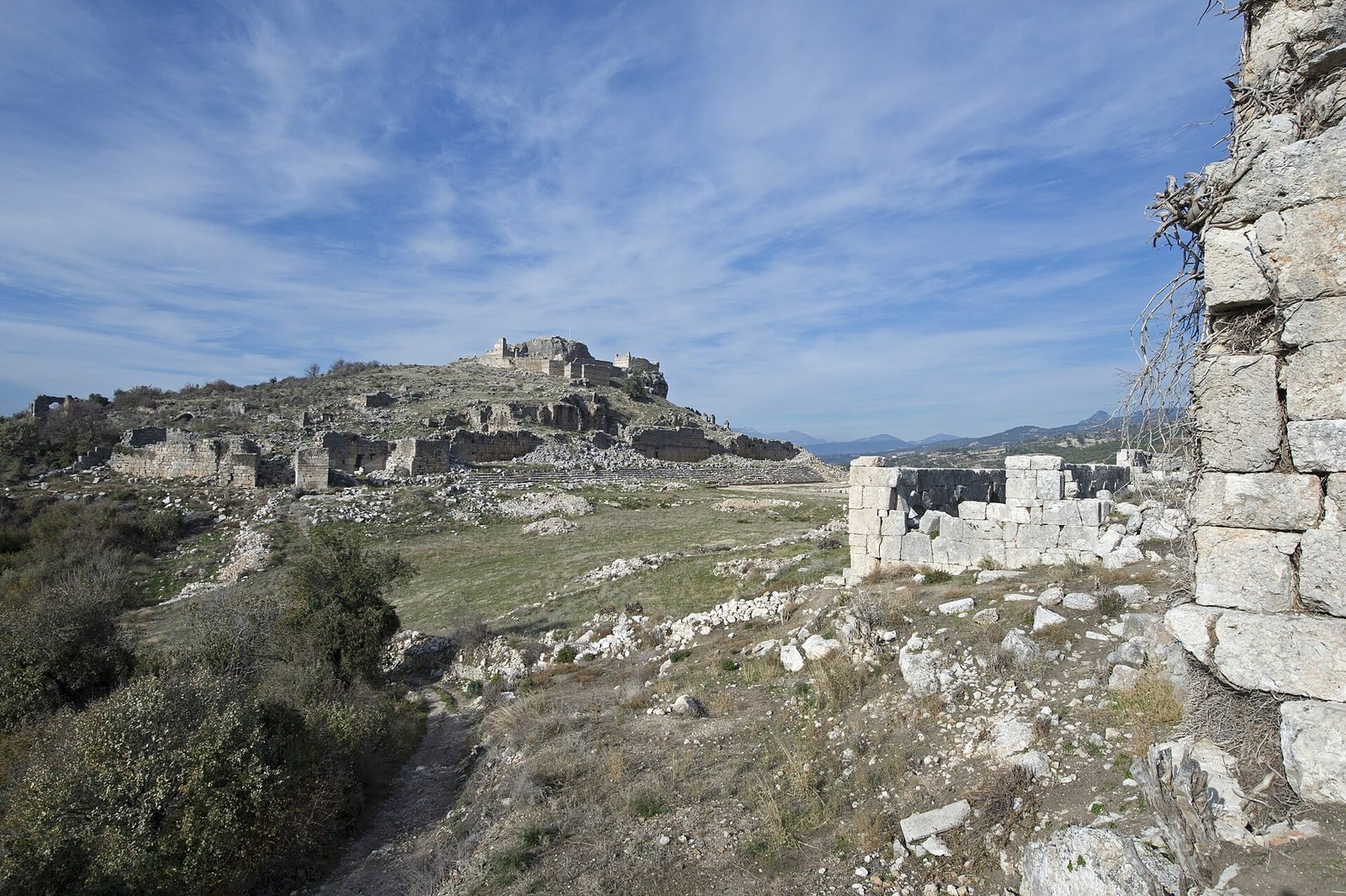
The remains occupy a rocky hill above a plateau near the modern village, with steep cliffs along the western, northern, and northeastern sides. The ancient city’s territory extended from the Akdağlar mountain slopes to the Eşen River plain. Its surviving buildings span several periods, with the fortified hilltop and the settlement on the southern and western slopes forming the main physical areas. Terraces, public buildings, tombs, and water features occupy the slopes and lower ground.
Acropolis and surrounding slopes
Palace and fortifications
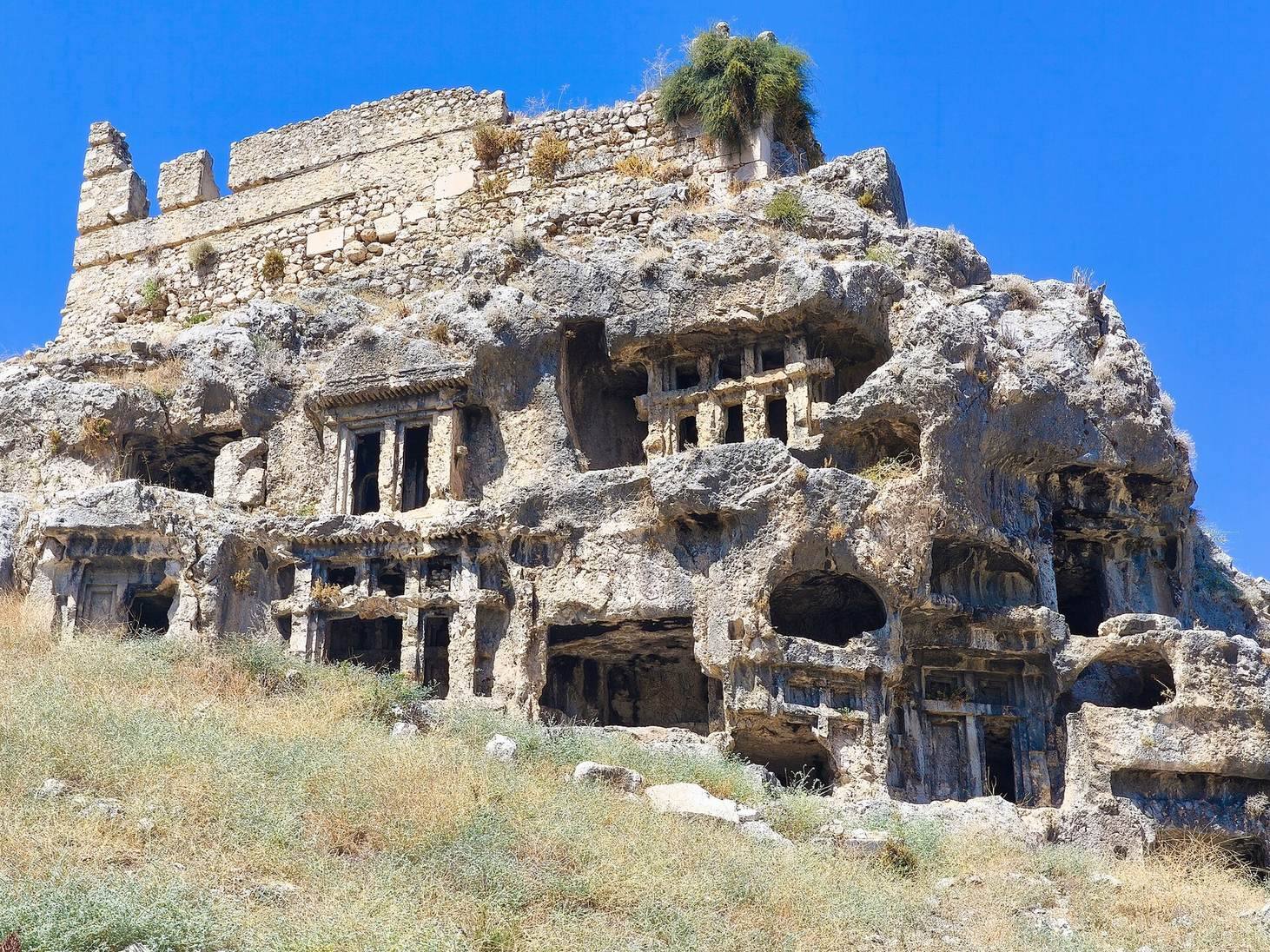
A ruler’s palace complex occupied the hilltop in the early Classical period. Successive defenses are represented by a Lycian wall and a Roman-period wall, while the Ottoman castle was built on the foundations of the ancient fortress.
Sanctuary on the northern slope
Hellenistic public buildings occupied the acropolis slopes. Beside the palace on the northern side, a sanctuary thought to have been dedicated to the local Lycian deity Trggas stood on a platform cut from the rock.
Rock-cut tombs
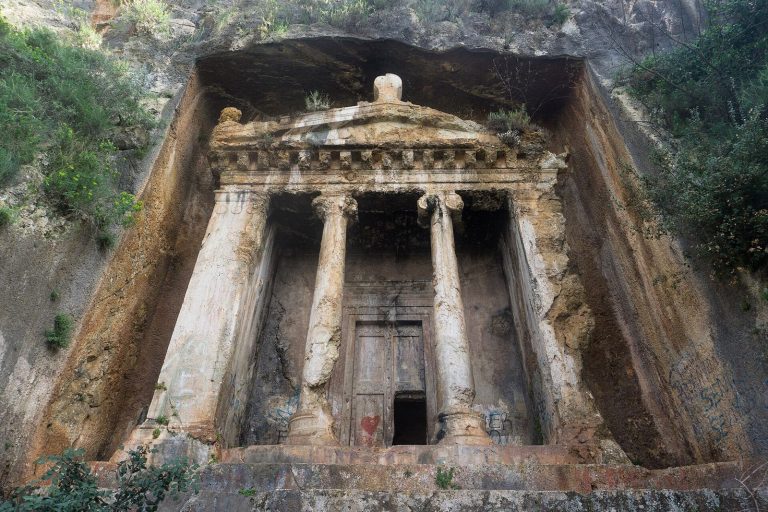
Lycian sarcophagi and tombs cut into the rock line the slopes toward the acropolis. The tombs include house-shaped and temple-shaped forms. A large temple-shaped tomb traditionally identified as Bellerophon’s has an unfinished façade with four columns. A relief at its entrance shows Bellerophon riding Pegasus, while an interior carving depicts a lion or leopard.
Terraced settlement
The southern and western slopes, where settlement was probably concentrated in early Lycian times, contain broad terraces and cisterns. The rear walls of buildings were cut into the rock. Remains in this area include structures identified as a public square and market, a theatre, Roman baths, and an early Byzantine church.
Civic and sporting buildings
Theatre
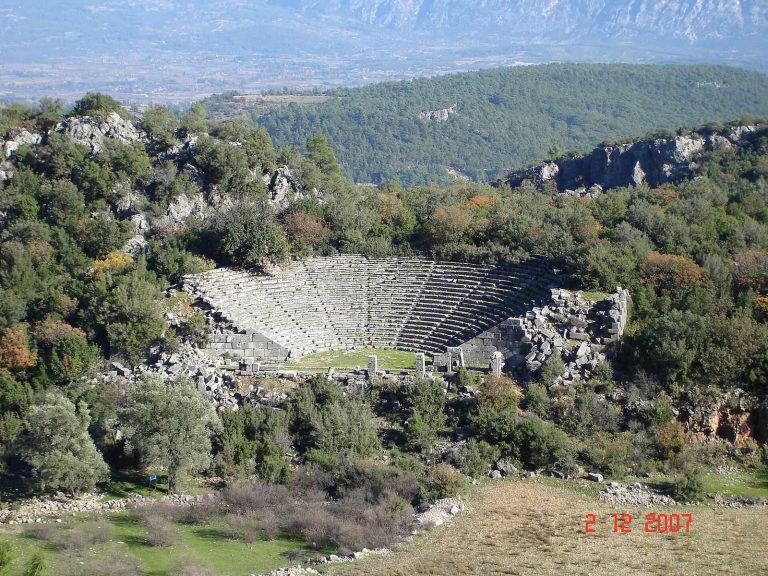
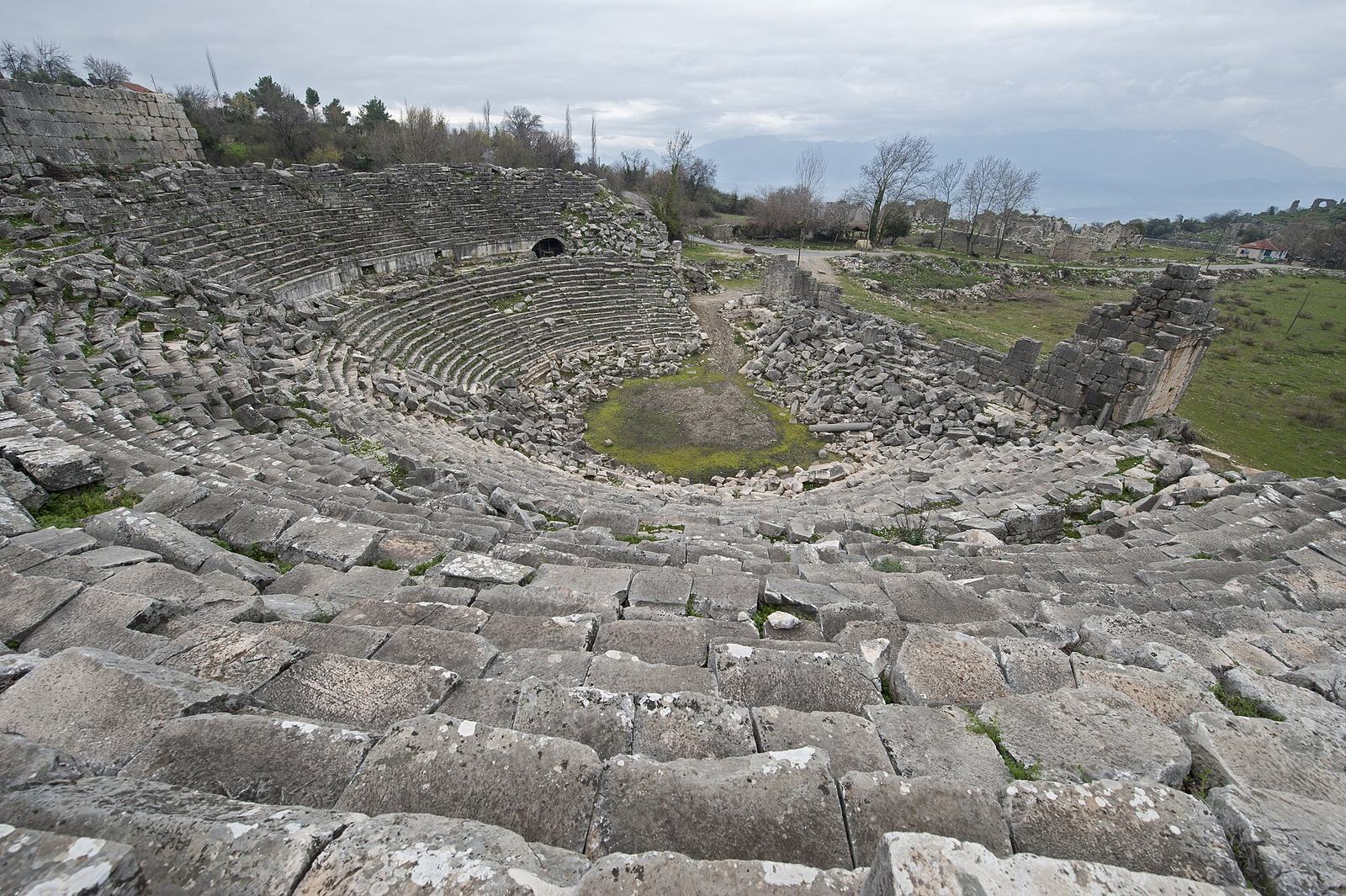
The theatre stands on the eastern slope and is among Tlos’s best-preserved monuments. Its design and an inscription recording restoration in the first century BC point to a Hellenistic foundation. The large auditorium faces a three-storey stage building, whose stone façade carries floral and figurative decoration. A small temple on the upper level of the auditorium is an unusual feature. The orchestra, the performance space, measures 20.5 metres across and extends slightly beyond a semicircle. Stone seats for distinguished spectators, known as proedria, are positioned above the horizontal passageway. Inscriptions record donations from private citizens and priests, from 100 to 3,000 denarii; the priest of Dionysus and high priest of the Cabiria rites gave 3,000. Opramoas also contributed. Roman-period renovations continued over at least 150 years.
Stadium and pool
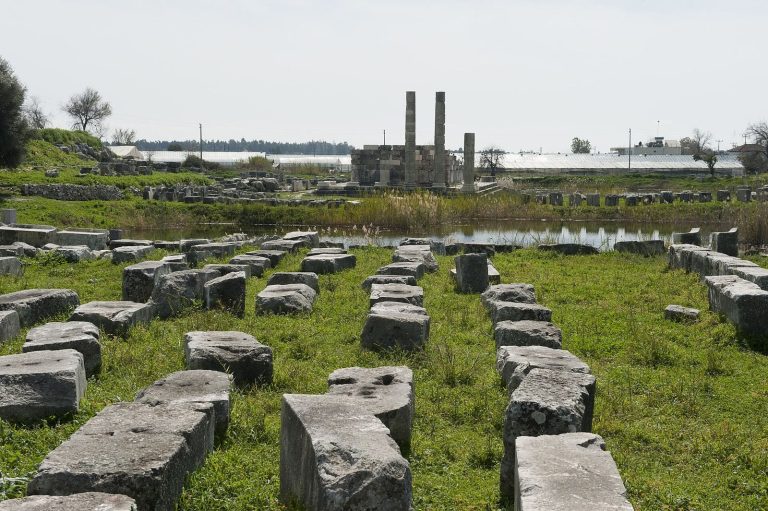
The Hellenistic stadium at the foot of the hill could seat 2,500 people and was altered and enlarged in Roman times. A colonnaded walkway originally bordered its northern, southern, and eastern sides. Running parallel to the track is a well-preserved pool 72 metres long, 8.3 metres wide, and one metre deep, with a fountain in front. Its position suggests that the stadium area also accommodated social and ritual activity.
Market building
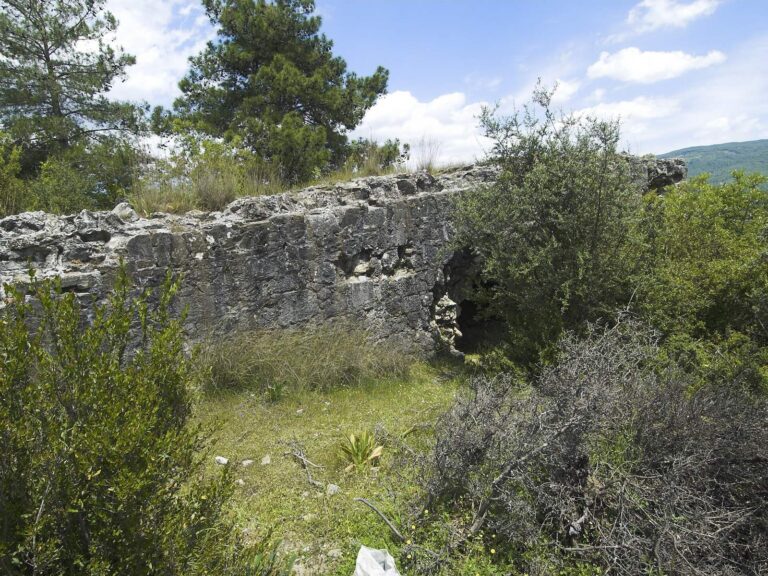
A long building parallel to the stadium is thought to have been a two-storey market, about 150 metres long and more than 30 feet wide. Its western wall has small rectangular doorways and larger arched entrances, and its stone blocks are carefully fitted. A larger structure at the southern end contains several chambers and four large arched doors.
Public square and related structures
A structure thought to be the agora, or public gathering and market space, lies across the road from the theatre. Nearby remains include a temple, a Byzantine church, and a basilica, an early form of large church building.
Baths and religious remains
Great Bath
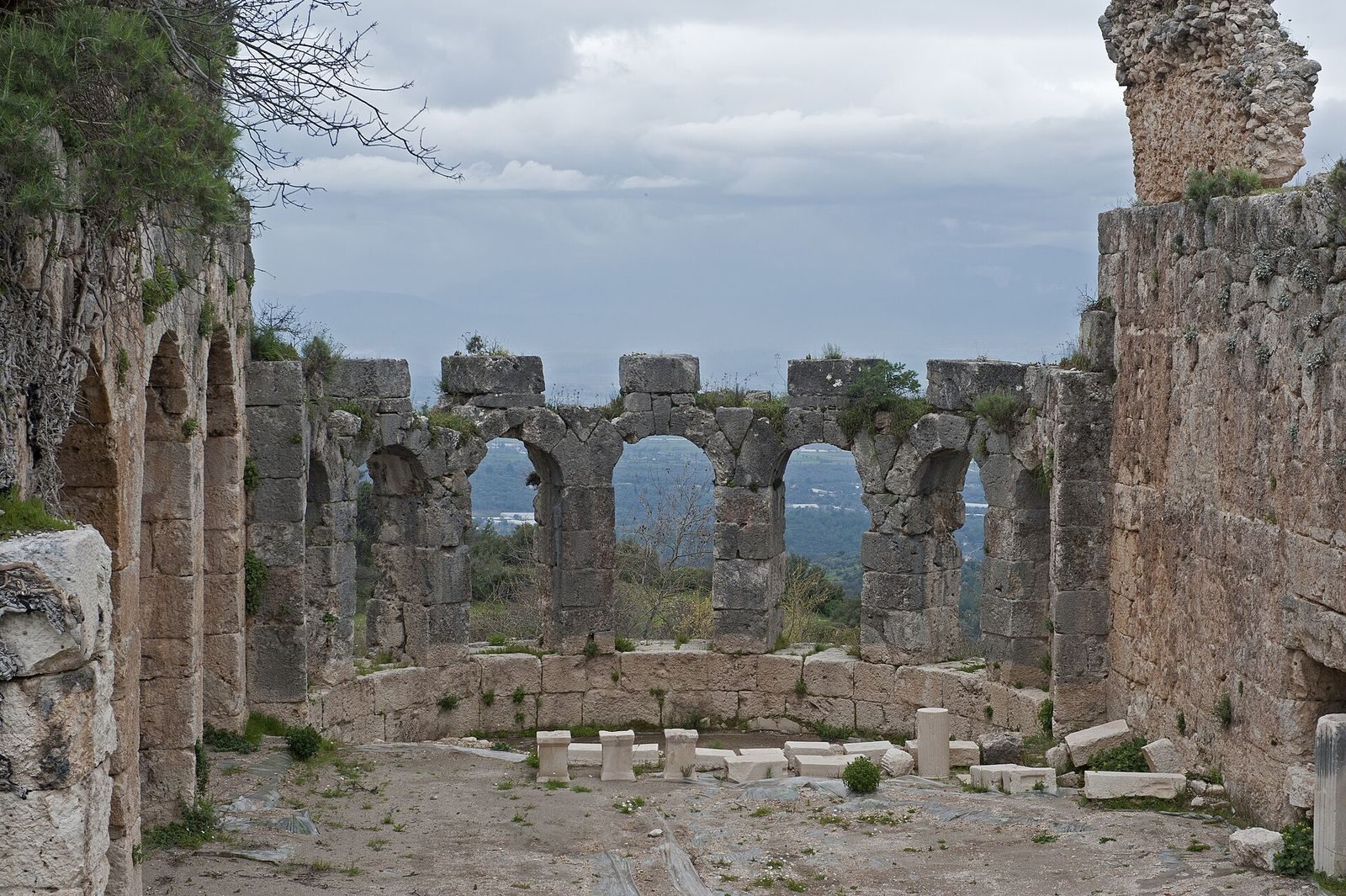
The Great Bath lies on a slope southwest of the city center. Its three rooms follow a plan typical of Lycian baths. The eastern room, reached through a monumental doorway, was the cold room. A small pool stands at the top of steps in its curved end. Two doorways in its western wall lead to the warm room, which was heated through the floor and side walls. The western room was the hot room; a small Byzantine church built within it led to the loss of most of its original features. During the Byzantine period, the cold room was also used as a cemetery. The remaining room has a curved end with seven windows overlooking the valley and may be the recessed space donated by Opramoas between AD 100 and 150.
Smaller public bath
The smaller public bath was probably first built in the early Roman period. Its three-room arrangement differs from the usual Lycian bath plan, and all its rooms had barrel-vaulted ceilings. The eastern room was the cold room. An arched doorway in its northern wall leads to an exercise and wrestling ground measuring 63 by 45 metres, surrounded by a colonnade. Dressing rooms and a fountain stood on the ground’s northern and southern sides. A room to the west may also have belonged to the bath complex.
Temples
A temple associated with the Three Brothers is linked to the statue commemorating Neoptolemos’s victory. A separate structure is identified as the Temple of Kronos. The remains also include a temple of Artemis, named in an agreement that required a copy of the agreement to be placed there.
Finds and inscriptions
Prehistoric and Bronze Age objects
Finds from the late Neolithic include stone axes, flint tools, pottery fragments comparable to material from Hacılar and Kuruçay, and rock paintings on the outer surfaces of the Tavabaşı caves. Related tools were recovered from the mound in front of Girmeler Cave, and similar pottery came from the Tavabaşı caves. Stone tools, bronze axes of different forms, daggers, and arrowheads belong to the Late Bronze Age. Small quantities of late second-millennium BC gray pottery and pottery from the Geometric period have also been found. Stone axes and flint tools were brought to light at Tlos in excavations during 2009 and 2010.
Community tomb and civic agreement
A first-century inscription records that Ptolemy, son of Leukios and a leader of Tlos’s Jewish community, built a collective tomb for fellow Jews. Its use was reserved for members of the community, and a non-Jewish family using it faced a fine imposed by the city. Skeletons described as those of former kings have also been recovered from royal tombs.
A surviving stone monument preserves an agreement between Oinoanda and Lycian cities. The agreement was to be copied onto four stones and set up at a shared sanctuary of the goddess Leto, at the temple of Artemis in Tlos, at the temple of Zeus in Oinoanda, and at a sanctuary in Caunos.