Gut Grünholz: A Historic Agricultural Estate in Schleswig-Holstein
Site at a Glance
- Popularity
- High
- Country
- Germany
- Primary era
- Early Modern
- Eras represented
- Medieval, Early Modern, Modern
- Civilizations
- Danish, German, Kingdom of Prussia
- Site type
- Domestic
- Remains
- Manor House
On this page8 sections
History
Gut Grünholz is a historic agricultural estate at Thumby in Schleswig-Holstein, Germany. It began as a medieval farmstead belonging to the bishops of Schleswig and was first recorded in 1463, when Hartwig Sehestedt was named as its owner.
Medieval estate and early ownership
Sehestedt built a small towered fortification near the farm and soon sold the estate. By 1475, it belonged to the knight Benedikt von Pogwisch. During his ownership, the earlier landholding developed into an estate-centered system of manorial control. In 1517, Benedikt’s son Wulf sold Grünholz to Duke Friedrich of Holstein; two years later, Friedrich exchanged it with Sievert von der Wisch for the estate of Hütten.
Changing owners and the manor house
Grünholz returned by inheritance to the Pogwisch family in 1655. It passed to the Ahlefeld family in 1716, then to the Thienen family in 1732. Lucia von Thienen, widow of Heinrich von Thienen, commissioned the present manor house, built between 1749 and 1752. The estate passed by inheritance to a branch of the Plessen family in 1752. The Buchwaldt family acquired it in 1807, followed by the counts von Moltke in 1834. In 1855, Magnus von Moltke moved to Upper Silesia and sold Grünholz to Duke Karl of Schleswig-Holstein-Sonderburg-Glücksburg.
Farming and later history
A fire in 1888 almost completely destroyed the historic farm buildings. The estate has nevertheless remained in agricultural use from the Middle Ages to the present. It also had its own railway connection through the Eckernförde district railways. With financial support from the railway, a salon carriage, a passenger railcar fitted with a sitting room, was acquired for the ducal family.
Grünholz remains owned by the Schleswig-Holstein-Sonderburg-Glücksburg ducal family, a branch of the historic House of Oldenburg with connections to the royal families of Denmark and Greece. The agricultural estate covers more than 1,200 hectares. Christoph, Prince of Schleswig-Holstein, manages its operations, and the family lives in the manor house.
Remains
Manor house
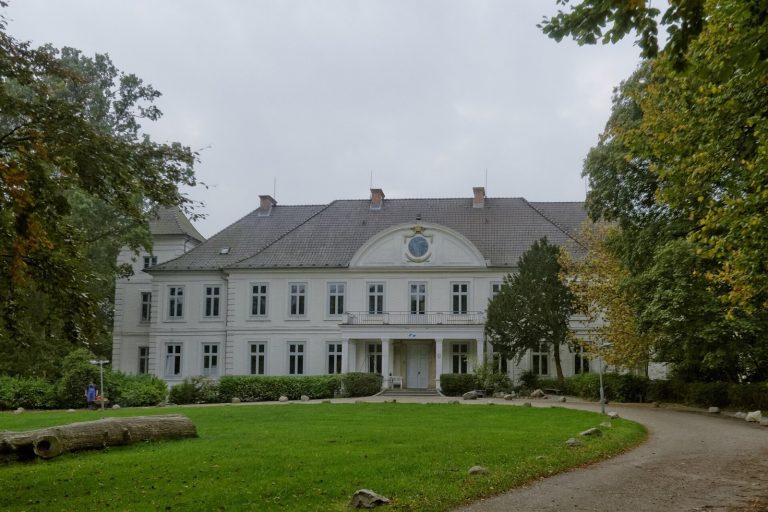
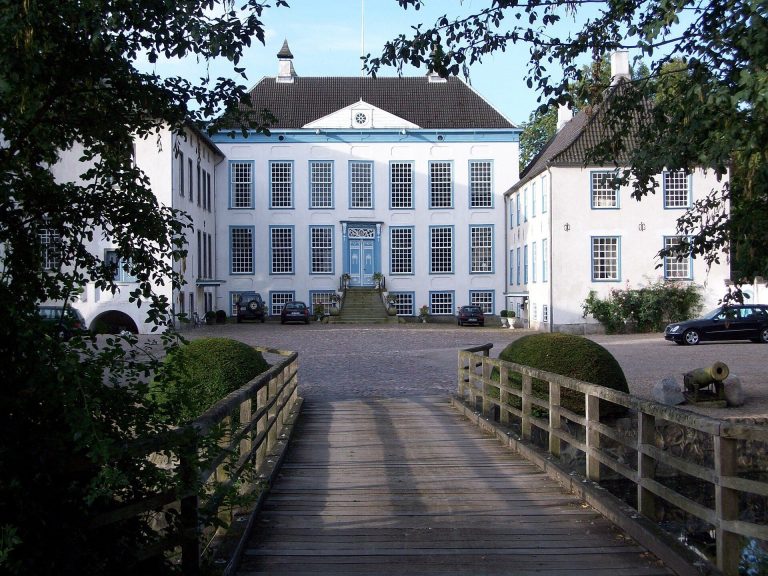
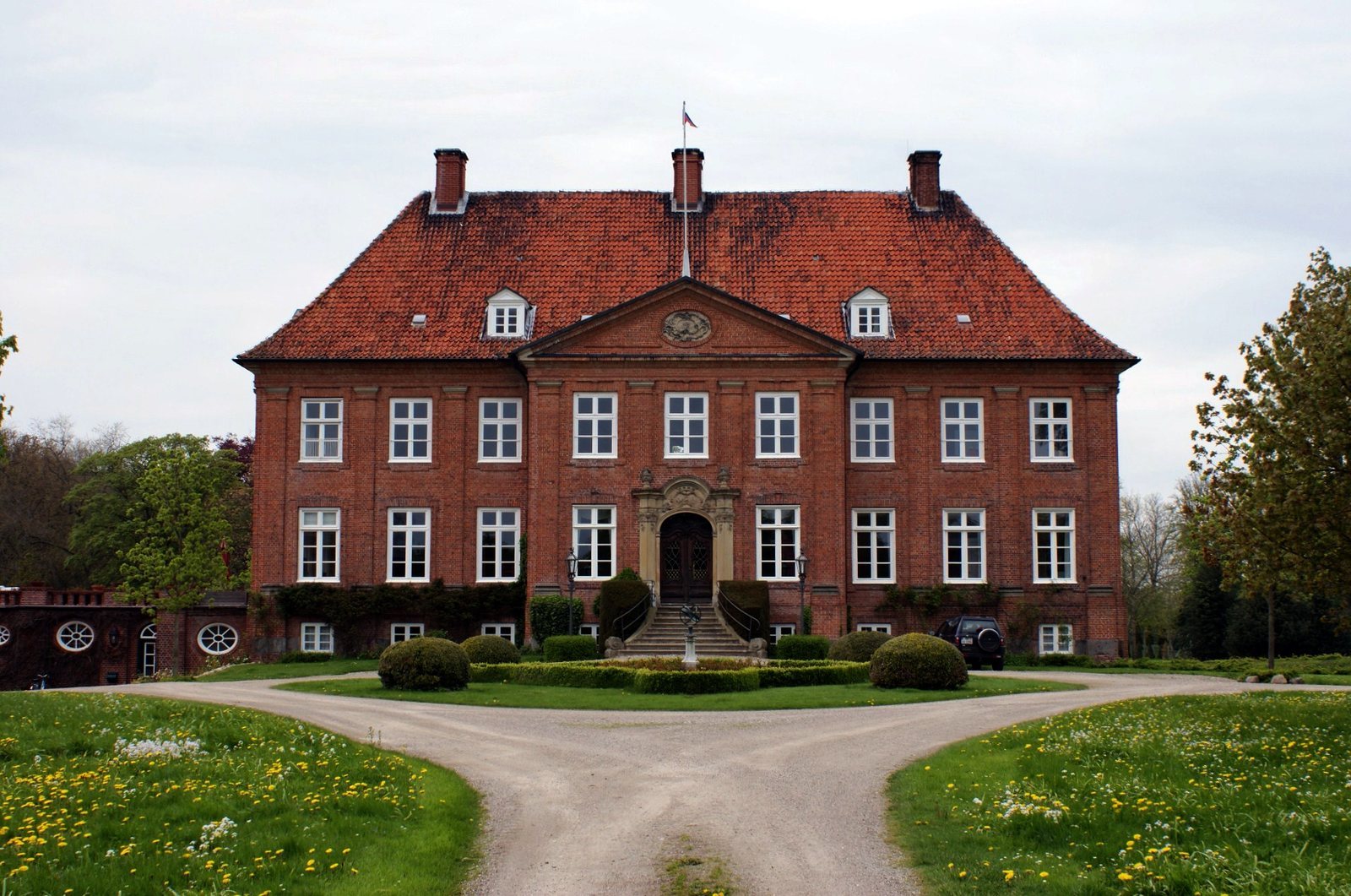
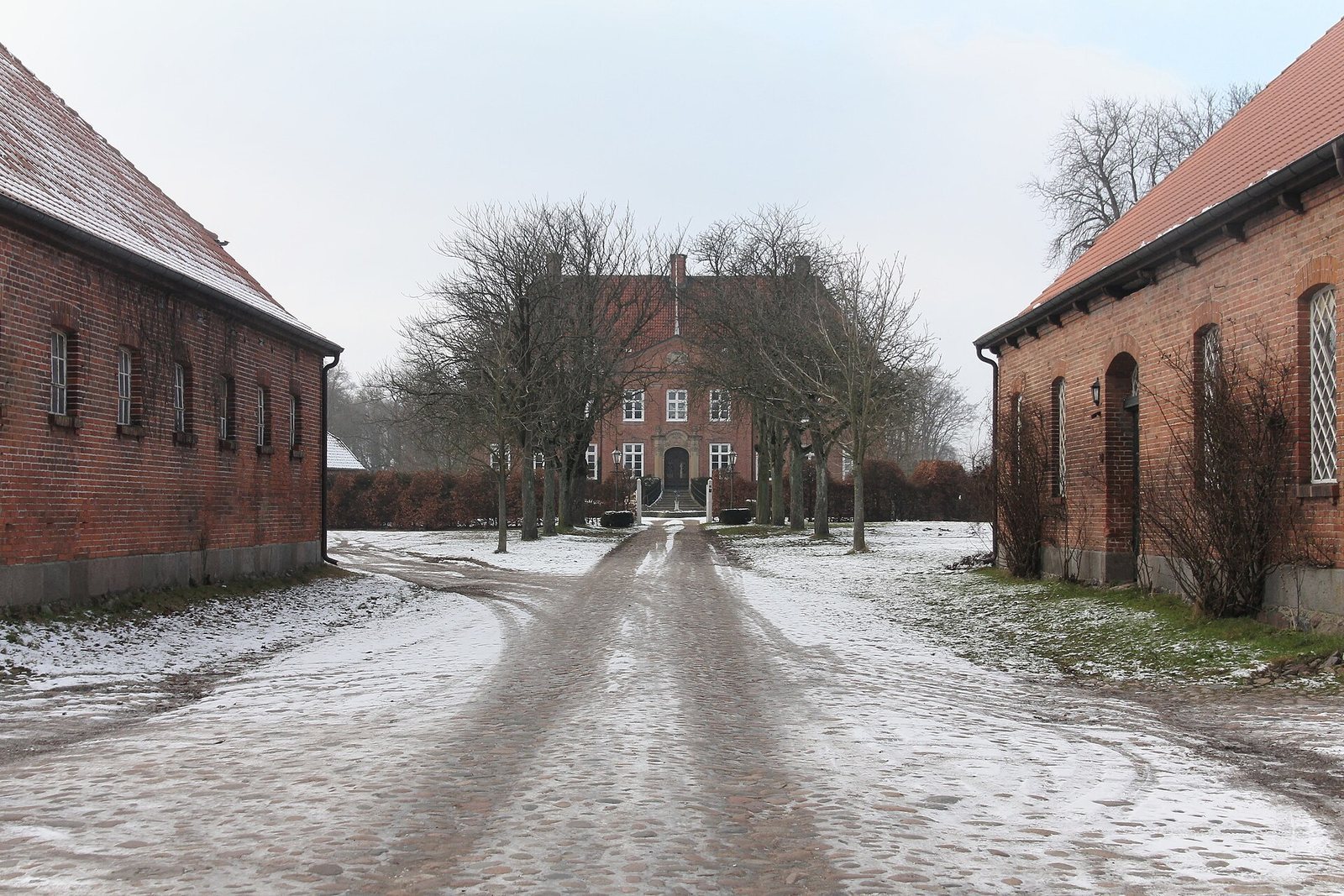
The manor house is a cuboid brick building with two full storeys above a basement base and a roof sloping on all sides. Its facade extends across nine window bays, or vertical divisions marked by windows. The house stands within the remains of a ditch that once encircled the farmyard, and water still surrounds two sides. A stone bridge leads to the Baroque sandstone entrance portal, a richly composed design displaying the double coat of arms of the Thienen and Brockdorff families. On the courtyard side, the central projecting section is crowned by a triangular pediment bearing the patron’s monogram. Shallow wall-attached columns divide the facades, whose clear lines anticipate Classicism, a style drawing on classical forms.
The interior is decorated in the Rococo style, known for elaborate ornament. Much of the fixed room decoration survives in its original condition, and the garden hall is regarded as one of the finest Rococo rooms in the former Duchy of Schleswig. The manor’s overall form has changed little since the eighteenth century. A terrace was added on the south side in 1910, with service rooms beneath it.
Farmyard
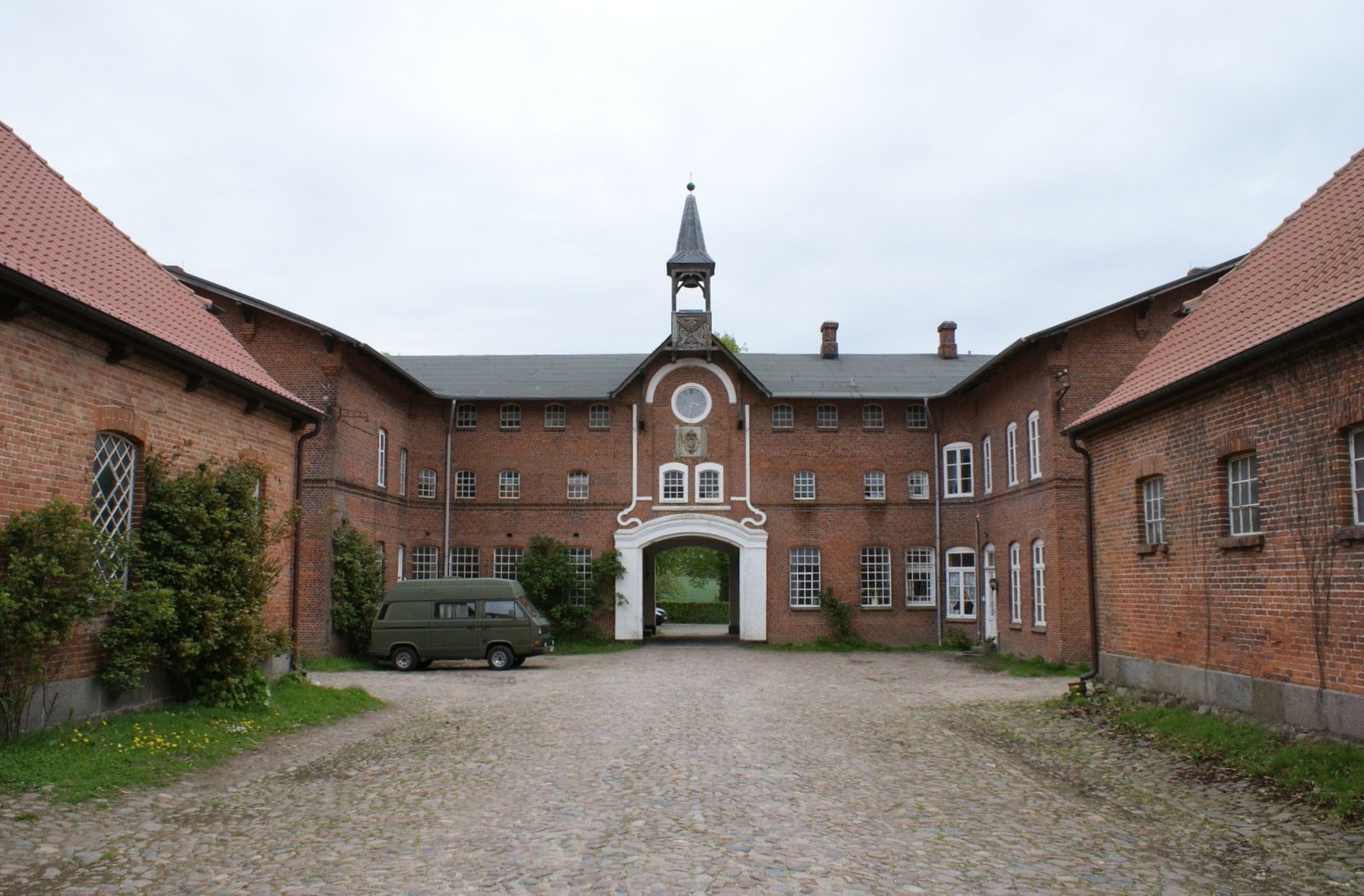
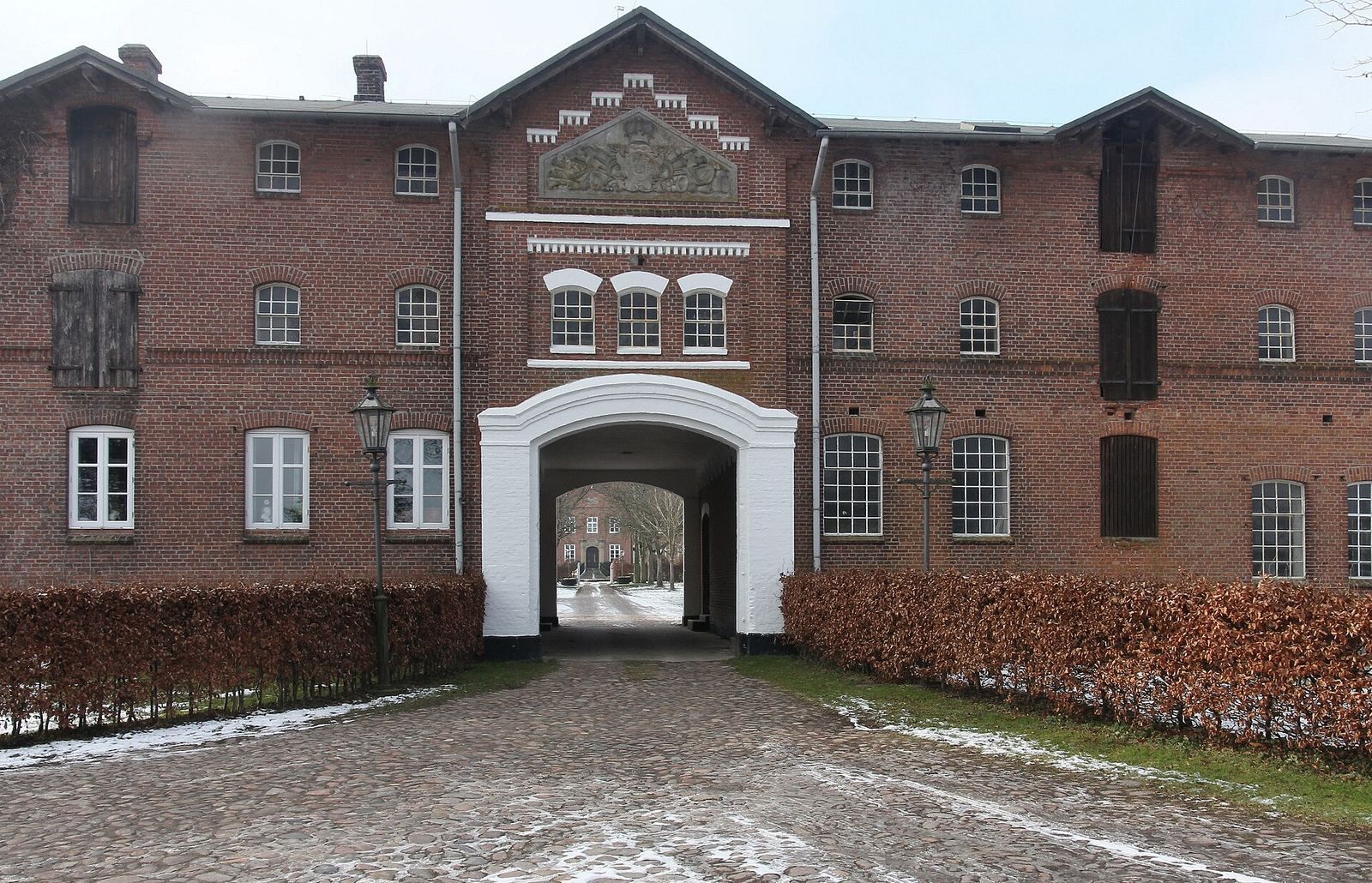
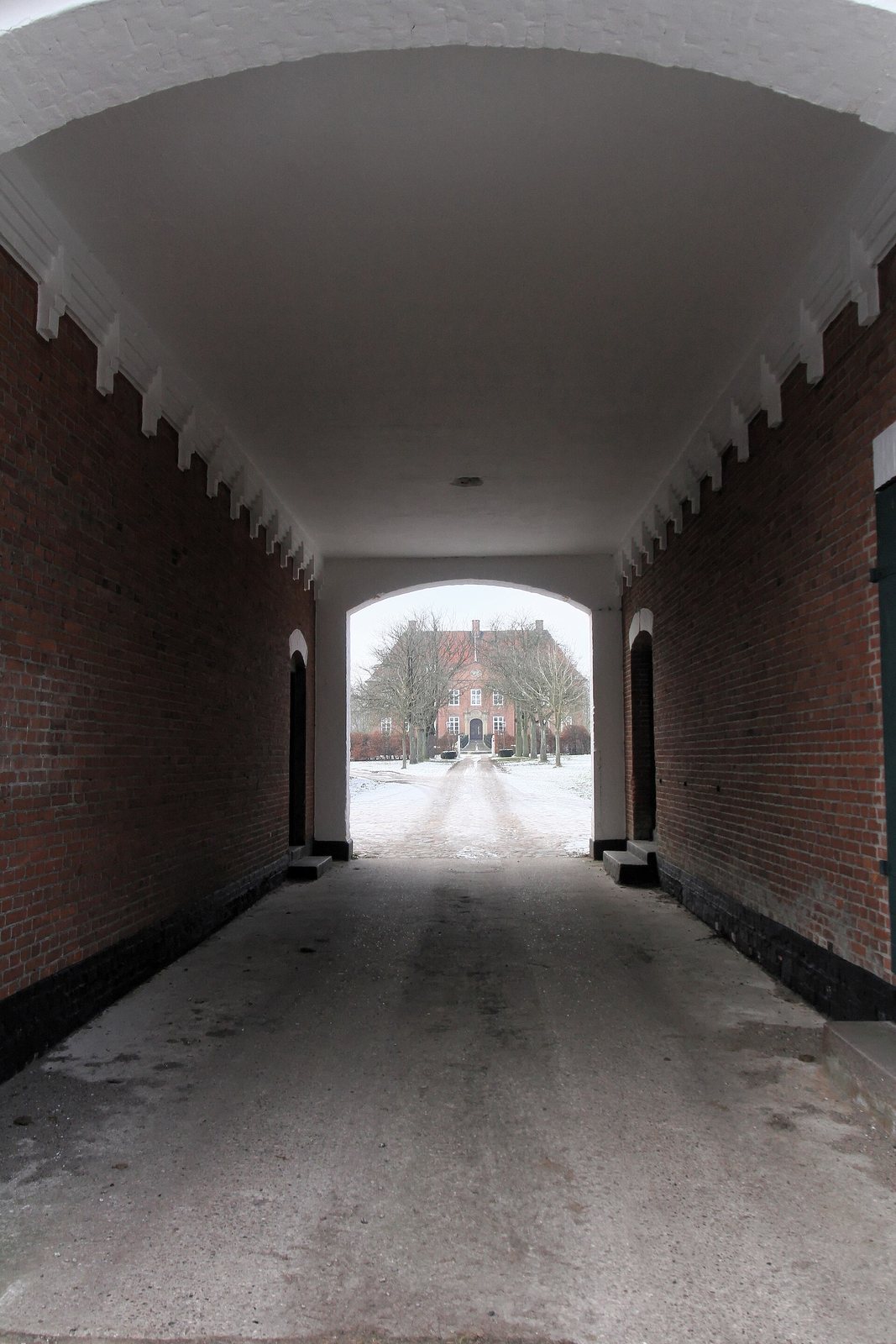
The large farmyard lies east of the manor. Its present buildings date mainly from the late nineteenth and early twentieth centuries. A gatehouse in a historical revival style marks the entrance. Beyond it, two smaller farm buildings and two large barns are arranged symmetrically along the manor’s axis. Stables and other outbuildings also form part of the complex.
Landscape garden
A large landscape garden extends west from the manor, with water features and groups of trees.