Château Margaux: A Historic French Wine Estate
Site at a Glance
- Popularity
- Very High
- Country
- France
- Primary era
- Modern
- Eras represented
- Early Modern, Modern
- Civilizations
- French
- Site type
- Economic
- Remains
- Production Complex
On this page12 sections
History
Château Margaux is a wine estate in France, first recorded in the 13th century as the fortified stronghold Château de La Mothe Margaux. Its present residence follows neoclassical design, drawing on ancient Greek and Roman forms, and neo-Palladian design, which adapts classical forms associated with Andrea Palladio. In 1855, the Bordeaux wine classification placed the estate in Premier Grand Cru Classé, its highest rank. This ranking formalized earlier merchant assessments, including an individual-wine price classification that survives from 1745.
Medieval and early modern ownership
On 24 November 1377, Bernard d’Albret left the estate to his sister Rose, who was married to Bertrand de Montferrand. Around 1420, the Montferrand and Durfort-Duras families formed an alliance and held Margaux jointly through 1437, with Médard de Durfort-Duras associated with the property. His name was also given to neighboring Château Durfort-Vivens. In 1447, François de Montferrand bore the title Baron of Margaux.
By the 15th century, wines known as ‘Margou’ and ‘Margous’ were associated with the estate. In 1479, Thomas de Durfort sold Château Dufort, a separate property, to Jean Gimel of Bordeaux. In March of that year, Thomas’s daughter married Jehan de Lory, who became owner of Margaux. Their son Louis inherited the estate in 1557, and Louis’s brother Isaac succeeded him.
The Lestonnac and Fumel families
At the turn of the 17th century, the Lestonnac family enlarged and consolidated the property. Pierre de Lestonnac cleared grain fields for vines and built a new château. In 1610, Olive de Lestonnac acquired Lamothe-Margaux, the heart of the estate, and expanded it with further land purchases. She lived there for part of each year and died at the estate in 1652.
Olive improved the residence for greater comfort and grandeur. It had a central house flanked by two square pavilions, with a ground floor and an upper storey. Additions included a large courtyard gate, a raised approach to the entrance, an upper-floor chapel, replacement fireplaces, new windows, and an adjoining garden. After Olive died without children, the estate passed to her cousin Pierre de Lestonnac and then to his son Jean-Denis d’Aulède de Lestonnac. Jean-Denis became Baron de la Mothe in 1658 and served as first president of the Parliament of Bordeaux, a high court with judicial and administrative powers. His daughter married Count Joseph de Fumel in 1682, and the Fumel family held the estate until 1768.
The eighteenth century and Revolution
By the early 18th century, the estate covered 265 hectares, about one-third planted with vines. The remaining land included grain fields, meadows, and woodland. In 1770, Élie du Barry became lord of Margaux through his marriage to Laure de Fumel and adopted the title Count d’Argicourt. Wine from the estate was among the early wines sold at auction in 1771. During a visit to Bordeaux in May 1787, American diplomat Thomas Jefferson ranked Margaux among the region’s four finest vineyards.
During the French Revolution, Élie du Barry was guillotined and the estate was confiscated. It passed to Miqueau, whose neglect damaged the vineyard. Laure de Fumel bought Margaux back, but was later forced to sell it.
Rebuilding and nineteenth-century reputation
Bertrand Douat bought the estate at auction in 1802 and commissioned a major reconstruction. The fortified château and nearly all the earlier buildings were replaced, and the estate’s canals and moats were filled in. An 18th-century orangery, a building used to shelter citrus trees, was retained and served as a wine cellar during the work. Landscape designer Toussaint-Yves Catros redesigned the grounds. Douat died in 1816 and left the property to his four children.
Alexandre Aguado acquired Margaux in 1835. He embellished the residence while preserving its existing arrangement and stayed there during harvests. In 1879, Frédéric Pillet-Will bought the estate and invested in its improvement, but the vine pest phylloxera, which attacks roots, devastated his efforts. Pillet-Will is credited with introducing Pavillon Rouge, the estate’s second wine.
The 1855 classification formalized a hierarchy shaped by earlier merchant assessments of wines from the Médoc and Sauternes. Through marriage, Margaux passed to Duke Louis-Charles-Marie de La Trémoille, who held it until his death in 1921. In 1925, a shareholder syndicate headed by Bordeaux wine merchant Pierre Moreau bought the estate. Fernand Ginestet acquired a majority share that year, and his son Pierre gained full ownership in 1949. In 1965, Pierre introduced a policy that separated exceptional vintages, which were aged and sold as great wines, from more ordinary years.
Twentieth-century restoration and ownership
The estate’s architectural ensemble received protection as a historic monument in 1946, renewed by a classification order in 1965. After the economic crisis of 1973, the Ginestet family had to sell. The French government blocked an attempted purchase by National Distillers & Chemical Corporation because Margaux had been declared a national asset. In 1976, the French retail group Félix Potin, led by André Mentzelopoulos, acquired the estate. He restored neglected vineyards and buildings with advice from wine specialist Émile Peynaud. By Mentzelopoulos’s death in 1980, Margaux had regained its Premier Cru reputation, particularly through its 1978 and 1979 vintages.
Around 1990, Corinne Mentzelopoulos continued to manage the estate while the Italian Agnelli family held 75 percent of its shares. After Giovanni Agnelli’s death, she bought out the family in 2003 and became sole owner.
Recent management and production
Paul Pontallier joined the estate in 1983, became managing director in 1990, and led a research and development department established in 2000. He died in 2016. Philippe Bascaules, who joined Margaux in 1990 and became technical director in 2000, later succeeded him as head of the estate.
The estate produces Château Margaux, its principal red wine; Pavillon Rouge, a second wine made from lots not selected for the principal wine; Pavillon Blanc, its white wine; and, since 2009, Margaux du Château Margaux. An appellation is a legally defined wine-growing area with rules for wines sold under its name. The Margaux appellation is restricted to red wines, so the white wine is sold under the broader Bordeaux appellation. Annual production is about 300,000 to 400,000 bottles. Approximate quantities include 150,000 bottles of Château Margaux, 200,000 of Pavillon Rouge, and 35,000 of Pavillon Blanc. Wine from vineyard plots outside the appellations is sold in bulk, and the estate also makes oak wine barrels on site.
Remains
The 262-hectare estate brings together cultivated vineyard land, the château, wine cellars, and later research and storage facilities. The planted areas and buildings reflect different phases of the estate’s development.
Vineyard and soils
About 87 hectares of the estate fall within the Margaux appellation, while approximately 90 to 100 hectares in total are planted with vines. Around 12 hectares carry white-grape vines, planted with Sauvignon Blanc; the rest are red-grape plantings. These consist of about 75 percent Cabernet Sauvignon, 20 percent Merlot, 2 percent Cabernet Franc, and 2 to 3 percent Petit Verdot. The average vine is about 35 years old. Grapes from younger vines and from more distant plots prone to frost are used for the second wine.
The vineyard soils include ancient Garonne gravels, generally 4 to 11 metres deep and sometimes mixed with clay. Fine and coarse flat gravel with flint predominate. Lower areas include limestone and Plassac molasse, a named local rock formation, while the white-grape plots have especially fine gravel. Across the Médoc plains, spring frost is uncommon, and good air circulation usually limits damage from summer rain.
Estate buildings
The present château
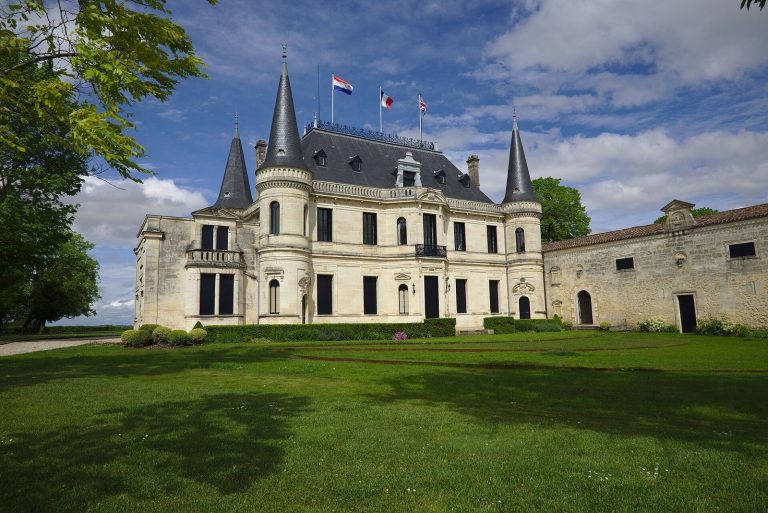
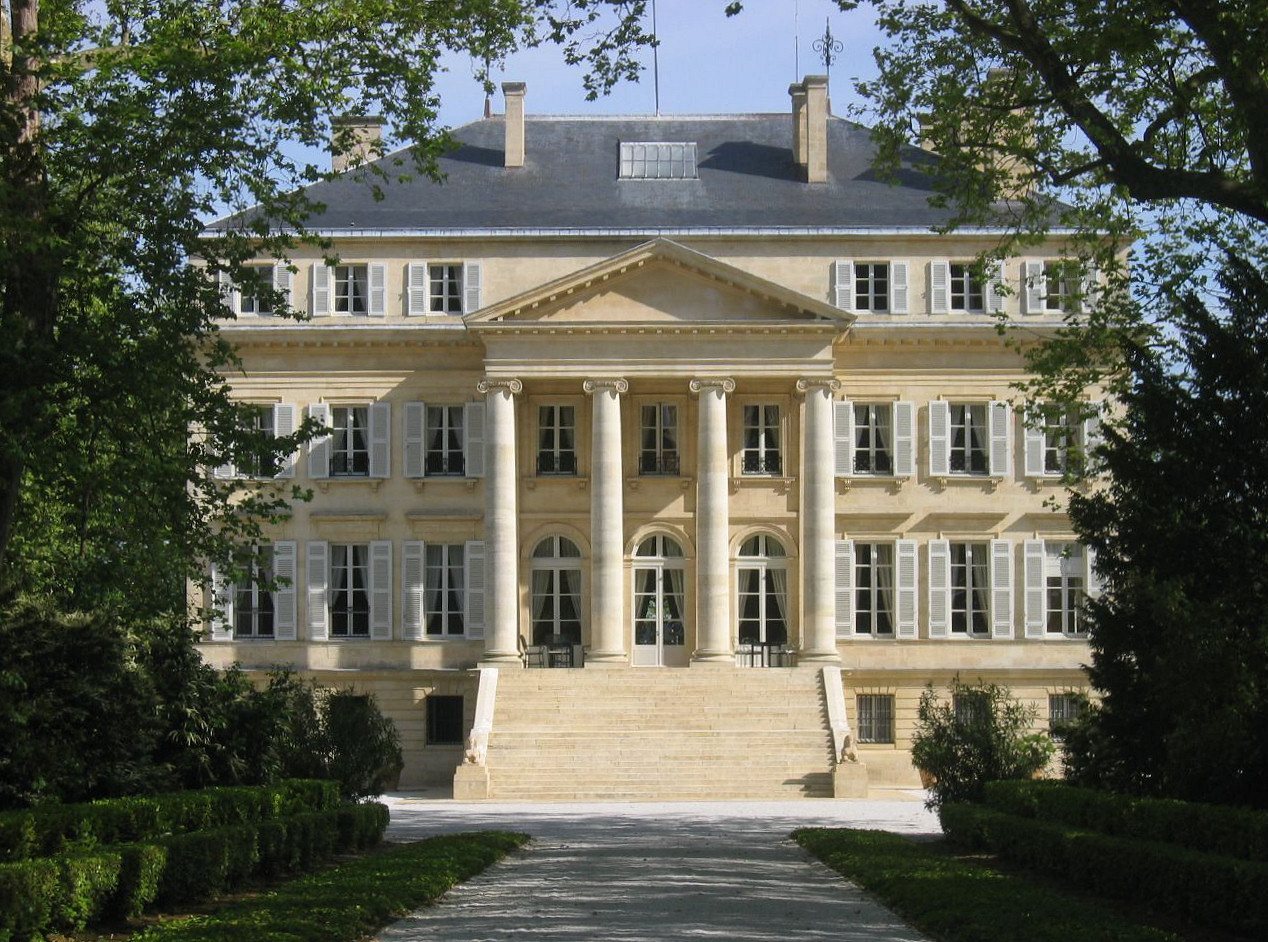
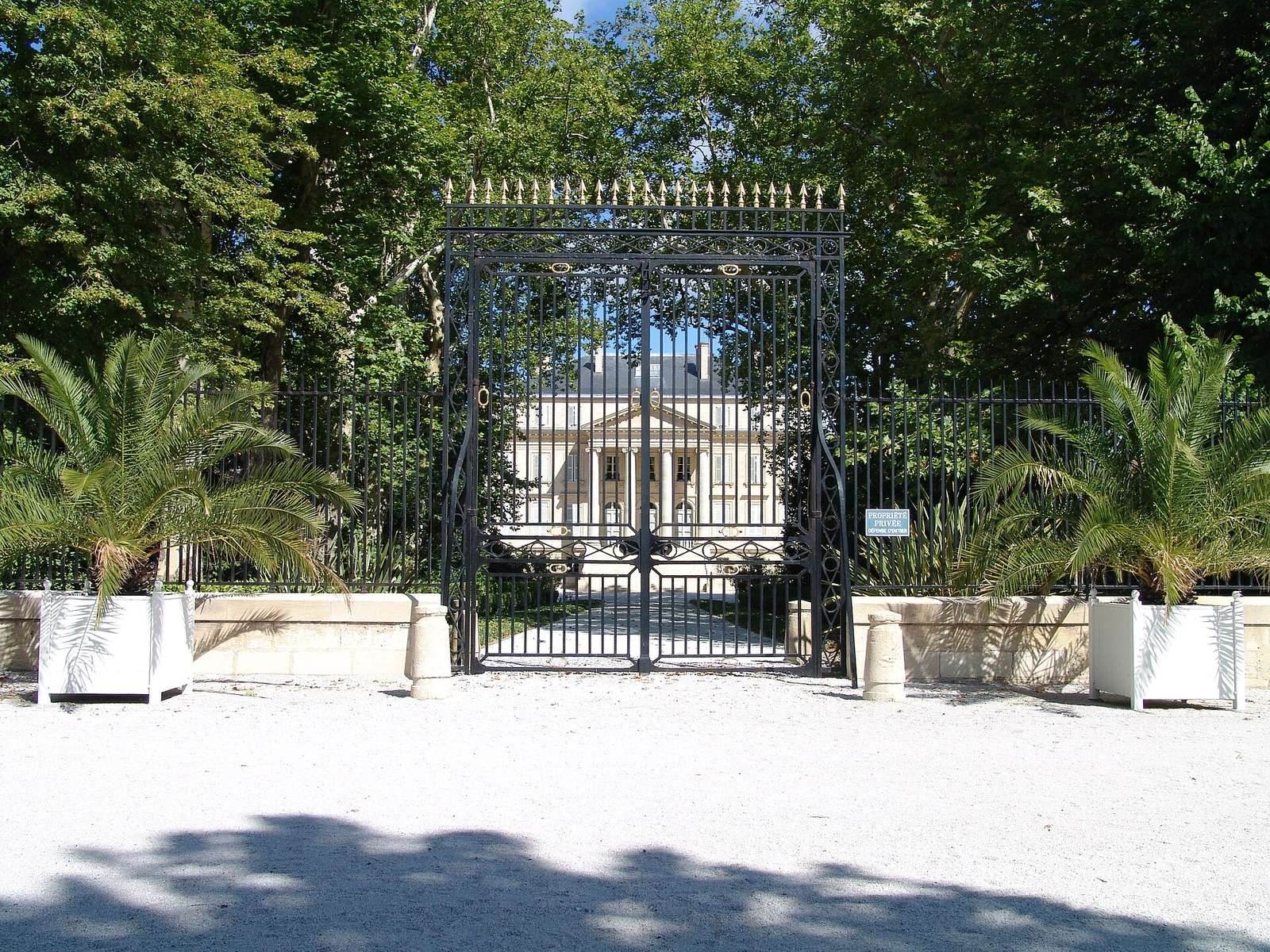
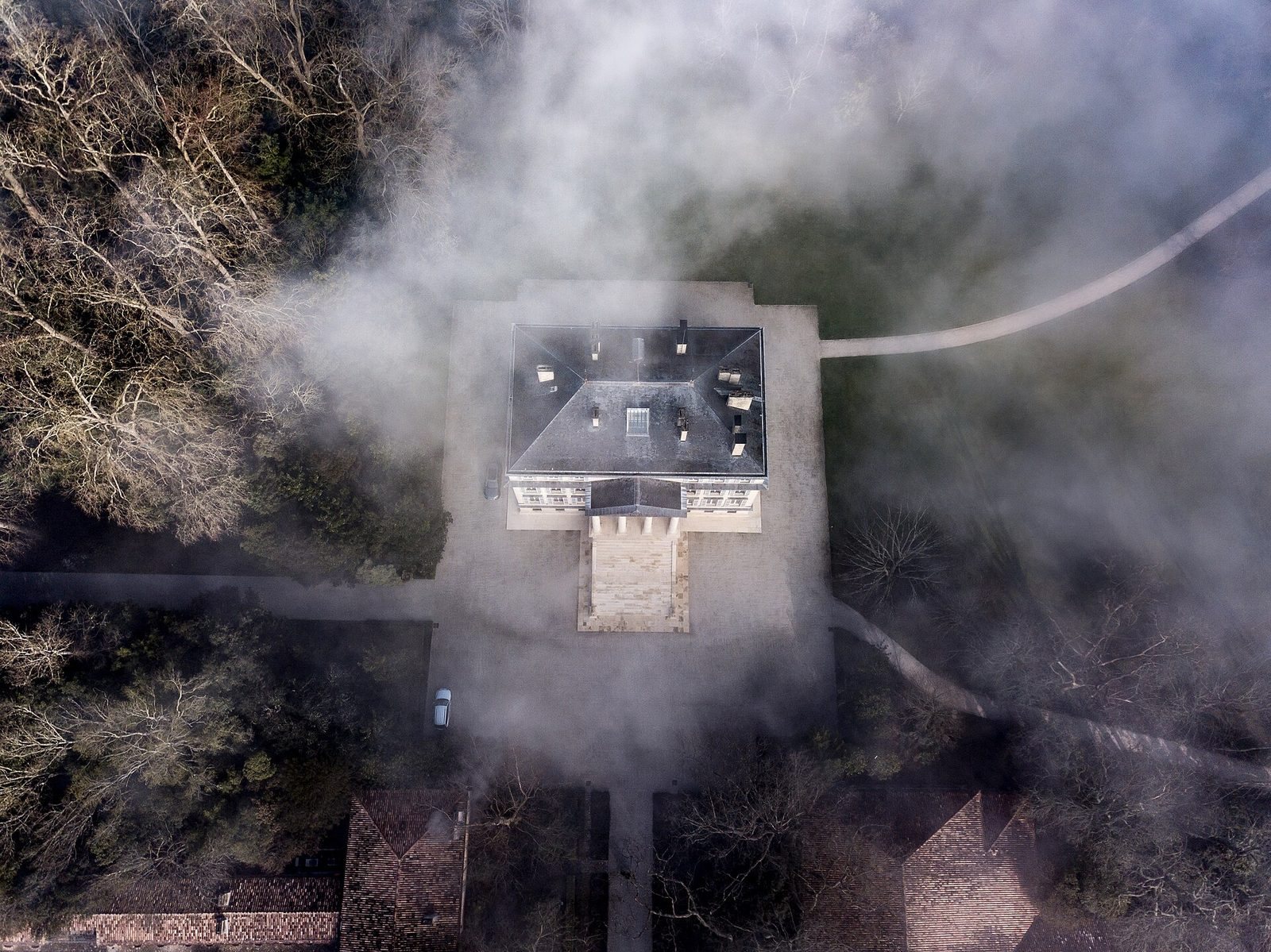
The château designed for the estate’s rebuilding is a four-level building with broad windows. Its monumental entrance has a portico, a roofed entrance supported by columns, formed by four Ionic columns with scroll-shaped capitals beneath a triangular pediment. The building is a major example of neoclassical architecture in the Bordeaux region.
Cellars and later facilities
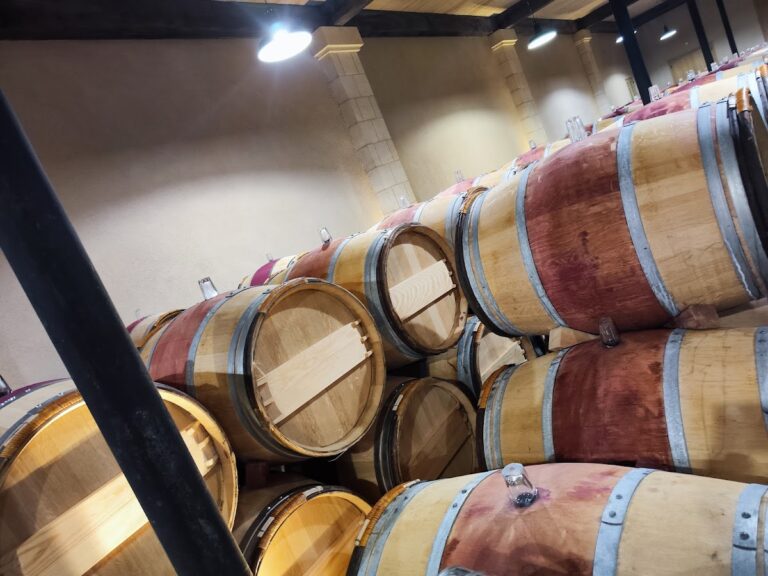
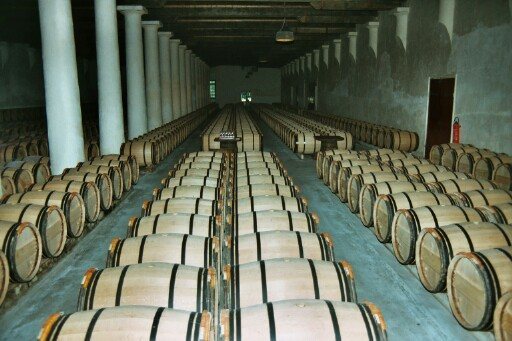
The wine cellars measure about 100 metres long and 23 metres wide. Their oak roof structure rests on Doric columns, a plain classical column type. A later building group designed by British architect Norman Foster extends the older cellars. It includes an 800-square-metre cellar, a research and development centre, and an underground wine library.