Barretstown Castle: A Historic Castle and Children’s Camp in Ireland
Site at a Glance
- Popularity
- Medium
- Country
- Ireland
- Primary era
- Medieval
- Eras represented
- Medieval, Early Modern, Modern
- Civilizations
- British, Norman
- Site type
- Domestic
- Remains
- Castle
On this page9 sections
History
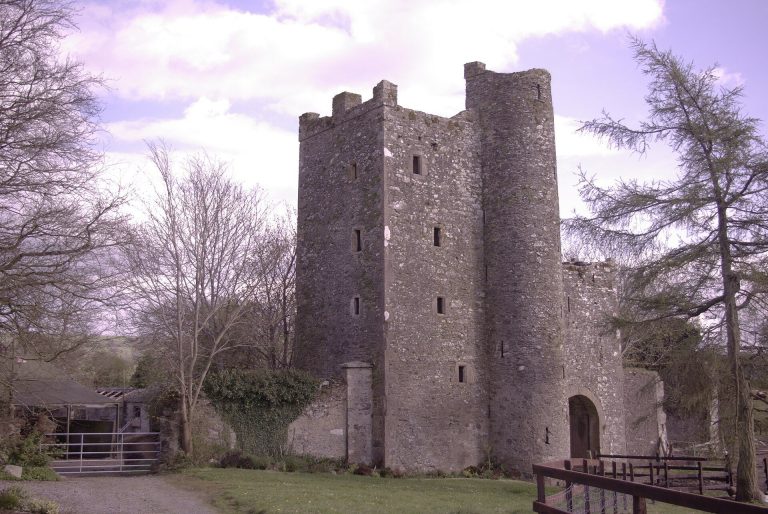
Barretstown Castle is a historic castle in County Kildare, Ireland, north of Ballymore Eustace. Settlers of Norman and related origins, known as Anglo-Normans, built a castle here in the late 12th century, after the English invasion of Ireland began in 1169. It formed part of the castle network of the Pale, the area of English control centred on Dublin. The present castle is dated to the 15th or 16th century.
Monastic ownership and the Eustaces
The castle’s first recorded reference dates to 1547, when an inquisition following the dissolution of the monasteries listed it as property of the Archbishop of Dublin. It had belonged to a Catholic monastery. After the monastery was suppressed, the property passed to the archbishop, was confiscated by the Crown, and later went to the Eustace family through a succession of perpetual leases.
The Eustaces were prominent among the English settlers in Ireland. In the 14th century, they held extensive lands in Kildare, Meath, Carlow and Wicklow. By 1659, Eustace was among the most common surnames in County Kildare.
The Borrowes family
In the 17th century, Sir Walter Borrowes acquired the castle and estate after marrying a daughter of the Earl of Kildare. The Borrowes family held the property for more than 200 years. Sir Kildare Borrowes, the 5th Baronet, held a hereditary title below the peerage and represented County Kildare and Harristown in the Parliament of Ireland, the kingdom’s legislature before its union with Great Britain in 1801.
The five Borrowes baronets who owned the castle during the 19th century played little part in public life. The family’s residence was substantially remodelled by Reverend Sir Erasmus Borrowes, the 8th Baronet. The family’s tenure ended under Sir Kildare Borrowes, the 10th Baronet, who lived from 1852 to 1924. Walter Borrowes, born at the castle, served in the British Navy and was killed in action aboard a submarine on 23 January 1915.
Changing ownership and modern use
After the Borrowes family left Ireland in 1918, Sir George Sheppard Murray bought the estate and turned it into a stud farm. Elizabeth Arden acquired the castle from the Murray family in 1962 and extensively reconstructed, redecorated and refurnished it, giving it its present appearance. After Arden’s death in 1967, businessman Garfield Weston lived there and improved the grounds.
The Weston family transferred the estate to the Irish government in 1977. The government used it for national and international conferences and seminars, and as part of the Irish National Stud, an institution devoted to breeding thoroughbred horses. The property later became the home of Barretstown Camp, part of Paul Newman’s SeriousFun network of camps for children with serious illnesses.
The camp opened in August 1994 and served 124 children that year. After a medical centre and programme hall were completed in 1995, it served nearly 300 children from Ireland, the United Kingdom, Germany, France, the United States and areas affected by the 1986 Chernobyl nuclear disaster in Ukraine. By 2009, the camp was serving about 1,900 children from across Europe.
Remains
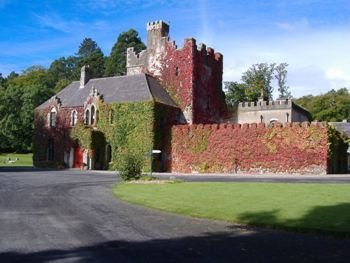
Barretstown is a lowland castle, built on relatively level or low-lying ground rather than a hilltop. The plastered building has an asymmetrical, medieval-romantic design, shaped by its 19th-century remodelling and later reconstruction. Its grounds include a lake in front of the castle, along with exotic trees planted during Murray’s ownership.
Castle and grounds
Castle
The castle’s asymmetrical form and medieval-romantic appearance reflect its later remodelling. Its entrance remains red, reportedly as a reference to Arden’s Red Door perfume brand.
Grounds
An artificial lake lies in front of the castle. Garfield Weston had it created during his ownership, while many of the exotic trees that now dominate the landscape were planted by Murray.
Camp facilities
The castle and grounds have been adapted for use as a children’s camp. A medical centre and programme hall, completed in 1995, provide facilities for the camp’s activities.