Wark on Tweed Castle: A Border Fortification on the Tweed
Site at a Glance
- Popularity
- Medium
- Country
- United Kingdom
- Primary era
- Early Modern
- Eras represented
- Medieval, Early Modern
- Civilizations
- English
- Site type
- Military
- Remains
- Castle
On this page8 sections
History
Wark on Tweed Castle, also known as Carham Castle, is a border fortification in the United Kingdom, built by Walter Espec in 1136. It guarded an important ford across the Tweed, whose lower course forms part of the England-Scotland border. First constructed from earth and timber, the castle later became a stone stronghold and endured repeated attacks as control of the border region shifted.
Foundation and medieval conflict
In 1138, David I of Scotland besieged Wark after his advance into England was halted at the Battle of the Standard on 22 August. On Espec’s instructions, the garrison surrendered on 11 November in return for safe conduct. The Scots may have damaged or destroyed the castle during the siege.
After the Anarchy, England’s mid-12th-century civil war over the royal succession, Henry II claimed Northumberland. Malcolm IV of Scotland surrendered the region and the castle without a fight, receiving the earldom of Huntingdon in return. Wark was subsequently developed as a stone fortress. In 1174, it withstood an attack by William I of Scotland.
In 1200, John, king of England, granted the castle to Robert de Ros. When de Ros rebelled in the First Barons’ War, a revolt against King John, the king captured and destroyed Wark during a northern campaign in late 1215 or early 1216. Henry III later returned it to the de Ros family, and Robert or his son William rebuilt it.
The castle remained a setting for royal and military activity. Henry III met Alexander III of Scotland there for negotiations in 1255. Edward I stayed at Wark in November 1292, and an English army departed from it in 1296 for the Battle of Dunbar. On 10 June 1314, Edward II gathered his forces at the castle before campaigning in Scotland; that campaign ended in defeat at Bannockburn. Scottish raids in the aftermath repeatedly damaged Wark. It was considered derelict when it passed to William Montagu, Earl of Salisbury, in 1329, but resisted a Scottish siege in 1342.
A legend connects Wark with an episode in 1349 that supposedly gave rise to the Order of the Garter. Edward III is said to have picked up a garter dropped by a Countess of Salisbury and, after courtiers laughed, declared that it would become an honour. The woman is identified either as Joan of Kent or as Catherine Montagu, Joan’s former mother-in-law.
Later medieval ownership and border warfare
Late in the 14th century, Wark belonged to Ralph Neville, Earl of Westmorland. Sir Thomas Grey acquired it in September 1398, but Scottish forces captured and plundered the castle the following year. In 1460, James II of Scotland attacked it while supporting Henry VI during the Wars of the Roses, the dynastic conflicts between Lancaster and York.
The castle was still held by the Grey family when James IV of Scotland captured it in 1513. English control returned after the Scottish defeat at Flodden on 9 September, and the Crown ordered the defences strengthened against artillery. In June 1518, Thomas Dacre described the refurbishment: the keep was complete and the three wards were nearly finished.
Artillery warfare and decline
In the early 1520s, a Scottish and French force led by John Stewart, Duke of Albany, besieged Wark. After two days of artillery fire, about 2,000 men, mostly French, crossed the Tweed by boat and entered the inner ward. William Lisle’s garrison drove them back. Bad weather and the arrival of an English relief force under Thomas Howard, Earl of Surrey, also helped prevent the castle’s capture. The prioresses of Coldstream and Eccles had warned English commanders of Albany’s plans.
In September 1523, Surrey inspected Wark with William Frankelyn, Chancellor of Durham, and Sir William Bulmer, Sheriff of Durham. He ordered new earthworks and estimated that the inner ward could withstand a ten-day siege, compared with two days for the outer ward. He considered Wark’s keep stronger than the keep at Guînes. In June 1524, Cardinal Wolsey ordered repairs to the keep walls, with roofing lead to be brought from Dunstanburgh Castle.
Damage continued during the conflicts of the 16th century. In 1542, Scottish raiders attacked carts carrying stone from Carham church to Wark. The castle captain, John Carr, had been captured the previous month at the Battle of Haddon Rig; men of the garrison under John Tempest were killed or injured in the raid. During the Rough Wooing, Henry VIII’s campaign to force a marriage between Mary, Queen of Scots, and his son Edward, Carr reported damage to the riverside defences in 1544. The Italian military engineer Archangelo Arcano was sent to advise on repairs in February 1545. A Scottish raid destroyed the castle in 1548.
In 1557, during renewed war between Scotland and England, Sir Ralph Grey transferred control of Wark to the Crown. Sir John Slingsby held and defended it. After peace in 1559, the Earl of Northumberland asked the English Privy Council to advise on the castle’s future and proposed a survey. Wark continued to figure in border affairs: its captain, Rowland Foster, led a raid into Scotland in May 1570. In April 1588, James VI of Scotland passed on the far side of the Tweed and received a cannon salute from the castle, for which he sent 20 crowns. Cannon salutes for the Scottish rebel Earl of Bothwell in 1594 angered James.
When James VI became king of England in 1603, the fortress lost its strategic purpose, and its garrison was withdrawn in 1633. In 1604, inhabitants of Berwick asked to use smaller cannon removed from Wark to defend their town and harbour. A Scottish garrison briefly occupied the castle in 1644, after Scotland allied with the English Parliament against Charles I. The ruins then deteriorated; the village spread across the former outer and middle wards, and people took stone from the remains for building. Wark is now protected as a Grade II* listed building and a Scheduled Monument.
Remains
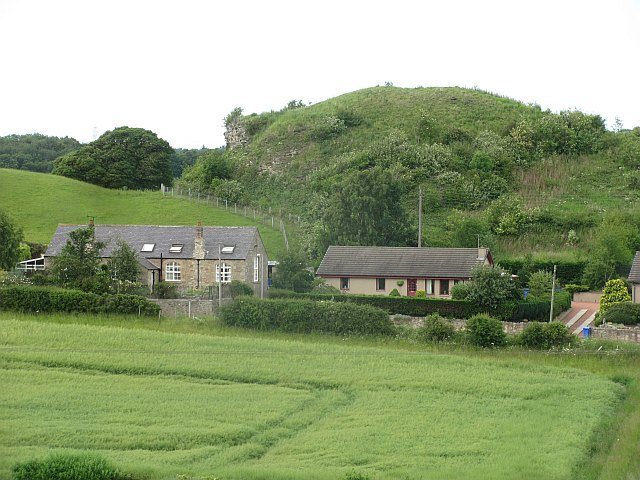
The castle occupies a terminal moraine, a ridge of glacial debris, at the west end of Wark-on-Tweed, south of the Tweed. Its position allowed it to control a ford across the river. The original earth-and-timber stronghold was arranged in three wards, or enclosed courtyards, and was later enclosed by stone defences.
The motte and wards
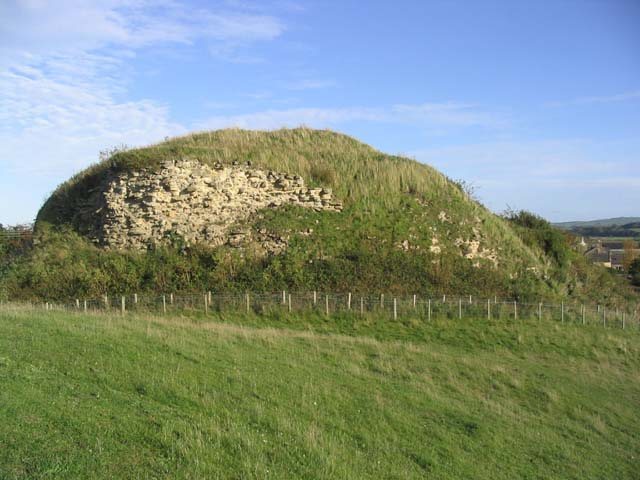
The inner ward centred on a motte, a raised mound that carried a wooden tower. The middle and outer wards extended to the east, in the area now occupied by the village. From 1158, a stone curtain wall, a defensive wall enclosing a courtyard, enclosed the castle, including its middle and outer wards. The wooden tower was probably replaced by an irregular, eight-sided stone shell keep, a stone enclosure built on a motte, around this time. It may instead date to the early 13th century, when towers and a gatehouse were also added.
The keep and The Ring
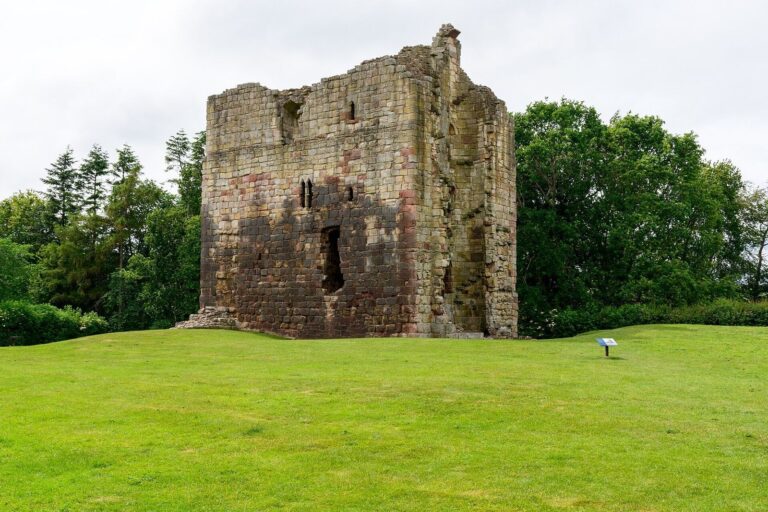
By 1518, the keep, also called the donjon, or principal castle keep, was complete and equipped to carry heavy cannon on its vaulted floors. An internal shaft allowed the guns to be raised through the building. A watchman on the roof could see Norham and the outskirts of Berwick. After the 1523 siege, a four-storey artillery tower called The Ring replaced the keep. Its remains survive on the medieval motte.
Earthworks and surviving defences
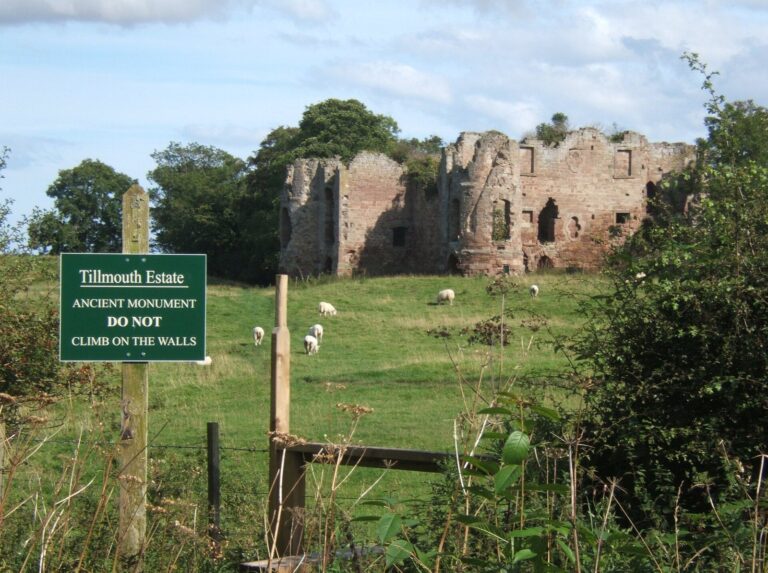
Earth bulwarks and other earthwork defences were added or strengthened in the early 16th century. The riverside walls had fallen by 1533, and a section of the riverside curtain wall had collapsed by 1544. In February 1545, Arcano noted that the roofs leaked. In March that year, one saker and one broken falcon, both types of cannon, were on top of the keep. The castle survives as a ruin, with The Ring on the motte and the former middle and outer wards beneath the village.