Festung Minden: A Garrison Fortress on the Weser
Site at a Glance
- Popularity
- Medium
- Country
- Germany
- Primary era
- Modern
- Eras represented
- Modern
- Civilizations
- Kingdom of Prussia
- Site type
- Military
- Remains
- Wall
On this page20 sections
History
Festung Minden was a fortified ring around the city of Minden in Germany, guarding a strategically important crossing of the Weser near the Porta Westfalica gorge. The crossing connected medieval trade routes and offered one of the few convenient places to cross the river, making control of it important to both military and civic authorities. Minden’s defenses developed from medieval town walls into a garrison fortress, expanded most extensively under Prussian rule.
Medieval town defenses
A wall enclosing the town is recorded by 1270, while the Marientor and a smaller gate by the Weser are mentioned as early as 1232. From 1306, Minden governed itself through a council and mayor and took responsibility for its own defense. Bishop Gottfried of Waldeck moved his seat to Petershagen, leaving military authority and the protection of the town among Minden’s duties.
Sieges and the Thirty Years’ War
On 1 May 1553, an army led by Philipp of Wolfenbüttel began a siege during a conflict involving Bishop Franz II of Waldeck and Duke Henry of Wolfenbüttel. The attack failed four days later, although the besiegers temporarily seized the Marien and Simeon suburbs. Minden’s defenders then demolished both suburbs and strengthened the town’s fortifications.
The Thirty Years’ War, a major European conflict fought from 1618 to 1648, brought another occupation. On 25 August 1625, Catholic Imperial commander Johann Tilly took the Protestant city. Its residents were compelled to resume Catholic observance, and Minden again became a bishop’s seat. Imperial troops stayed until 1634, imposing contributions and occupation costs on the city while enlarging its defenses.
Swedish forces besieged Minden for three weeks in 1634. They drained the ditches and dug forward trenches until their cannon could reach the city. Minden surrendered in November to the Swedish army under Duke Georg of Brunswick-Lüneburg. Swedish control continued until the Peace of Westphalia in 1648, and the fortifications were systematically expanded during the occupation. The name “Festung Minden” came into use during this period.
Brandenburg-Prussian garrison and the Seven Years’ War
The Peace of Westphalia awarded the Principality of Minden, including its capital, to the Elector of Brandenburg, one of the princes entitled to choose the Holy Roman Emperor. In 1650, Minden became a Brandenburg-Prussian garrison and fortress town. Elector Frederick William placed five companies of soldiers there. The city lost control over its own defense and occupation, and its economy weakened as it became chiefly a military bridgehead on the Weser. The Thirty Years’ War had already left many residents impoverished, and much of the urban elite departed.
In 1669, the regional government returned from Petershagen and took up residence in the former episcopal court, which it used until 1906. The fortress remained in service but received no major modernization before the Seven Years’ War, a conflict fought from 1756 to 1763. French troops gained entry through the bridgehead after a betrayal and opened the gates to their forces. The city changed military hands four times during the war.
The Battle of Minden took place outside the city on 1 August 1759, after the French had captured the fortress. The fortress itself played no part in the battle. Allied forces led by Duke Ferdinand of Brunswick defeated the French, blocking their advance into northern Germany. The British Army commemorates the victory as the “Day of the Roses.” In 1764, Frederick II formally abolished Minden’s fortress because its defenses were no longer considered modern. Most fortifications were demolished and the rest deteriorated. The city did not expand beyond its earlier limits before 1800.
French occupation and Prussian rebuilding
French troops occupied Minden in November 1806. The city and the former Prince-Bishopric of Minden, a church territory ruled by a prince-bishop, belonged to the Kingdom of Westphalia, a Napoleonic client state, from 1807 to 1810, and then to the French Empire until 1813. The ramparts were provisionally repaired during this period. Napoleon used the Weser crossing during the invasion of Russia. After the Battle of Leipzig, French troops withdrew and destroyed two arches of the stone bridge over the Weser.
After Prussia’s territory expanded to include the Rhine Province and Westphalia, King Frederick William III ordered Minden and other major cities fortified. From 1813 to 1850, Prussia rebuilt and enlarged the fortress to protect its western provinces and secure the Weser gorge at Porta Westfalica. A royal commandant oversaw the work, planned by a fortress-construction directorate established at Minden in 1816. Colonel Ernst Michael von Schwichow became its first commandant. Surveys made in 1814 and 1815 recorded the earlier defenses and informed the new plans. Early work included removing older medieval structures, acquiring land, and clearing some houses.
The rebuilding proceeded in stages. Ramparts, gates, and protected military chambers were renewed between 1817 and 1821; major military buildings followed from 1827. Defenses around the railway station, outside the earlier city fortifications, began in the late 1840s and continued into the 1860s. Further military buildings were also added during that decade.
Abolition and urban change
Prussia’s annexation of the Kingdom of Hanover in 1866 removed the fortress’s main strategic purpose. A law passed on 30 May 1873 ordered its abolition, but negotiations over the transfer of the fortifications and the price of the land continued until 5 March 1879. Military rules had kept a strip 600 metres beyond the ramparts free of buildings. The ramparts were removed by 1884, allowing the city to develop across the cleared land.
The defensive ring had restricted Minden’s growth, while the need to house soldiers added to residential crowding. In the nineteenth century, Minden averaged 12.1 people per residential building, compared with about 7.6 in comparable Westphalian towns.
Remains
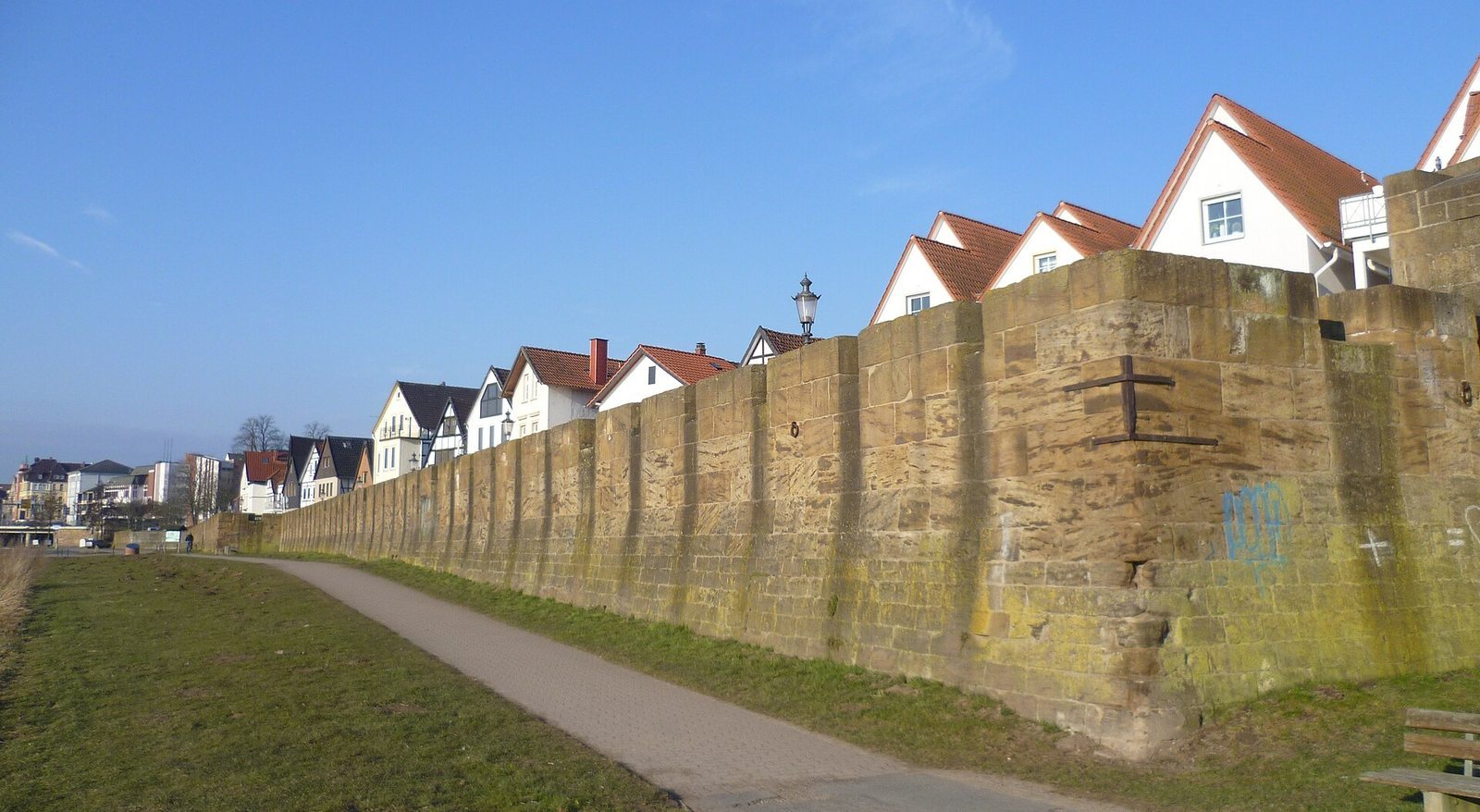
The fortress was organized as a closed ring, with five gates connecting the city to its main roads. Its defenses grew from a medieval wall into layered earthworks, ditches, gates, and outworks. A clear zone outside the defenses provided a field of fire, while military and supply buildings occupied parts of the city. The surviving features reflect both the older town defenses and the later Prussian system.
Medieval and early-modern defenses
Walls, ramparts, and water defenses
From 1501, ramparts were built 10 to 12 metres in front of the medieval wall, generally following its course. Along the Weser they projected farther outward. This arrangement brought the lower course of the Bastau within the fortress, enabling the stream to feed the defensive ditches. Most ditches were flooded; the stretch between Hahler Gate and Marientor remained dry because of the slope. Rounded artillery positions stood near the present-day Schlagde, at corners facing the river, and close to the bridge.
Gates and river approaches
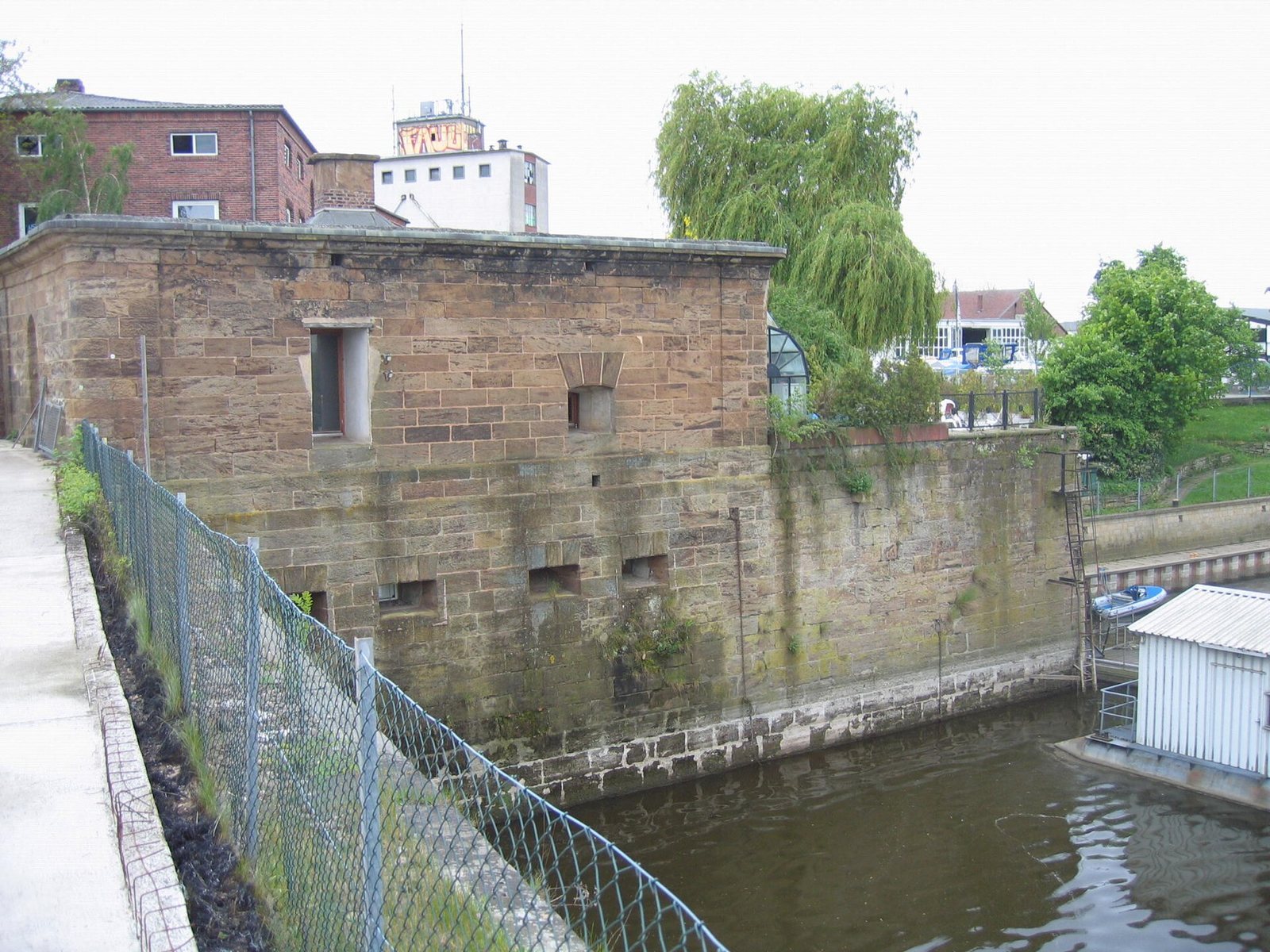
Outer gates stood 10 to 12 metres beyond the older entrances, with defensive enclosures between the inner and outer gates. Those at Marien and Simeon were completed in 1521. Bridges linked the gate lines, while the Weser gate guarded the crossing. On the opposite bank, a bridgehead with a square tower defended the approach. A round brick tower called the Hexenturm was added on the northern defenses around 1630, between the ditch and wall. A weir regulated water flowing through the northeastern Kumpgraben and onward to the Stadtbeeke, which ran into the city.
Outworks and artillery positions
After the 1553 siege, small ravelins, outworks set in front of a main fortification, were built before the five city gates. They became the sole entrances to the city, and a high artillery position was established near Hahler Gate. Under Tilly, the outer defenses at Fischertor were completed and the gate outworks were reshaped as bastions, projecting wall sections designed to provide flanking fire.
Prussian city defenses
Gates through the ramparts
The Prussian ramparts rose as much as 10 metres above the neighboring streets and broadly followed the earlier fortress outline. Five gates were planned along the main roads: Wesertor, Hausberger Tor, Simeonstor, Königstor, and Marientor. Hausberger Tor, Königstor, and Marientor passed through the earthworks, with guard casemates, protected chambers for soldiers or weapons, on both sides.
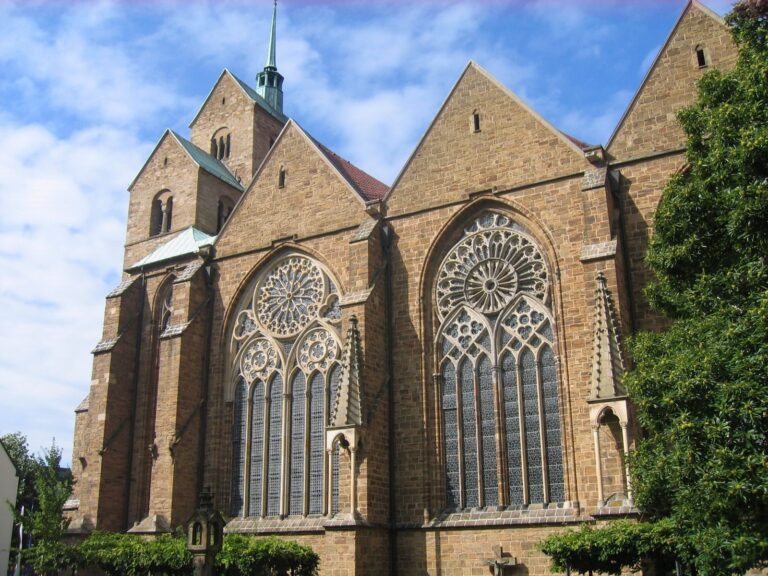
Marientor stood in the northwest, near Marienkirche and where the upper and lower parts of the city met. The gate occupied the junction of a dry ditch serving the upper town and a water-filled ditch below. Its city entrance opened onto the lower terrace; a curved tunnel carried the road up toward the countryside. The older Schwedenturm was incorporated into the defenses and covered with earth.
Simeonstor and Wesertor
Built in 1820, Simeonstor stood where the rear wall of the rampart rose two storeys. Its defensive design focused on firearms, while the city-facing side received carefully proportioned architectural detailing. Wesertor closed the northern end of the river-facing rampart and provided the city’s exit to the bridge. It was a protected, free-standing gate, armed on three sides for firearms and artillery. Earth covered these sides, with a walled platform and firing openings above.
Bridgehead and southern outworks
From 1813, the eastern-bank bridgehead was enlarged into a hornwork, an outer defense built around a central wall and flanking works, with a bastioned layout. The Osterbach supplied its ditches. An open assembly area lay before its curtain wall, the wall connecting defensive positions, and two blockhouses stood within it. The bridgehead lost its original role when the station defenses were built. South of the city, the crownwork, a detached outwork projecting from the main defenses, stood well ahead of the principal line. Its enclosed space served as a parade ground in peacetime and a storage area in wartime. The rampart reached 9.25 metres, and its ditch was up to seven metres deep.
Military buildings
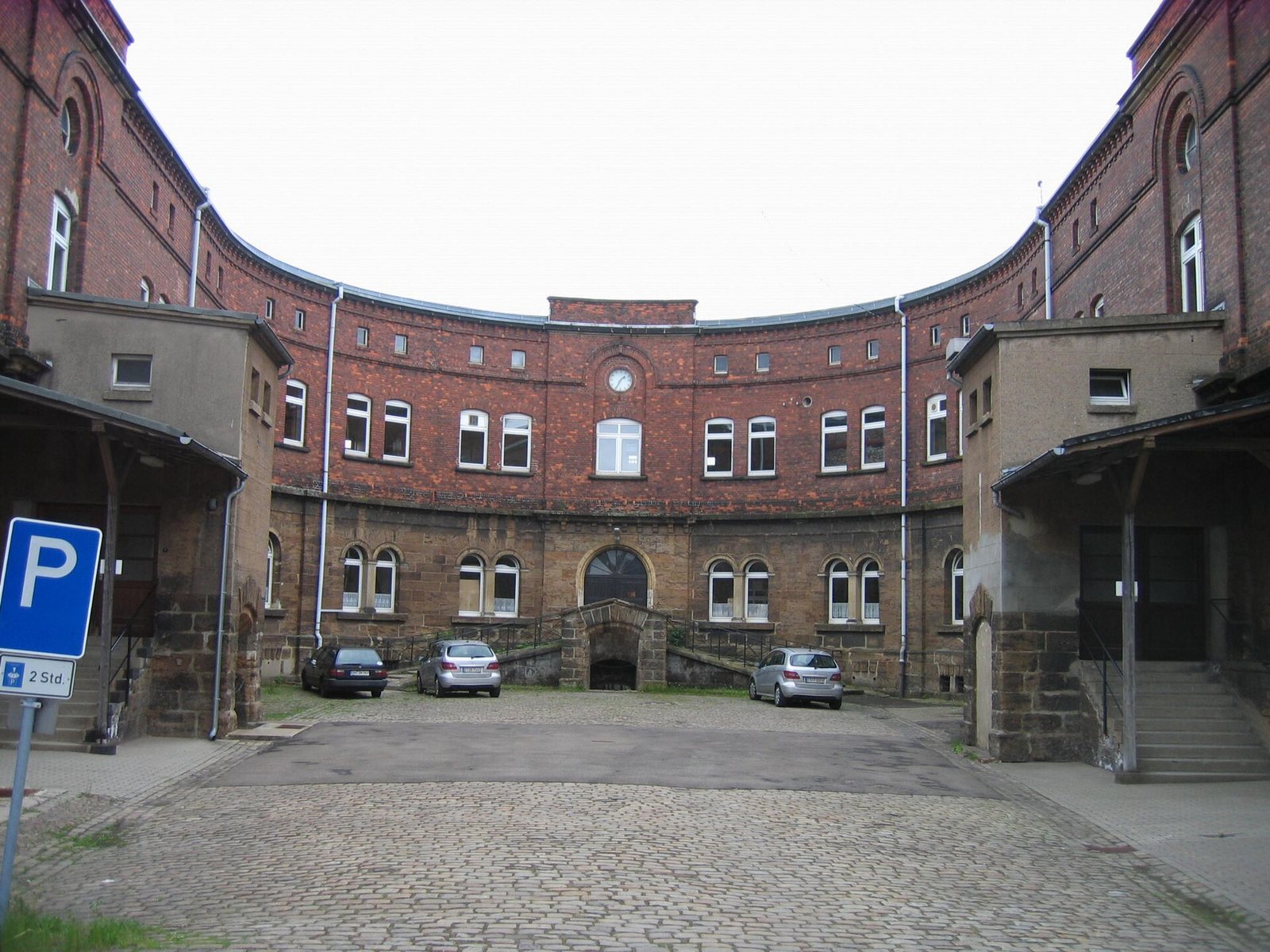
The inner-city military complex included defensive barracks built in 1827–29, a hospital from 1829–32, a garrison bakery from 1832–43, and a provisions and grain storehouse from 1835–36. A provisions office on Hohestraße followed in 1862–63. An officers’ casino stood on Kampstraße, and two fodder barns were built on Marienstraße.
Railway station defenses and surviving structures
Station
Minden railway station was built in 1847 on a plateau east of the Weser, outside the earlier fortress, and surrounded by three streams. It was designed as a transfer point between the Cologne–Minden Railway and the Hanover State Railway. Although altered, the station retains its original overall form, and operating structures from the railway’s opening year also survive.
Forts
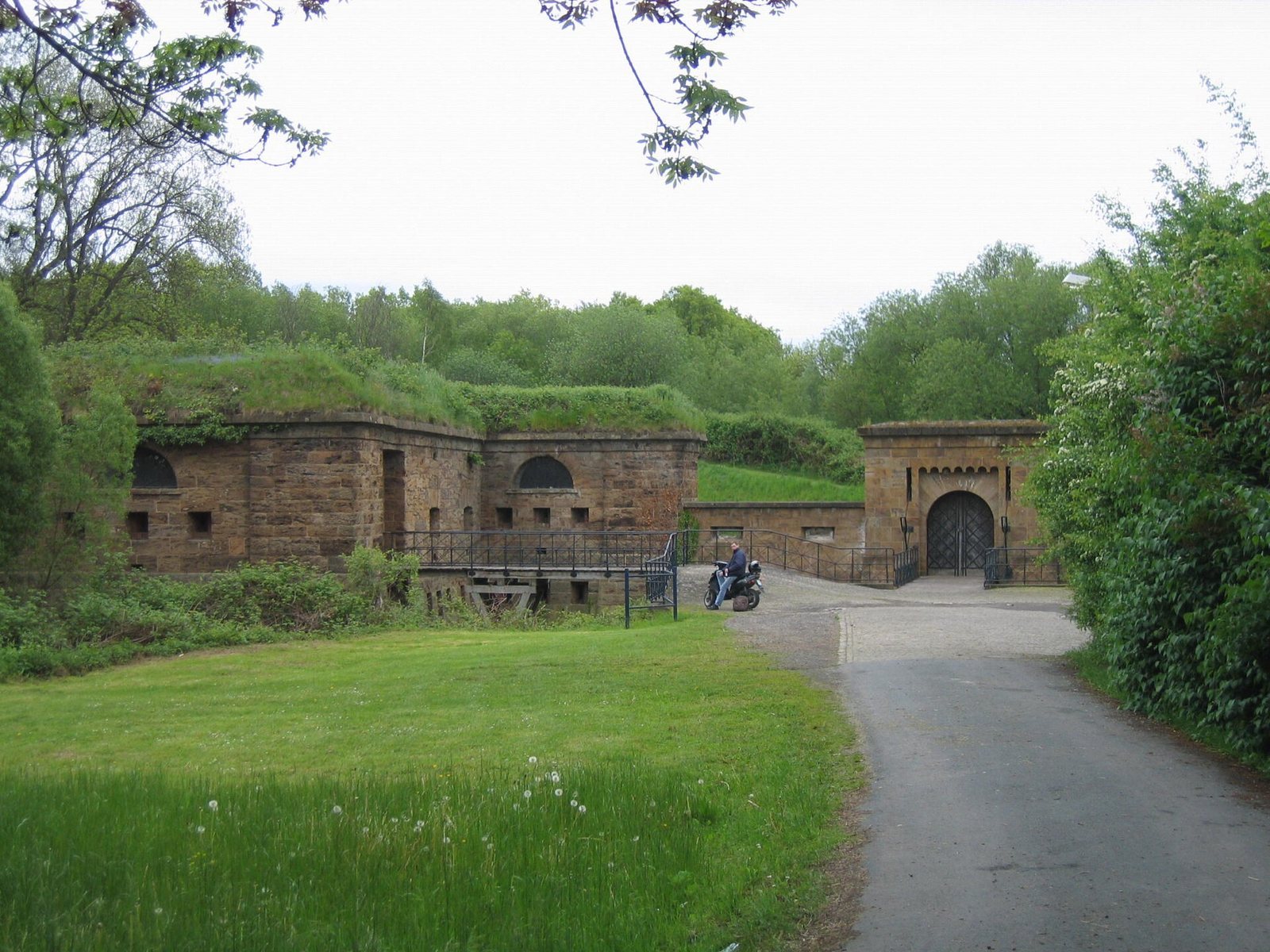
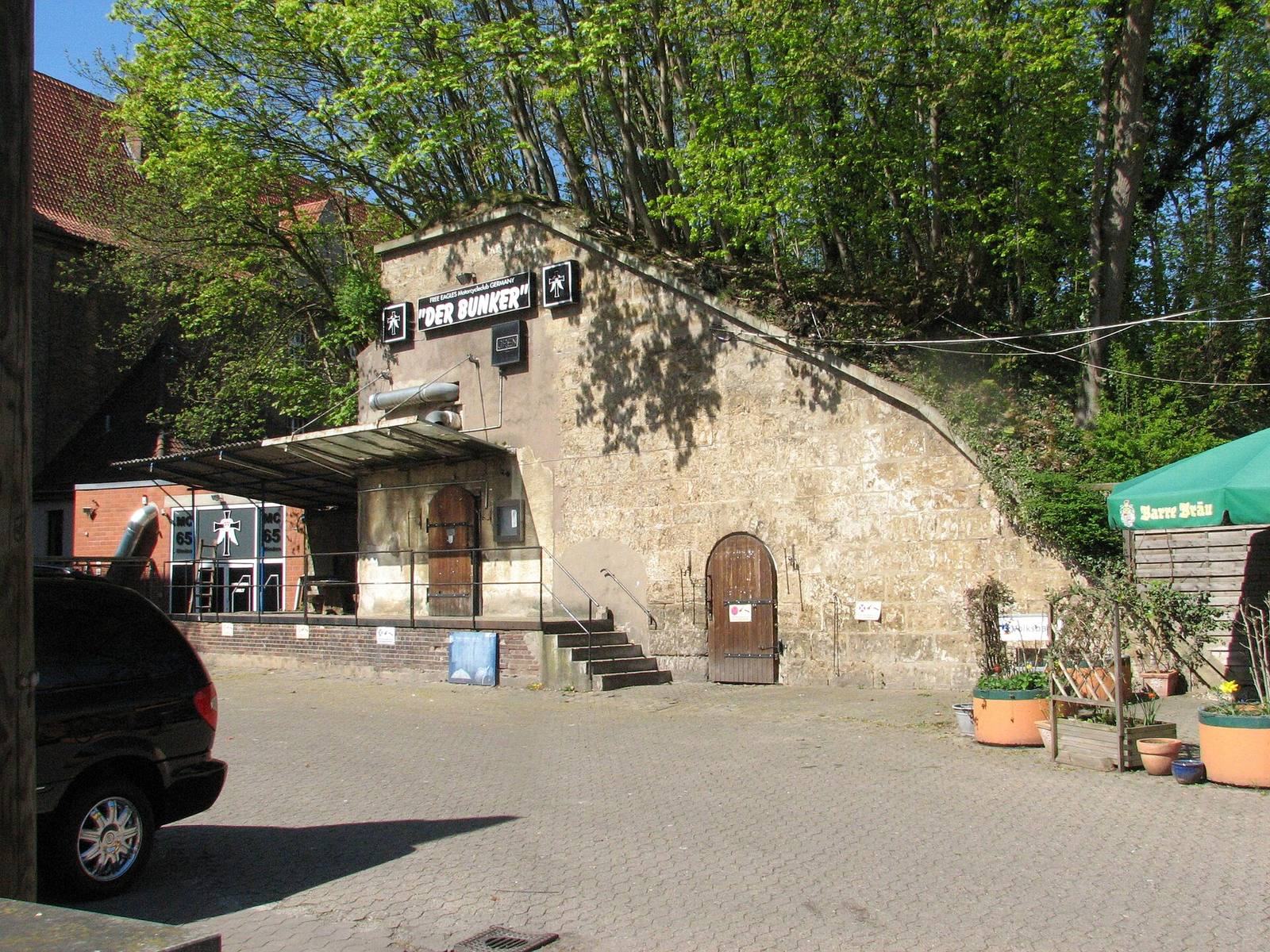
Three forts defended the station. Fort C survives in full and guarded the railway exit toward Cologne. Of the other two forts, their inner defensive structures remain, protecting road and railway exits toward Bremen, Hanover, and Berlin. Fort C contains a branch of the Prussian Museum and is also used as quarters by a local citizens’ company during Minden’s traditional Freischießen shooting festival. The surviving inner structures of the other forts serve as offices and storage rooms.
The former fortress ring
The Mindener Glacis, a green belt along the former defensive circuit, now occupies the line of the fortress ring. It preserves the outline of the former defenses within the expanded city.