Porta Pia: Renaissance Gate in Rome’s Aurelian Walls
Site at a Glance
- Popularity
- Very High
- Country
- Italy
- Primary era
- Early Modern
- Eras represented
- Early Modern, Modern
- Civilizations
- Papal States
- Site type
- Military
- Remains
- Gate
On this page13 sections
History
Porta Pia is a northern gate in Rome, Italy, built during the Renaissance, a period of European cultural and artistic development, as part of the Aurelian Walls, the city’s late-antique defensive circuit. Commissioned by Pope Pius IV as a civic improvement, it was built from 1561 to 1565. Urban expansion had left nearby Porta Nomentana unable to provide access to Via Nomentana, so the new gate replaced it and the older entrance was closed.
Commission and construction
Michelangelo designed Porta Pia, his final architectural work. Giorgio Vasari, an artist and biographer, recounted that Michelangelo offered Pius IV three proposals. The pope chose the least costly of designs Vasari described as beautiful but extravagant. Michelangelo’s advanced age and the participation of assistants may have affected how closely the completed gate followed his plans.
Construction was underway by 1561. Giacomo Del Duca, an architect who had assisted with the project from 1562, finished the work after Michelangelo died in 1564. Del Duca also built Porta San Giovanni. Florentine banker Pierantonio Bandini financed the project through a loan requested by the Apostolic Camera, the papal government’s administrative and financial body.
Alterations and restoration
A second arch was opened around 1575 to accommodate growing traffic. A lightning strike may have badly damaged the upper part of the gate in the late sixteenth century, after which it remained in near-ruinous condition until restoration. Another lightning strike damaged it in 1851.
Architect Virginio Vespignani led restoration and modernization from 1853 to 1869. The work altered the gate and its surroundings, including the addition of buildings and a courtyard.
The 1870 breach
On September 20, 1870, Italian troops fought papal forces at the Aurelian Walls. Italian artillery opened a breach west of Porta Pia, and Bersaglieri, an Italian mobile infantry corps, entered Rome through it. Known as the Porta Pia breach, the action ended the Papal States, territories governed by the popes, and led to Rome’s annexation by the Kingdom of Italy, completing Italian unification. Artillery damaged the gate, which was restored in 1871.
The fighting also badly damaged the exterior statues of Saint Agnes and Saint Alexander. They were restored at the Basilica of St Paul Outside the Walls.
On September 11, 1926, anarchist and antifascist activist Gino Lucetti threw a bomb at a car carrying Benito Mussolini, Italy’s Fascist dictator, as it passed Porta Pia. The attempt had no effect.
Remains
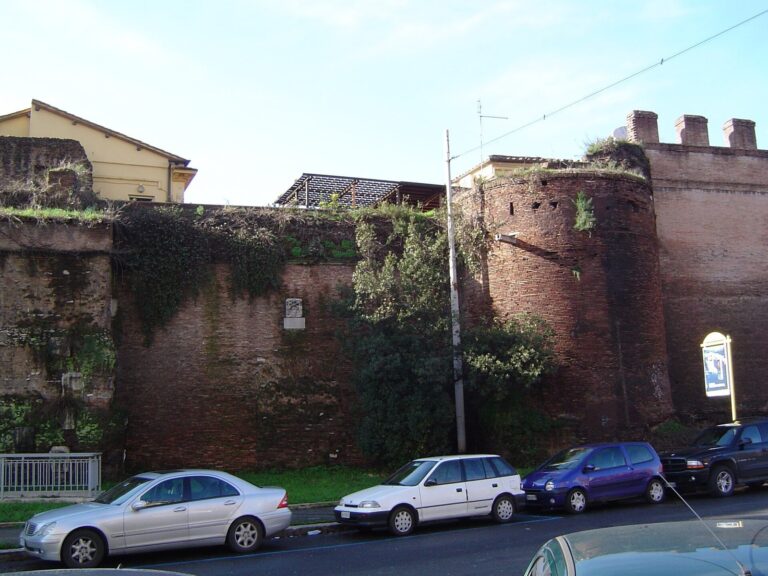
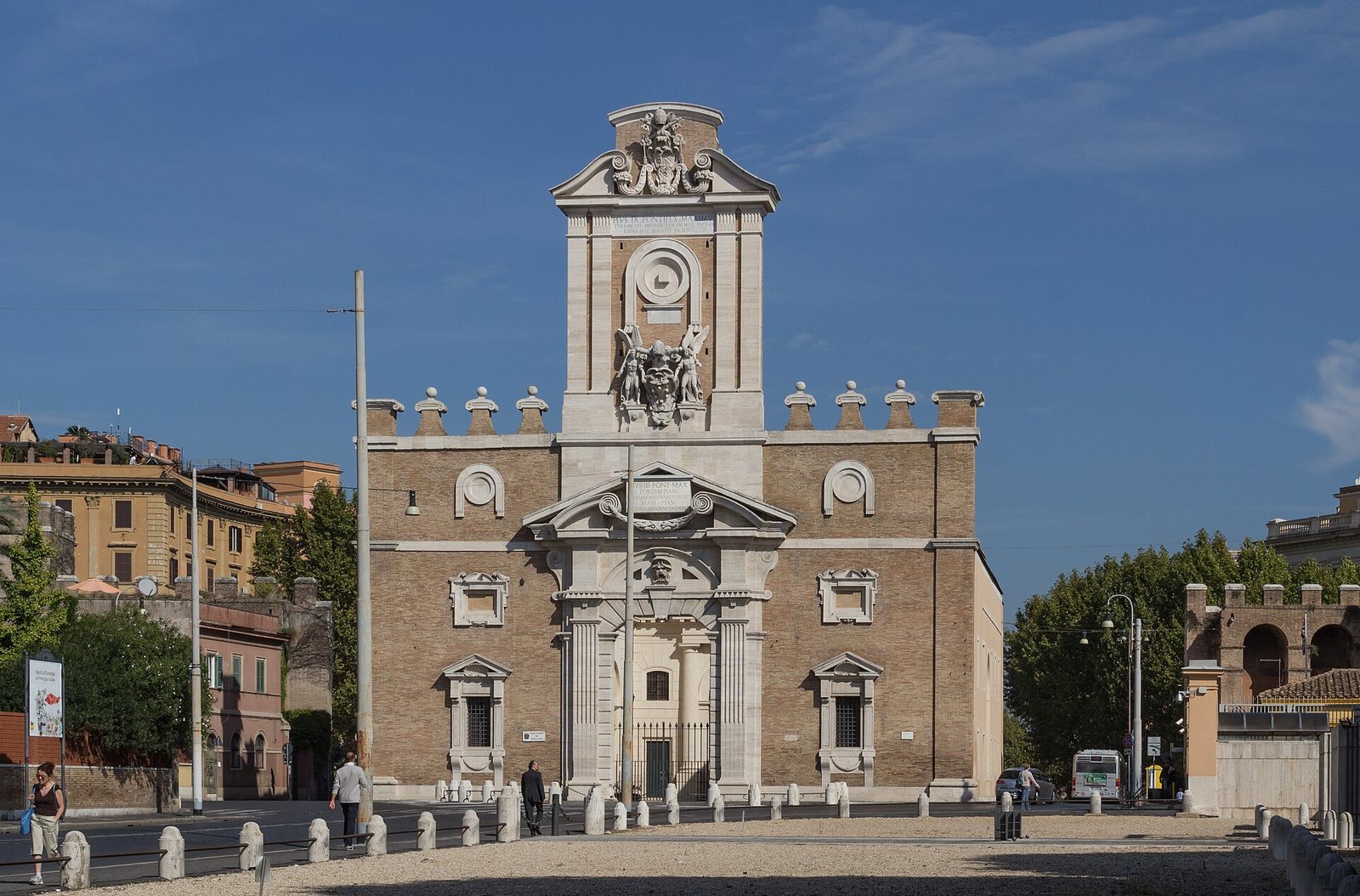
Porta Pia combines marble and masonry in a Renaissance design set slightly back from the line of the Aurelian Walls. Two angled sections connect it to the wall. Its present arrangement has two arches, while the original plan appears to have shown a single arch, an elaborate city-facing façade and a simpler outer passage.
The gate and its architectural details
Plan and approach
Via Pia ends at the gate after following a long, straight approach from the Quirinal. The road followed the line of the ancient Roman road Alta Semita and continued along the route of today’s Via XX Settembre. An inscription above the central arch names the construction of Porta Pia and the route of Via Pia.
Early images give differing impressions of the design. A bronze medal made by Gian Federico Bonzagna in 1561 shows a version unlike the gate as it stands. Bartolomeo Faleti’s 1568 engraving is another early depiction, though it is not entirely accurate. Prints through 1577 show a tower on the outer side; later images depict it shortened. Whether it collapsed or was deliberately reduced remains uncertain.
Outer façade
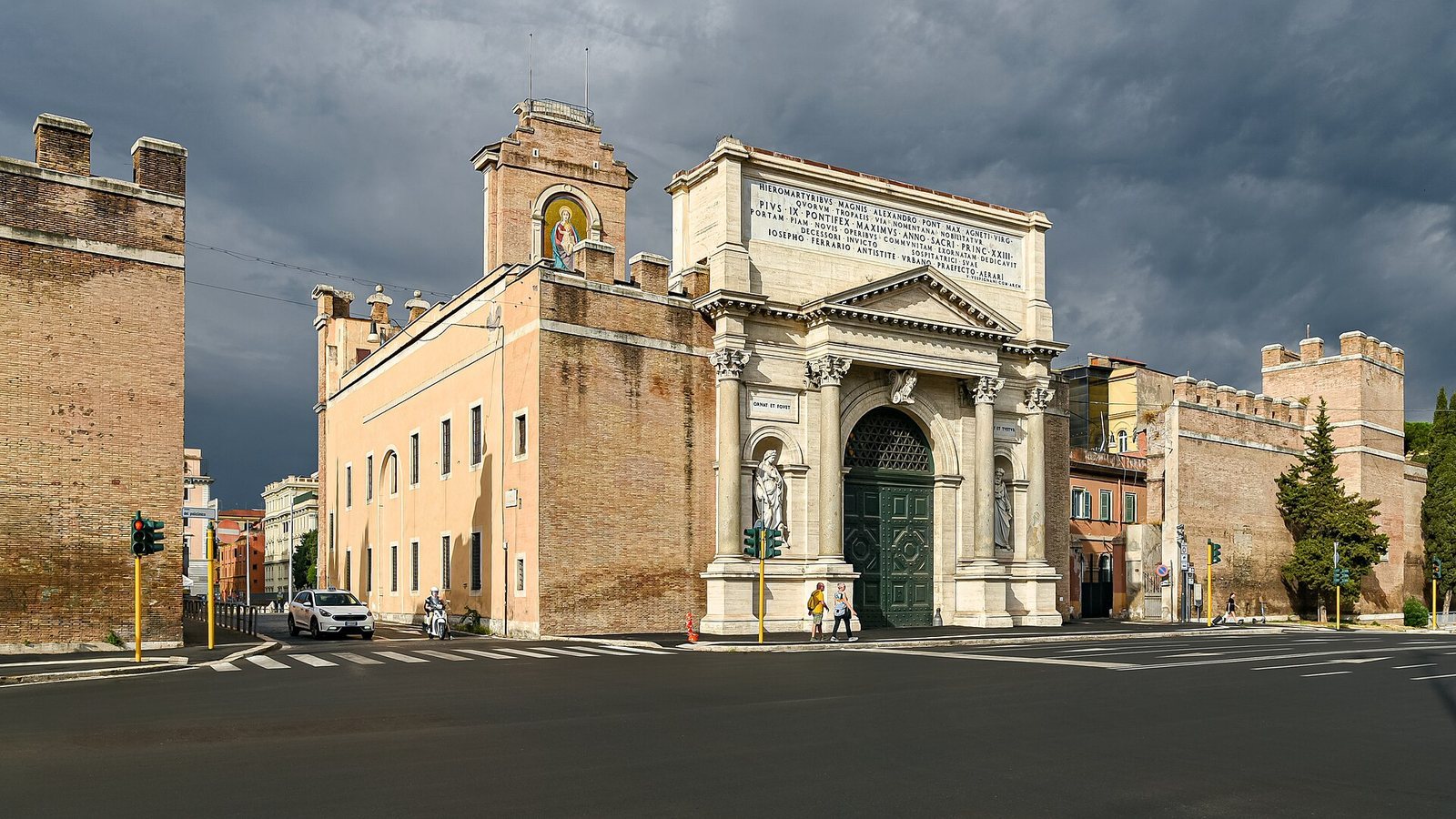
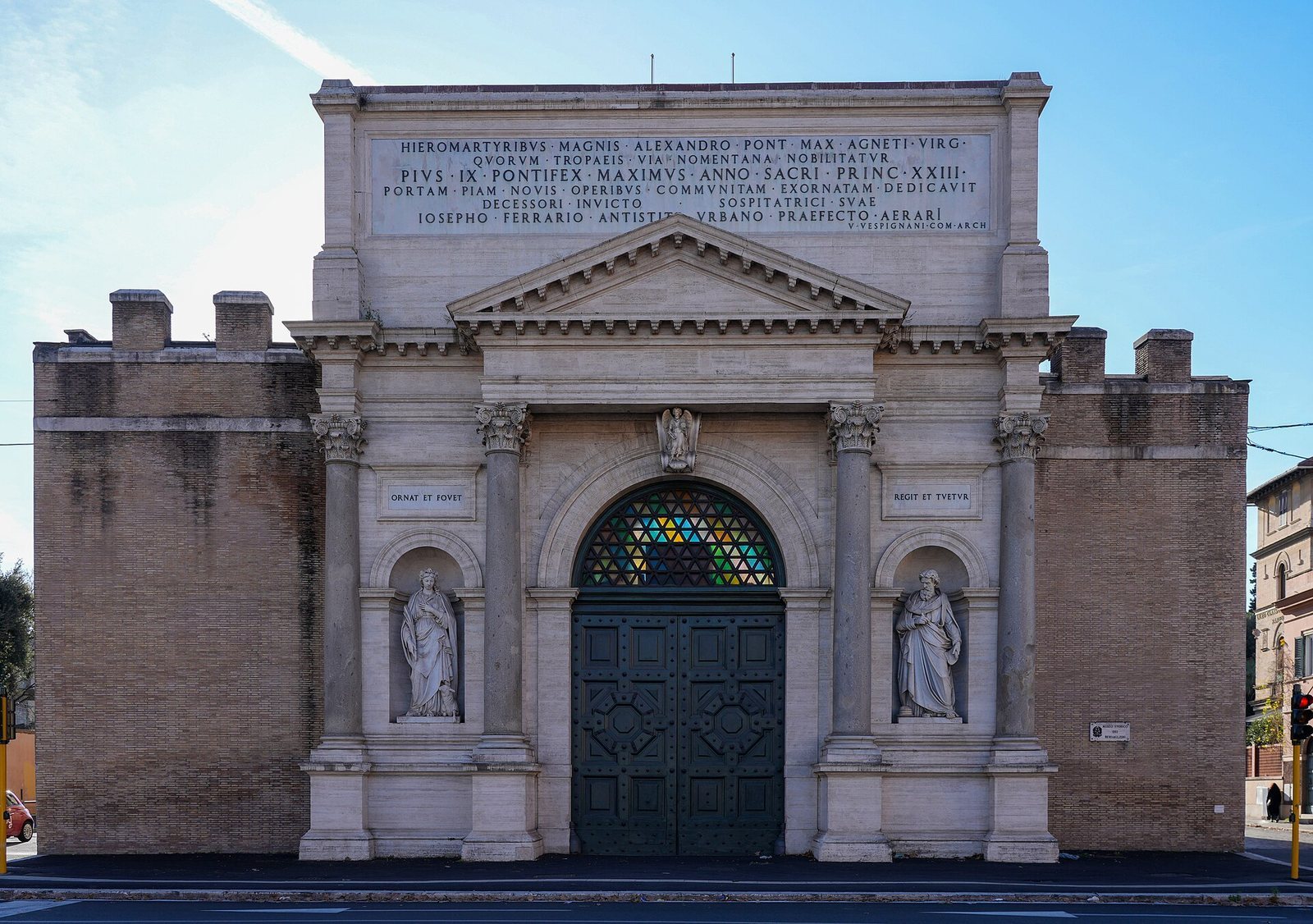
Vespignani’s outer façade uses neoclassical forms, a revival of ancient Greek and Roman architecture, and aligns with the city wall. Inspired by Faleti’s engraving, it was intended to follow Michelangelo’s design closely. Two separate niches for statues are each flanked by a pair of columns. The figures represent Saint Agnes, an early Christian martyr, and Saint Alexander, identified on the gate as a pope and saint. Their inscriptions describe Agnes as adorning and warming, and Alexander as ruling and protecting. An inscription above the outer arch recalls Pius IX’s survival when an audience hall at the nearby Sant’Agnese convent collapsed during his visit on April 12, 1855.
Inner façade
Beneath the right-hand window, a roughly carved grinning mask has hooked wings. Roman popular tradition associated it with Michelangelo. A roughly blocked-out stone beneath the other window may reflect haste during construction. Nearby decorations resemble a basin surrounded by a towel. A legend interprets them as a joke about the Milanese Medici of Marignano, a family of barbers, in contrast with the better-known Florentine Medici.
Bersaglieri buildings and commemorations
Courtyard and former customs buildings
Vespignani’s additions included buildings on both sides of the older gate and an interior courtyard enclosed by a new neoclassical outer entrance. The buildings between the arches once served as customs premises and became the Historical Museum of the Bersaglieri in 1931.
Memorials at the breach
A marble-and-bronze memorial marks the point where Italian artillery broke through the wall. Opposite the gate, in the center of Piazzale di Porta Pia, the 1932 Monument to the Bersagliere commemorates the corps. Its six-metre bronze figure shows a running bugler carrying a rifle. Publio Morbiducci sculpted the figure, while Italo Mancini made its travertine base, formed from a limestone building stone. Six carved scenes in Trani stone, a building stone from the town of Trani, flank the base. The monument followed an initiative by the Bersaglieri national association and was commissioned by Mussolini.
Courtyard commemorations
The courtyard contains the monumental tomb of Enrico Toti, an Italian First World War soldier commemorated as a national hero, and busts of four Bersaglieri. Alessandro La Marmora founded the corps. Luciano Manara and Goffredo Mameli died defending the Roman Republic, established in Rome in 1849, while Giacomo Pagliari died in the assault at the Porta Pia breach.