Los Algarbes: A Prehistoric Burial Complex in Spain
Site at a Glance
- Popularity
- Low
- Country
- Spain
- Primary era
- Bronze Age
- Eras represented
- Stone Age, Bronze Age
- Civilizations
- Unclassified
- Site type
- Burial
- Remains
- Necropolis
On this page8 sections
History
Prehistoric burial ground
Los Algarbes is a prehistoric burial complex in the Valdevaqueros inlet of Tarifa, Spain. It is one of the most important archaeological complexes in Cádiz province. Its burial ground is associated with the Chalcolithic, or Copper Age, when copper was used alongside stone tools, and the Bronze Age, when bronze came into use. It dates to around the end of the third millennium BCE.
The funerary structures may have marked territorial boundaries, perhaps indicating areas claimed by the different social groups buried there.
Later use and investigation
Phoenician, Roman, and Islamic cultural presence followed in later periods. During the twentieth century, peasants also used the caves as dwellings. The site was discovered in 1967, and study began in the late 1960s. In the mid-1970s, archaeologist Carlos Posac Mon excavated ten funerary structures associated with the Bronze Age. Later excavation and conservation of the caves enabled researchers to examine social relationships within the population.
From 2010 to 2012, the Andalusian regional government carried out work to enhance the site’s heritage value. On 7 June 2018, Los Algarbes was designated an Asset of Cultural Interest, Spain’s formal heritage-protection status.
Remains
Funerary architecture
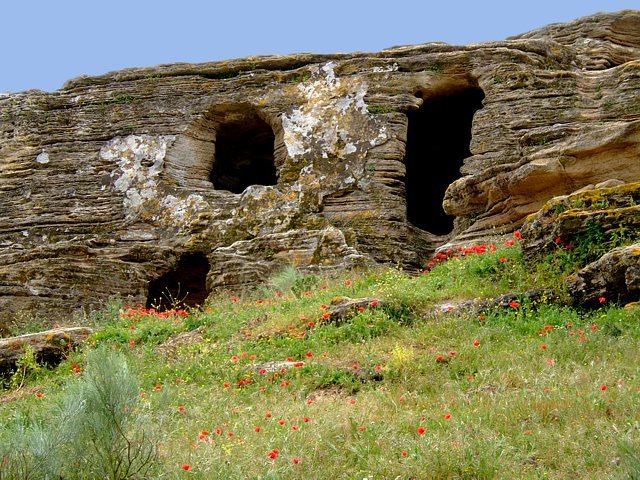
The complex occupies a rocky outcrop on a spur of Paloma Alta hill, about 120 metres above sea level and less than one kilometre from the coast. It lies within the Natural Park of the Strait and comprises around fifty funerary structures and artificial caves, including chambers cut into the rock and a large-stone construction.
Artificial caves
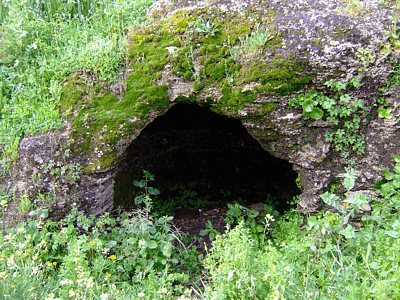
The caves have circular chambers, with entrances positioned at different levels.
Sandstone corridor structure
A large-stone construction has a broad corridor cut into sandstone. It has been linked to a covered-gallery burial, a tomb arranged around a long, roofed passage.
Finds, engravings, and memorial
Burial goods include abundant ceramic vessels, objects made of bronze, ivory, and gold, flaked and polished stone tools, and ornaments, mainly pendants and perforated discs made from mollusc shells. Engravings form the site’s rock art. A monolith near the complex commemorates Lothar Bergmann, a German researcher of caves who discovered several dozen caves and rock-art shelters in Cádiz province.