Château de Montségur: Cathar Stronghold and Royal Fortress in France


Site at a Glance
- Rating
- 4.6
- Popularity
- Medium
- Country
- France
- Primary era
- Medieval
- External website
- Open
- Eras represented
- Medieval, Early Modern
- Civilizations
- French
- Site type
- Military
- Remains
- Castle
On this page12 sections
History
Château de Montségur is a medieval fortified castle in France, built and rebuilt on the summit of the Pog during the struggles between Cathar communities and the French monarchy. A first fortress existed by the twelfth century, but it had fallen into ruins by about 1204. The site later became a major Cathar refuge before the settlement was besieged and surrendered in 1244.
From the early fortress to Montségur II
Around 1204, Raymond de Péreille, one of Montségur’s lords, directed the construction of a new fortified settlement. Known archaeologically as Montségur II, it was a castrum, or fortified settlement combining a stronghold, an enclosed defensive area, and associated houses. It included the lord’s fortified residence, a castle, a village, and surrounding defenses. The castle itself was reconstructed in 1206.
The rebuilt site developed during the Albigensian Crusade, the thirteenth-century military campaign against Cathar communities and their supporters in southern France. The Cathars were members of a medieval Christian dissident movement with organized religious communities in southern France and northern Italy. Montségur also sheltered dispossessed faydits, noble or military figures who had lost lands or political rights during the suppression of the movement and the transfer of power to the French crown.
A centre of the Cathar Church
Montségur’s role as a Cathar refuge was recognized by the Fourth Lateran Council in 1215. This major Roman Catholic council, held in Rome, addressed church doctrine and discipline and supported the suppression of heresy. The Treaty of Meaux-Paris in 1229 ended the principal phase of the Albigensian Crusade and transferred territories in Languedoc toward French royal control. After the treaty, Montségur’s function as a shelter for the Cathar Church was reaffirmed, and from 1232 it became the church’s principal centre. Guilhabert de Castres, a Cathar theologian and bishop, was associated with the site.
Pierre-Roger de Mirepoix, Raymond de Péreille’s cousin and son-in-law, served as the settlement’s military commander. About 500 people may have lived within the defenses, including Cathar religious personnel, lay inhabitants, refugees, and faydits. Cathar Perfects, members of the movement’s religious elite, lived alongside people whose roles included farming, herding, craft production, and occasional commerce. The community cultivated cereals and maintained substantial food reserves. Local workshops produced wool and animal-skin clothing, dyes, tools, jewelry, religious objects, and lead tokens used to identify Cathar groups.
Attacks and the final siege
Montségur endured four major attacks or sieges during the first half of the thirteenth century. Forces led by Guy de Montfort attempted to take it in 1212, followed by an attempt led by Simon IV de Montfort in 1213. In July 1241, Raymond VII of Toulouse began an unsuccessful siege on the orders of Louis IX, king of France. The final campaign was commanded by Hugues des Arcis, the royal seneschal of Carcassonne.
The immediate cause of the last royal campaign was an attack carried out by men from the Montségur garrison. On 28 and 29 May 1242, they took part in the killing of inquisitorial representatives at Avignonet. Blanche of Castile, queen regent of France, and Louis IX ordered the ensuing campaign. The final siege began in May 1243, when several thousand crusading or royal troops surrounded the fortress. The defenders numbered roughly 70 to 100 fighters.
During the winter, the attackers captured the watchtower after a difficult nighttime ascent and placed a trebuchet there. This counterweight siege engine could throw large stones against the fortress. About a month later, the barbacan, an advanced defensive work protecting an entrance or approach, also fell, possibly through local betrayal. A final assault in February 1244 was repelled, but the defenders had been severely weakened.
On 1 March 1244, after a blockade of about ten months, Pierre-Roger de Mirepoix negotiated the surrender. Soldiers and lay inhabitants were to be spared, while Cathars who renounced their faith were to be released. A fifteen-day truce allowed those who wished to prepare spiritually and receive the last sacraments. On 16 March, more than 200 Cathars who refused to renounce their faith were burned in a mass execution. The commonly cited total is about 220 men, women, and one young girl. They included members of Raymond de Péreille’s family and soldiers who chose not to abandon the Cathars.
The location of the execution remains disputed. Tradition places it at the Camp dels Cremats, while other interpretations locate it on a nearby hill or connect the prisoners with later interrogation at Bram. After the surrender, the Cathar settlement and its outer fortifications were demolished. Royal authorities granted the pog, an Occitan term for a prominent hill or mountain peak, to Guy II de Lévis, lord of Mirepoix and marshal of the faith. The castle was then rebuilt as a royal garrison.
The later royal fortress and modern interpretation
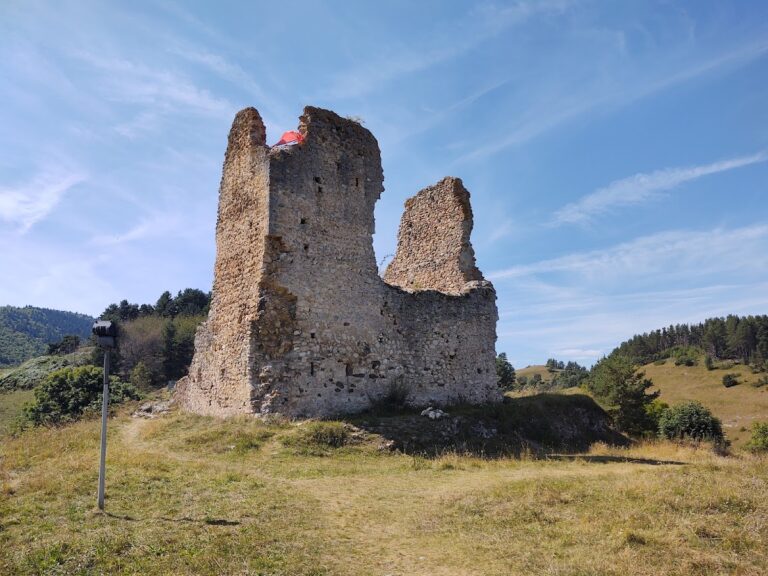
A force of about thirty men remained at the castle until the seventeenth-century Treaty of the Pyrenees. The present ruins belong principally to this later fortress, known as Montségur III, rather than to the Cathar stronghold besieged in 1244. The castle was progressively rebuilt and modernized over roughly three centuries, producing a structure that represents post-medieval royal French defensive architecture.
Interest in Montségur revived during the nineteenth century through the writings of Napoleon Peyrat, a Protestant pastor and writer whose work appeared around 1870. Romantic and esoteric interpretations later presented the site as a Cathar temple, a refuge of the Knights Templar, a solar sanctuary, or a hiding place of the Holy Grail. Otto Rahn, a German writer on Cathar and Grail legends, especially promoted theories concerning the Grail. Historical research has challenged these interpretations, and they do not constitute established evidence for the site’s medieval function.
Modern investigation has altered understanding of the mountain and its settlement. A restoration campaign begun in 1947 reduced unauthorized digging, although it also removed or obscured some archaeological evidence. Speleological investigation, the exploration of caves and underground features, led to the discovery of a burial in the Avenc du Trébuchet in 1964. An avenc is a natural shaft or sinkhole, a type of geological feature known in the Ariège region. The Groupe de Recherches Archéologiques de Montségur et Environs, founded in 1968, carried out further excavations.
The castle was designated a monument historique, a French legal category for a protected historic monument, in 1862. Protection was extended to the pog in 1883 and to the archaeological remains and defensive lines in 1989. The site became a protected site in 2001 and was included in the UNESCO World Heritage serial property Royal Capetian Fortresses of Languedoc in 2026 under criterion (iv). A ceremony seeking pardon and mercy for violence and other failings committed by Christians took place at Montségur on 16 October 2016 under Jean-Marc Eychenne, bishop of Pamiers, Couserans, and Mirepoix. A further restoration campaign began on 8 June 2026 to secure and enhance the castle and its castrum, including vegetation clearance on the settlement terraces and consolidation of the keep, stairways, and ramparts.
Remains
Mountain setting and defensive enclosure
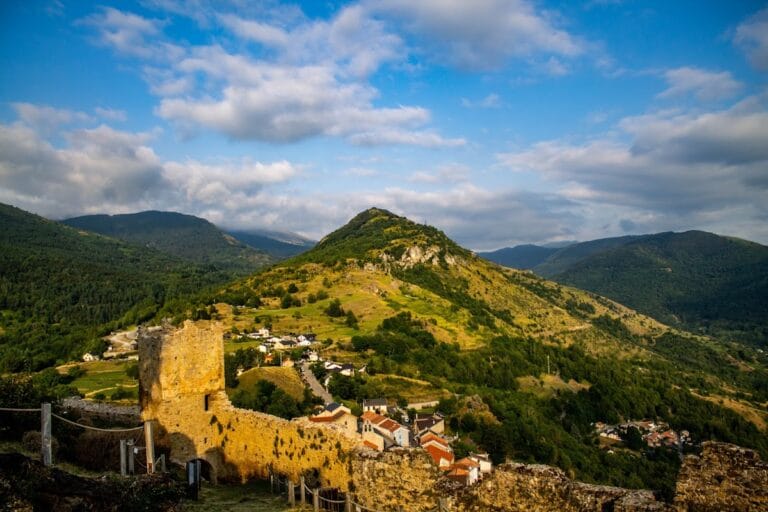
The ruins occupy the summit of the Pog, an isolated mountain peak rising to about 1,200 to 1,207 metres above the Pays d’Olmes. The summit stands approximately 170 metres above the road and is surrounded by steep slopes and cliffs. This elevated setting formed the physical context for a fortified settlement whose defenses extended beyond the later castle.
Montségur II occupied the summit as a fortified castrum containing a lord’s residence, castle, village, and enclosing walls. On the side facing the present road, three defensive walls protected the settlement. The first stood near the present entrance. On the opposite side of the Pog, about 800 metres away, the watchtower called the Roc de la Tour overlooked an approximately 80-metre cliff. A barbacan protected the approach to the tower. During the final siege, attackers seized this position and used it to support a trebuchet that bombarded the fortress.
Surviving traces of the Cathar settlement
Village terraces
The Cathar village occupied the interior of the fortified enclosure. Portions of its terraces survive, especially on the north-western side of the present castle. Foundations of several houses remain in these stepped areas, together with stairways linking different levels. The terraces preserve the arrangement of domestic buildings within the earlier settlement, even though the later fortress dominates the surviving ruins.
Cistern and silo
A cistern with a capacity of about 50 cubic metres survives among the settlement remains, alongside a silo. These installations formed part of the community’s storage and water-management system. Excavations have also yielded food refuse and animal bones, including remains of cattle, sheep, roe deer, wild boar, geese, chickens, and fish. The finds indicate a varied diet and a population that included more than Cathar religious specialists. They also show that the inhabitants were not uniformly vegetarian.
Montségur III
The recognizable castle is the later structure erected and altered after the destruction of Montségur II. Its principal defensive element is a high, thick shield wall on the side exposed to attack. The wall is about 4.20 metres thick and protects the remaining buildings. The present fortress was progressively modified over approximately three centuries, so its surviving form belongs mainly to later royal French defensive construction rather than to the Cathar settlement of 1244.
The Lévis family may have made limited changes in the fourteenth century to provide a chapel for the chaplain. Another surviving architectural element was retained or altered in the sixteenth century. The ruins are now generally fragmentary. Their relationship to the earlier fortresses remains archaeologically contested, although the terraces and other settlement remains outside or beside the later fortification preserve physical evidence of Montségur II.
Archaeological finds and later traditions
Excavations associated with Montségur have produced foundations, domestic remains, food refuse, animal bones, tools, jewelry, religious objects, and lead tokens. Stone balls used with a trebuchet weigh approximately 23 to 78 kilograms. Cereals appear among the excavated food remains, together with evidence for the consumption of domesticated animals, game, poultry, and fish. A burial discovered in the Avenc du Trébuchet adds evidence from the mountain’s underground landscape.
The surviving architecture has also been interpreted through measurements using the English cane, a historical unit of length that is later than the medieval construction. The use of this unit does not resolve the relationship between the present ruins and the earlier fortresses. That relationship remains a matter of archaeological debate.
A traditional solar alignment is associated with the castle. At the winter solstice, the first sunlight is said to pass through the fortress along its length, while at the summer solstice sunlight is said to pass through four north-western arrow slits in the keep. Modern interpretations have connected this phenomenon with solar or even Zoroastrian worship, but those religious explanations remain unverified.
A modern stele at the Camp dels Cremats, the traditional location of the 16 March 1244 execution, commemorates the Cathars who were killed there according to that tradition.