Lamu Fort: A Coastal Fort and Museum in Kenya
Site at a Glance
- Popularity
- Medium
- Country
- Kenya
- Primary era
- Modern
- Eras represented
- Modern
- Civilizations
- Omani, Swahili
- Site type
- Military
- Remains
- Fort
On this page9 sections
History
Construction and Omani protection
Lamu Fort is a stone fort in Lamu, Kenya, whose construction appears to have begun under Fumomadi, Sultan of Pate, before completion around 1821 with Omani assistance. Pate was a Swahili coastal polity in the Lamu Archipelago. Abdalla bin Hemed, a leader of the Mazrui, a prominent political family associated with Mombasa, also took part despite the uneasy relationship between the Mazrui and Pate. When Fumomadi died in 1809, one storey had been built and work stopped.
In 1812, Lamu defeated forces from Pate and Mombasa at the Battle of Shela, but the threat to the town continued. Work on the fort resumed in 1813 with assistance attributed to Sayyid Said bin Sultan, ruler of Muscat and Oman from 1804 to 1856. Around 1814, Sayyid Said sent a governor to Lamu and provided a protective garrison of soldiers from Balochistan. The fort later served as a base for Omani efforts to extend control along the East African coast, including the defeat of Mazrui rebels in Mombasa. Lamu’s influence in the archipelago grew at Pate’s expense.
Changing regional role
After Sayyid Said moved his sultanate’s capital to Zanzibar, Lamu’s strategic importance declined. Its economic standing also weakened in relation to Mombasa and Zanzibar.
Prison, museum and heritage status
The British colonial administration turned the fort into a prison in 1910. In the 1950s, it held detainees associated with Mau Mau, a Kenyan anti-colonial movement active under British rule. The prison remained in use after Kenya became independent in 1963, until the fort’s transfer to the National Museums of Kenya in 1984.
A library associated with Lamu Museum was established in 1978. In 1984, the National Museums of Kenya converted the fort into a museum, and careful restoration followed. A temporary exhibition opened in 1993. The fort was declared a scheduled monument on 15 May 1984 and became a National Monument of Kenya that year. It also forms part of Old Town Lamu, a UNESCO World Heritage Site, recognized through a program of the United Nations agency for education, science and culture. In 2006, ground-based laser measurements produced a three-dimensional record of the fort.
Remains
Plan and setting
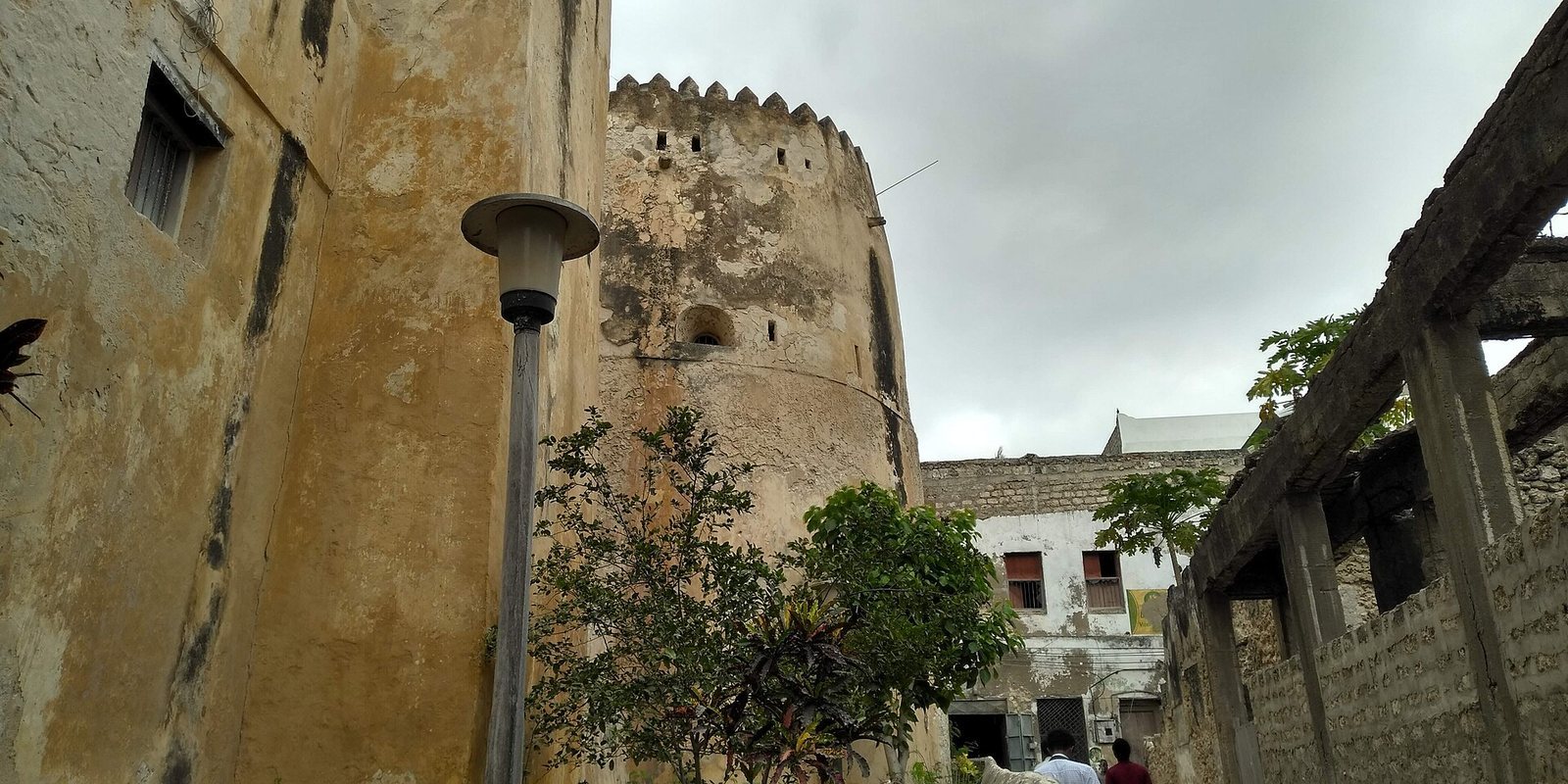
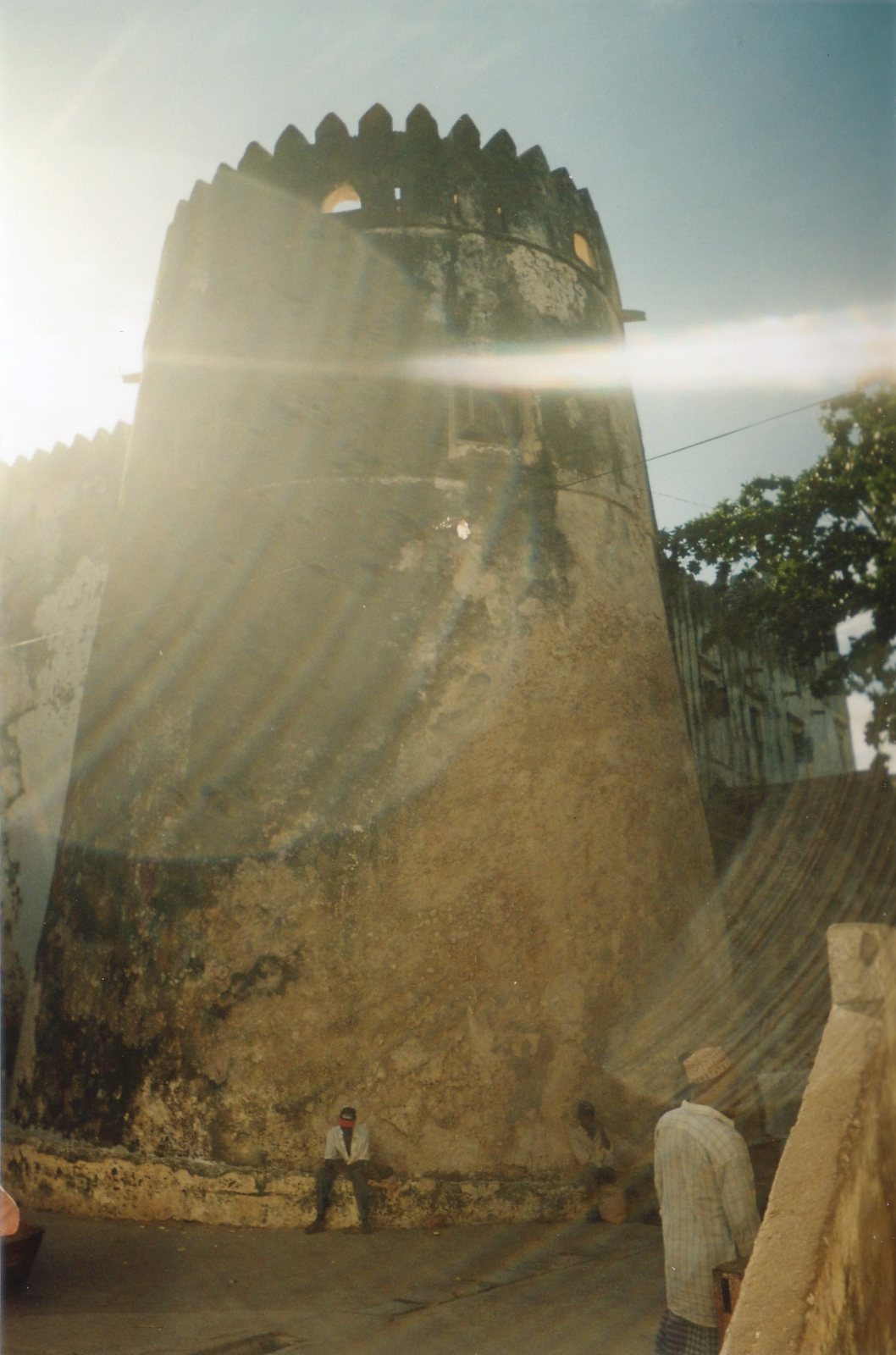
The fort stands at the southeast corner of Lamu’s old stone town, beside Pwani Mosque, whose origins date to the fourteenth century and which is described as the town’s oldest known mosque. The fort originally stood on the waterfront, which followed the town’s main street. As the shoreline receded, it came to occupy a central position about 70 metres from the main jetty. The present building is a massive, roughly square, two-storey stone structure, with rounded gun towers projecting from its northwest and southeast corners. Its squat, sturdy form contrasts with the elegant Swahili architecture of other town buildings.
Early descriptions
When he visited in 1823, British naval officer and travel writer Thomas Boteler described a large square building with a tower at each corner, a spacious entrance covered by a curved ceiling, and three levels of balconies supported by interior arches. He judged the construction so light that firing the fort’s guns might bring it down. Captain W. F. W. Owen, another British naval officer who visited that year, estimated its dimensions at 100 yards square, with walls 40 to 50 feet high.
Surrounding shops
Rows of shops built around the fort during the nineteenth century survive in part.
Interior and present uses
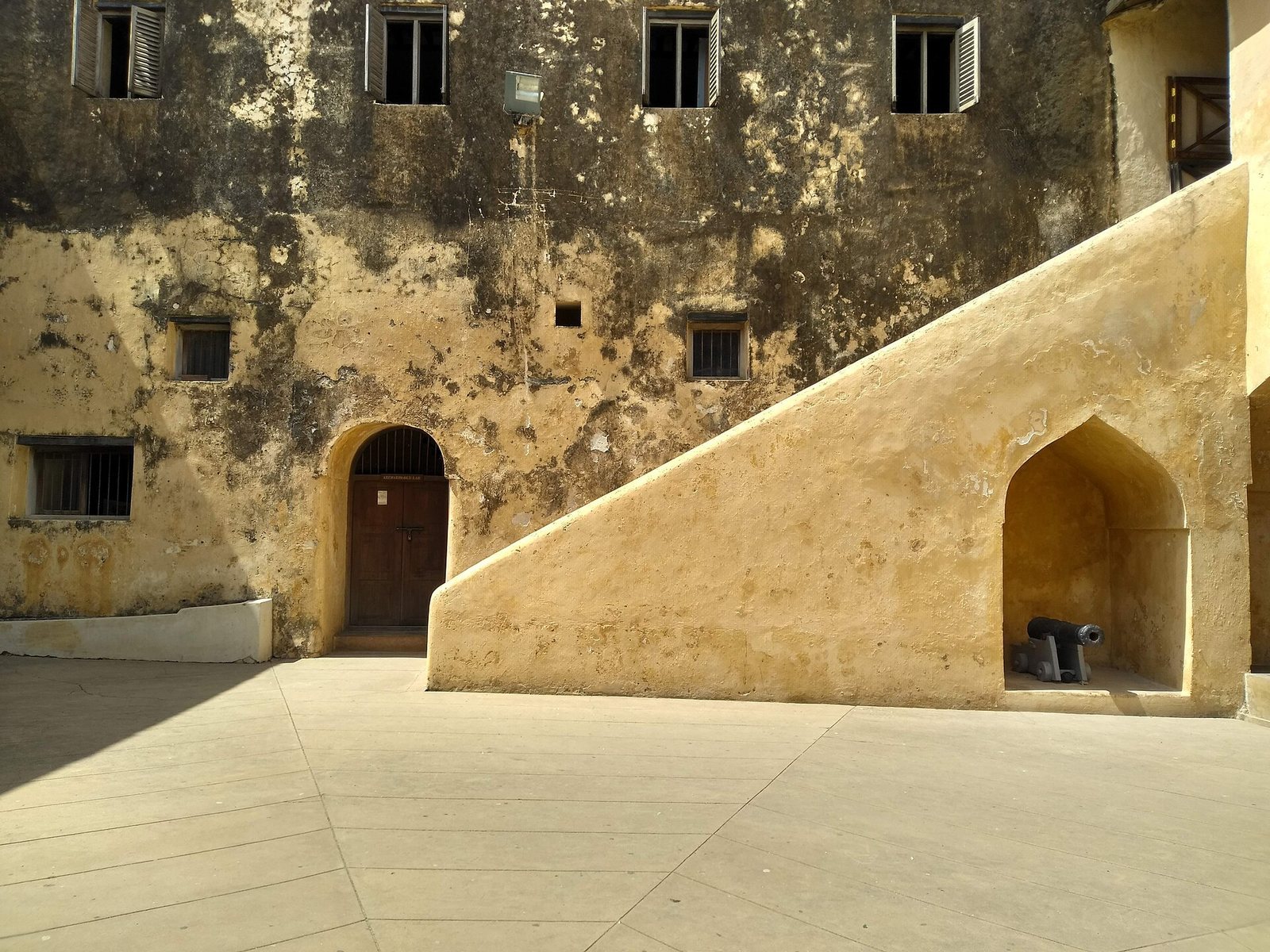
The ground floor contains a museum exhibition focused mainly on environmental conservation. The courtyard is used for community meetings, weddings and public performances. Offices, laboratories, a workshop and a conference facility occupy the second floor. The library associated with Lamu Museum holds a substantial collection of Swahili poetry and reference works on Lamu.