Faxe Church: A Late Gothic Church in Denmark
Site at a Glance
- Popularity
- Very Low
- Country
- Denmark
- Primary era
- Medieval
- Eras represented
- Medieval, Early Modern
- Civilizations
- Danish, Denmark–Norway
- Site type
- Religious
- Remains
- Church
On this page17 sections
History
Faxe Church is a late Gothic church in Faxe, Denmark, built at the end of the fifteenth century, probably in or shortly after 1492. It belongs to the Diocese of Roskilde and the Evangelical Lutheran Church of Denmark; the church was previously Catholic.
Romanesque predecessor and late medieval church
A Romanesque church stood on the site before the present building. Limestone masonry from that earlier structure remains incorporated into the church and probably dates to the reign of Valdemar Atterdag, a fourteenth-century Danish king. In 1492, King Hans transferred the site to Copenhagen University.
Parish changes and continued use
The northern aisle was added in the seventeenth century as the parish population grew. In 1638, the tower room, which had probably served as a baptistry, became the porch for the west entrance.
Fresco discoveries and restoration
Magnus Petersen found frescoes in the tower room in 1862. Jacob Kornerup restored them in 1877, and H. Borre undertook further restoration in 1950. Paintings above the organ were discovered in 2007.
Remains
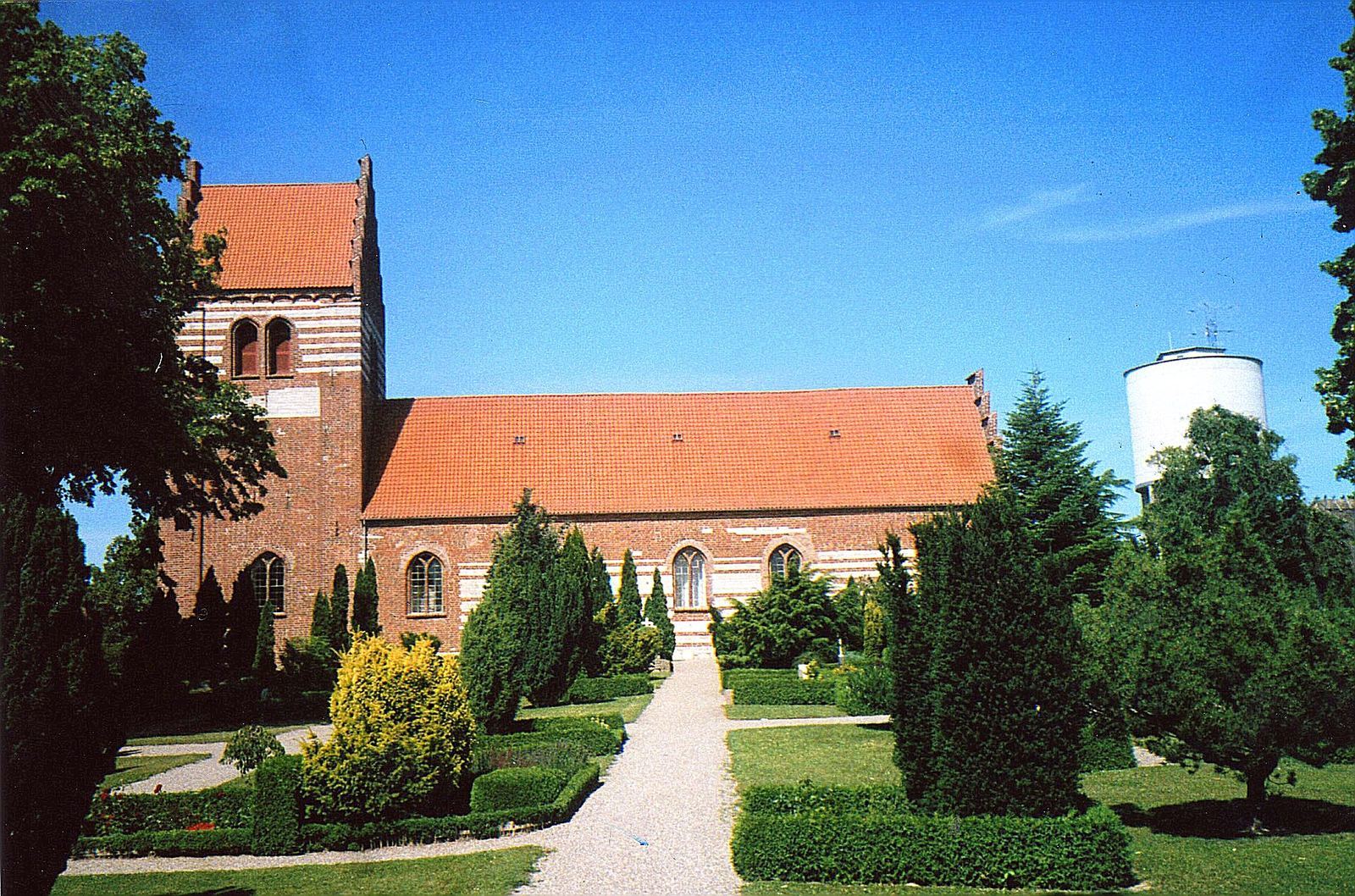
The 40-metre-long church is arranged around a red-brick nave with limestone trim, a northern aisle, and a tower at the west entrance. Its late Gothic fabric incorporates limestone masonry from the earlier church.
Nave and tower
The tower was built at the same time as the nave or soon afterward. On its east gable, nine narrow recesses shaped like windows rise to different heights, alongside three Gothic windows that have been bricked in. Limestone bands reach roof level on the east side, while their less regular completion elsewhere may reflect hurried construction. A pointed arch in the south wall outlines a bricked-up doorway, probably once used by the priest. Five cross vaults, made from intersecting arched sections, rest on wall pillars over the nave; a similar vault covers the tower room.
Painted decoration
Frescoes in the tower-room vault
The vault depicts episodes from the story of John the Baptist. The north section shows his capture. In the east, Herod sits at a table with Herodias and Salome as a servant presents John’s head to Salome. The south section shows John’s beheading, with Herod directing the execution on the eastern side.
Frescoes on the tower-room north wall
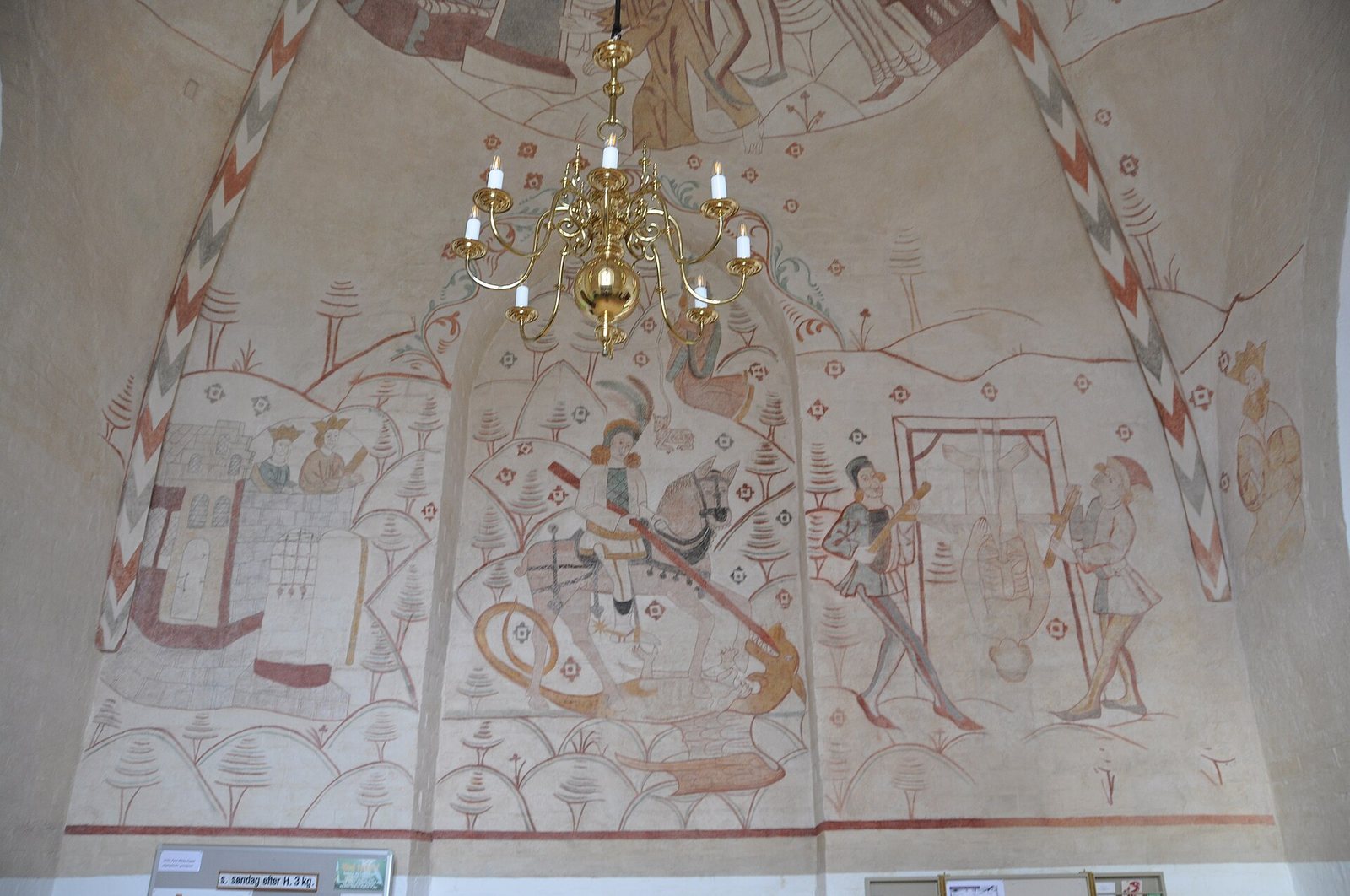
A painting on the north wall depicts George confronting the Dragon. At its western edge, a king and queen stand on a town wall, with a princess above them. The eastern image shows the martyrdom of Simon the Apostle.
Paintings above the organ
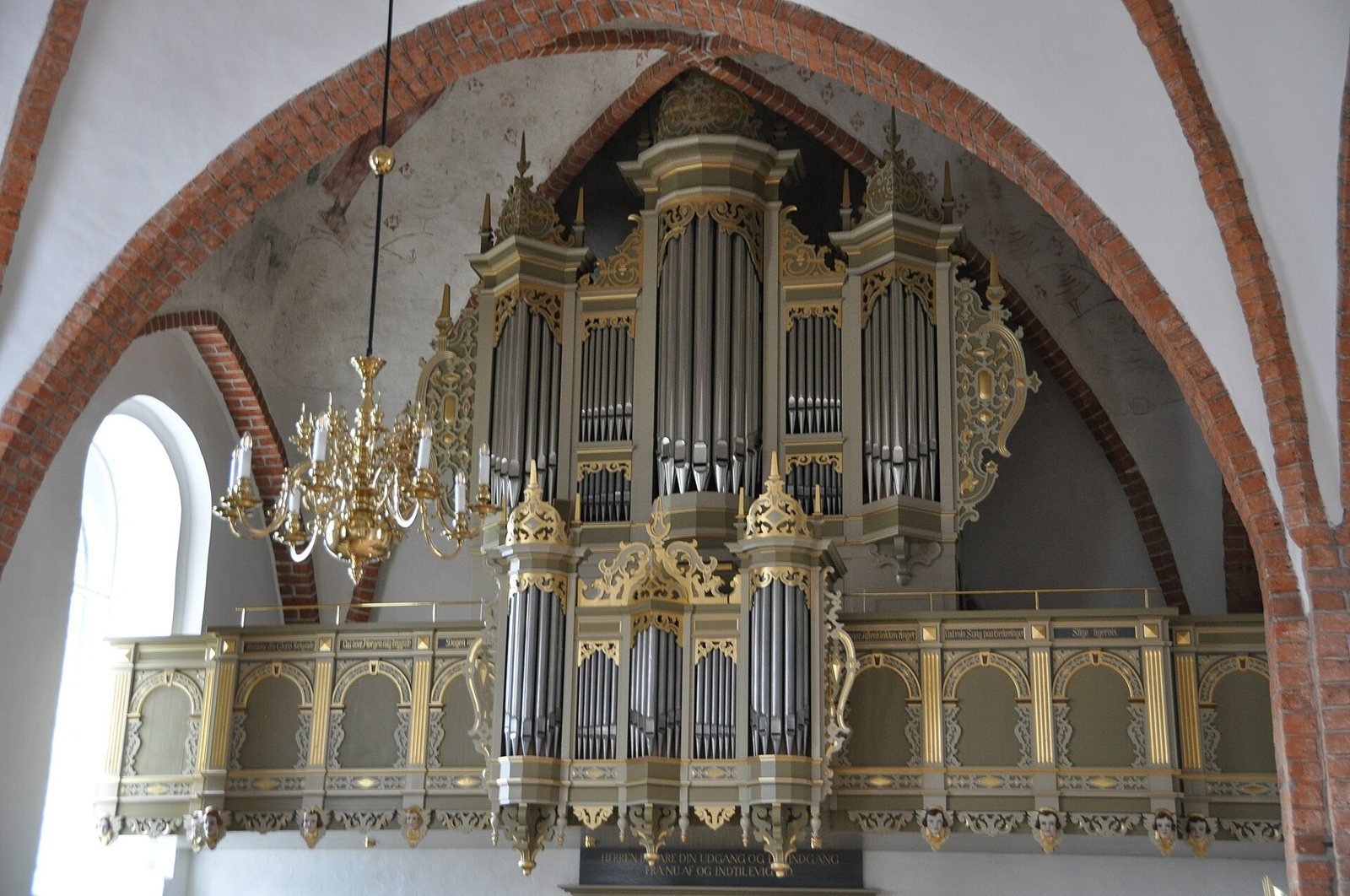
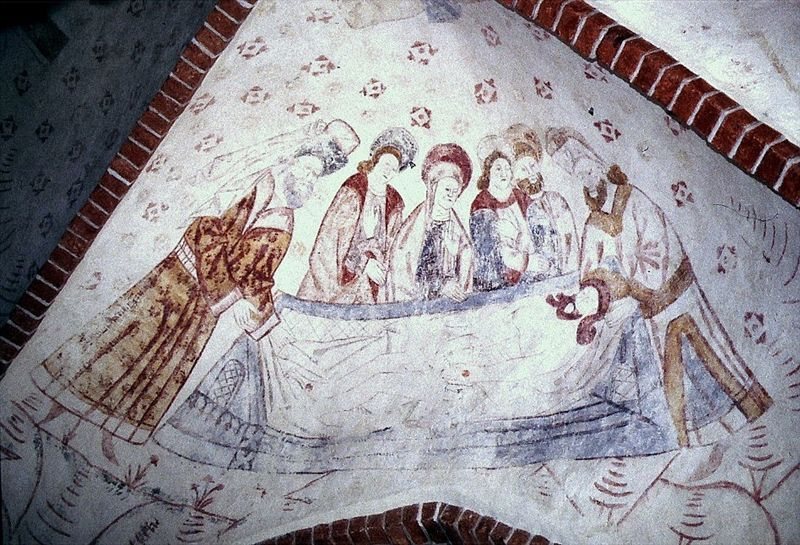
Frescoes in the vault above the organ date to the beginning of the sixteenth century. They show the Descent from the Cross, Mary grieving over Christ’s body, the placing of Christ in the tomb, and the Ascension. The paintings are attributed to the Brarup workshop, which is thought to have decorated the church as a whole.
Church furnishings
Altarpiece
The altarpiece is a painting made in 1717 by Hendrick Krock, a court painter to Frederik IV of Denmark.
Pulpit
The raised preaching platform, or pulpit, dates to 1614–1615 and probably came from the workshop of Danish woodcarver Abel Schrøder.
Figures from the chancel arch
Figures of Mary and John flank the altar. These figures and a cross now in the northern aisle, which came from the chancel arch, probably once hung between the chancel and nave.
Earlier stonework and churchyard
Limestone sculptures and baptismal font
Two limestone sculptures in the northern aisle probably came from the earlier church. They are carved with lions and snakes, motifs that may point to an artist from Jutland because they are unusual in the region. The Romanesque granite baptismal font, made around 1200–1250, is decorated with four palm trees and attributed to the workshop of Bondo Friso.
Churchyard graves
The churchyard contains the graves of painter Malthe Engelsted (1852–1930), diplomat Kjeld Gustav Knuth-Winterfeldt (1908–1992), businessman Conrad Nielsen (1866–1914), and businesswoman Nicoline Nielsen (1874–1951).