El Puente: An Ancient Maya Regional Center in Honduras
Site at a Glance
- Popularity
- Medium
- Country
- Honduras
- Primary era
- Classical
- Eras represented
- Classical
- Civilizations
- Maya
- Site type
- City
On this page14 sections
History
El Puente is an ancient Maya city in Honduras’s Florida Valley, settled around the middle of the sixth century during the Early Classic, an early period in Maya history. Similarities in its architecture and pottery to those of Copán, a major Maya city and political center, suggest that El Puente may have been established to oversee two trade routes meeting in the valley.
The site lies in La Jigua municipality, about 11 km north of La Entrada and 2 km north of the confluence of the Chamelecón and Chinamito rivers. It stood on a frontier between Maya and non-Maya peoples.
Regional ties and political status
El Puente was independent at some points in its history, but became tributary to Copán sometime between the sixth and ninth centuries. In other words, it came under Copán’s authority and owed it tribute. During the Late Classic, a later period in Maya history, it was a regional center closely allied with Copán. Its trading connections reached Maya cities in the highlands and Petén, a region of northern Guatemala, and extended to central Mexico.
Migration, political change, and abandonment
As Copán declined during the first half of the ninth century, people from that city moved to El Puente, including skilled specialists and some members of its elite. After Copán’s collapse, around AD 850 to 950, political conditions in the La Entrada region deteriorated. Local leaders lost prestige and territory, and El Puente began to decline after AD 900. The city was abandoned around AD 950.
Archaeological study and protection
Archaeologist Jens Yde described and mapped El Puente in 1935. Honduras designated it Cultural Heritage of the Nation in 1989. The La Entrada Archaeological Project began excavation and restoration work in 1991, with excavations continuing from 1995.
Remains
El Puente contains about 210 structures, including tombs, religious buildings, and residences. Its core is arranged around five plazas, two of which served religious ceremonies and communal and administrative activity. The architecture is predominantly Maya, though some buildings reflect influence from neighboring non-Maya areas. Nine structures have been investigated and restored.
Masonry and construction
Builders used tufa, a relatively fragile stone, along with schist, a metamorphic rock, and hard limestone. Tufa was the most common material and could crumble. Building interiors contained varying mixtures of stone, earth, and clay. Mortar made with little lime and hard clay was vulnerable to water, causing the plaster-like stucco coating on walls to detach and contributing to collapses. Stonework quality also varies between buildings and within individual structures. The buildings do not consistently follow the symmetry found at longer-established Maya sites, and stairways on a single structure can differ in size across its four sides. Some long buildings were joined end to end.
Plaza drainage
Stone-cut channels carried rainwater away from the plazas. A channel at the base of Structure 5 remains functional, and another was excavated east of Structure 3.
Principal buildings
Structure 1
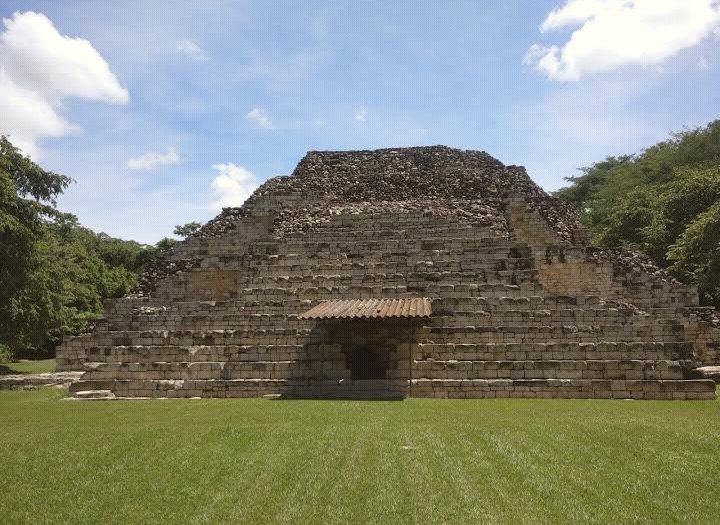
At 12 m tall, Structure 1 is the site’s tallest building. It once stood 5 m higher and was the tallest structure outside ancient Copán. The radial pyramid, a pyramid with stairways on several sides, has six tiers and stairs on all four sides; those facing east and west are best preserved. Its upper building contained three rooms. Fallen remains point to a vaulted roof, a curved roof formed by masonry, with channels to carry away rainwater. Sculptures of three human figures decorated a wall. Excavations inside and around the building yielded ceramic fragments, burnt clay, and burnt maize and beans. Looting has badly damaged the structure.
Structure 3
The north wall of Structure 3’s first platform has particularly fine stonework, while the rest of the building is more roughly finished.
Structures 4 and 5
Both buildings stand on the northwest side of Plaza 1, at the far northwest of the site core. Structure 5 has three Copán-style rooms, with features resembling those of ancient Copán. Excavation revealed traces of household activity. Its walls are only 30 cm thick and could not support a vaulted roof.
Structure 31
This pyramid stands on the eastern side of the core and contains two rooms. The main room retains part of a stone bench. Its entrance opens onto the main stairway, which climbs the west side from Plaza C. Looting has badly damaged the eastern portion. An altar and an uninscribed stela, an upright stone monument, were associated with the temple.
Burials and archaeological finds
Excavated burials contained offerings of jade and ceramic vessels, some decorated with bands of hieroglyphic writing. One vessel held 13 obsidian prismatic blades, long, sharply edged tools made from obsidian. In another burial, rough stones formed a circle around the body, with a seashell beside the skull. Green obsidian from Pachuca, a source in central Mexico, has also been recovered at El Puente.
Condition and restoration
Agricultural activity has damaged parts of the site. Some remains of ancient Maya dwellings have been restored.