Pharr Mounds: A Middle Woodland Burial Complex in Mississippi

Site at a Glance
- Popularity
- Medium
- Country
- United States
- Primary era
- Classical
- Eras represented
- Classical
- Civilizations
- Unclassified
- Site type
- Burial
- Remains
- Necropolis
History
Pharr Mounds is an eight-mound burial complex in Mississippi, United States, built between 1 and 200 CE during the Middle Woodland period, an archaeological period in eastern North America. The site was used for burials during the Miller 1 phase, a chronological phase of the Miller culture, an archaeological culture of the southeastern United States. It is regarded as one of the largest and most important sites of its era.
Materials from outside the region indicate that local communities participated in the Hopewell exchange system, a network through which Middle Woodland communities exchanged materials and objects. Connections extended as far as the Great Lakes.
In 1966, National Park Service archaeologist Charles Bohannon supervised excavations of four mounds. Pharr Mounds was added to the U.S. National Register of Historic Places, the federal register of places recognized for historical significance, in 1978 as part of the Natchez Trace Parkway, at milepost 286.7.
Remains
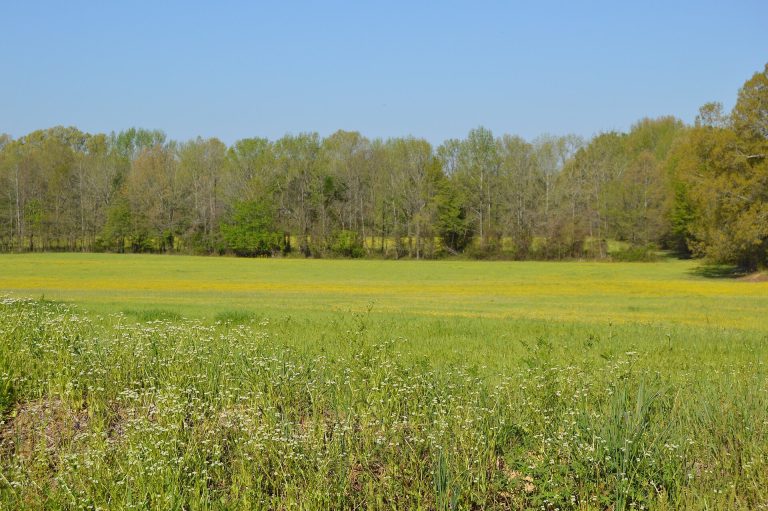
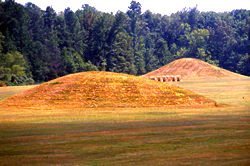
The site lies near Tupelo, in parts of Itawamba and Prentiss counties, at the headwaters of the Tombigbee River. Its rugged, hilly surroundings include broad, swampy streams. Eight dome-shaped burial mounds of varying sizes occupy 90 acres on Pharr Flats, a gently rolling terrace overlooking the confluence of Little Brown and Mackeys creeks. Plowing and cultivation have nearly flattened several of the mounds.
Excavations of four mounds revealed fire pits and low clay platforms at their bases, as well as human remains, some cremated, and ceremonial objects. Finds include copper ear-spools, ornaments worn at the ears, and a greenstone platform pipe, which has a flat, platform-like base. The materials represented include Great Lakes copper, greenstone, a green-colored rock, galena, a lead sulfide mineral, and mica.