Coronado State Monument: The Kuaua Pueblo Archaeological Site
Site at a Glance
- Popularity
- Medium
- Country
- United States
- Primary era
- Medieval
- Eras represented
- Medieval, Early Modern, Modern
- Civilizations
- Unclassified
- Site type
- City
On this page8 sections
History
Coronado State Monument, near Bernalillo in New Mexico, United States, preserves the remains of Kuaua, a Tiwa-speaking Pueblo settlement established around 1325. Kuaua means “evergreen” in Tiwa, a Pueblo language. Its Indigenous community was part of the Pueblo peoples of the American Southwest, and the settlement was the northernmost of 12 Tiwa villages. It remained occupied for about three centuries.
Kuaua and the Spanish expedition
Francisco Vásquez de Coronado’s expedition camped in the area between 1540 and 1542 while searching for gold. The monument bears Coronado’s name, but Kuaua was already inhabited when the Spanish expedition arrived. The settlement was almost certainly abandoned as a consequence of the arrival and the aftermath of the Tiguex War, a conflict between Coronado’s expedition and Pueblo communities in the region, which took place in February 1541. Conflicts with Spanish colonists and Navajo communities also reduced Kuaua’s population during the sixteenth century. The village was abandoned toward the end of that century.
Excavation and monument status
Excavations at Kuaua took place from 1934 to 1939 under a team led by archaeologists Edgar Lee Hewett and Marjorie F. Tichy, later Lambert. In 1935, Gordon Vivian and Tichy found the remains of a painted ceremonial room.
The monument was dedicated on May 29, 1940, during the four-hundredth-anniversary commemoration of Coronado’s entry into New Mexico. It was the first state archaeological site in New Mexico to open to the public. The site received New Mexico Historic Site designation in 1935 and State Monument protection in 1940. It joined the New Mexico State Register of Cultural Properties in 1971 and the National Register of Historic Places, the federal register of historic properties, in 1976. It is part of the state-governed Museum of New Mexico system.
Remains
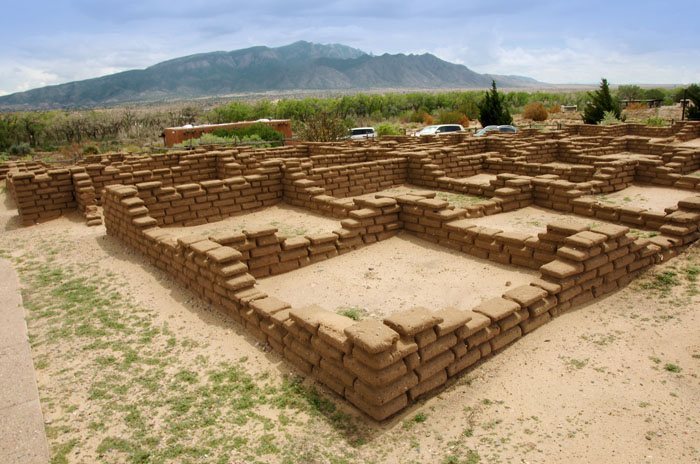
The 5.7-acre site lies beside the Rio Grande, near Bernalillo. Its excavated remains show that the settlement developed from south to north. An interpretive trail passes through the ruins and along the river’s west bank.
Village layout and ceremonial rooms
Pueblo remains
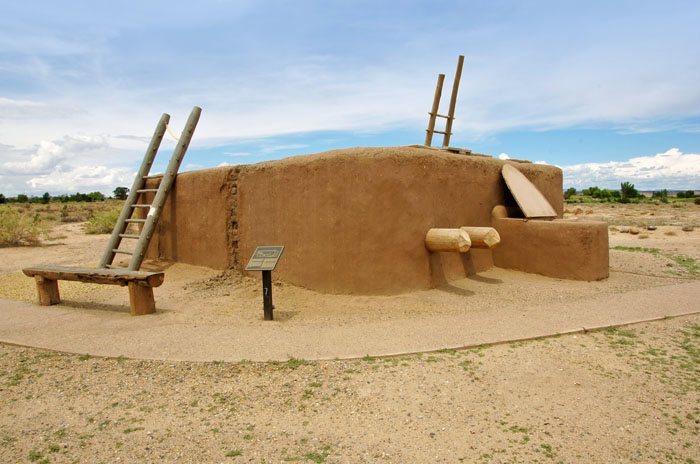
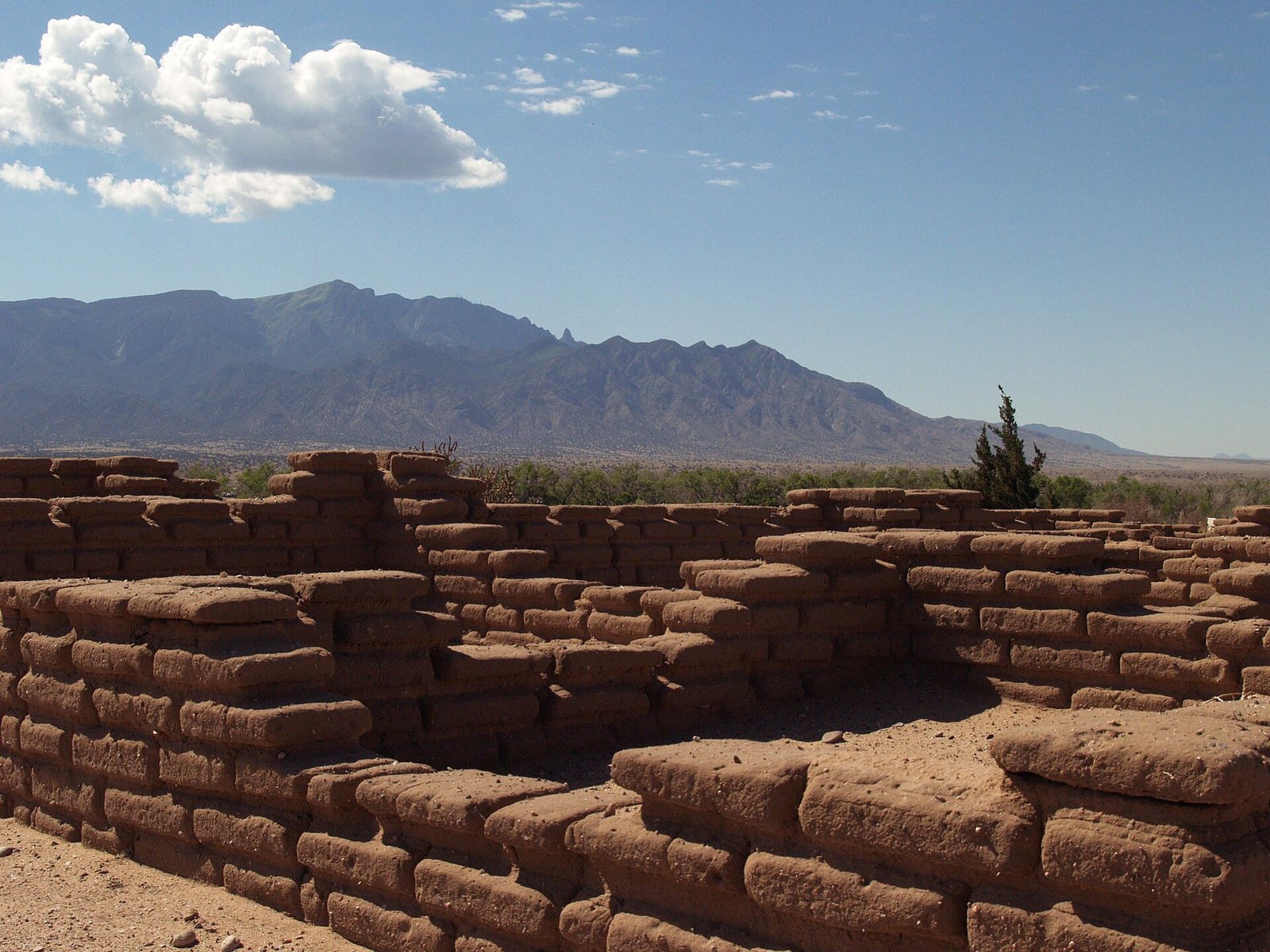
Most visible building remains are reconstructed foundation walls. Two small buildings made of adobe, or sun-dried earthen brick, were also built in a sixteenth-century style.
Kivas and wall paintings
Excavation revealed six kivas, ceremonial rooms in Pueblo communities, with round, square, and rectangular plans. A square kiva in the pueblo’s south plaza contained extensive wall paintings dating to before 1541. They are regarded as among the finest examples of pre-contact Native American art in North America. The original kiva was largely destroyed during efforts to stabilize its paintings. In 1938, a replacement was built on its foundations, with faithful mural reproductions on its interior walls by Native American artist Velino Shije Herrera. Fourteen restored murals are displayed in the visitor center.
Visitor center
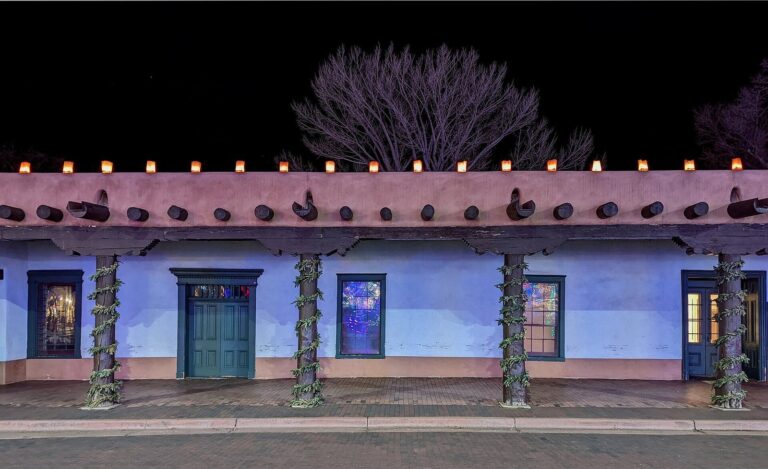
Built in 1939, the visitor center was designed by John Gaw Meem in the Pueblo style, which draws on Pueblo building traditions. It displays the restored murals along with Pueblo and Spanish Colonial artifacts.