St. Maria (Großhaslach): An Evangelical-Lutheran Parish Church
Site at a Glance
- Popularity
- Very Low
- Country
- Germany
- Primary era
- Early Modern
- Eras represented
- Medieval, Early Modern, Modern
- Civilizations
- German, Holy Roman Empire, Kingdom of Bavaria
- Site type
- Religious
- Remains
- Church
On this page12 sections
History
Origins and medieval church
St. Maria is an Evangelical-Lutheran parish church in Großhaslach, Germany. Named for Mary, the mother of Jesus, it belongs to the Evangelical-Lutheran Deanery of Ansbach, a regional church district. Local tradition credits Benedictine monks, members of a monastic order following the Rule of St. Benedict, with founding the earliest church here in the eighth century. The monks came from St. Gumbertus Monastery in Ansbach. Tradition places the church on a hill spur previously used for pagan sacrifice, but its original dedication is unknown.
A Romanesque fortified church, in a medieval architectural style, was built here in the 12th or 13th century. Toward the end of the 15th century, a late-Gothic church replaced the earlier building on the same site. Late Gothic is a later medieval architectural style. The church was consecrated in 1497.
Reformation and parish connections
The Reformation, a 16th-century movement that led to Protestant churches including Lutheran churches, was introduced at St. Maria around 1530. The parish’s relationship with nearby churches changed over the following centuries. St. Kunigund in Reuth, once directly affiliated with St. Maria, became a subordinate branch church in 1453 and separated from the parish in 1473. St. Laurentius in Vestenberg separated in 1578. St. Matthäus in Markttriebendorf remained a branch church until the 17th century, when it became a branch of St. Johannes in Bürglein.
St. Martin in Bruckberg became a branch church in 1935, after its community had belonged directly to St. Maria’s parish. In 1981, its parish area was reassigned to St. Martin in Kleinhaslach. During the Reformation, St. Martin in Kleinhaslach and the settlements of Kehlmünz and Kleinhaslach had been transferred to St. Andreas in Dietenhofen.
St. Maria’s parish served Bonnhof at least until 1144 and Gottmannsdorf until the 13th century. Its other associated settlements included Großhaslach, Höfstetten, Ketteldorf, Neuhöflein, Steinbach, and Wustendorf. St. Kunigund’s former parish area included Aich, Mausendorf, Moosbach, Neuses b. W., Reuth, Triebendorf, Watzendorf, and Wollersdorf. St. Laurentius served Adelmannssitz, Frohnhof, and Vestenberg, while St. Martin in Bruckberg served Bruckberg, Reckersdorf, and Neubruck.
The church from 1783
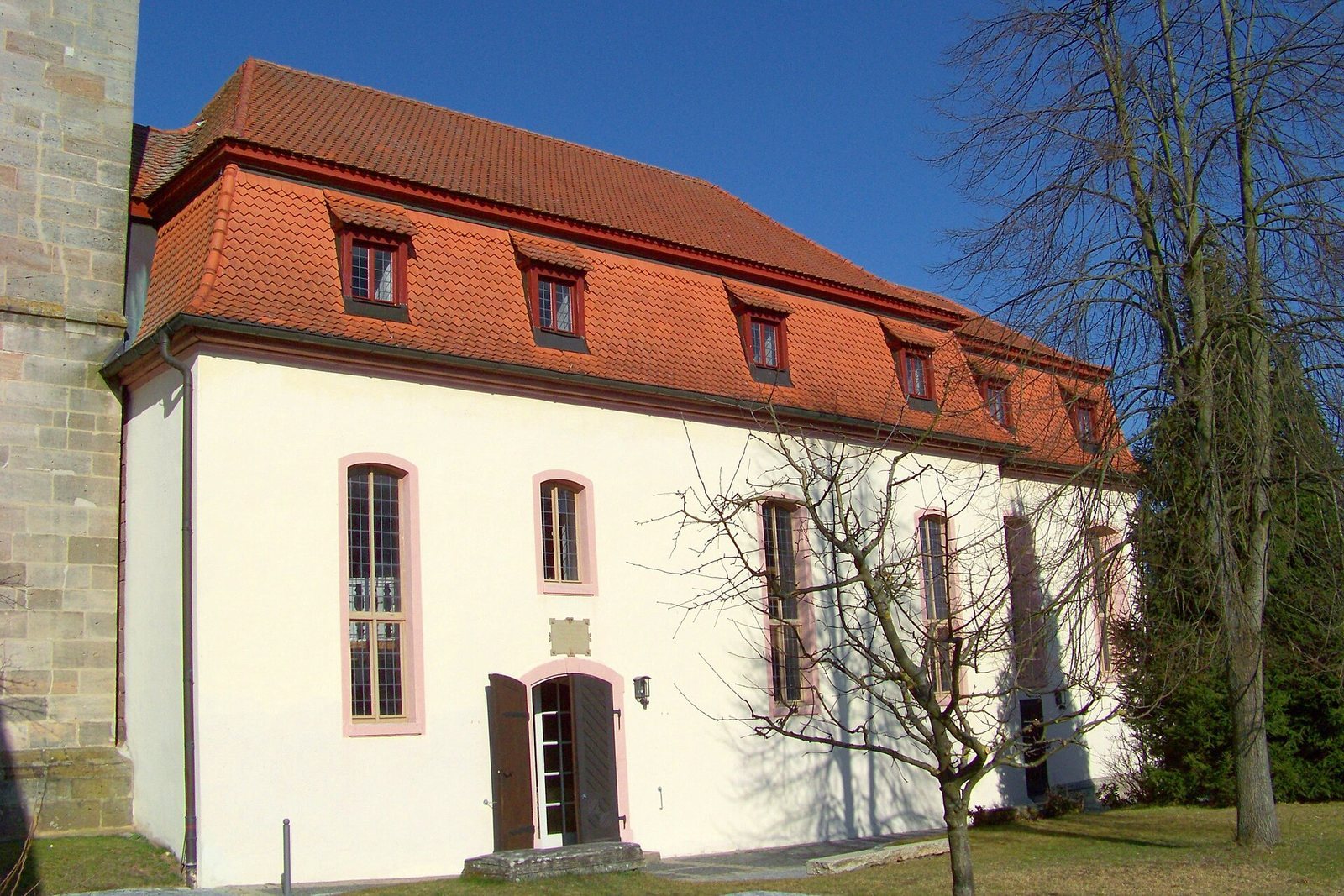
A new hall-style church, with a broad unified worship space, was built in 1783 to a design by Johann David Steingruber, court architect to the margraves of Ansbach, territorial rulers. Großhaslach is also a station on the Middle Franconian Way of St. James, part of a network of Christian pilgrimage routes associated with the shrine of St. James at Santiago de Compostela. This route runs from Krakow through Prague to Nuremberg, then continues through Roßtal, Heilsbronn, Großhaslach, Weihenzell, and Häslabronn to Rothenburg ob der Tauber.
Remains
The church complex combines remains of its medieval fortified enclosure with a late 18th-century hall church. The church has a tower at its west end and a recessed chancel, the sanctuary area, at the east. The medieval enclosure also includes an ossuary, a building for storing human bones.
Medieval churchyard fabric
Fortified enclosure and baptismal font
Fragments of the fortified church’s defensive wall and a Romanesque baptismal font survive from the medieval church. The font is now in the baptismal chapel. Part of the cemetery’s high wall, built from cut stone blocks, also survives. It originally enclosed the church and parsonage, and later buildings were constructed against it. On the east side, a tall round-arched gateway has a brick canopy and traces of Gothic moulding on its outer face. A smaller pointed-arch doorway to its north has been blocked. Beside the ossuary on the west side, a large relief stone bears an apostle cross, a cross motif associated with the apostles and used in church decoration.
Ossuary
Built around 1500 in the late-Gothic style, the ossuary uses cut stone and rubble stone. Its south and east walls have moulded entrances with ogee arches, shaped with an S-like curve. A tall rectangular window on the east side has beveled inner edges. The gabled roof was added later.
The 1783 parish church
Hall and chancel
The church hall is arranged along four window axes. The south side has two, while the north side has three tiers of windows with shallow-curved tops. Three rectangular doorways provide entrances, two on the south side and one on the north. A mansard roof, with a steeper lower slope and a flatter upper slope, carries dormers with shallow-curved tops.
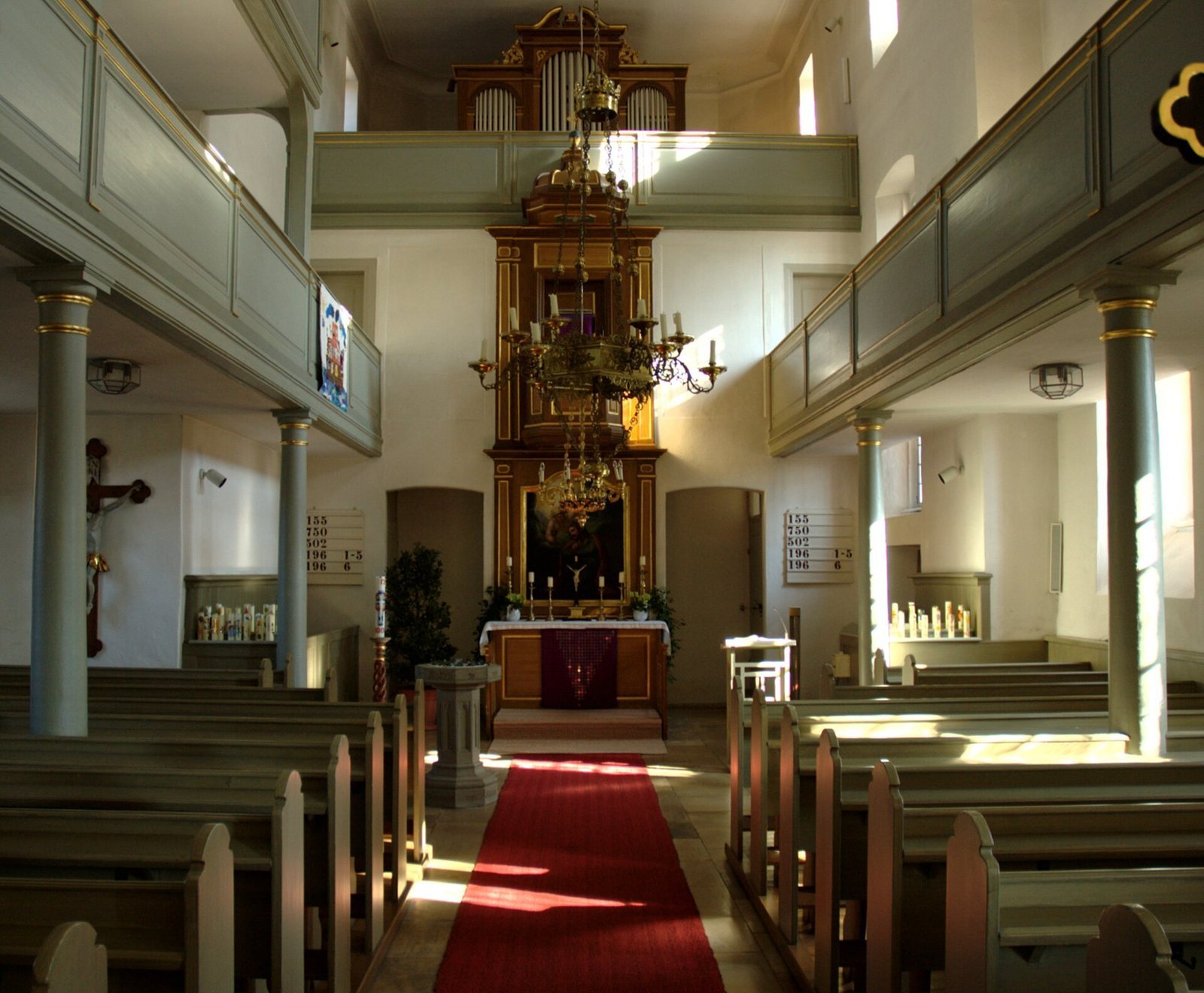
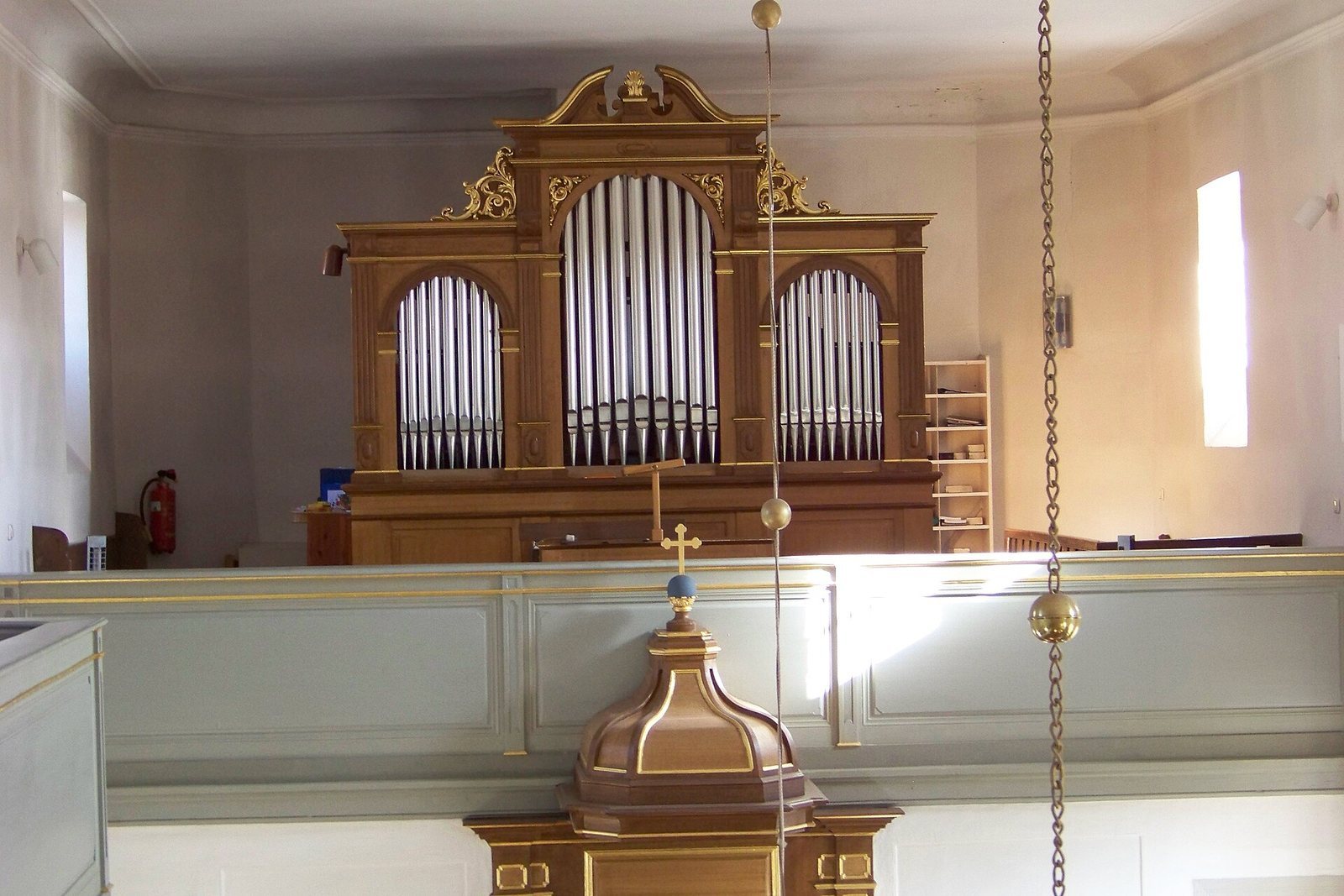
The recessed chancel at the east end has two window axes and terminates in three sides of an eight-sided shape. It stands on the base of an older chancel. The eastern part now serves as a sacristy, a room used in preparing for church services. A boarded partition screens it off, with a pulpit altar, combining pulpit and altar, and an organ gallery above.
West tower
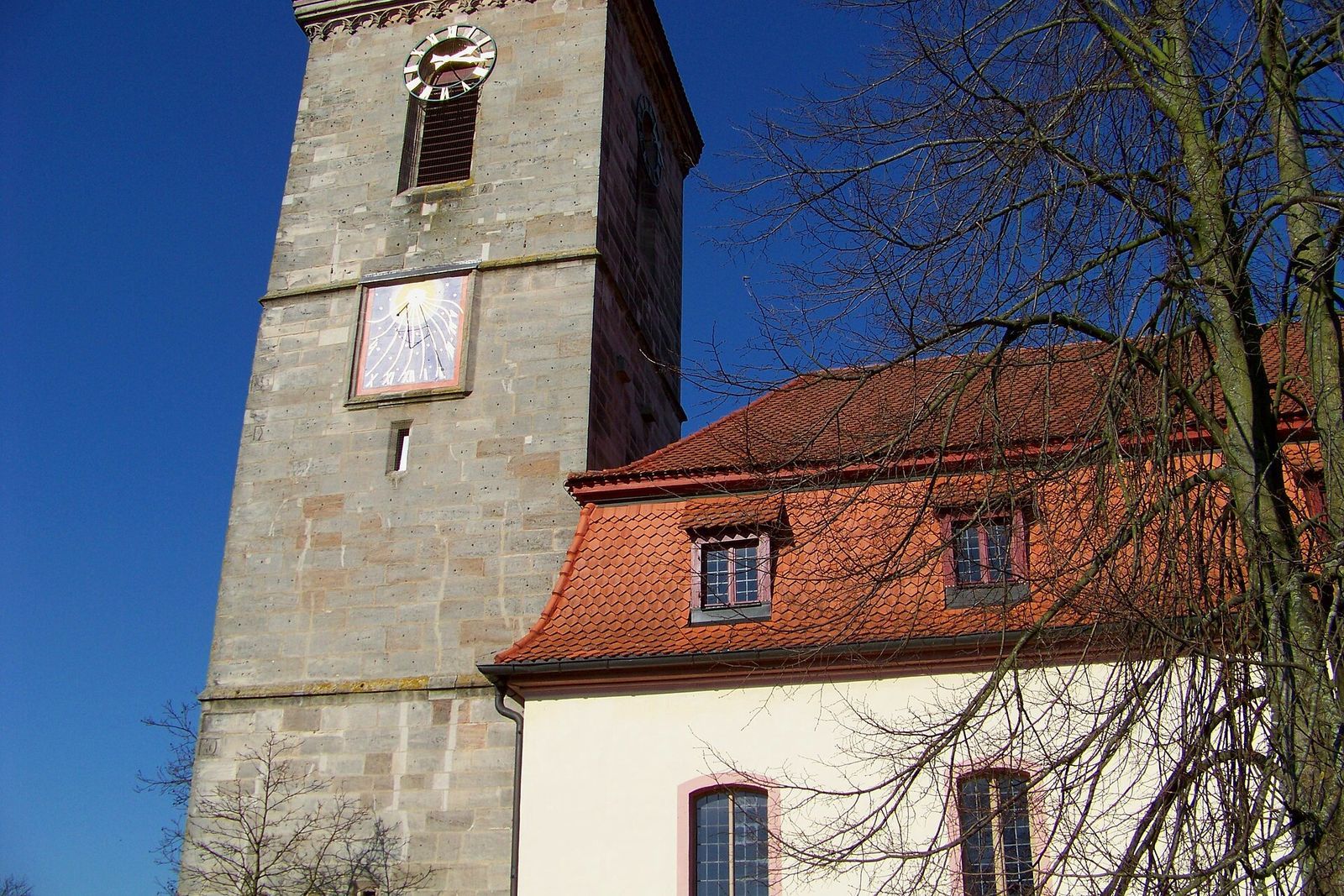
The three-storey tower adjoins the church hall on the west and connects to it through a pointed-arch doorway. Its four-sided cap is sheet metal. Rectangular windows with beveled inner edges occupy the lower storeys; the upper storey has pointed-arch openings for sound and a decorative band of three-lobed shapes below the projecting roofline.
On the tower’s south side, above a projecting horizontal rain ledge, a coat of arms appears beside an inscribed plaque dated 1497; the inscription is illegible. The first upper storey also bears a diamond-shaped relief and carvings of a chalice and jug. A sundial sits in a moulded rectangular frame below the second rain ledge.
Interior and organ
The hall has a flat ceiling and two-storey wooden galleries with a marbled finish. Plain, unfluted Tuscan columns support the galleries. Johannes Strebel built the organ in 1890. It has 11 stops, one keyboard, and a pedalboard.