Tønder Kristkirke: A Lutheran Church in Denmark
Site at a Glance
- Popularity
- Low
- Country
- Denmark
- Primary era
- Early Modern
- Eras represented
- Medieval, Early Modern
- Civilizations
- Danish
- Site type
- Religious
- Remains
- Church
On this page16 sections
History
Medieval predecessors
Tønder Kristkirke, or Christ Church, is a Lutheran church in Tønder, Denmark, within Tønder Parish and the Diocese of Ribe, the regional church district. Medieval Tønder had a church dedicated to St. Nicholas on this site, as well as a separate St. Lawrence’s Church, estimated to date from around 1200, and a Franciscan monastery church. The St. Nicholas church was built around 1350. By 1591 it had become dilapidated and too cramped, so it was demolished to make way for a new building.
Reformation and rebuilding
Construction of the new church began on 30 April 1591. It was completed on 25 July 1592 and consecrated on 4 October. The church was intended from its foundation for Protestant worship, in keeping with the Reformation, the 16th-century movement that reshaped Western Christianity. Its name, Christ Church, reflected the changed religious setting after the cult of saints had ended. The building combines medieval town-church planning and Gothic forms, a medieval European style, with construction undertaken when Renaissance architecture, a later European style, was already dominant in the region. It is among the few Gothic churches designed from the outset for evangelical services.
The prosperity of Tønder’s merchants helped provide the church’s rich furnishings. Their trade included grain, cattle, and lace.
Pastors and restoration
Hans Adolph Brorson served as pastor from 1729 to 1735. He later became a bishop and one of Scandinavia’s leading hymn writers. A restoration in 1894 sought to return the church’s arrangement to the state before the singers’ gallery was installed.
Remains
Plan and tower
Nave, choir, and brickwork
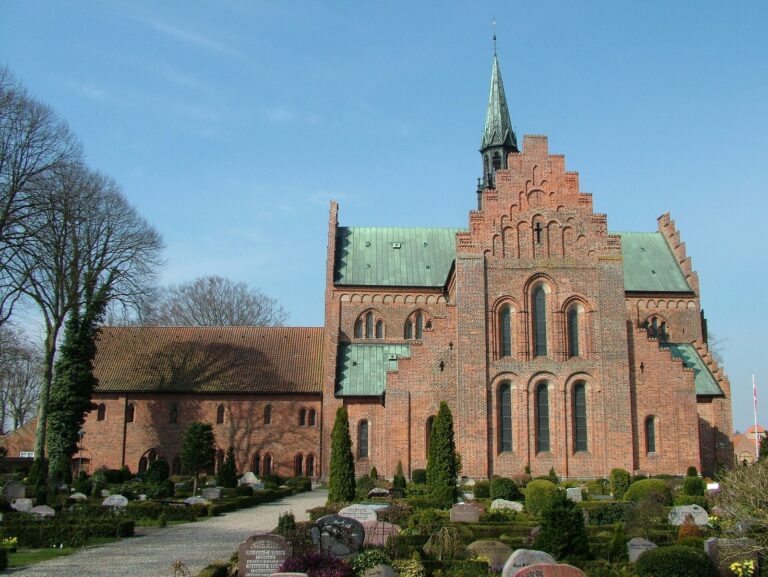
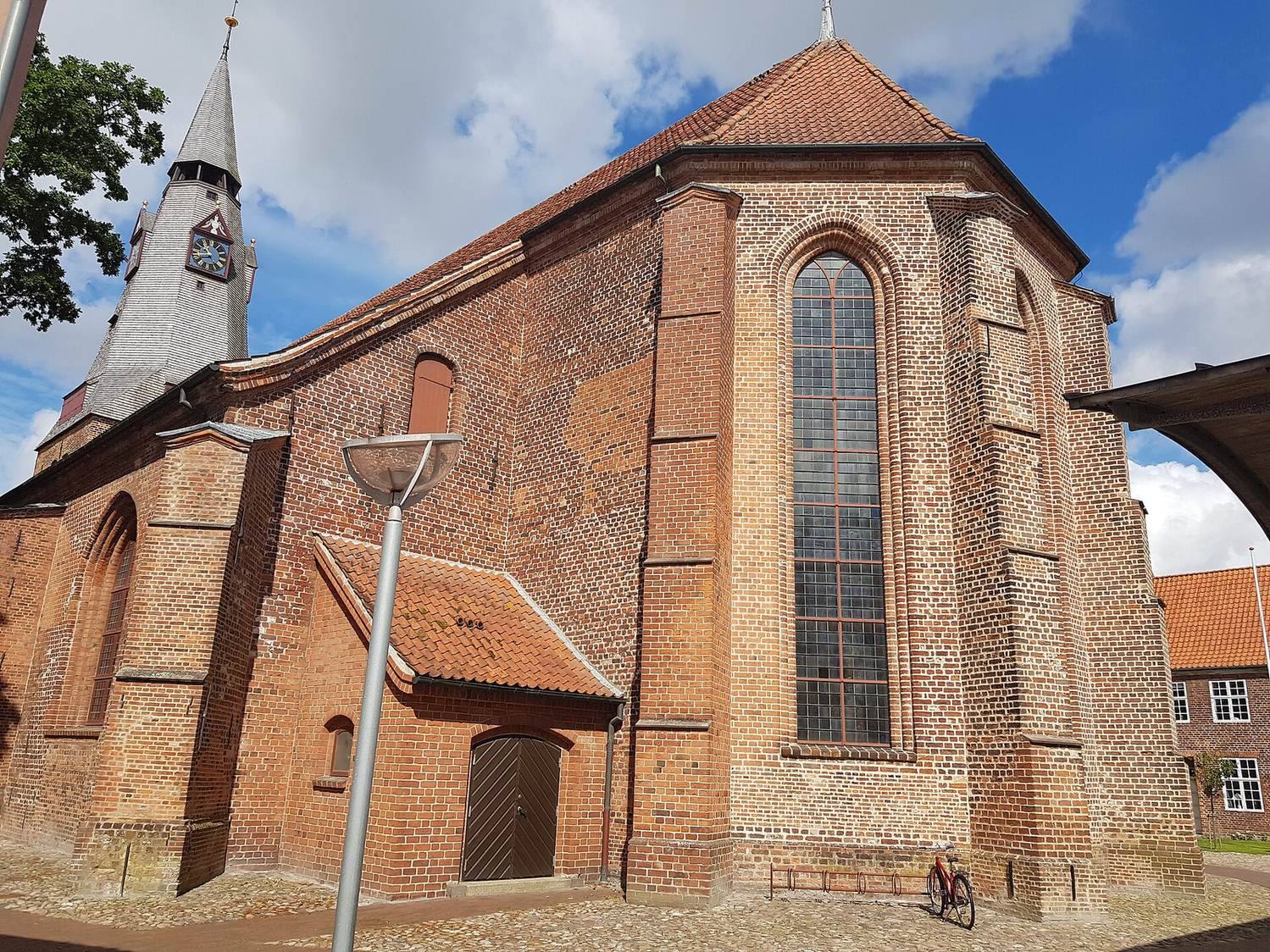
The church has an east-facing choir at the same height as the central nave. The nave is higher and wider than the side aisles, which are separated from it by arcades, or rows of arches. The nave and choir are built of monastery-format brick, a traditional large brick size, laid in cross bond, an interlocking pattern of brick courses. Pointed-arch windows, buttresses (projecting wall supports), and the roof retain Gothic forms. The crosswise arches and vaulted ceilings rise less steeply than in Gothic examples.
Tower
The 48-metre-high tower is the oldest part of the church and the only surviving remnant of the St. Nicholas church. It was attached to that earlier building around 1520 and was incorporated into Kristkirke with little alteration. The tower dominates Tønder’s townscape and can be seen from the North Sea. It formerly served as a beacon for sailors.
Historic furnishings
Dedicatory plaque
A plaque dated 1593 remains in the left side aisle. Installed by Andreas Thomäus, the chief pastor and provost, it records the substantial contribution made by Johann Adolph of Bremen toward the church’s construction. Johann Adolph was Duke of Schleswig-Holstein-Gottorf and elected Archbishop of Bremen, holding secular and ecclesiastical offices.
Singers’ gallery and altarpiece
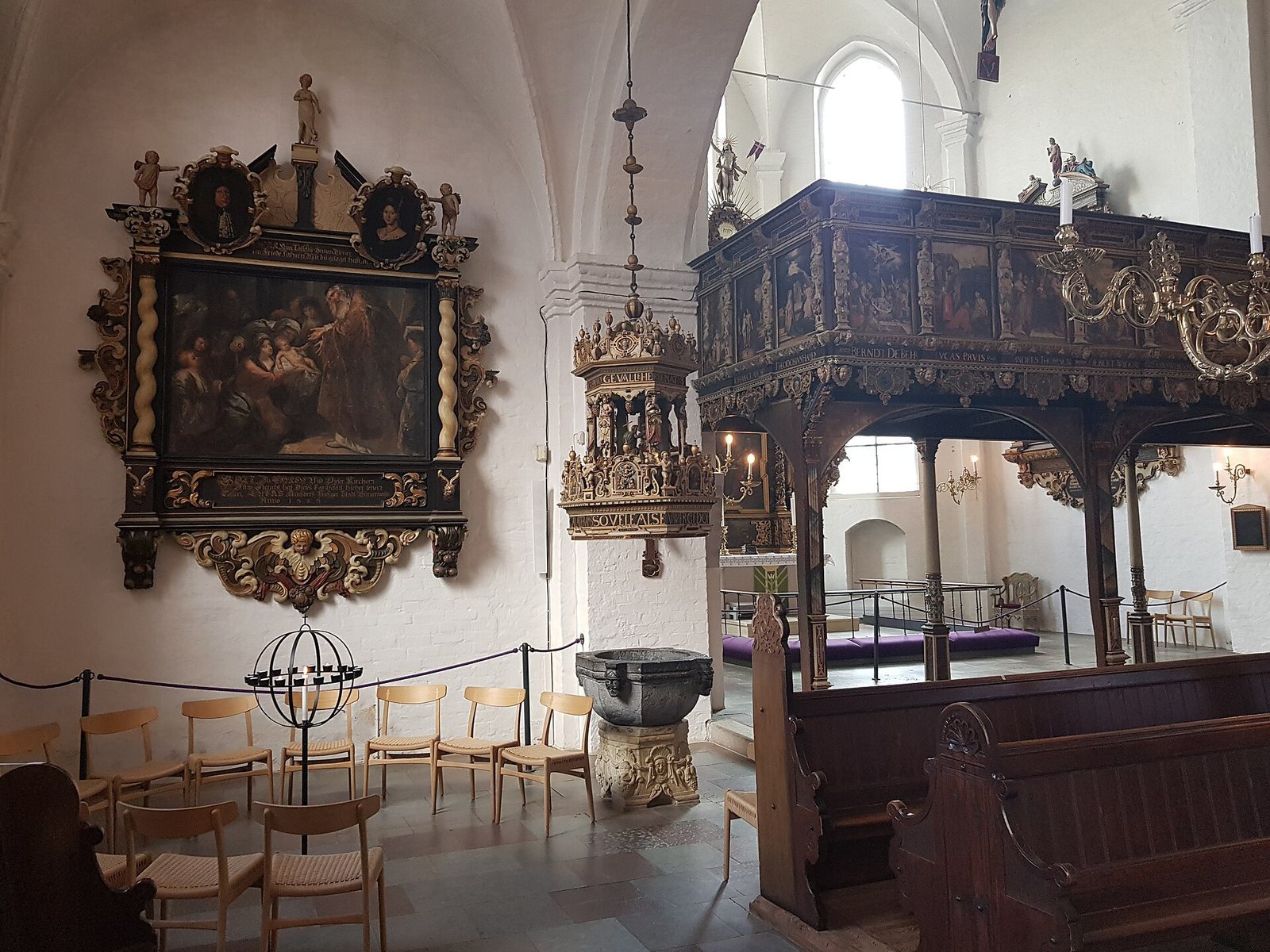
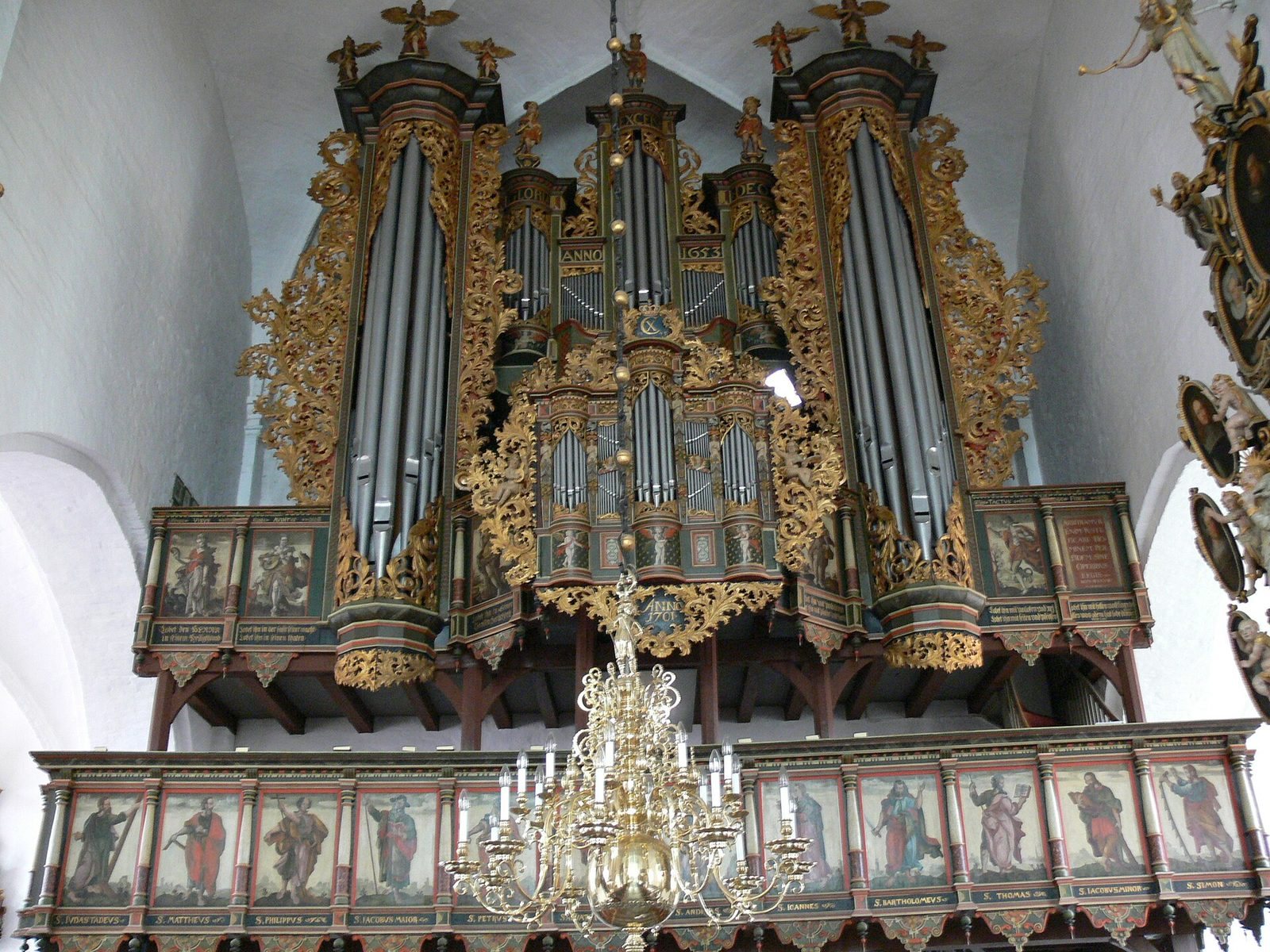
The singers’ gallery, built in 1623 by Peter Petersen, gives the impression of a choir screen, a partition separating the choir from the main body of a church. Hans Schmidt decorated it with biblical paintings. Its front panels show biblical scenes, while the reverse bears female figures representing virtues and the seasons.
Behind the gallery stands a large Baroque altarpiece, a later European artistic style, dating from 1695. The clerk Friederich Jürgensen and his wife donated it, probably in memory of their deceased daughter. A Last Supper painting fills the center; above it is a portrait of their daughter beneath the donors’ coats of arms. Most of the Baroque carving survives, including twisted columns, figures of the Evangelists, angels, decorative child figures known as putti, and carved leaf ornament. The carving is probably from Peter Petersen’s workshop.
Pulpit and crosses
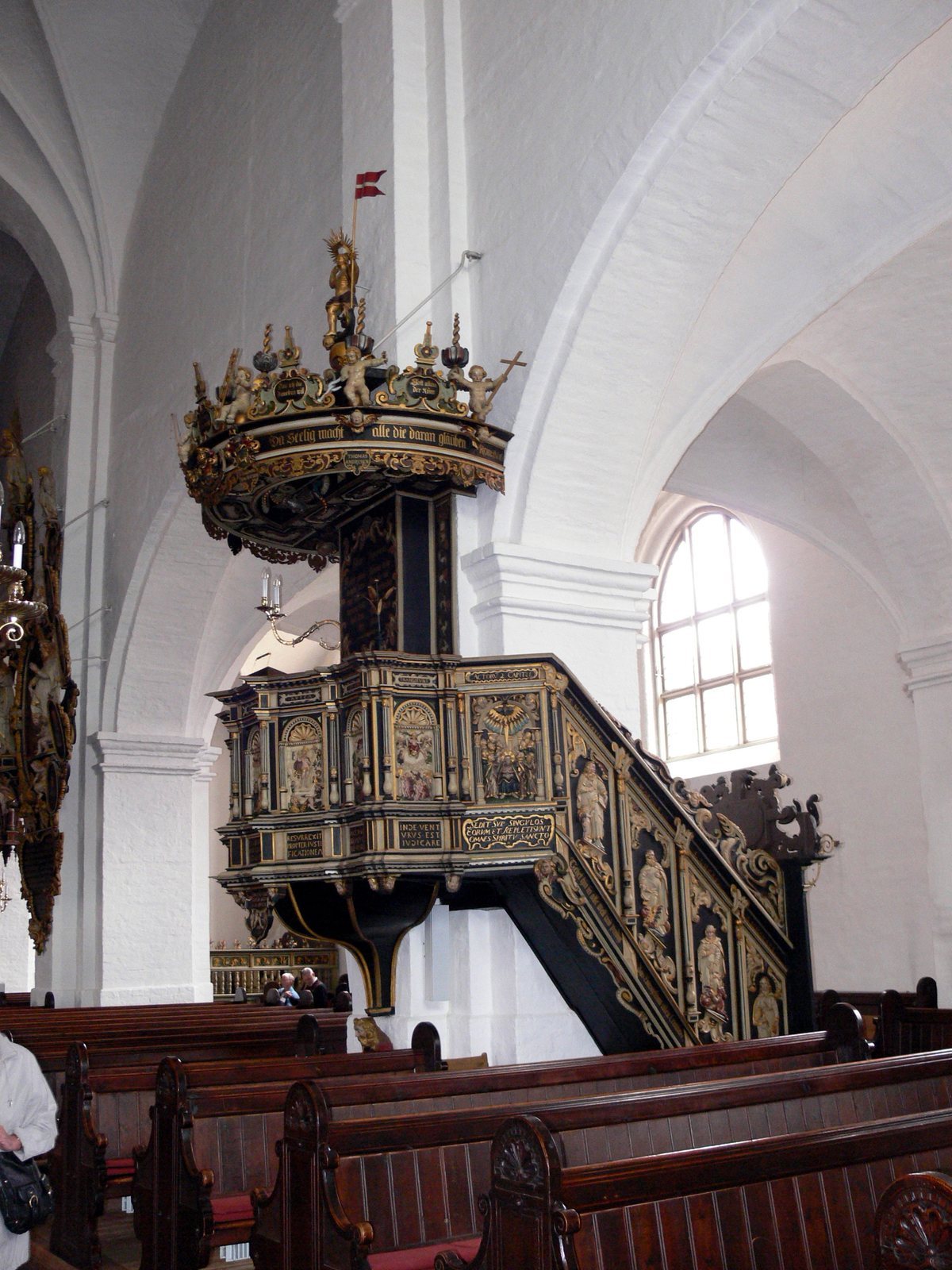
The pulpit was made in 1586 for the former St. Nicholas church and later transferred to Kristkirke. A figure of Moses supports it. Six reliefs depict episodes from the life of Jesus: the Annunciation, Nativity, Baptism, Crucifixion, Ascension, and Last Judgment. A seventh, showing the Fall of Man, was added after the pulpit’s transfer. Its sounding board and staircase date from 1663.
Three crosses from St. Nicholas church are now in Kristkirke. A large Gothic crucifix dates from around 1350. A processional cross from the first half of the 15th century is above the sacristy entrance, and a cross from the early 16th century is above the baptismal font.
Font, pews, and chandeliers
The font has an octagonal basin of black marble from Namur, decorated with four male heads and believed to date from around 1350. Its lower section is sandstone; that part and the Renaissance cover probably date from 1619. Many pews were replaced in 1894, though a few from 1592 remain.
The oldest chandelier is a Renaissance work from 1592 in the tower room. Four Baroque chandeliers in the nave date from 1622, 1650, 1651, and 1654. Their decorations respectively include a bear, an angel, a warrior, and a ship.
Memorials and organ
Tomb monuments
Tomb monuments to mayors and other prominent citizens include fourteen epitaphs, or memorial monuments, dating from the late 16th to the late 17th century. Their styles trace a development from the Renaissance to the late Baroque. The oldest commemorates Mayor Carsten Andersen, who died in 1578; the latest dates from 1695.
Organ
Th. Frobenius & Co. built the organ in 1945, using a case made by Johan Heide in the 18th century. The instrument has a slider-chest mechanism, in which sliding boards control which groups of pipes sound. It has 37 stops, three manuals (keyboards played by hand), and a pedal played by foot.