Magdalenenberg: A Hallstatt-Period Burial Mound in Germany
Site at a Glance
- Popularity
- Medium
- Country
- Germany
- Primary era
- Iron Age
- Eras represented
- Iron Age, Modern
- Civilizations
- Hallstatt culture
- Site type
- Burial
- Remains
- Burial Mound
On this page10 sections
History
Magdalenenberg is a Hallstatt-period burial mound near Villingen-Schwenningen in Baden-Württemberg, Germany, constructed around 616 BCE according to tree-ring dating of its central chamber. It belongs to the Hallstatt culture, an Early Iron Age archaeological culture of Central Europe, and is among Central Europe’s largest burial mounds of this period. The central grave held the burial of a person identified as an early Celtic prince.
The Hallstatt-period cemetery
In the decades after the central burial, 126 more burials were placed in and around the mound. They belong to the Hallstatt period’s Ha D1 phase. Use of the cemetery had probably ended by the time the central grave was plundered, around 500 BCE. Wooden spades and damage to grave goods point to the robbery. A fortified settlement at Kapf, a hill spur where the Kirnach and Brigach rivers meet, has been proposed as the cemetery’s associated settlement, but the connection remains uncertain.
Medieval memory and early investigations
The mound remained a local landmark in the Middle Ages and early modern period, though its original purpose as a burial place had been forgotten. A Salem estate register dated 1320 names it Kreuzbühl; that entry is known through a copy made in 1465. A 1610 map shows a cross associated with Mary Magdalene on the mound, while a 1704 siege sketch depicts a Lorraine cross at the same spot. During Villingen’s seventeenth-century witch trials, women confessed under torture to dancing with the devil there. One confession, from 1633, gave the devil’s name as Cäsperlin.
In 1887, former Villingen magistrate Heinrich Könige brought the mound to the attention of Ernst Wagner, director of Karlsruhe’s Grand Ducal Antiquities Hall. Wagner’s test trench convinced him that the mound was artificial. In 1890, forester Hubert Ganter excavated down from the summit toward the central grave in search of treasure, but the earlier robbery had left few finds. From 1970 to 1973, archaeologist Konrad Spindler led a German Research Foundation project, funded by Germany’s scientific research organization, that excavated the mound and its immediate surroundings. The work examined the later burials and recovered evidence of the plundered central chamber.
Recent interpretations and scientific studies
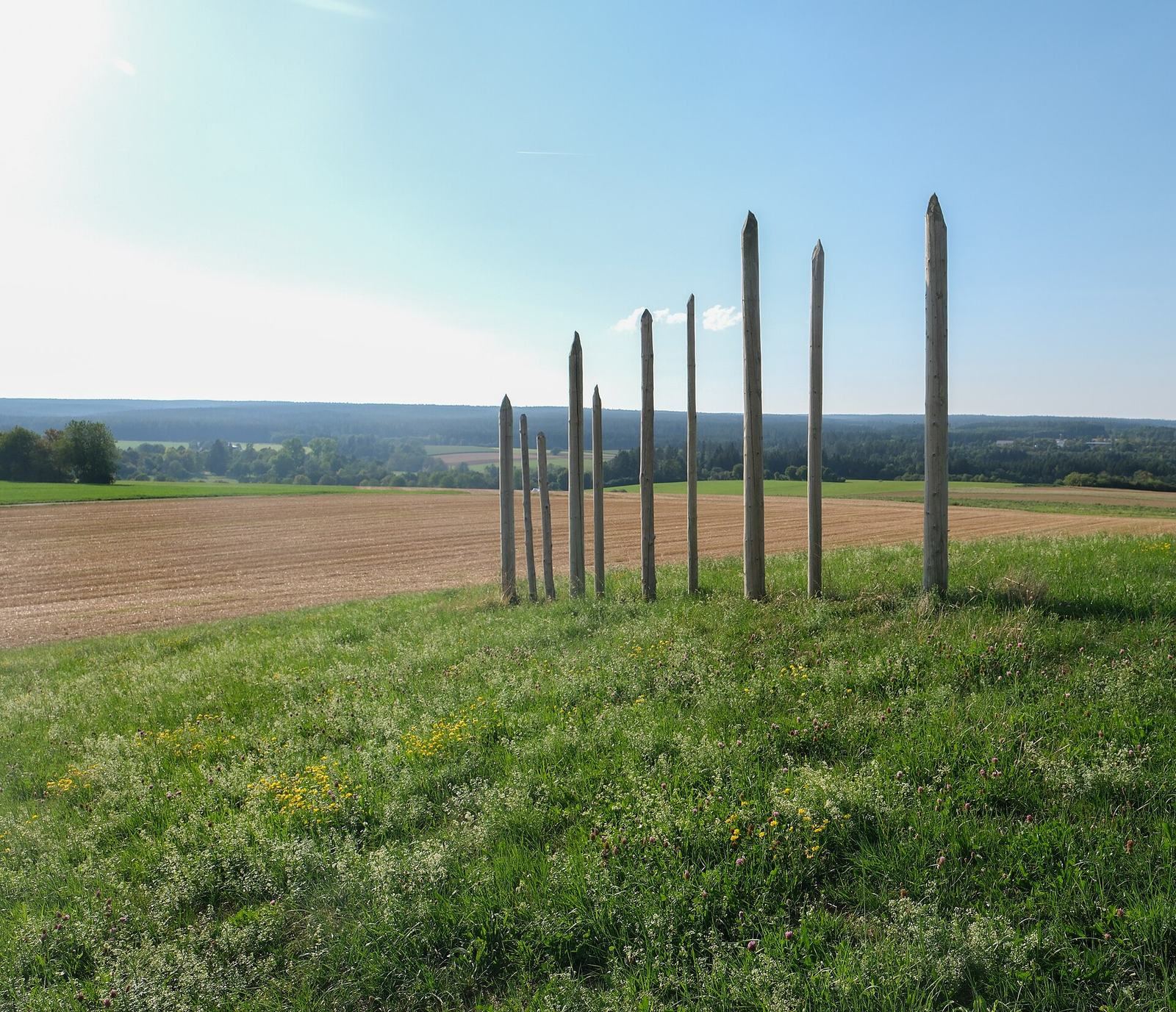
In 2011, archaeologist Allard Mees proposed that the graves were arranged in relation to the night sky and could have formed part of a lunar calendar. Using software from the US National Aeronautics and Space Administration to reconstruct the constellations between the winter and summer solstices, he argued for a date of 618 BCE, close to the tree-ring date. He interpreted the graves as aligned with northern constellations and the lunar cycle rather than the solar cycle. In his proposal, large wooden posts marked a lunar standstill, when the Moon reaches its most northerly or southerly rising and setting positions in its roughly 18.6-year cycle, and could help predict eclipses. The interpretation remains disputed: critics have challenged its evidence, source criticism, and methods, while other scholars have welcomed the approach.
A 2024 ancient-DNA study analyzed genome-wide data from 17 people buried at Magdalenenberg, among 31 individuals sampled from Hallstatt-period burials in southern Germany. The ancestry profiles were mainly associated with components widespread in present-day France, with Italian affinities in part of the group. Some later burials contained people linked by third-degree biological relationships, a measure of genetic closeness. Chemical isotope signatures were consistent with local origins in the Black Forest, and mobility indicators showed no significant difference between males and females. Three early burials, including the central burial, had genetic affinities with populations south of the Alps, including northern Italy, a pattern discussed in connection with transalpine contacts.
The same study found a third-degree relationship between a richly furnished woman buried at Magdalenenberg and an individual from Eberdingen-Hochdorf, as well as a more distant relationship between the central burial and another person from Hochdorf. These links have been interpreted as evidence of a wider elite network. Magdalenenberg is about a century older than the Hochdorf and Asperg elite burials considered in the study.
Remains
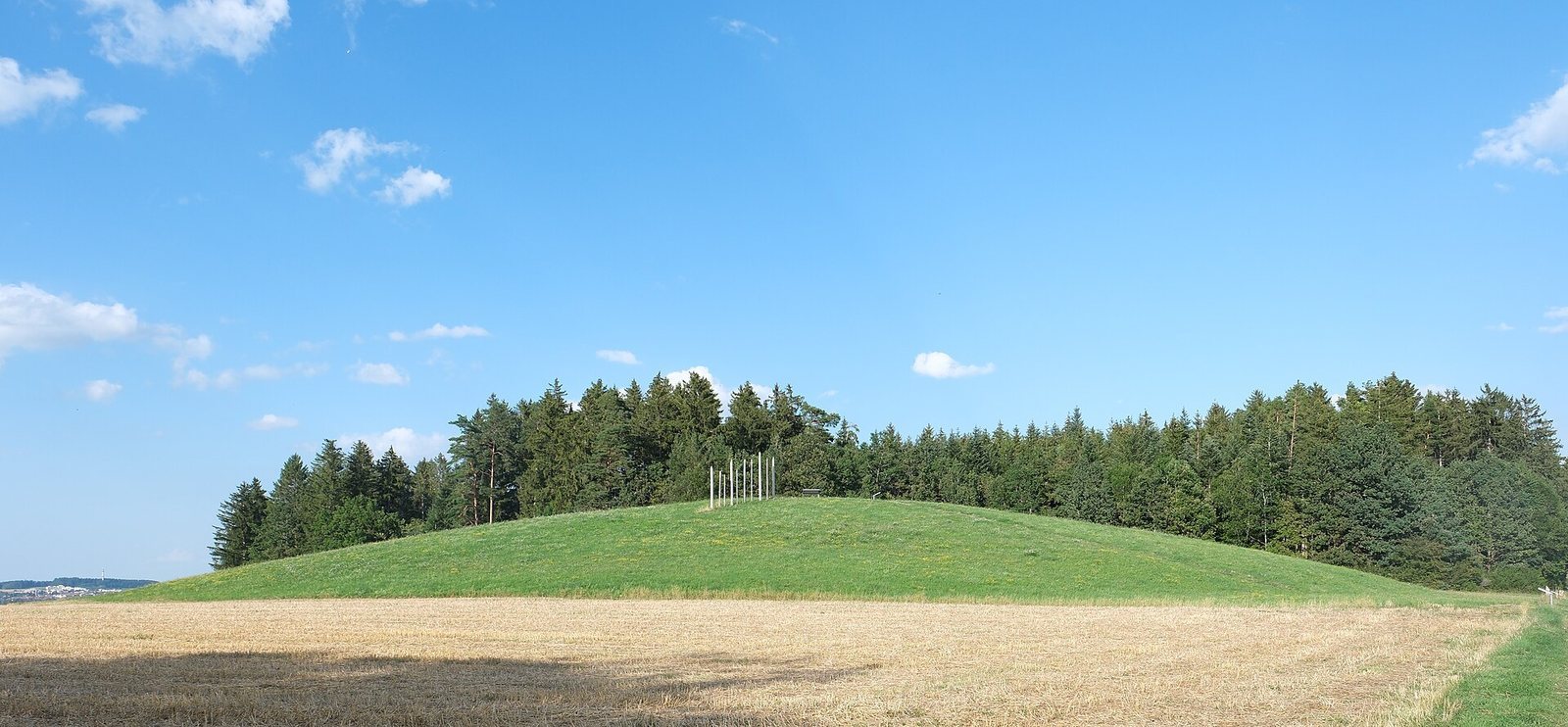
The mound stands on the eastern slope of the Black Forest, at roughly 700 metres above sea level, on the southwestern edge of the Laible woodland and about two kilometres southwest of central Villingen. It is approximately 100 metres across and has a volume of about 33,000 cubic metres. Originally around 10 to 12 metres high, it now rises about eight metres above the surrounding landscape. The central burial lay within the mound, with later graves distributed in and around it.
The central burial
Wooden chamber
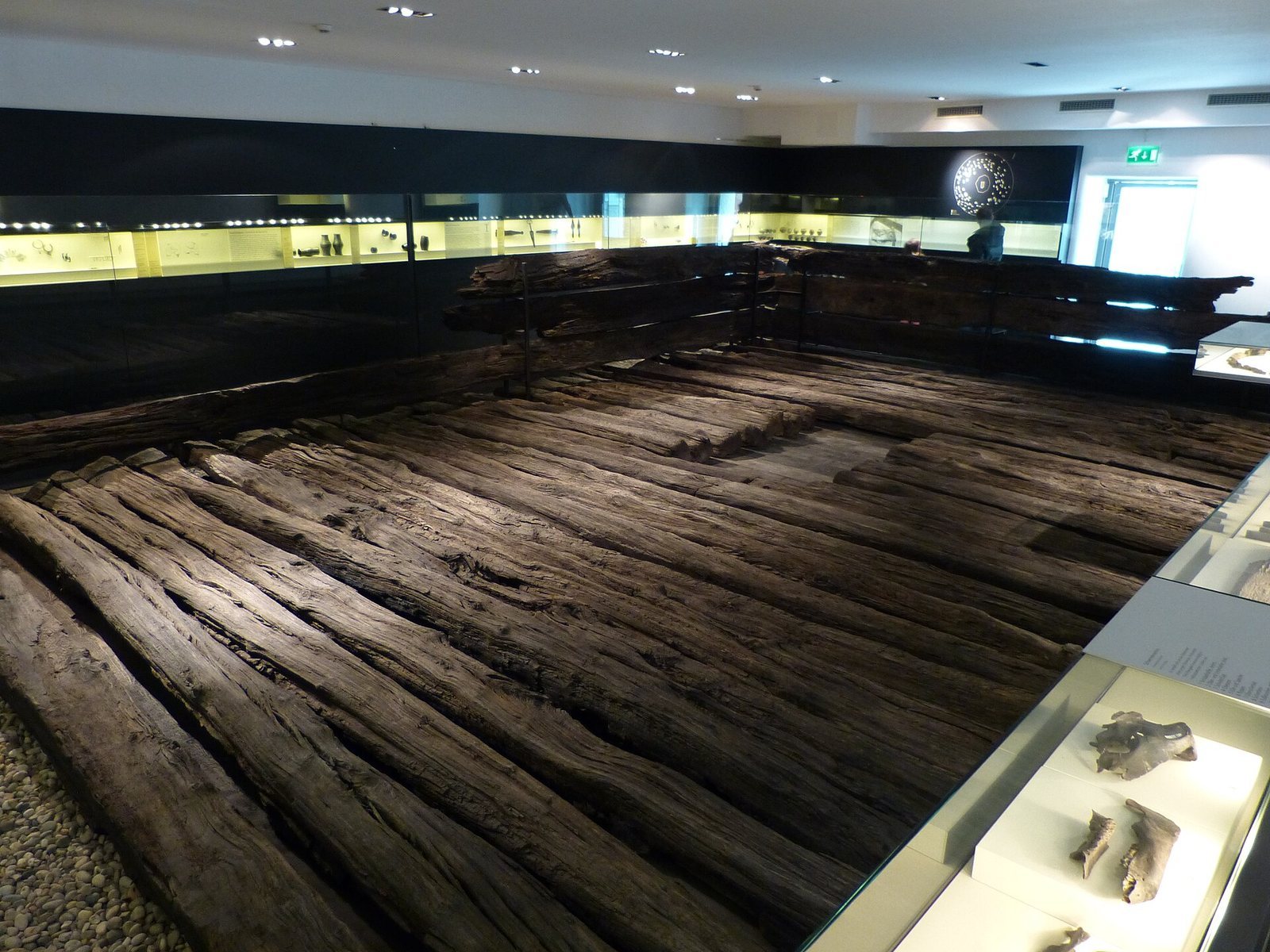
The central grave’s plank-built wooden chamber measured eight by 6.5 metres. It is described as the largest Hallstatt-period wooden find in Central Europe and is now displayed at the Franziskanermuseum in Villingen. Archaeologists documented wooden post settings associated with the mound, and some posts have been reconstructed on the summit at their recorded positions.
Grave finds
Finds from the robbed chamber included the prince’s bones, remains of a four-wheeled wagon, a horse bridle, and pig bones, including the skeleton of a young pig. Fragments that may have belonged to a bow were also recovered, though their identification is uncertain.
Later burials and grave goods
The later graves yielded jewellery such as jet and bronze-sheet bracelets, numerous fibulae (ancient brooches used to fasten clothing), and an amber necklace. Other objects included a dragon-shaped fibula from what is now Slovenia, bronze and iron antenna-hilt daggers with projections at the end of their handles, bronze daggers, spearheads, and an Iberian belt hook. Excavated objects from the site are displayed at the Franziskanermuseum.
Posts and later site features
The function of the large wooden posts found within the mound remains uncertain. In 2014, a path project added a gravel area laid out to the dimensions of the burial chamber and a hand-worked beam used as seating.