Burg Drachenfels: Medieval Castle Ruin in Königswinter, Germany
Site at a Glance
- Rating
- 4.7
- Popularity
- Low
- Country
- Germany
- Primary era
- Medieval
- External website
- Open
- Eras represented
- Medieval
- Civilizations
- Holy Roman Empire
- Site type
- Military
- Remains
- Castle
On this page11 sections
History
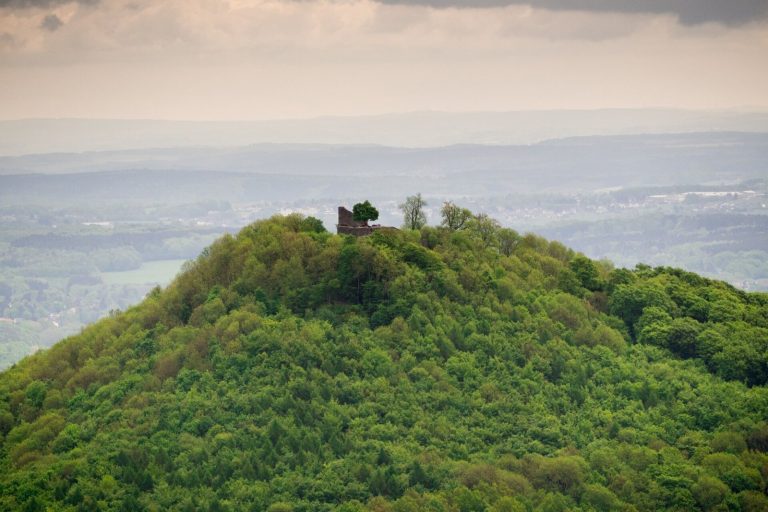
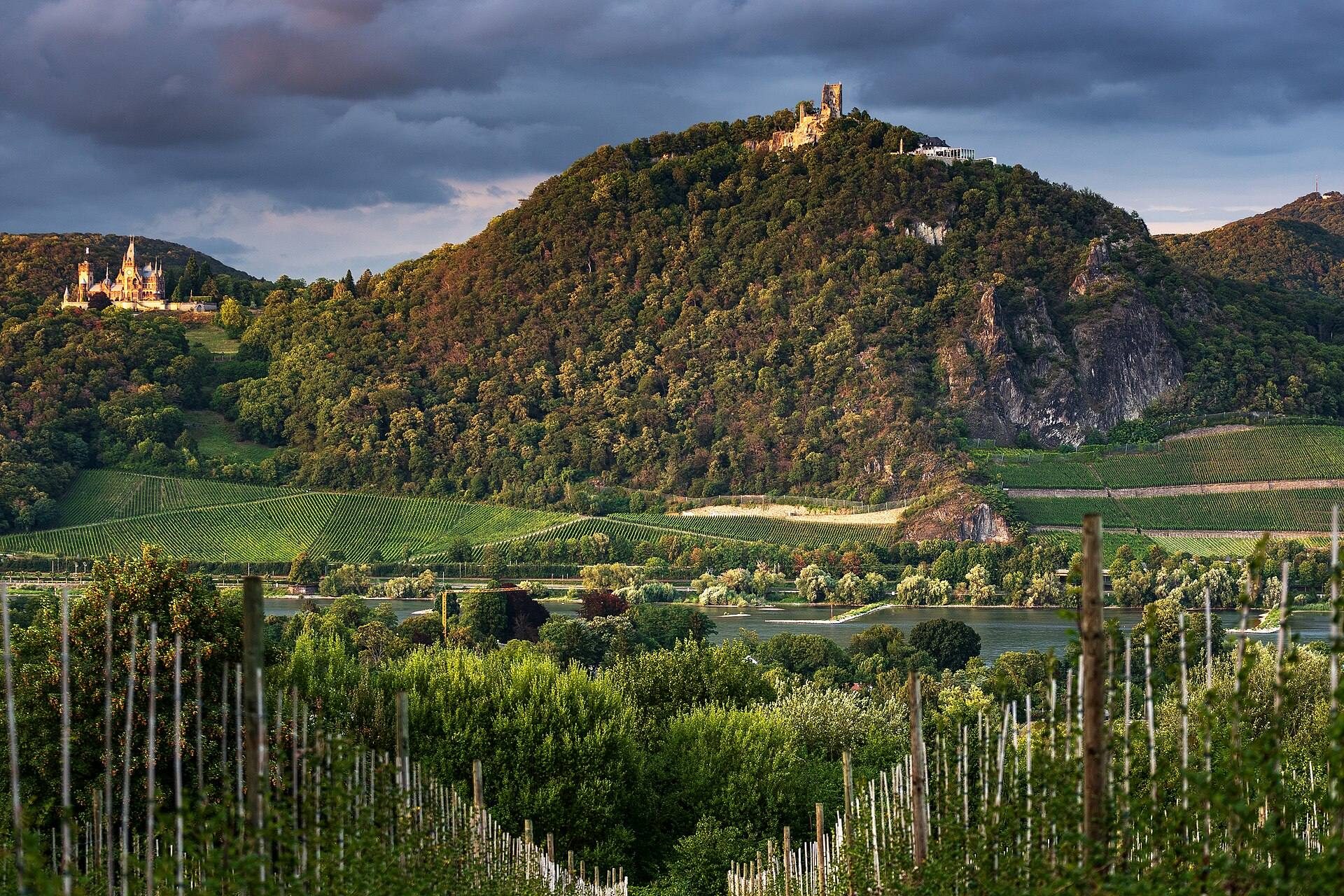
Burg Drachenfels is the ruin of a medieval hilltop castle in Königswinter, Germany, built during the territorial expansion of the Archbishops of Cologne. Construction began in 1138 under Archbishop Arnold I of Cologne and was completed in 1149 by Gerhard von Are, provost of the St. Cassius foundation in Bonn, who acquired the unfinished project. Perched on the summit of Drachenfels in the Siebengebirge, the castle helped defend Bonn and could potentially block the road through the Rhine valley.
Foundation and episcopal control
The Archbishops of Cologne were senior churchmen who also ruled extensive territories in the medieval Rhineland. Their castles served as instruments of territorial control. The archbishopric already held nearby Wolkenburg, while opposing forces used the Siebengebirge to establish Löwenburg. Drachenfels therefore formed part of a wider network of fortified positions in a politically contested landscape.
Gerhard von Are formally undertook in 1149 that each provost of St. Cassius would assist the Archbishops of Cologne with the castle in an emergency. Pope Victor IV confirmed the transfer in 1162, and Rutger von Drachenfels reaffirmed a comparable obligation in 1327. Castle administration was placed in the hands of hereditary burgraves, officials responsible for administering and defending a castle. The first recorded burgrave was Godart, son of Rudolf von Wolkenburg, in 1176.
The Drachenfels burgraves
The hereditary office remained within the Drachenfels family for centuries. The recorded succession included Heinrich von Drachenfels in 1225, Godart in 1252, Heinrich from 1280 to 1305, Rutger from 1308 to 1327, Heinrich from 1331 to 1366, Godart from 1388 to 1428, and Johann from 1432 to 1454. Later holders included Godart and Olbrück in 1455, Heinrich and Olbrück from 1457 to 1468, Claus and Olbrück from 1468 to 1493, Johann in 1508, and Heinrich and Olbrück from 1526 to 1530. The main line ended with Heinrich’s death in 1530.
The family gained substantial wealth from the trachyte quarries on the mountain. Trachyte is a volcanic building stone, and stone from Drachenfels was supplied widely for medieval construction in the lower Rhine region. The most famous burgrave, Godart, profited especially from trachyte supplied for Cologne Cathedral.
Conflict, inheritance, and military use
In 1493, a family conflict led to a siege after Claus von Drachenfels was killed by his nephew Heinrich. Heinrich’s brothers surrendered after a prolonged assault by Archbishop Hermann of Hesse. The archbishop and the cathedral chapter then administered the castle. In 1508, its return to Johann von Drachenfels was decided, and Johann also received Wolkenburg as a pledge and 1,000 guilders in compensation. Heinrich was pardoned in 1526 and permitted to return.
Through the marriage of Agnes, Heinrich’s niece and sole heiress, Dietrich, Lord of Millendonk and Meiderich, acquired the castle in 1531. When the Millendonk line ended with the death of Johannes II on 1 May 1621, Drachenfels reverted to the archbishopric. In 1623, the fief was granted to Johannes II’s nephew, Imperial Field Marshal Count Johann Jakob von Bronckhorst-Batenburg, who died in 1630. Ferdinand Waldbott von Bassenheim zu Gudenau acquired the lordship in 1642 for 11,000 thalers. It later passed to Johann Jakob Waldbott von Bassenheim zu Bornheim in 1735, Clemens August von der Vorst-Lombeck zu Gudenau in 1777, and the Schäfer brothers of Königswinter in 1813.
Drachenfels again became strategically important after the Cologne Elector Gebhard Truchsess von Waldburg converted to Protestantism. In 1583, Archbishop Ernst of Bavaria secured use of the castle and stationed archiepiscopal troops there for five years to protect Bonn and the Rhine route. During the Thirty Years’ War, a European conflict from 1618 to 1648, Swedish troops under General Baudissin captured Drachenfels in 1632. Spanish troops expelled them in 1633, and Elector Ferdinand of Cologne ordered the outer works demolished in 1634 to prevent further fighting. The castle was not repaired after the wartime damage. Its lord lived at Gudenau and gave little attention to the residential buildings, while the revenues of the castle chapel were assigned to Königswinter’s parish church.
Quarrying and preservation
From the mid-thirteenth century, the construction of Bonn’s city walls reduced Drachenfels’s importance as a defensive stronghold. Quarrying increasingly threatened the castle and summit, reaching close to the top of the mountain. It was prohibited in 1807 when complete destruction became a danger. The Königswinter stonecutters’ guild acquired the summit in 1827, but public opposition to its ownership led the Crown Prince of Prussia to advocate preservation. The Prussian state became the definitive owner on 26 April 1836. The castle ruin is now owned by the state of North Rhine-Westphalia, while the mountain slopes belong to the Siebengebirge Conservation Association.
Drachenfels also acquired a place in nineteenth-century historical memory. On 18 October 1819, students from Bonn gathered there to commemorate the anniversary of the Battle of Leipzig. Heinrich Heine took part and later described the excursion in his poem The Night on Drachenfels.
A major rockfall in 1967 prompted stabilization of the ruin. Between 1971 and 1973, North Rhine-Westphalia financed extensive measures to secure the summit. The castle’s historical appearance remains difficult to reconstruct in detail because architectural drawings and similar records were lost. Numerous drawings and paintings, especially views from the left bank of the Rhine, provide the principal basis for reconstruction, although no close-range drawing has been found.
Remains
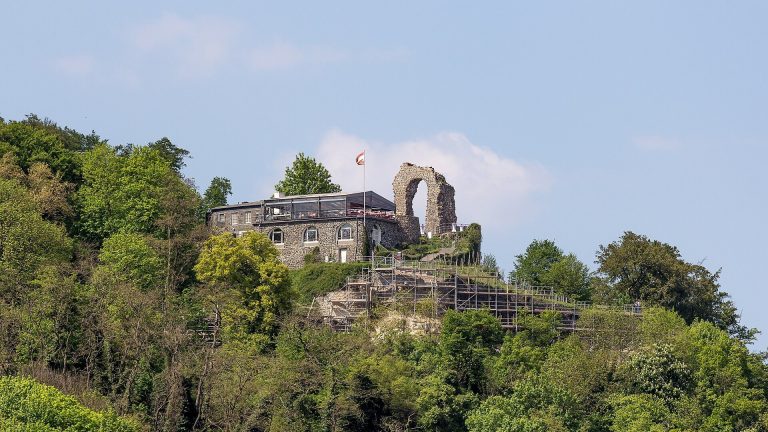
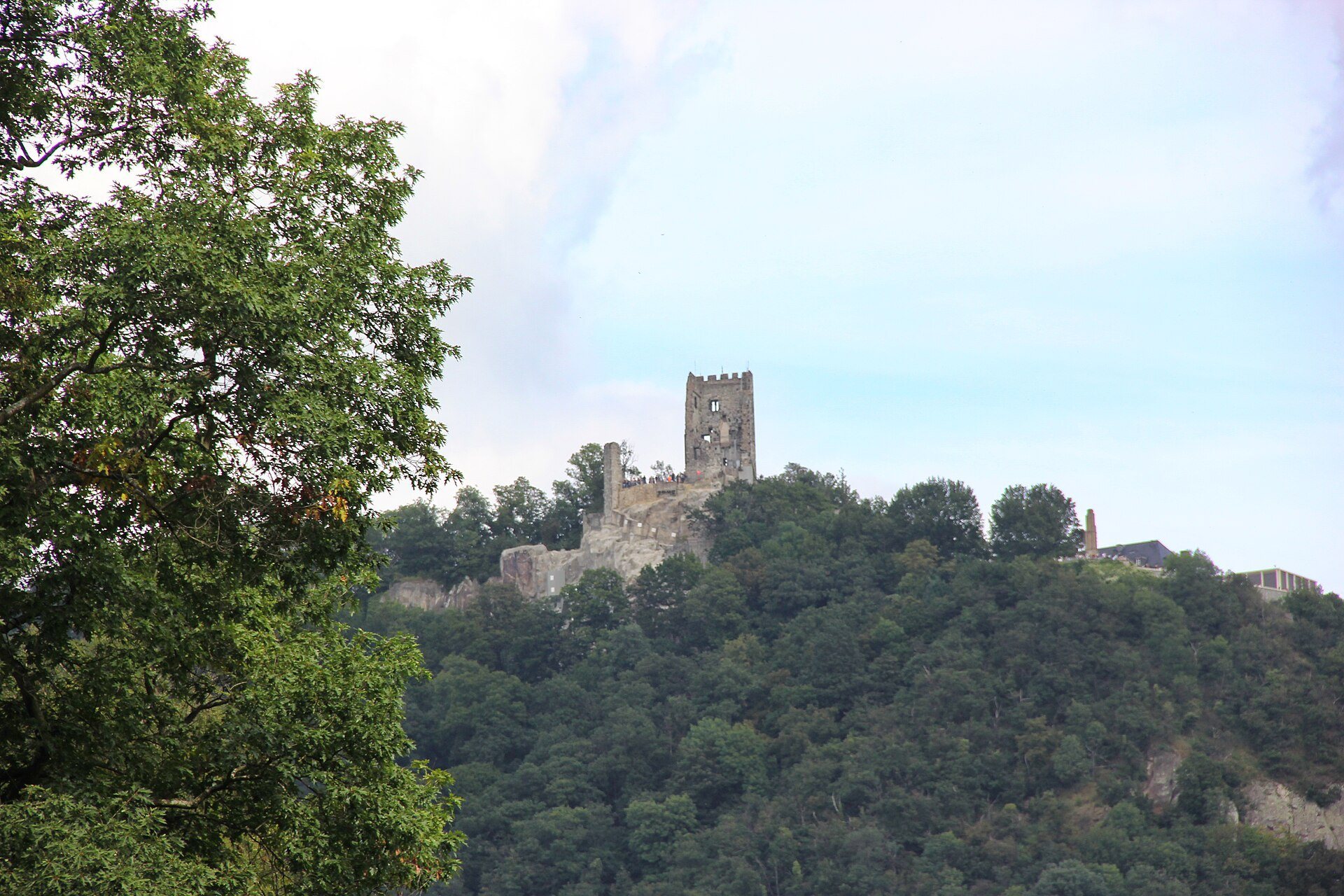
The ruin stands 321 metres above sea level on the summit of Drachenfels. The castle was arranged in three identifiable parts: a central keep, the main castle on the present visitor plateau, and a lower castle or outer bailey. The buildings and summit were formed from Drachenfels trachyte, the volcanic stone quarried from the mountain and used extensively in medieval church construction. Cologne Cathedral’s exterior was built exclusively from Drachenfels trachyte until work was suspended around 1528.
Lower castle
The lower castle was entered through a gateway protected by a round tower. Surviving corbels indicate that the tower had two storeys, and the reveal of the gateway remains in place. The former east wall of the outer bailey survives as a foundation. A northern route passes along a wall with loopholes and beam holes. The beams supported a wall-walk, a passage along the top of a defensive wall behind crenellations, from which defenders could fire. At the end of this route, a small plateau contains a monument installed in 1914. Part of the northern wall survives behind it, close to the edge of the former quarry.
The lower castle contained a knights’ hall, a residential building, and a chapel. Stables may also have stood there. Much of the southern section has disappeared, while a report about the 1788 rockfall places the kitchen and servants’ rooms in that area. Drawings show a square tower on the southwest side, apparently a substantial residential building designed in tower form.
Main castle and keep
Entrance and surviving walls
The entrance to the main castle lay beyond a sharp bend in the route. Rounded masonry and sixteenth-century drawings indicate that a tall building stood beside the entrance, while the wall also contained a small corner tower controlling the approach. A few steps lead toward the visitor plateau. Among the wall remains on the right is a window known as the Cologne Window.
Central keep
The keep, the principal fortified tower of a castle, stands at the centre of the main castle. It is approximately 25 metres high, 10.5 metres wide, and 9.20 metres deep. The tower had three storeys. The lowest normally had no entrance and received light through narrow openings, including surviving light slits on the east and south sides. The entrance to the middle storey was on the east side. The upper storey had three windows, one of which survives in its original condition on the east side. Other remains indicate a staircase leading to the top of the tower.
A section of the keep’s southwest side probably collapsed during the 1788 rockfall. Half of the south wall and almost the entire west wall were lost in the collapse, along with the Rhine-facing residential building and part of the chapel. A large supporting pier was built in 1855 to prevent further slipping of the rock and additional destruction of the keep. The surviving ruins were repaired by the government in 1891 and 1892.
Two lightning conductors stand on the highest points of the keep’s battlements. Between them is an antenna belonging to the amateur-radio relay station DB0SB. The summit rock was reinforced after the 1967 rockfall by driving steel anchors through its western and southern sides and connecting them with reinforced concrete.
Memorials and associated remains
A five-metre-high monument has stood below the Cologne Window since May 1914. It is a replica of the first Landsturm monument of 1814 and commemorates members of the volunteer Siebengebirge Landsturm who died during the Wars of Liberation from 1813 to 1815. The Landsturm was a territorial militia raised for local defense, while the Wars of Liberation were the German campaigns against Napoleonic rule.
The grave slab of Heinrich von Drachenfels, the last member of the main burgrave line, is preserved at St. Mary’s Visitation Church in Bad Honnef. A surviving stone cross marks the place near Kuckstein where Claus von Drachenfels was killed.