Fraugde Church: A Medieval Church in Odense, Denmark
Site at a Glance
- Popularity
- Low
- Country
- Denmark
- Primary era
- Medieval
- Eras represented
- Medieval, Early Modern, Modern
- Civilizations
- Danish, Denmark–Norway
- Site type
- Religious
- Remains
- Church
On this page20 sections
History
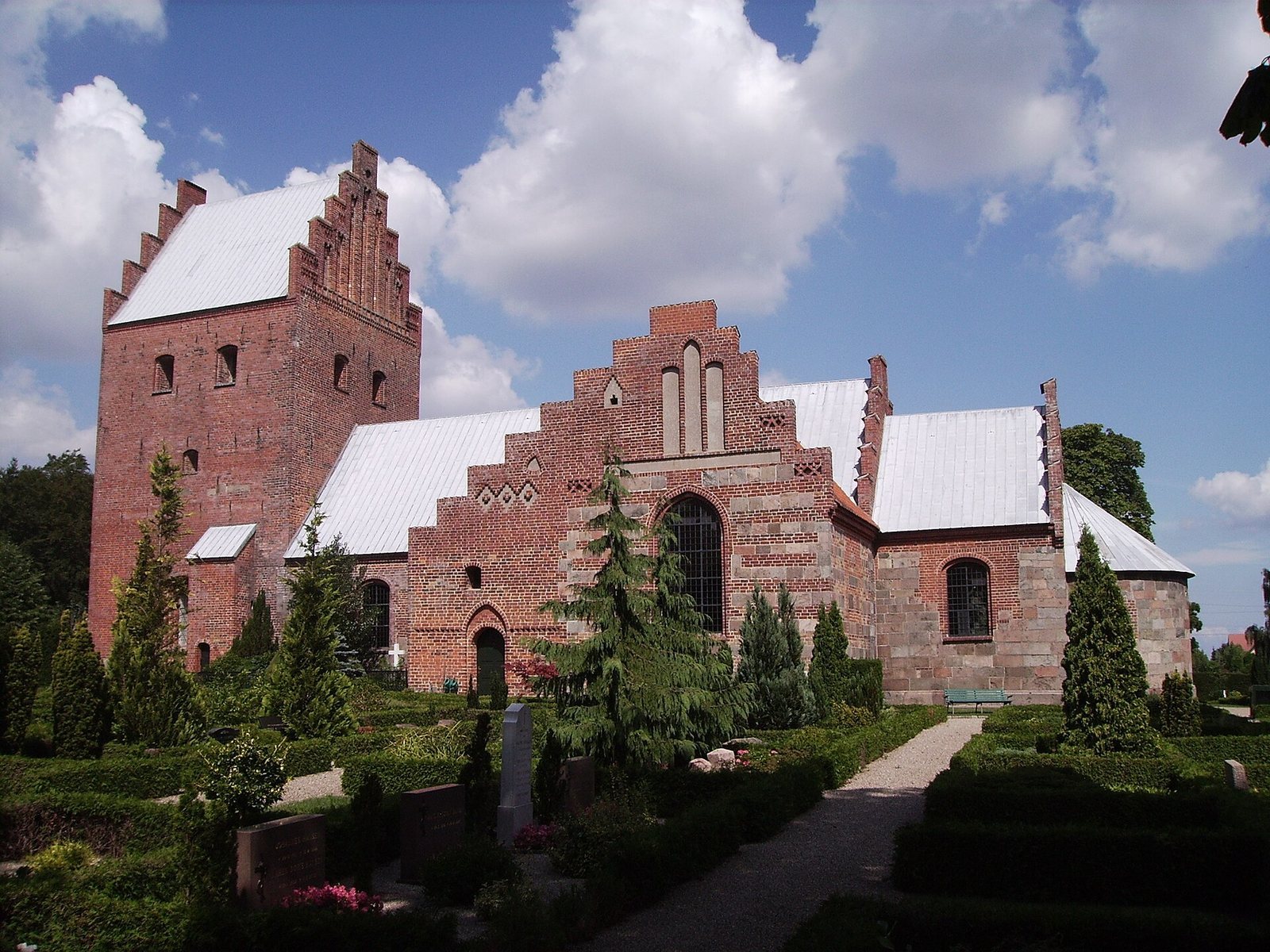
Fraugde Church is a twelfth-century Romanesque church in Odense, Denmark. Romanesque architecture is an early medieval style associated with rounded arches. The church enters the written record in 1239, when Pope Gregory IX granted it an indulgence, a reduction of spiritual penalties associated with sin in medieval Catholic practice. Dedicated to St. Lawrence, an early Christian martyr, it received further indulgences during the fourteenth and early fifteenth centuries.
Medieval ecclesiastical ties
In 1317, the church was assigned to the provosts of Vor Frue Church in Odense. A provost was a senior cleric with administrative duties, and Vor Frue thereafter provided Fraugde’s church services. A late-medieval crucifix also figures in the church’s recorded history. In 1590, Bishop Jacob Madsen noted that it stood before the opening to the chancel, in line with an altar dedicated to the Holy Cross, and requested its removal from that position.
Reformation and private ownership
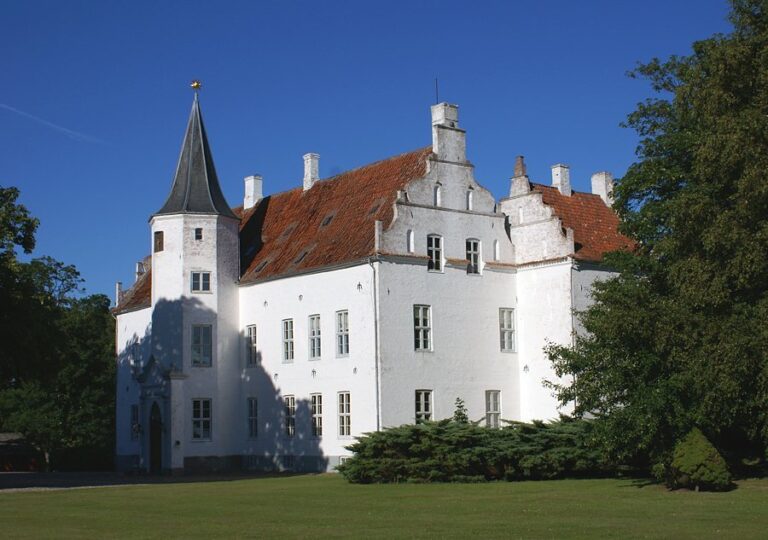
After the Reformation of 1536, the religious transformation that established Protestant churches in Denmark, Fraugde Church passed to the Crown. Its connection with Vor Frue Church continued until 1674. In that year, Anne Margrethe Gøtzen bought the church and immediately sold it to Christoffer Pedersen Balslev of the nearby manor, Fraugdegård. The manor owned it until R. C. Langkilde acquired it in 1853. Langkilde’s family retained ownership until the church became independently owned in 1913.
Family chapels and burial use
The north crosswise arm of the church, called the north transept, first served as a burial chapel for the family of Danish nobleman Peder Marsvin. The chapel was closed in 1797, and the space was then used for Admiral Frederik Christian Kaas and his wife, Christine Elisabeth Birgitte Kaas. The south transept served as a family chapel for Bishop Thomas Kingo, a Danish bishop and hymn writer.
Andreas Michael Ali Sehested, who owned the church from 1822 to 1850, arranged a family burial chapel in the former porch before 1850. That chapel was closed in 1901. These changes accompanied a long history of private ownership alongside the church’s religious use.
Rediscovery and interpretation
Late-medieval consecration crosses came to light in 1934. Romanesque wall paintings were uncovered beneath the interior whitewash in 1974, with more revealed between 1975 and 1977. A coat of arms associated with Sehested was found in the porch in 1998.
One proposed explanation for the paintings’ French artistic connections links them to Bishop Simon of Odense, consecrated around 1158, and his ties with Archbishop Eskil of Lund. Eskil lived in exile in France from 1161 to 1167, was close to Bernard of Clairvaux, and had connections with senior church circles. The paintings may have been made with the knowledge of Odense’s Benedictine St Canute’s Monastery, perhaps as a trial for the decoration of Odense Cathedral. They may also have expressed the French connections promoted through Simon, but this interpretation remains conjectural.
Remains
Building fabric and medieval additions
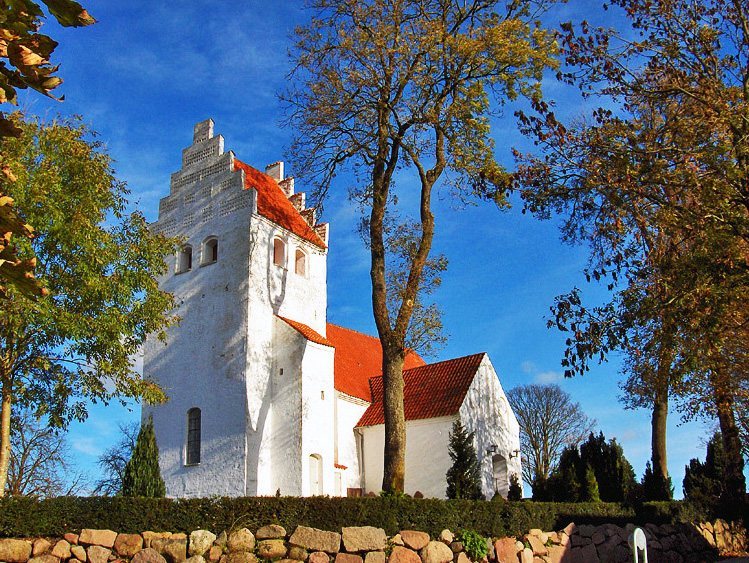
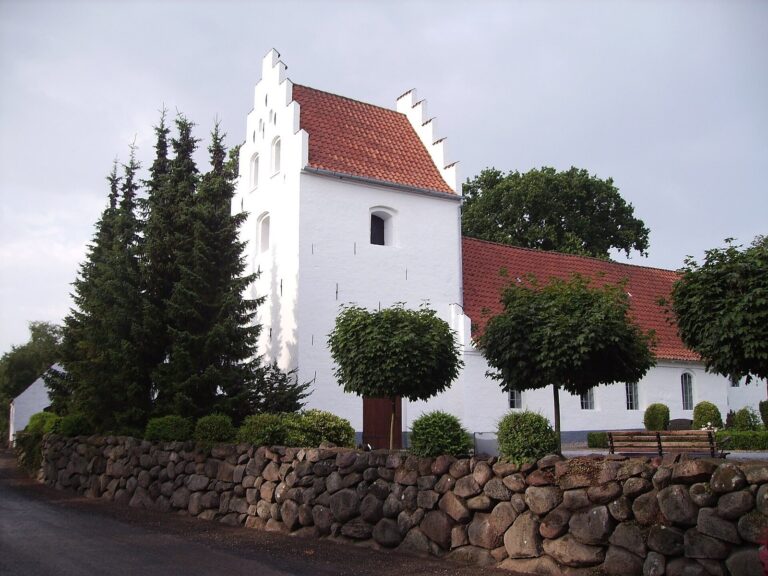
The church combines a twelfth-century stone core with later brick changes and additions. Its first building has an apse, a rounded projection at the east end, and was constructed from carefully dressed ashlar and more naturally shaped fieldstone. In the following two centuries, brick replaced the gable triangles and a vaulted ceiling was added over the apse. A porch was later built on the south side, opposite the nave’s second bay from the east. The chancel was vaulted around 1420 to 1430; the nave was extended westward and vaulted around 1445 to 1455. The south and north transepts and, finally, the west tower were added later, although the order in which the transepts were built is uncertain. Gothic, a later medieval style often associated with pointed arches and vaults, characterizes these later changes.
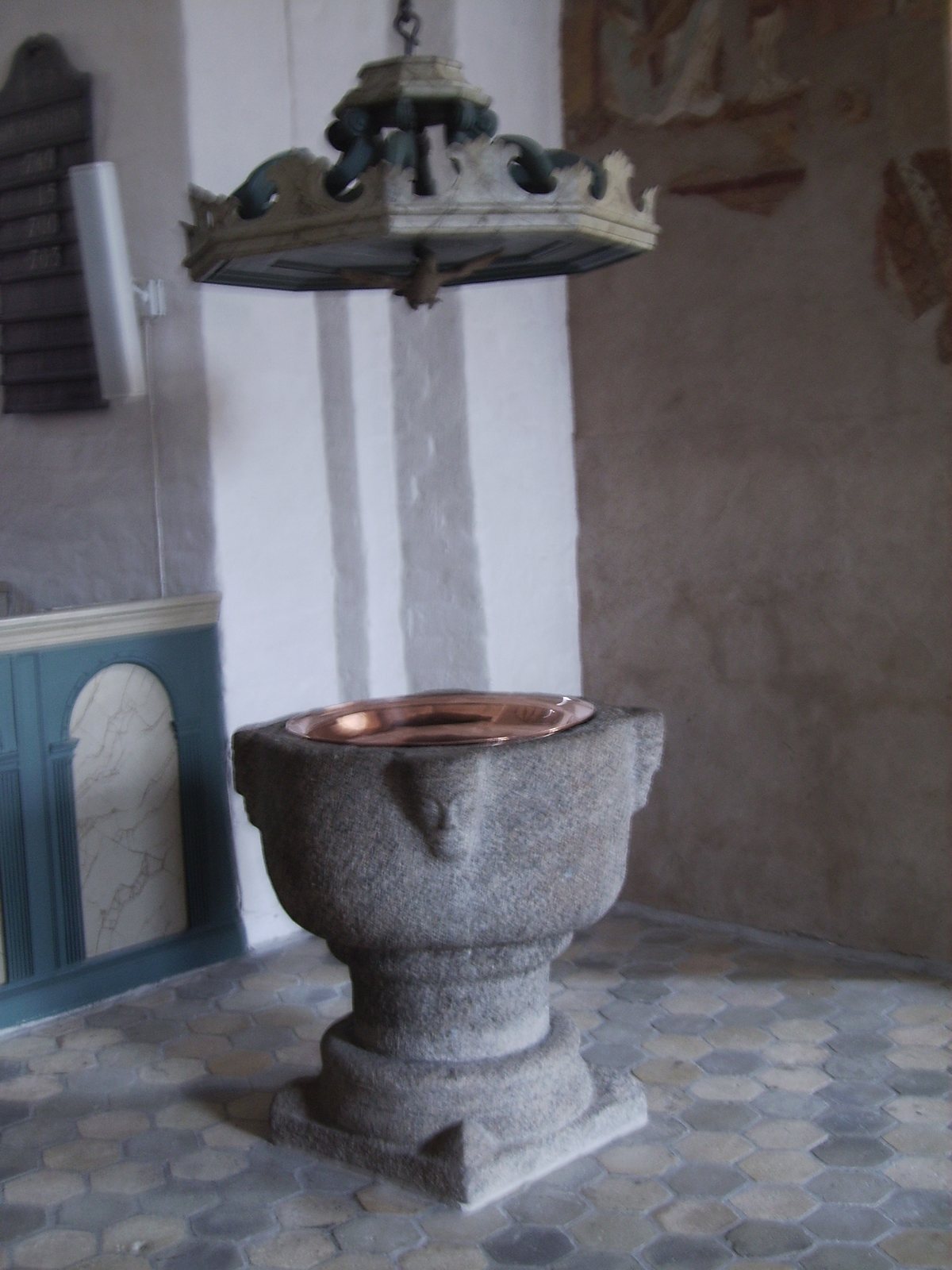
The earlier interior is reconstructed as having a timber-beam ceiling, small round-headed windows high in the walls, and painted decoration. The surviving Romanesque baptismal font and projecting impost blocks, supports from which an arch springs, also belong to this earlier interior. The font’s basin is encircled by four projecting male heads.
Painted decoration
Pigments and preservation
The church retains murals dating from around 1200 to the early nineteenth century. The Romanesque paintings survive in fragments, but their remaining sections are exceptionally well preserved. Their blue pigment was made from crushed lapis lazuli; a green pigment known as salt green was produced using copper plates, honey, salt, and vinegar or urine. The extensive use of both colors was unusual in Romanesque decoration, and details such as clothing folds and eyes remain sharply visible.
Chancel arch and triumphal wall
Paintings surround the chancel arch and cover parts of the west face of the triumphal wall, the wall dividing the nave from the chancel. They include a psychomachia, an allegorical contest between good and evil, in which a helmeted warrior in a tunic points a spear at a crouching figure. A scene of the sacrifice of Isaac appears on the arch’s north side. The triumphal wall once carried two horizontal bands of paintings; the lower band remains recognizable, showing three seated, crowned men on each side of the chancel opening. The figures closest to the opening may be Melchizedek on the south and Abraham on the north. A cloth in Abraham’s lap, with souls looking upward, and his halo support that identification.
The seated figures have been interpreted as a selection from the Twenty-Four Elders of the Book of Revelation, who worship before God’s throne. One interpretation sees the wall and its opening as an image of the end of time, centered on a crucifix that once hung in the opening, with the scenes beside the arch showing the reward for Christ’s sacrifice. The lost portions of the paintings prevent a secure reconstruction of the complete design. Traces of a band above the lower frieze preserve a few capital letters.
Musicians in the lower frieze
Three figures in the lower band hold musical instruments. Beside Abraham, an elder holds an eight-shaped instrument with three strings, identified as a type of medieval fiddle. No bow is visible, and the pose may show it as an attribute rather than an instrument being played. Farther south, the best-preserved musician holds a small, pear-shaped rebec, a bowed string instrument, with one hand on its neck and a bow resting on the strings. A fragmentary figure farther south, partly hidden by a later vault, holds a small harp; the strings have not survived, but the right hand appears poised to pluck them.
This group of the Twenty-Four Elders with instruments is described as unique among Danish wall paintings. The closest comparison for the instruments is a carved stone at Gamborg Church on Funen, depicting an angel with a large rebec-shaped instrument; other Romanesque images of instruments are known from Djursland, North Zealand, and Scania. Possible artistic models include paintings and manuscripts from France and Italy. At Saint-Martin in Thevet, surviving elders hold stringed instruments, while a mural at Montmorillon, dated around 1200, shows two elders with a three-stringed rebec and an object on a long staff. In some illustrated Apocalypse manuscripts, instruments are played by the elders or held as attributes or offerings.
Furnishings
Font and crucifix
The Romanesque granite baptismal font is the church’s oldest furnishing. Its four projecting male heads surround the basin. A late-medieval crucifix from around 1525 shows Christ hanging low from the arms of the cross, with his loincloth billowing around his hips.
Candlesticks, pulpit, and bell
Late-Gothic altar candlesticks date to about 1550. A pulpit made around 1575 has arcaded panels and projecting corners with columns. Its painted panels show the apostles Philip, Bartholomew, Matthew, and Thomas. The pulpit’s Renaissance design draws on classical forms. A bell cast in 1590 bears the name of Borchardt Jensen Quelligmeyer Gelgeter, and the church’s alms box, a receptacle for donations, dates to around 1600.
Altarpiece and organ gallery
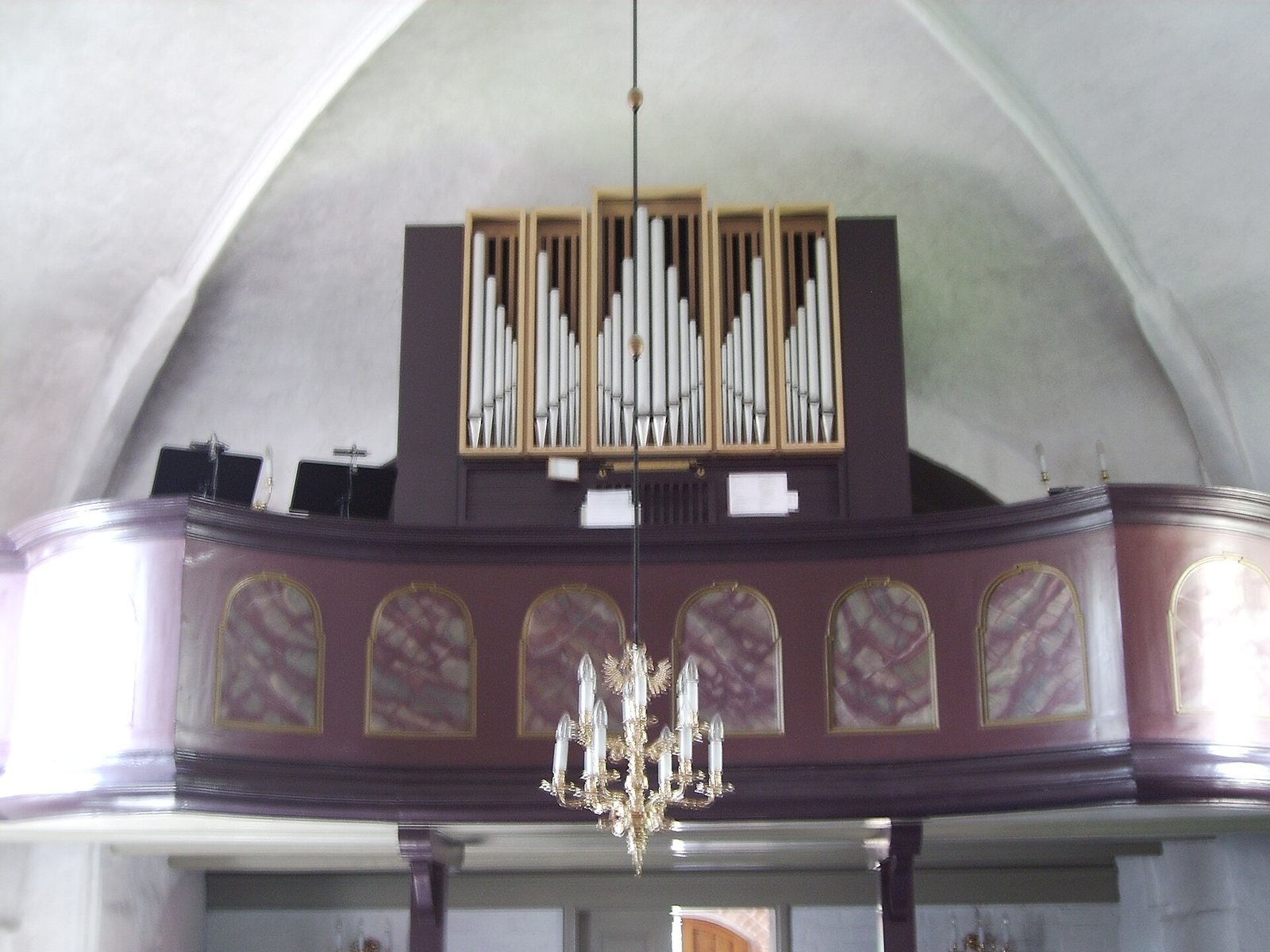
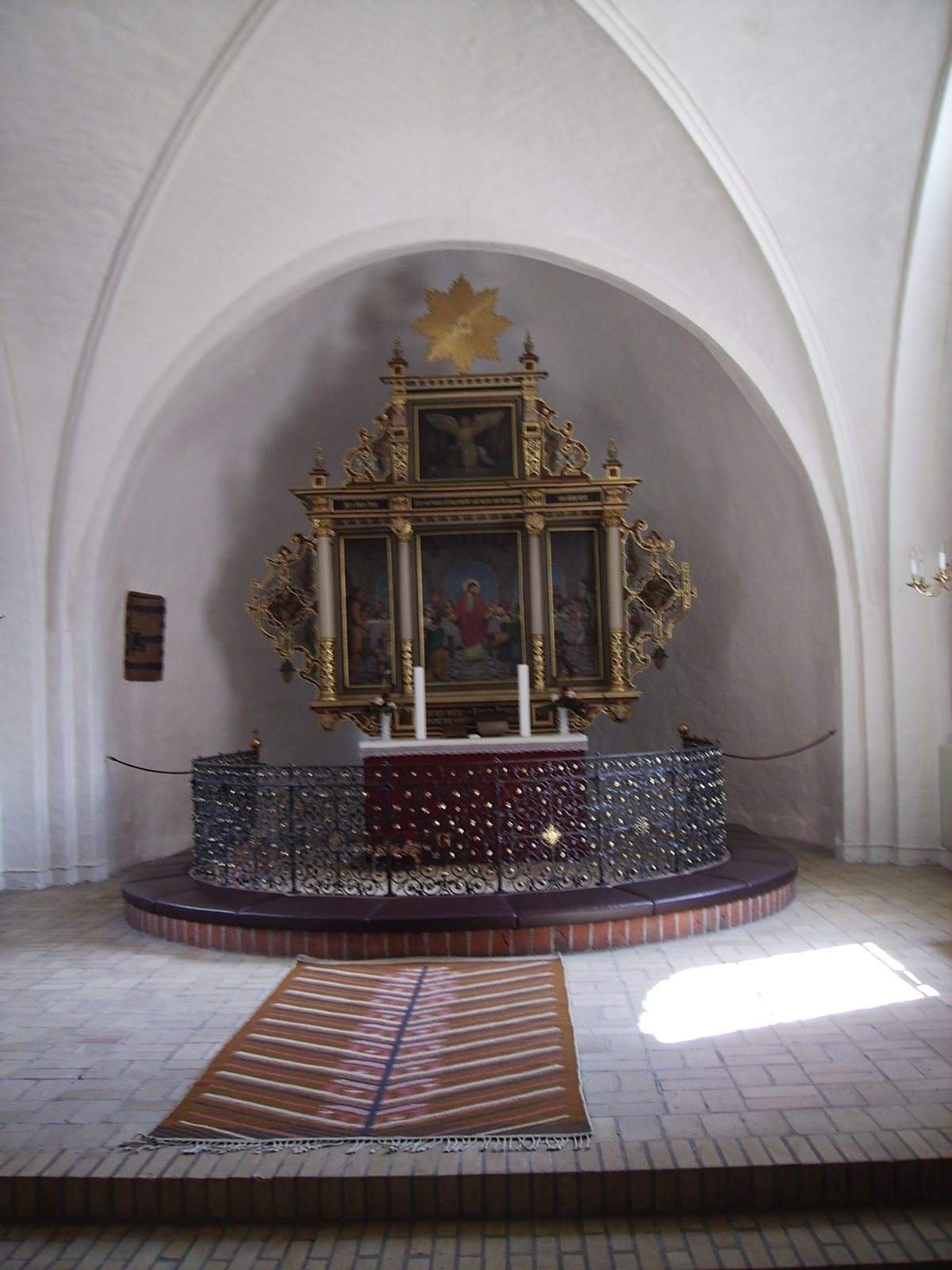
The large canopy altarpiece, an altar structure beneath an architectural canopy, was made around 1600 and acquired from Vor Frue Church in 1672. It incorporates material from a late-medieval altarpiece. Paintings added by Rudolf Rud-Petersen in 1931 depict the Great Banquet. Fragments on the reverse show God the Father, St. Eligius, and a female saint. Paintings from the earlier altarpiece are kept on the organ gallery, built in 1771.
Pews, vessels, and later fittings
Claus Daa and Ingeborg Parsberg of Fraugdegård installed two family pews at the front of the nave in 1637; the other pews date to around 1650. Silver altar vessels made in Odense by Jesper Hansen Rust in 1684 were donated by Christoffer Balslev and Karen Riisbrigh of Fraugdegård. Their daughter Birgitte Balslev and her second husband, Christian Bircheroed, gave the church a wafer box in 1707. The tower clock is signed NCS 1761. A Baroque-style altar rail, with elaborate ornament, was made in 1954 by metalworker Hans Rasmussen of Hudevad.
Burial spaces and memorials
North transept
A sandstone memorial to Peder Marsvin’s family, dated 1620 and possibly made in Jutland, stands in the north transept. Its later burial chapel contains the sarcophagi, or stone burial chests, of Frederik Christian Kaas and his wife, along with the coffin of his sister Sophie Kaas. A cast-iron grille separates the chapel from the church. Made in 1709 for Kingo’s family chapel in the south transept, it was later moved to its present position. The crypt below the transept is associated with the chapel; plaques and coffin fittings from burials there now hang in the transept.
South transept
The south transept holds the ornate coffins of Thomas Kingo and his wife, Birgitte Balslev, as well as a Baroque memorial of sandstone and marble made by Thomas Quellinus in 1703. A burial crypt beneath this transept is associated with its family chapel. Inscribed plaques and coffin fittings from burials in the crypt are displayed on the transept walls.
Porch and churchyard
The former porch now serves as a sacristy. It contains the coat of arms associated with Andreas Michael Ali Sehested, found there in 1998. A Romanesque gravestone recovered beneath the porch floor is displayed as a sculpture in the churchyard. Five other gravestones are inside the church, including three fragments kept in the north burial crypt. The churchyard is also the burial place of Thomas Kingo and the novelist Morten Korch.