Reformed Church in Copenhagen: A Dutch Baroque Church for Reformed Congregations
Site at a Glance
- Popularity
- Medium
- Country
- Denmark
- Primary era
- Early Modern
- Eras represented
- Early Modern, Modern
- Civilizations
- Danish
- Site type
- Religious
- Remains
- Church
On this page12 sections
History
The Reformed Church in Copenhagen is a Dutch Baroque place of worship in Denmark, established for Reformed immigrants. Queen Charlotte Amalie of Hesse-Kassel, a German-born queen consort and Calvinist, obtained permission for herself and her court to practise their faith before her 1667 marriage to King Christian V. Calvinism is a Protestant tradition associated with the teachings of John Calvin. In 1685, Christian V authorized a Reformed congregation for German, Dutch, and French immigrants, many of them refugees. Its members included merchants, craftsmen, and military officers.
Founding the congregation
Charlotte Amalie financed the church and laid its foundation stone on 20 April 1688. It was consecrated on 10 November 1689. Hendrik Brokhamm is identified as its architect, and court painter Jacques d’Agar was also associated with the construction.
German- and French-speaking Reformed communities initially worshipped together before separating into German and French congregations. The original complex also provided homes for four ministers, a school, an old-age home, and an orphanage. Over time, these additional buildings were sold, while the German and French rectories, with rooms for congregational use, remained.
Fire and rebuilding
The Copenhagen Fire of 1728 badly damaged the church. It was rebuilt with new furnishings associated with sculptor Friederich Ehbisch, and much of the interior was refitted between 1730 and 1732. In 1730, the organ front from Copenhagen Castle was transferred to the church before the castle was demolished to make way for the first Christiansborg Palace.
Later use and commemoration
Architect Ludvig Knudsen restored the church in 1880 and built a congregational community house and a multi-storey building in 1886. The German and French Reformed congregations continue to worship there. A Korean Presbyterian congregation began using the church around 1990, followed by a Ghanaian Presbyterian congregation in 2011.
These congregations, together with a congregation in Fredericia, form the Reformed Synod of Denmark, an assembly of church representatives and a member of the international World Alliance of Reformed Churches. In 2001, the church marked the bicentenary of the Battle of Copenhagen, a major naval engagement between Britain and Denmark, with the first performance of Danish composer Frederik Magle’s work Håbet (“Hope”). The commemoration honoured Olfert Fischer, a Danish naval officer and one of Denmark’s commanders in the battle.
Remains
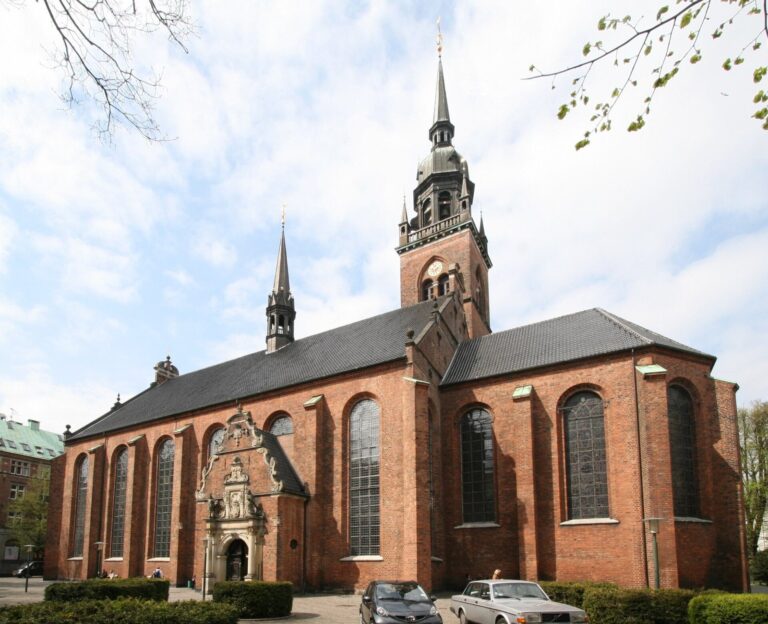
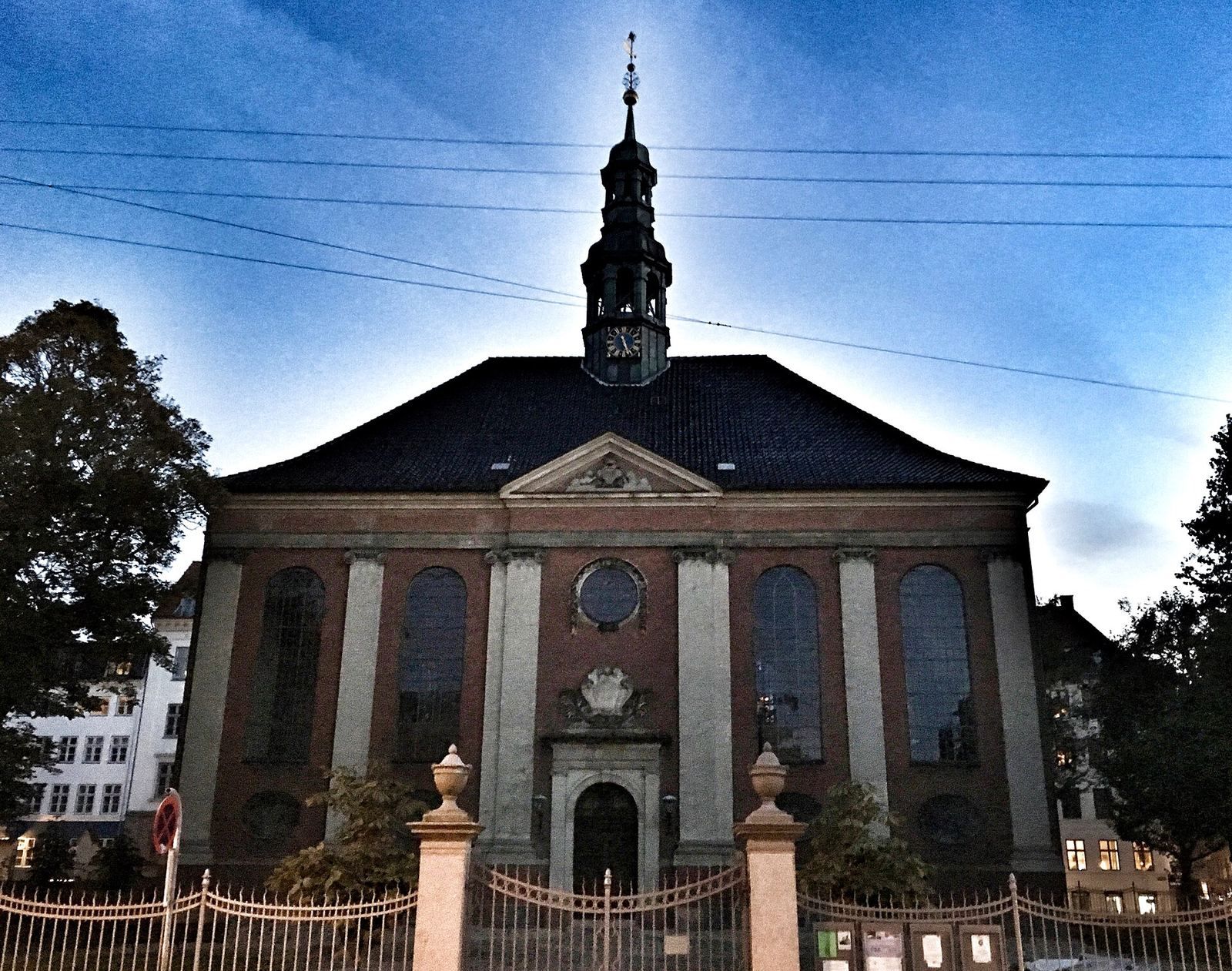
The red-brick church has a rectangular plan measuring about 25 by 16 metres and stands on Gothersgade opposite Rosenborg Castle. Its Dutch Baroque design places the worship space along the building’s shorter axis. The church’s design is thought to have been influenced by the Flemish Mennonite church on Amsterdam’s Singel. Mennonites belong to a Protestant tradition with Anabaptist origins.
Exterior and roof
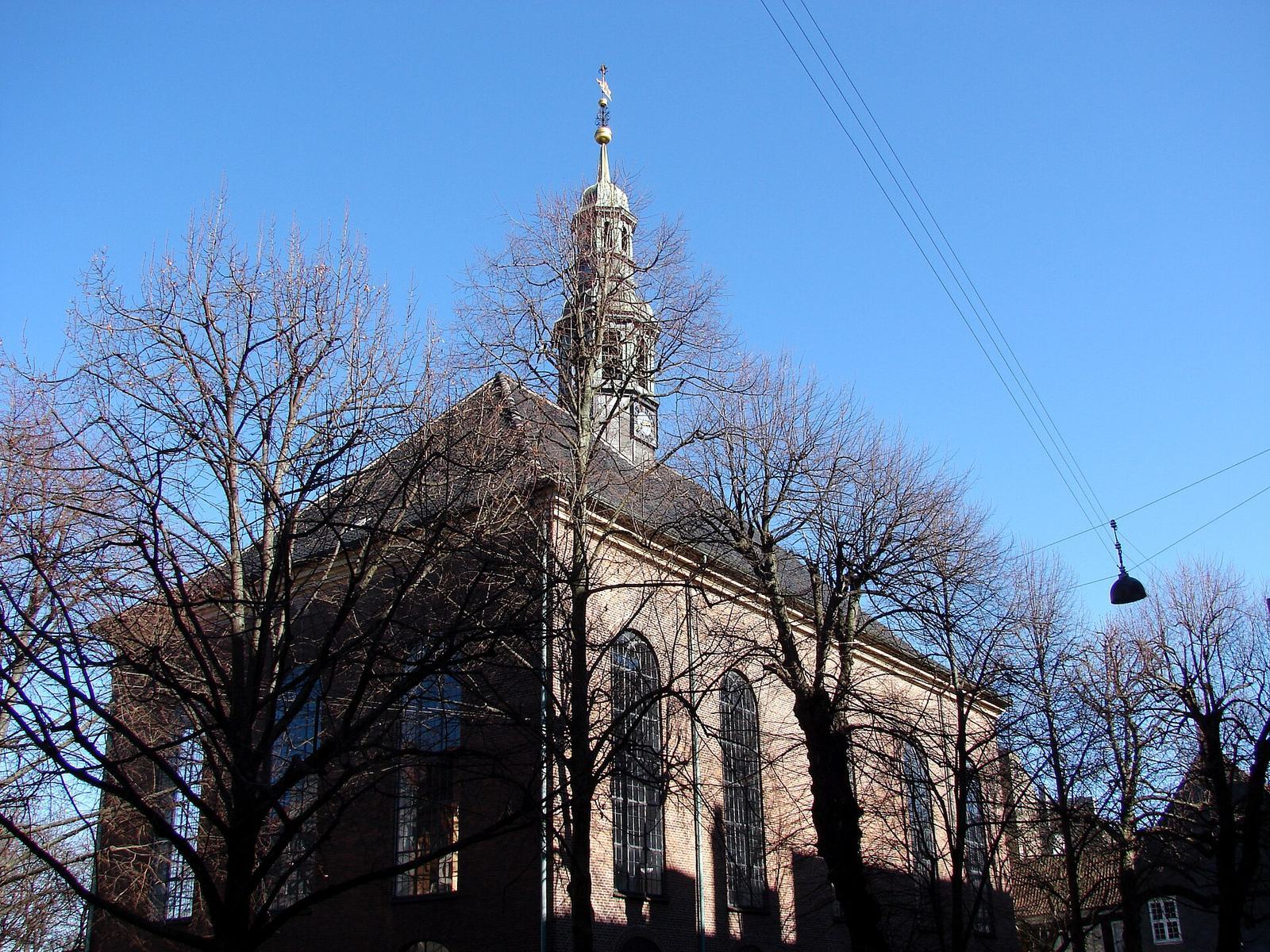
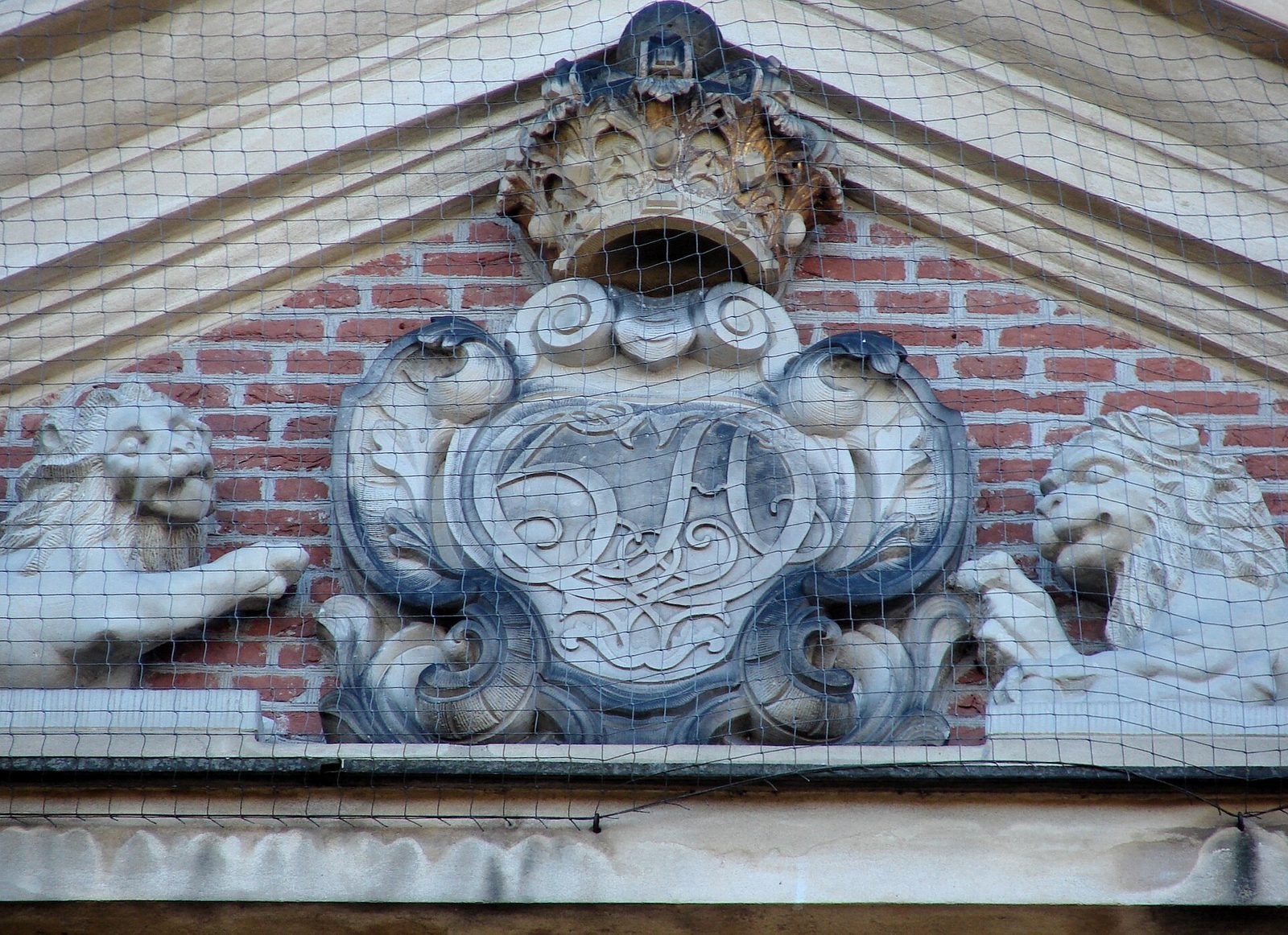
The Gothersgade façade has a slightly projecting central section, flat Ionic columns, and a triangular gable. A decorative panel above the entrance bears the monograms of Christian V and Charlotte Amalie, together with an inscription from Isaiah 2:3. The roof, which slopes on all sides, is covered in black tiles. Above it, a copper-covered flèche, or small spire, rises 13.5 metres. Added in 1731, it has two tiers, two lanterns, and bells.
Worship space and furnishings
Pulpit and seating
A central Rococo pulpit dating to 1731 stands above the communion table. Benches form a four-sided arrangement facing it, and communion is served from a single table given by a royal couple. The church was designed for 600 people and now accommodates about 400.
Royal box and fittings
An enclosed, octagonal royal box is made of oak and crowned with a roof ornament. Its carved column tops and gilded details include Corinthian features. Enclosed pews were first reserved for noble families and later for wealthy merchants and bankers. The carved wooden interior reflects the Reformed prohibition on images of God and Christ. The organ front, brought from Copenhagen Castle, dates to 1724; the present organ was made by Köhne in 1878. A model merchant ship hangs from the ceiling, donated by Swiss consul and chocolate manufacturer Fritz Cloëtta. The Mouvielle family, owners of a well-known delicatessen on Østergade, donated two electric chandeliers.
Churchyard
Burial sections and memorials
The former churchyard is divided into German and French sections near the entrance, with a shared area at the rear. The French section contains 18 graves and 15 gravestones. The rear section has four burial plots and further gravestones, including those of Vice Admiral Olfert Fischer and confectioner Jacob Minis. Others buried in the churchyard include French immigrant and Danish court painter Jacques d’Agar; C. de Cormaillon, commander of Kastellet, Copenhagen’s historic citadel; naval officer Antoine-Nicolas le Sage de Fontenay (1725–1787); Fischer (1747–1820); clockmaker Urban Jürgensen (1776–1830); and French sculptor Louis-Auguste Le Clerc (1688–1771).
Trees and conservation
A horse chestnut estimated to be 250 years old was removed in December 2007, and cuttings were preserved. During the 2013–14 churchyard restoration, the fence was repaired and gravestones were cleaned and conserved by the National Museum. Four chestnuts grown from the preserved cuttings were planted as part of the work. Two stand on either side of the main gate; the other two are beside the fence near the garden of the first French pastor on Aabenraa.