Muszyna Castle: A Medieval Border Fortress in Poland


Site at a Glance
- Rating
- 4.5
- Popularity
- Medium
- Country
- Poland
- Primary era
- Medieval
- External website
- Open
- Eras represented
- Medieval, Early Modern
- Civilizations
- Kingdom of Poland
- Site type
- Military
- Remains
- Castle
On this page10 sections
History
Muszyna Castle is a medieval hilltop fortress in Muszyna, Poland, whose origins are associated with the changing frontier between Poland and Hungary. One tradition places its foundation in 1301, while other interpretations date the existing fortress to the turn of the fifteenth and sixteenth centuries, after an earlier stronghold was destroyed in 1474. The castle guarded the trade route along the Poprad toward Hungary and later became the residence of officials who administered the Muszyna domain.
Origins and Episcopal Rule
In 1301, the Hungarian king Wladislaus granted the Muszyna estates, together with Płoche Castle, to Jan Muskata, Bishop of Krakow. The estates later became property of the Polish Crown. They were returned to the Krakow bishopric in 1391 under King Wladislaus Jagiełło by Bishop Jan of Radliczyce, although another tradition places the transfer in 1440, when Zbigniew Oleśnicki was Bishop of Krakow.
The location of the earlier stronghold linked with Muszyna remains uncertain. It may have stood on Baszta, or on the highest summit of the Koziejowka range, at 636 metres above sea level, probably on a hill adjoining the present ruins. Documents from 1468 mention a Muszyna starost, a royal or territorial official responsible for administering a district, and a record from 1488 refers to a Muszyna castellan, an official traditionally connected with a castle’s administration and military command. Zbigniew Oleśnicki is identified as the castle’s first owner and investor.
The Muszyna Frontier
For many years, the castle stood at the center of the Muszyna domain, also known as the Muszyna Key or Muszyna Frontier. This autonomous ecclesiastical territory was administered by the Krakow bishops and maintained its own administration, military force, and courts. The domain remained under the bishops until the partitions of Poland, the eighteenth-century divisions of Polish-Lithuanian territory among Austria, Prussia, and Russia.
During the seventeenth century, under King John II Casimir, the fortress continued to have a defensive function. After the First Partition of Poland in 1772, the Habsburg monarchy acquired the region containing Muszyna. Following the dissolution of the Muszyna domain, its landed property entered Habsburg chamber possession in 1781. The castle was abandoned in the second half of the eighteenth century and subsequently fell into ruin.
Ruins, Traditions, and Reconstruction
The condition of the monument in the nineteenth century was captured in drawings by Maciej Bogusz Stęczyński and Napoleon Orda. The castle tower may have survived until 1908. Stęczyński also preserved the traditional association of the site with a lord called Paloch. According to the story, Paloch gave the castle to a monastery after his brother failed to visit him during his final illness. A later Krakow bishop supposedly exchanged another estate with the monastery and acquired Muszyna and the castle for the bishopric.
Local legends connect the castle with the Swedish Deluge, the seventeenth-century Swedish invasion of the Polish-Lithuanian Commonwealth. One story says that the Muszyna starost Bedliński ordered secret underground passages to be excavated and hid treasure there, guarded by petrified children. Another tells of enchanted soldiers sleeping in a large underground hall. They are said to awaken briefly each year on Palm Sunday and eventually to join the sleeping knights of the Tatra Mountains in a victorious battle against the Commonwealth’s enemies.
Between December 2020 and October 2023, the municipality of Muszyna undertook renovation and partial reconstruction as part of a joint Slovak-Polish project supported by European Union funds. The work rebuilt or reconstructed the square tower, the courtyard, and part of the main building. The castle is legally protected as an immovable monument in Poland and entered the national heritage register under number 283/80 on 30 January 1980.
Remains
Hilltop Layout and Construction
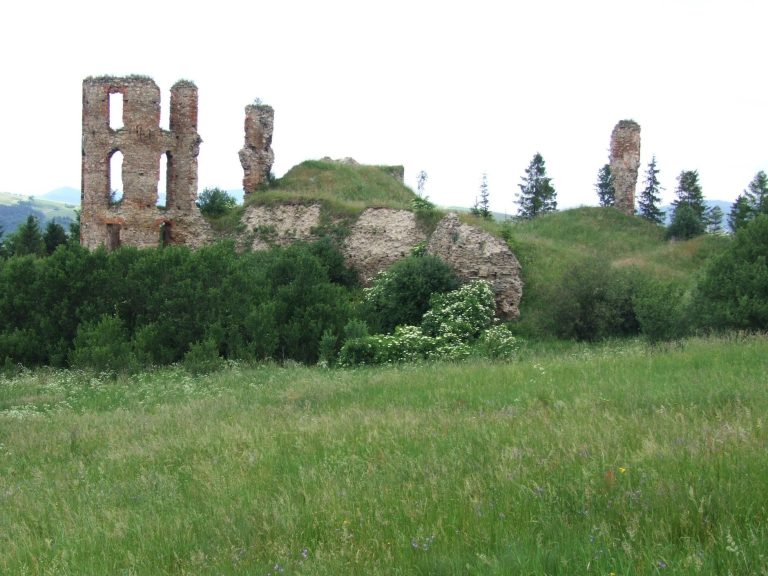
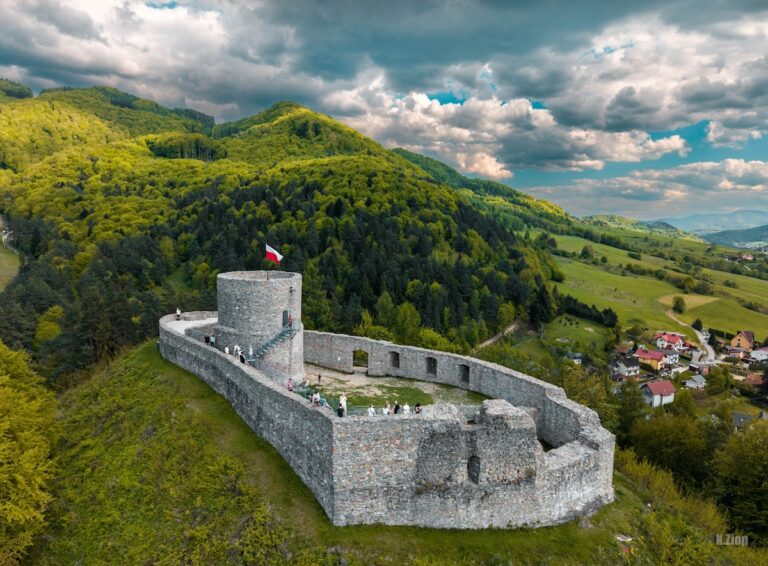
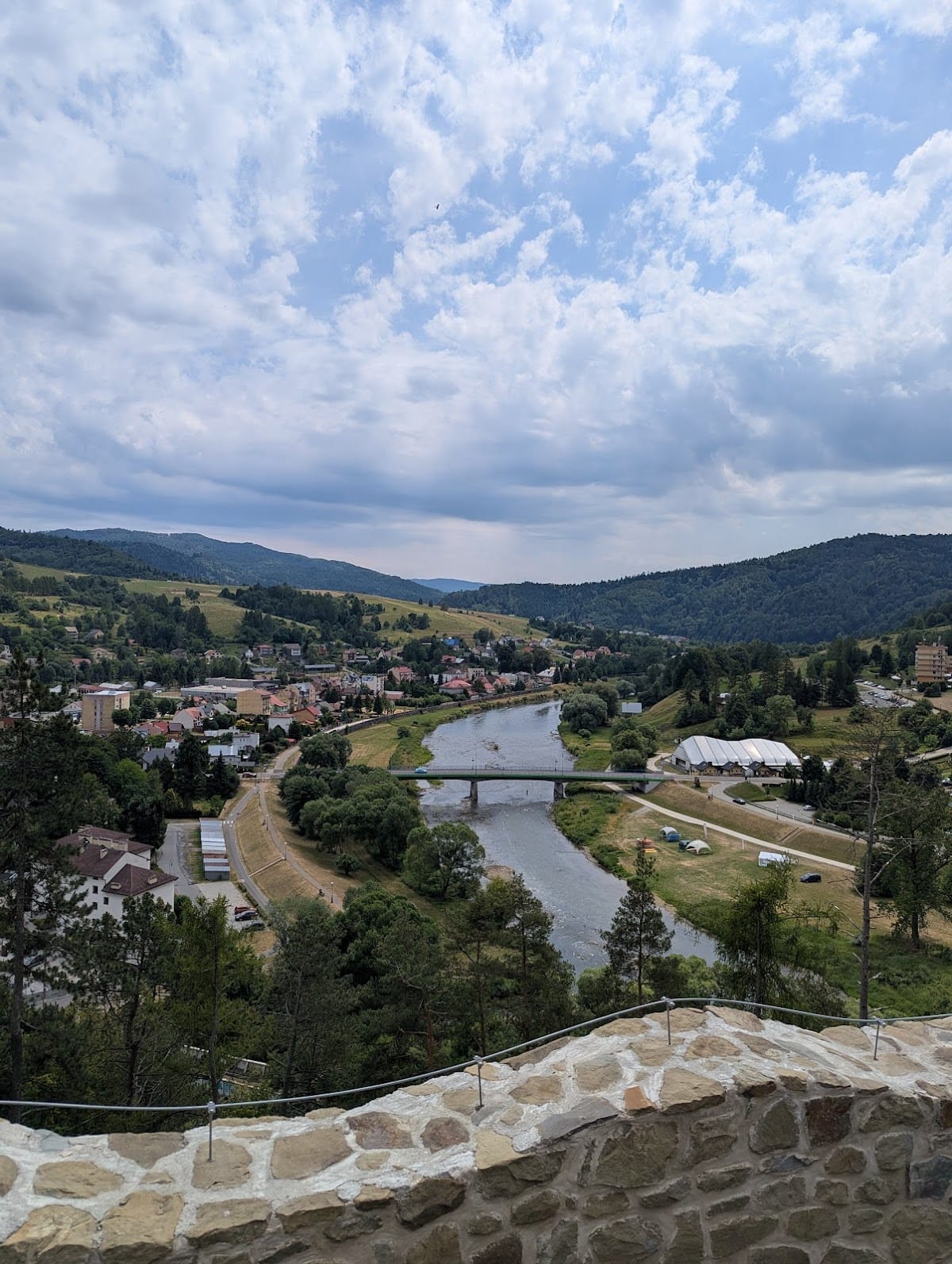
The ruins occupy the summit of the steep 527-metre hill called Baszta or Zamczysko. The hill forms part of the Koziejowka range and stands on the right bank of the Poprad, above Muszyna’s old town and between the Muszynka and Szczawnik streams. Remnants of the tower and shield wall survive on the summit. The walls have been associated with mauergusswerk, a building technique that combines stones worked on one side with rubble and lime.
Square Tower
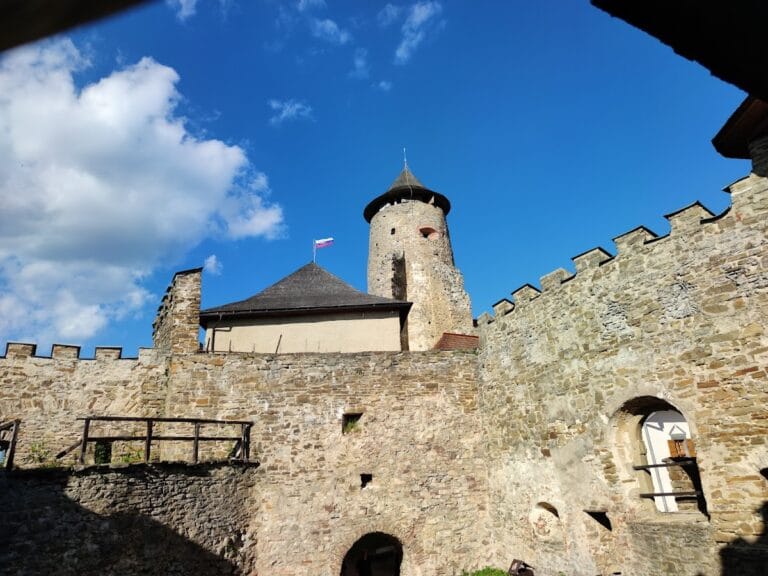
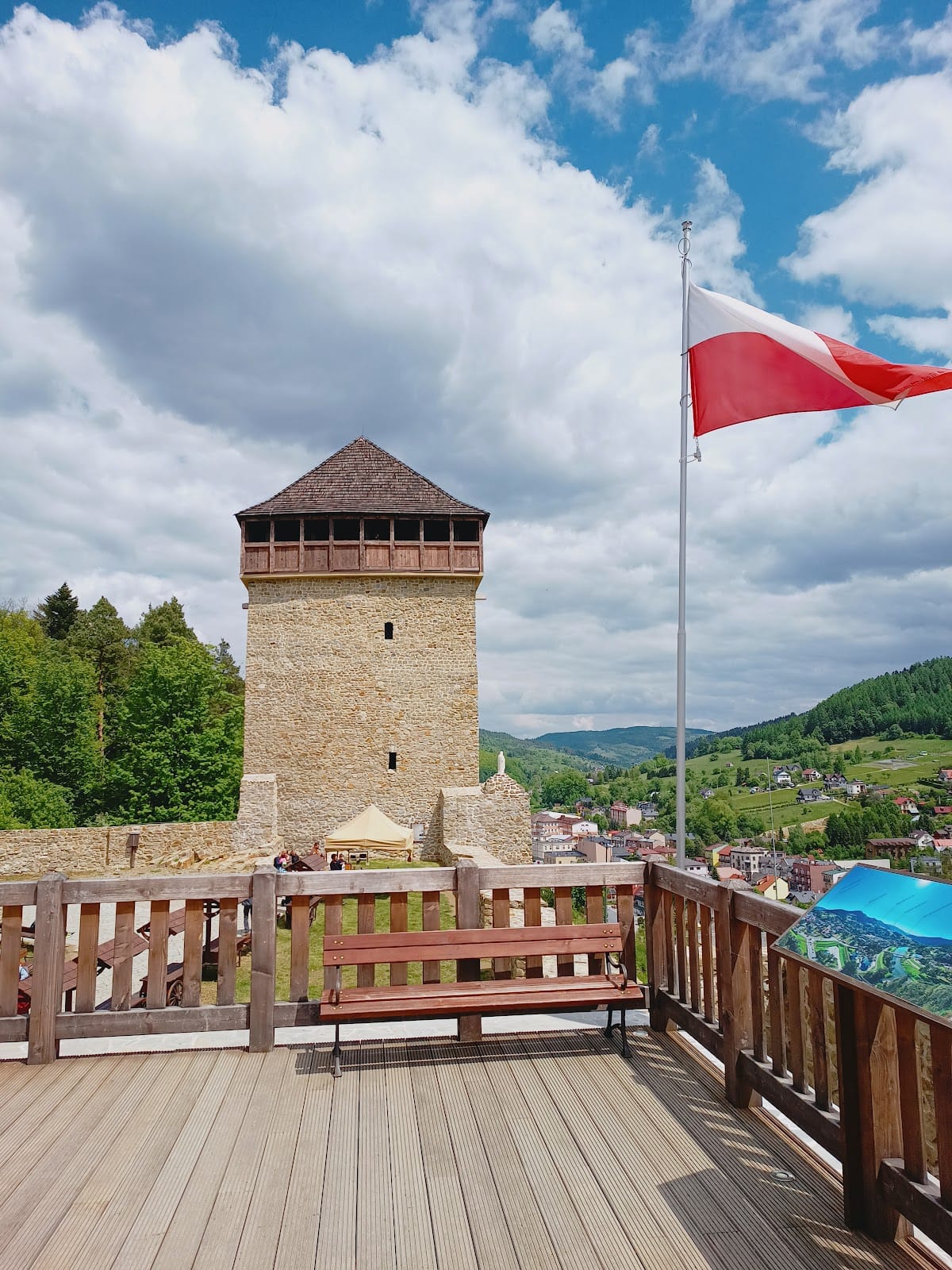
The northern part of the fortress contained a quadrangular tower with thick walls strengthened by sloping buttresses. It was partially reconstructed during the works carried out from 2020 to 2023 and now rises to 14 metres. A glazed viewing terrace occupies the reconstructed tower, while an exhibition room inside the castle presents the history of Muszyna and the fortress.
Courtyard and Residential Building
The approximately rectangular courtyard included a deep well cut into the rock. Its eastern side was closed by a residential building divided into two sections. Part of this main building was reconstructed during the recent renovation and partial rebuilding.
Southern Defenses
The southern side was protected by a double wall enclosing a narrow, elongated inner courtyard. Portions of this defensive system remain among the surviving masonry. When the tower was better preserved in the second half of the nineteenth century, a crude chimney could be seen within its thick wall. It was reportedly formed by building masonry around a circular wooden trunk as the trunk was raised, with a thickness of 15 inches.
Historical Depictions
One version of Stęczyński’s drawing bears the title “Muszyna with the ruins of Paloch’s Castle in the Sandeck district, viewed from the south.” The image preserves both a nineteenth-century view of the ruined fortress and the traditional name associated with it.