Duart Castle: Clan MacLean’s Medieval Stronghold on Mull


Site at a Glance
- Rating
- 4.5
- Popularity
- Medium
- Country
- United Kingdom
- Primary era
- Medieval
- External website
- Open
- Eras represented
- Medieval, Early Modern
- Civilizations
- Kingdom of Scotland
- Site type
- Military
- Remains
- Castle
On this page16 sections
History
Duart Castle is a medieval castle in the United Kingdom, on the Isle of Mull in Scotland, beside the Sound of Mull. Its oldest parts are attributed to the thirteenth century, although the precise foundation date is uncertain. The castle became the seat of Clan MacLean, a Scottish Highland kin group whose chief exercised territorial, political, and military authority.
Medieval origins and MacLean lordship
Tradition associates the castle’s construction with Clan MacDougall. Another reconstruction places the site earlier in lands held by Clan Mackinnon, before it passed to Clan MacDonald. The castle came into the hands of Clan MacLean during the following century.
In 1350, Lachlan Lubanach MacLean of Duart, the fifth clan chief, married Mary Macdonald, daughter of John of Islay, Lord of the Isles. The Lord of the Isles was the powerful medieval lordship that controlled extensive territories and influence across the western Scottish islands and mainland. Duart formed part of Mary’s dowry, and in 1390 her brother Donald Macdonald, Lord of the Isles, confirmed the castle to the MacLeans by charter.
Seventeenth-century conflict
Duart became involved in the rivalry between Clan MacLean and Clan Campbell, two Highland kin groups whose chiefs held territorial and military power. In 1647, government troops associated with Clan Campbell attacked and besieged the castle, but Royalist troops of Clan MacLean defeated and drove them away.
In September 1653, a Cromwellian force of six ships anchored offshore after the MacLeans had fled to Tiree. A storm on 13 September destroyed three of the ships, including the Swan. The wreck was discovered in 1979 and is believed to lie within a protected marine area north of the castle.
In 1678, Archibald Campbell, ninth Earl of Argyll and chief of Clan Campbell, invaded MacLean lands on Mull. Sir John MacLean, the fourth Baronet, fled from Duart to Cairnbulg Castle and later to Kintail, where he received protection from the third Earl of Seaforth. In 1691, Sir John surrendered Duart Castle to Archibald Campbell, tenth Earl of Argyll, who was later created the first Duke of Argyll. The Campbells partly demolished the castle and scattered stones from its walls. Donald MacLean, fifth Laird of Torloisk, reused some of this material for a family cottage near the castle.
Abandonment and reconstruction
The castle remains were abandoned by about 1751. Descendants of the first Duke of Argyll sold Duart in 1801 to MacQuarrie, who later sold it to Carter-Campbell of Possil. The ruins then remained within the Torosay estate until A. C. Guthrie acquired the estate in 1865.
On 11 September 1911, the ruins were separated from the Torosay estate and purchased by Sir Fitzroy Donald MacLean, the twenty-sixth chief of Clan MacLean. Restoration began that year according to plans by the Scottish architect John James Burnet, transforming the castle into a twentieth-century reconstruction that incorporated surviving historic fabric.
Further major repairs became necessary by 2012. Water entering through the chimneys caused four ceilings to collapse during the winter of 2013–14, and an appeal for restoration was launched in July 2014. Another phase of the restoration project was under way in 2020. Duart Castle was included in Scotland’s Category A listed-building register in 1971. Category A is Scotland’s highest listed-building category, reserved for buildings of special architectural or historic interest.
Remains
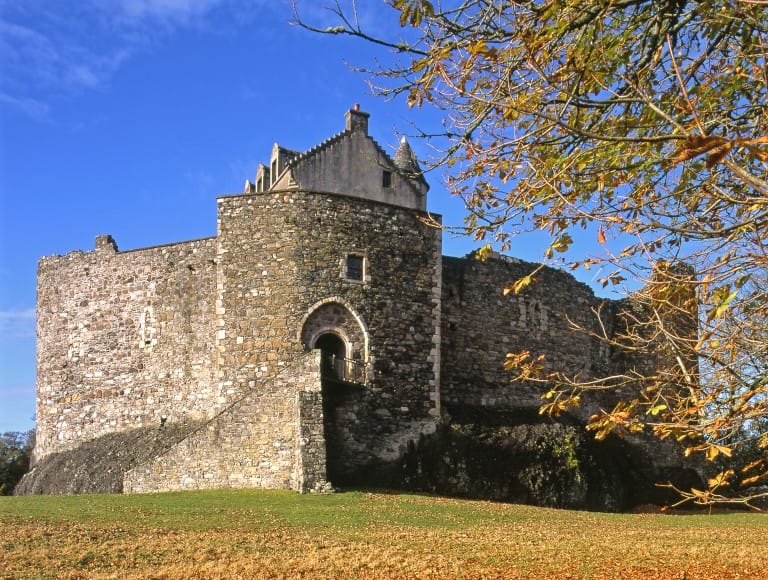
Duart Castle occupies a rocky small peninsula on Mull’s eastern side, beside the Sound of Mull, Loch Linnhe, and the Firth of Lorn. This position allowed the castle to monitor an important waterway along Scotland’s west coast. The enclosure has medieval fabric attributed stylistically to the thirteenth century, although definitive evidence for that date is lacking. The walls on the other sides of the enclosure are probably older than the great residential tower.
Enclosure and entrance
Courtyard entrance
The entrance to the courtyard is set slightly above the surrounding ground level in the southwestern wall. A staircase leads up to it, linking the approach with the enclosed interior.
Residential buildings
Great residential tower
A large residential tower occupies the entire northwestern side of the castle. The three-storey building contained residential and reception rooms. Its first floor holds the principal hall, which has a large fireplace.
Seventeenth-century house
A large house was added around the middle of the seventeenth century and altered several times in later centuries. The two-storey house in the eastern corner of the courtyard has an L-shaped plan and a large spiral staircase. Built directly against the older walls, it required those walls to be pierced for window openings. Above the northeastern entrance, the inscription “SAM 1653” identifies the initials of Sir Allan MacLean, the nineteenth clan chief, and provides evidence for the building’s date and builder.
Carved and commemorative remains
Sheela-na-gig
A heavily weathered Sheela-na-gig was found within one section of the masonry. This type of carved figure usually depicts a female form and appears on some medieval churches and other buildings in Britain and Ireland. Its original meaning remains debated.
Great Hall colours
The regimental colours of the 236th Battalion of the Canadian Expeditionary Force, the New Brunswick Kilties, are laid up in the Great Hall.
Associated maritime and lighthouse features
Wreck of the Swan
The remains of the seventeenth-century warship Swan lie in waters north of the castle within a protected marine area. The wreck was discovered in 1979 after the ship was lost in the storm of 13 September 1653.
Duart Point lighthouse
Duart Point lighthouse stands southeast of the castle. Built in 1900, it is a memorial to the Scottish novelist William Black.