Church of the Holy Spirit in Żabno: A Baroque Parish Church in Poland
Site at a Glance
- Popularity
- Low
- Country
- Poland
- Primary era
- Early Modern
- Eras represented
- Early Modern, Modern
- Civilizations
- Polish–Lithuanian Commonwealth
- Site type
- Religious
- Remains
- Church
On this page13 sections
History
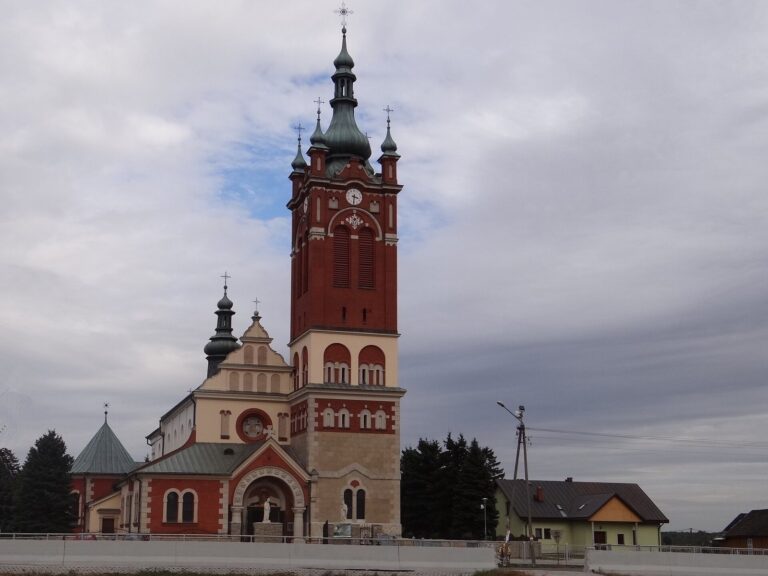
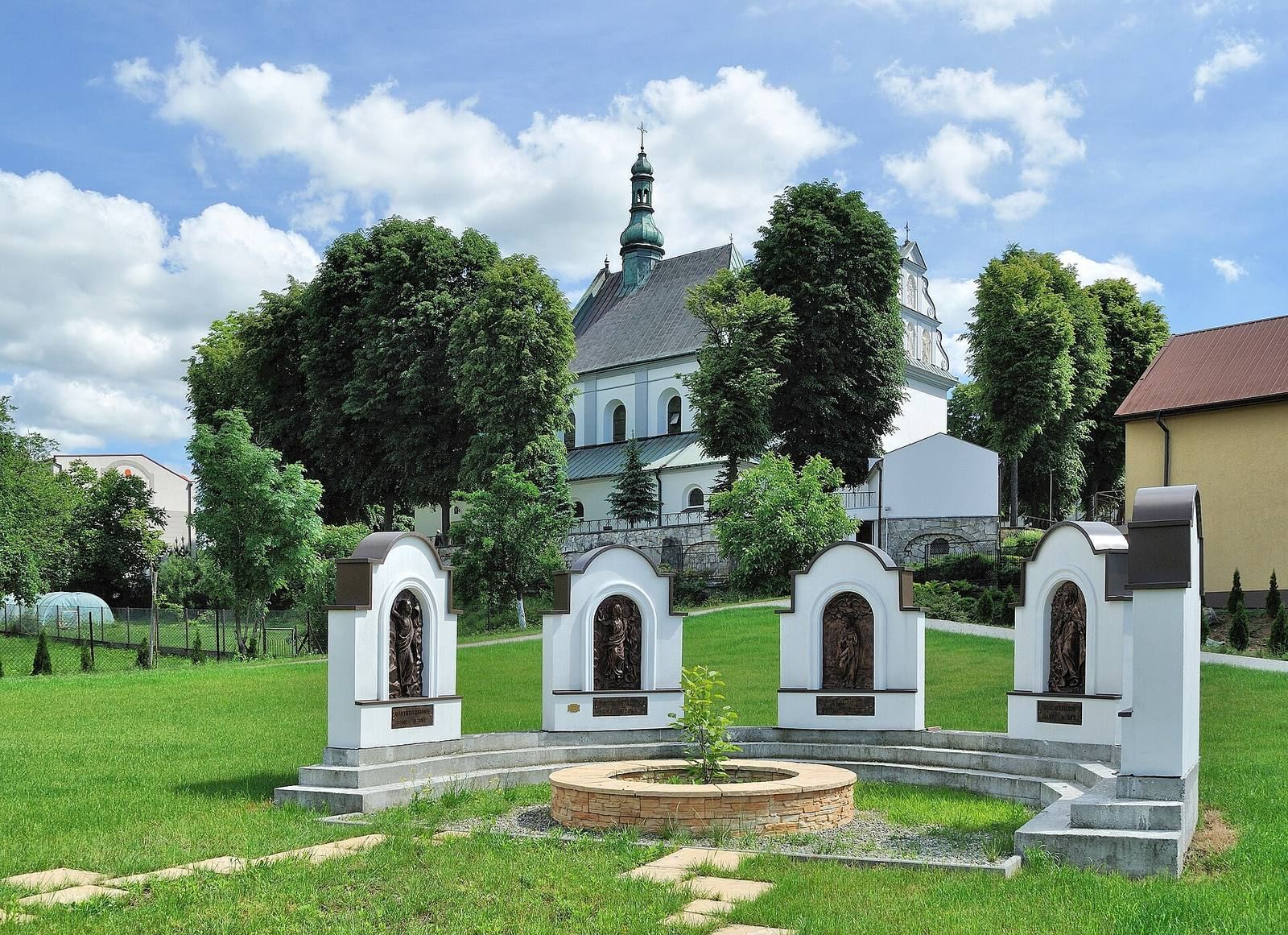
The Church of the Holy Spirit in Żabno is a Roman Catholic parish church in Poland, built between 1663 and 1685 in the Baroque period. Its architecture combines Baroque and Neo-Baroque forms.
Construction and consecration
Rafał Kazimierz Makowiecki financed the church’s construction. A Polish nobleman, he held a castle-district office known as a castellan’s post and a royal administrative office called a starosta’s post. Bishop Mikołaj Oborski consecrated the church in 1685.
The church is dedicated to the Holy Spirit and belongs to the Żabno deanery, a territorial grouping of parishes within the Diocese of Tarnów. Its liturgical feast is Pentecost, the Christian celebration of the Holy Spirit’s descent upon Jesus’s disciples.
Fire and military damage
Fires damaged the building in 1799 and 1888. During military operations in 1915, the roof was damaged and the main portal was destroyed.
Twentieth-century changes
Between 1955 and 1957, the church was enlarged with side aisles and a vestibule, an entrance space. A dome was also added over the sacristy, a room used for clergy and liturgical items. In 1968, the wooden ceiling was replaced with one made of reinforced concrete.
Remains
Plan and exterior
Building plan and materials
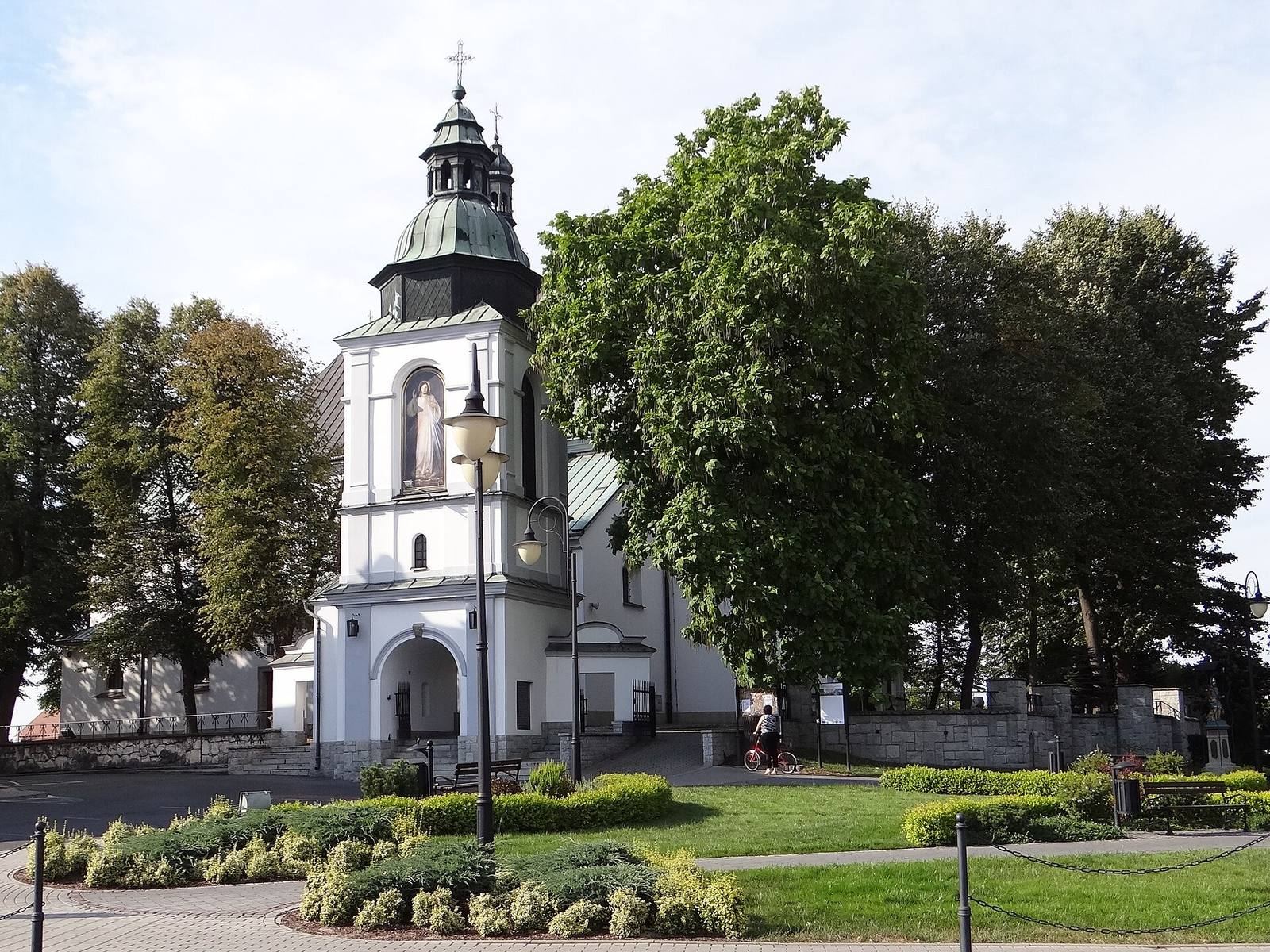
The church is built of brick masonry incorporating stone and finished with plaster. Its present layout has a central nave with side aisles, arranged in three bays, or sections defined by structural divisions. A short chancel, the area around the altar, ends in a semicircular form. A chapel adjoins its south side and a sacristy its north side, while an extension of the main body projects westward. The church has one altar.
Facade and roofs
Shallow, column-like pilasters divide the exterior walls, with supporting projections between them. The gable of the western section follows a Renaissance tradition and contains two tiers of arches, with reliefs of saints made in 1960. Sheet metal covers the roofs. Those above the chancel and main body have two slopes; the roofs over the additions beside the chancel slope down from the main walls. A small bell housing rises above the nave, topped by a raised roof structure known as a lantern.
Stone portals
The main entrance has a stone Baroque portal dated 1684, with an inscription tablet. It was reconstructed after its destruction. At the south entrance, a 17th-century Baroque stone portal has a broken pediment, a triangular crown interrupted at its center. A statue of the Virgin Mary standing on a dragon rises above it.
Interior
Ceilings and vaults
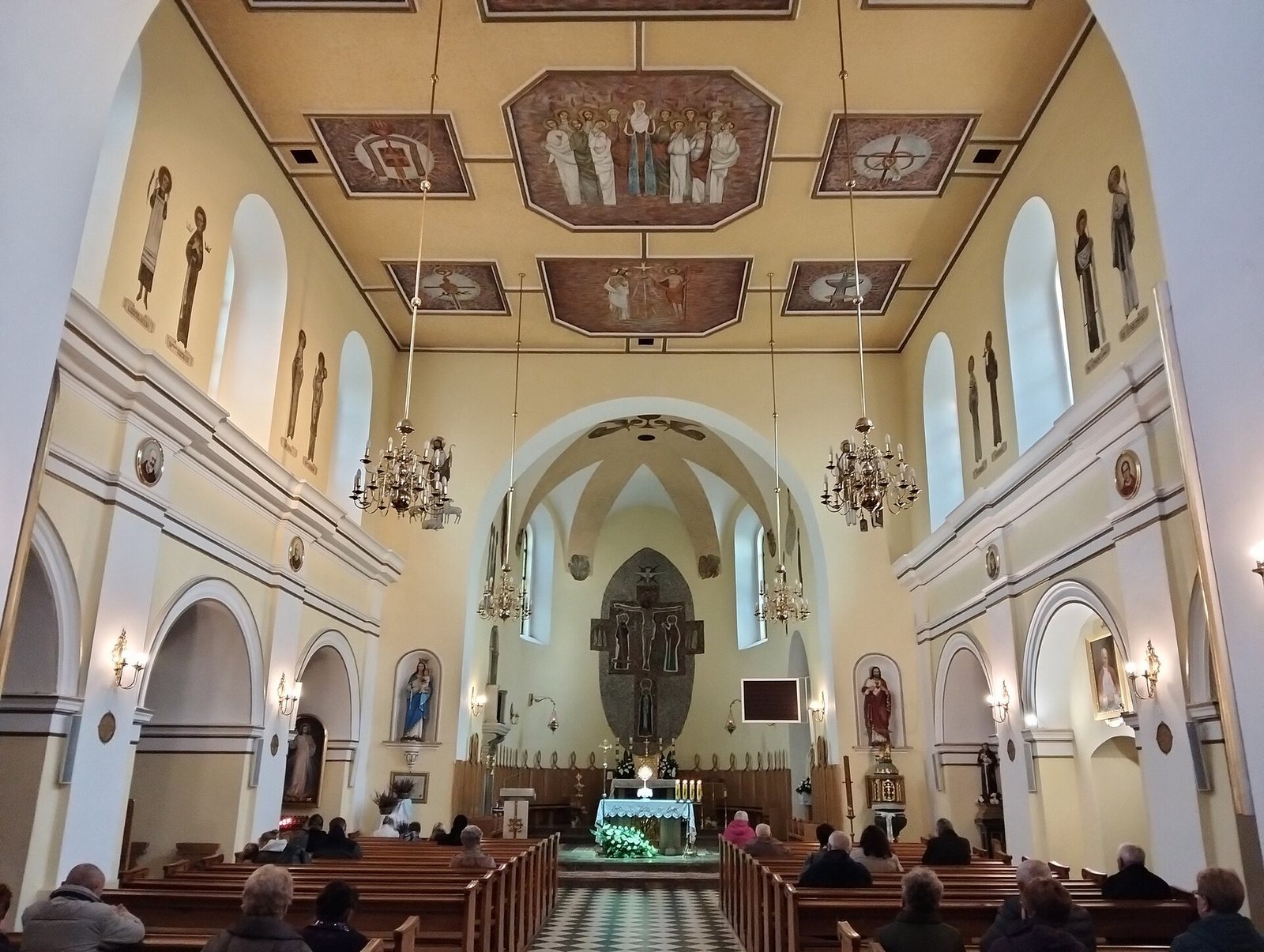
Pilasters, shallow column-like projections, divide the nave walls but stop below the ceiling. The chancel has a barrel vault, a tunnel-shaped ceiling, with curved recesses set into it. The adjoining spaces have groin vaults formed where barrel-shaped ceilings cross. Flat ceilings cover the main nave and the front part of the church, while the side aisles have sail vaults, whose curved surfaces rise between supports.
Painted decoration
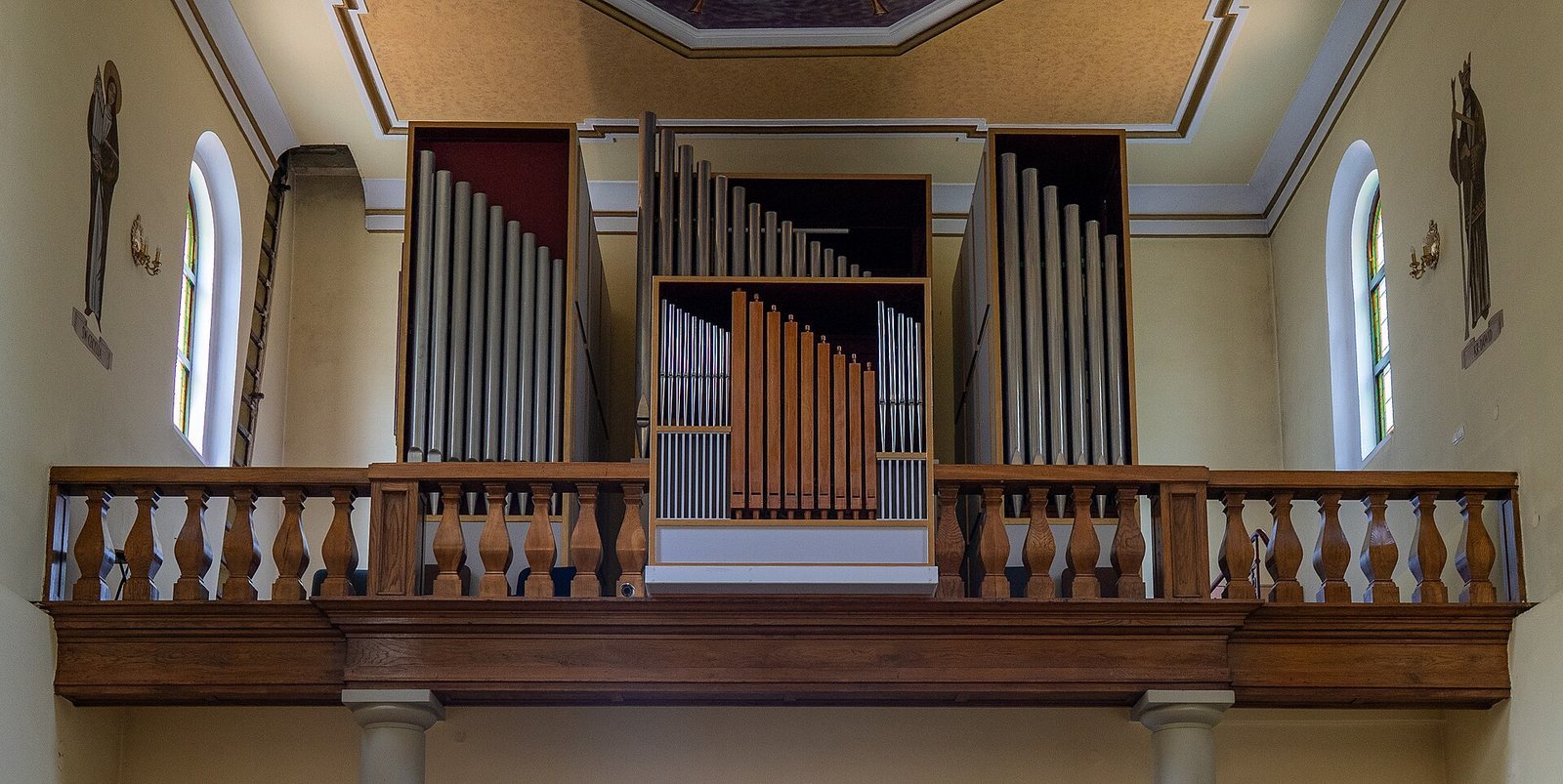
Paintings by Łukasz Karwowski depict the Annunciation, Christ’s baptism, the Resurrection, Pentecost, and the Ascension. Other figures include Cecilia, traditionally regarded as the patron saint of music; Hedwig of Anjou, a 14th-century queen of Poland; Stanislaus Papczyński, a 17th-century priest who founded the Marian Fathers; and Simon of Lipnica, a 15th-century Franciscan friar. The painted subjects also include Benedict, Świerad, an early medieval hermit venerated as a saint; Dobrawa, a 10th-century Bohemian duchess associated with Poland’s early Christianization; Karolina Kózka, a young Polish Catholic martyr; Maximilian Kolbe, a 20th-century Franciscan priest; Kinga, a 13th-century Hungarian-born duchess of Poland who became a nun; and Stanisław.
Gethsemane group
The church also contains a sculpted Gethsemane group made by Jan Wnęk in 1866. It represents the garden where, in Christian tradition, Jesus prayed before his arrest.