Church of Saint Demetrius of Thessaloniki in Pskov: An Orthodox Church and Cemetery
Site at a Glance
- Popularity
- Low
- Country
- Russia
- Primary era
- Early Modern
- Eras represented
- Early Modern, Modern
- Civilizations
- Russian
- Site type
- Religious
- Remains
- Church
On this page10 sections
History
The Church of Saint Demetrius of Thessaloniki in Pskov is an Orthodox church in Russia, founded in 1534 at a monastery dedicated to the same saint. Saint Demetrius is a Christian martyr venerated in the Orthodox tradition. The church belonged to the Pskov diocese, an ecclesiastical district overseen by a bishop, and was also called the Church of Demetrius in the Field.
The monastery and its early history
Records from the second half of the sixteenth century and the beginning of the seventeenth place the monastery beyond Peter’s Gate, toward the fields and the Pskova River. Swedish forces devastated it in 1615, but the monastery was restored soon afterward. In 1685, its peasants helped roof sections of Pskov’s city walls. By 1698, the monastery owned 28 households.
Parish use and changes
By 1763, the church had been assigned to the bishop’s household. In 1782, Pskov merchant Vukola Evstafyevich Podnebesny paid for a side chapel dedicated to the Presentation of the Virgin, a Christian feast commemorating Mary’s presentation at the Temple. The church became a parish church in the early nineteenth century. Its poor condition prompted a demolition proposal in 1808, which the Holy Synod, the governing body of the Russian Orthodox Church during the imperial period, rejected.
The chapel was heightened in 1864, after which the Pskov ecclesiastical consistory resolved to raise the bell tower with a timber structure. New icon screens, which separate the sanctuary from the main worship space, were installed in the main church in 1876 and in the chapel in 1882.
Persecution and continued worship
In December 1937, the church’s two serving archpriests, Alexei Vasilyev and Konstantin Znamensky, were arrested and soon executed. Alexei Cherepnin, a priest who had served there since 1915, was arrested in 1938 at the age of 80 and died in a Leningrad prison.
The church was still officially active by the summer of 1941, although services had stopped because no priest was available. During the occupation, priest Georgy Benigsen revived parish life. Until the late 1980s, it was one of five churches in Pskov where Orthodox worship remained authorized. The church received state protection in 1960 as a monument of republican significance and is classified as a cultural heritage site of federal significance.
Remains
Church and cemetery
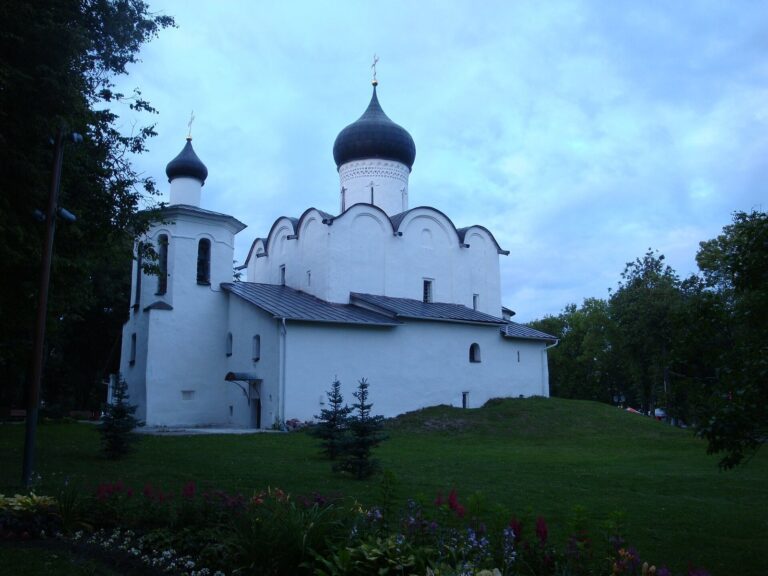
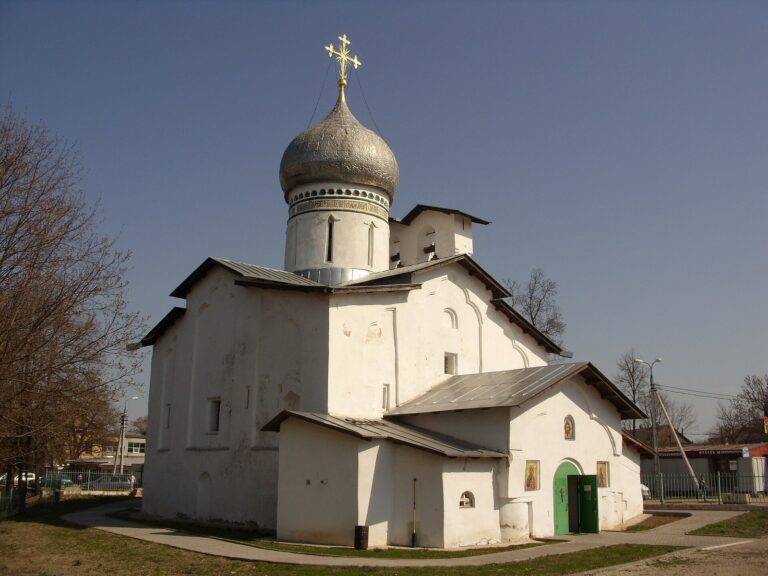
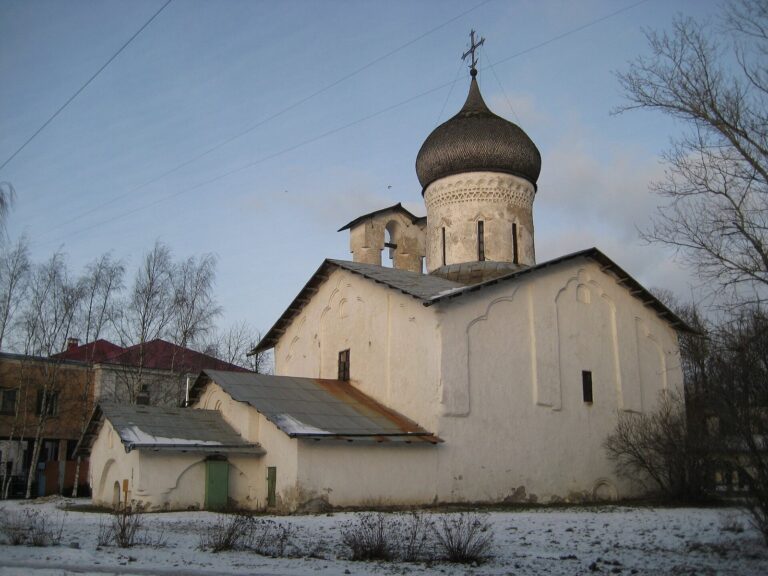
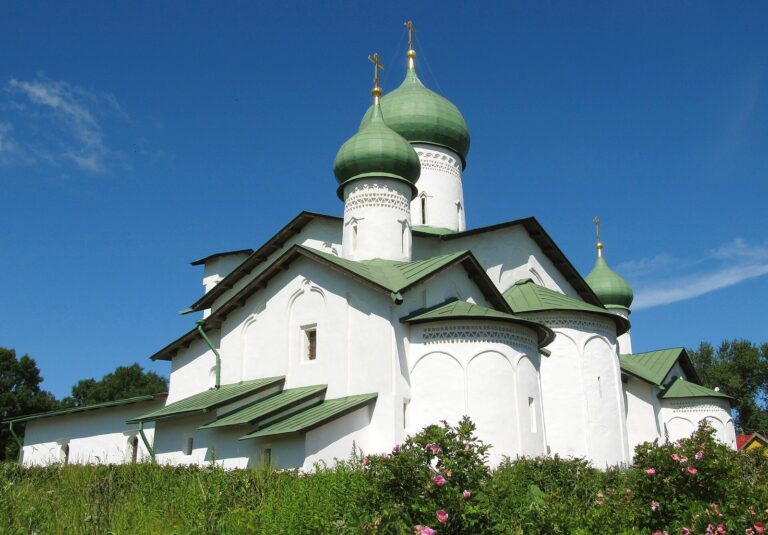
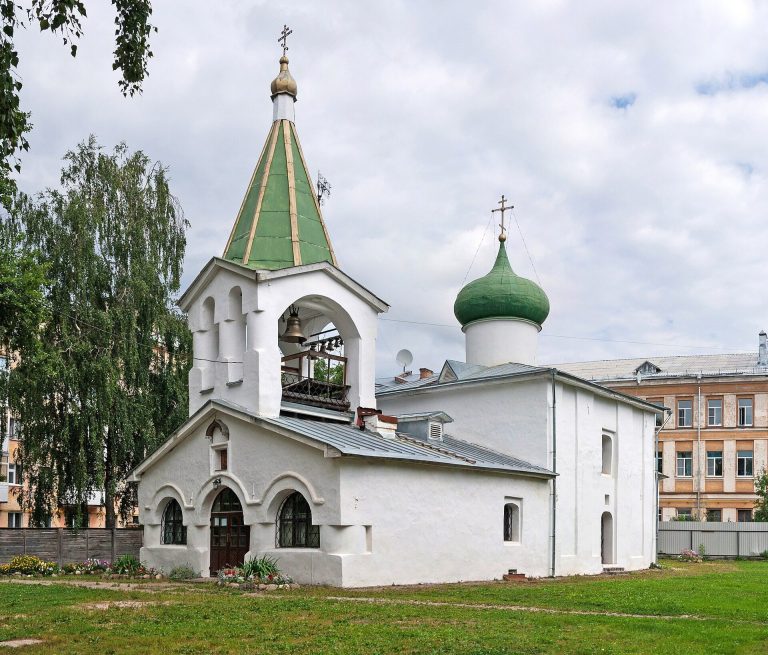
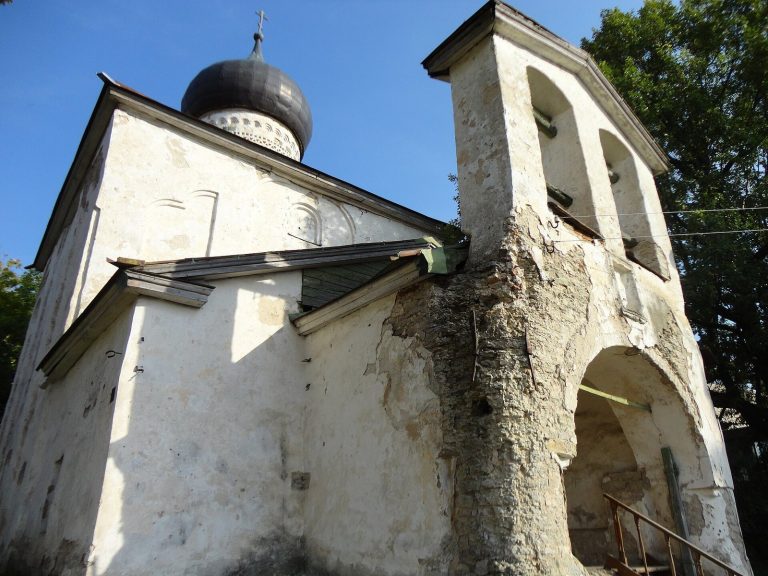
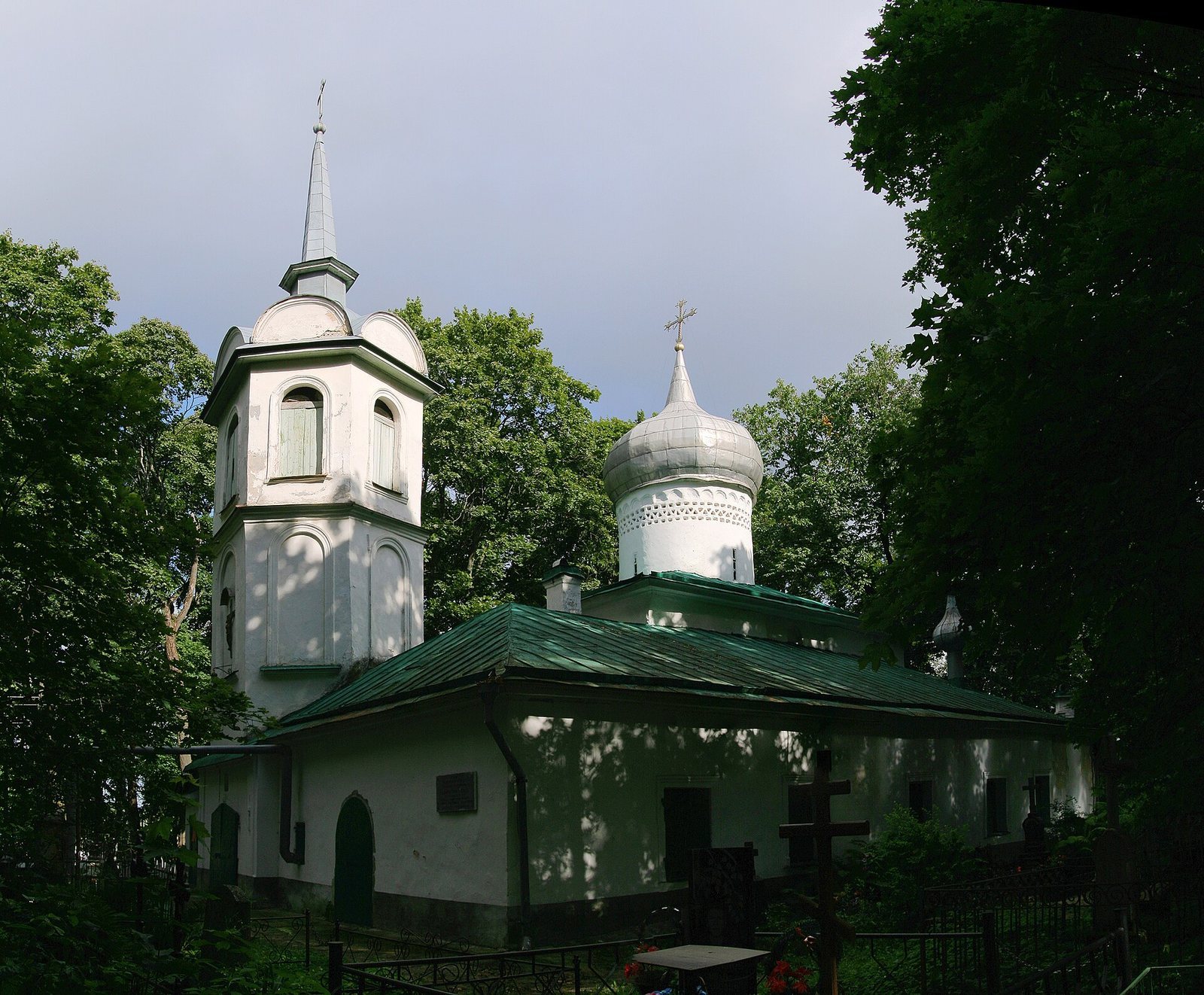
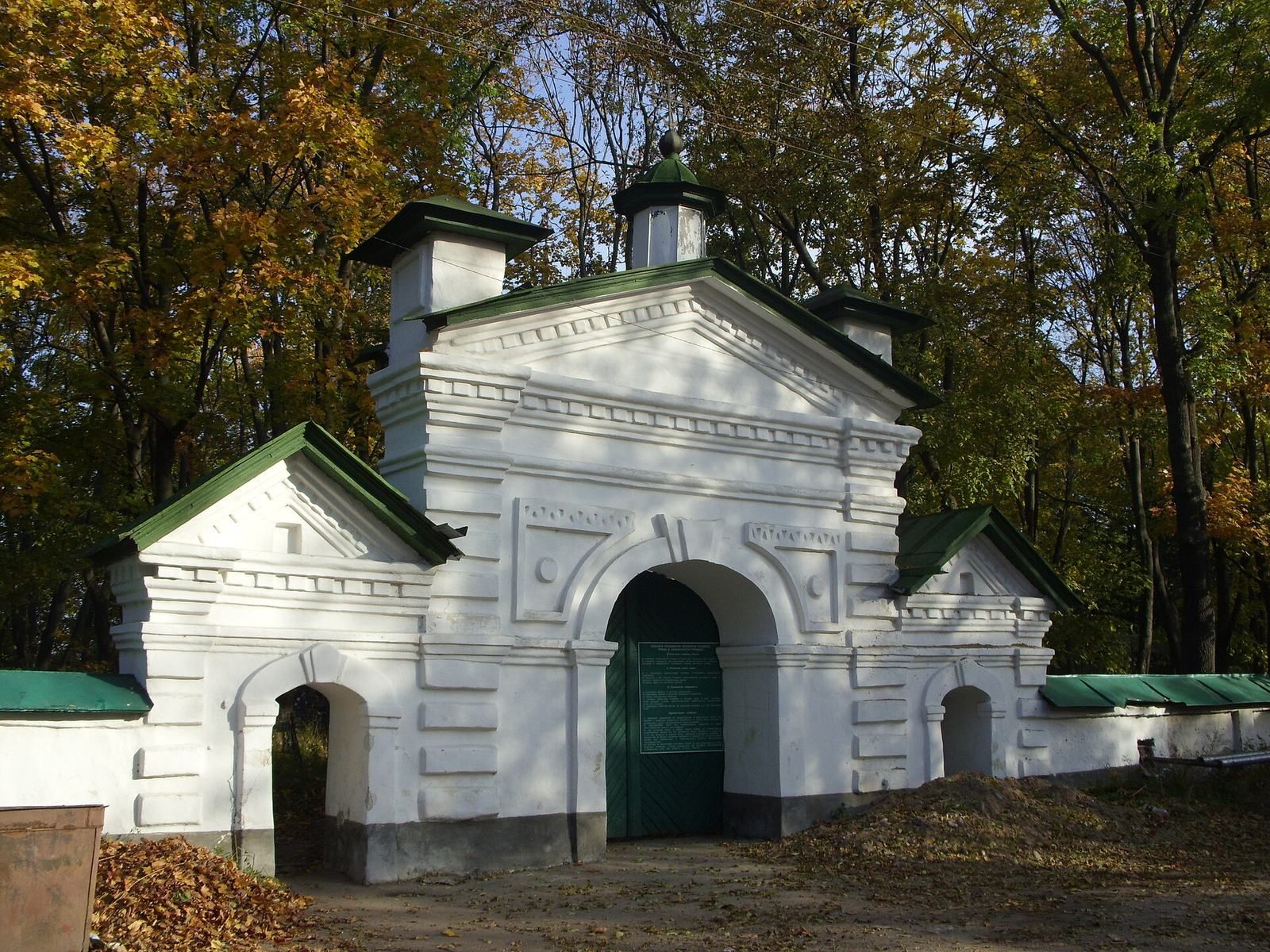
The church stands within its associated cemetery on the left bank of the Pskova. The complex includes a square main church, a western entrance vestibule and bell tower, and a south chapel. The buildings are made of local limestone slabs laid with lime mortar, then plastered and whitewashed.
Main church
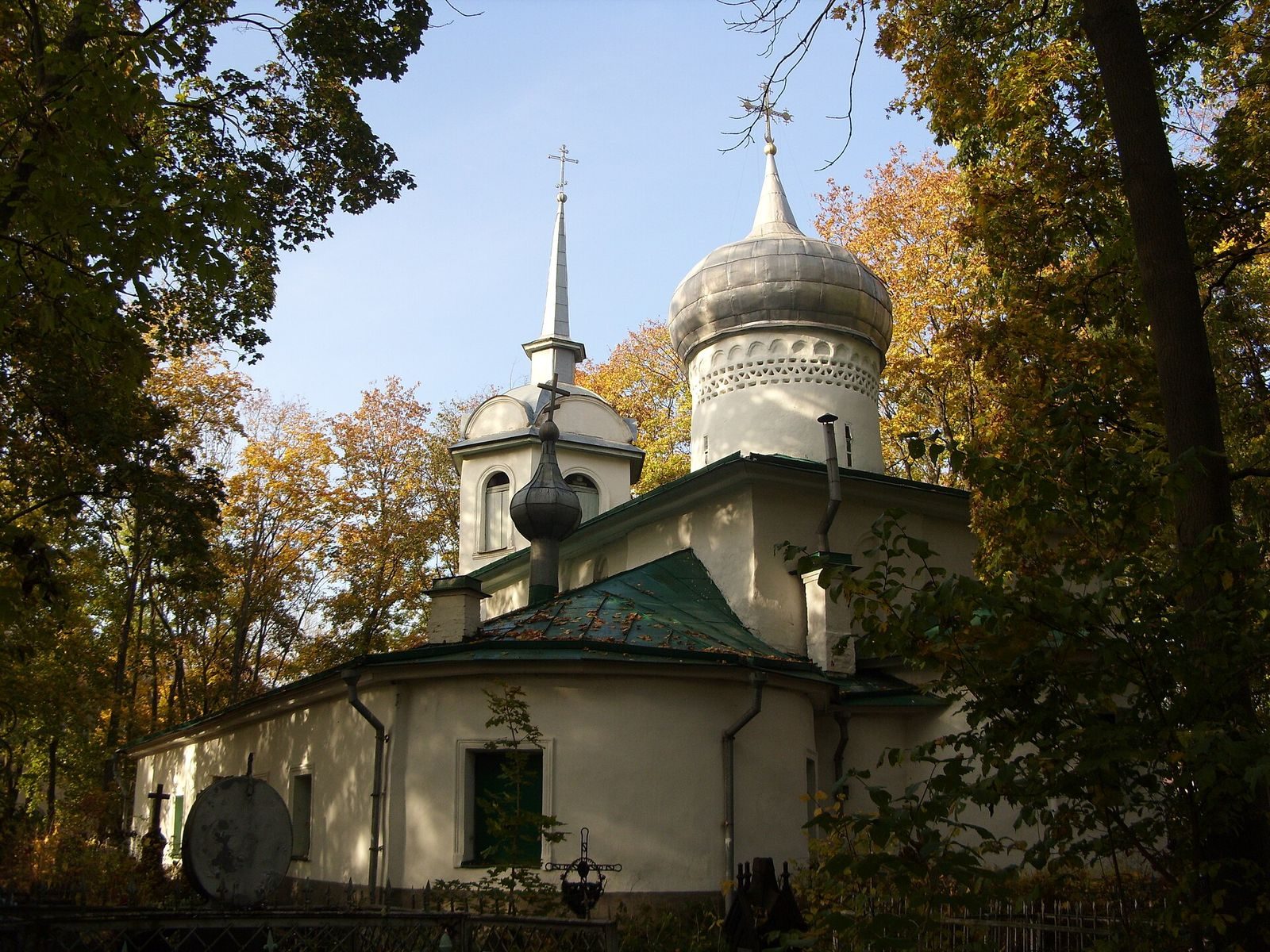
The main church is a square space supported by four piers, with three projecting sanctuary spaces. It measures 22 metres from west to east and 8 metres across. Its facades have restrained decoration characteristic of sixteenth-century Pskov church architecture. The windowed structure beneath the dome is ornamented with two rows of projecting angled bricks, divided by a band of diagonally set bricks.
The lower parts of the western piers are painted with white oil paint to about human height, while their upper portions carry oil-painted decoration. A description from 1763 says that the church had a wooden-board roof and a dome covered with tin.
Western entrance and bell tower
A vestibule and a three-tier bell tower occupy the west side. The tower’s upper levels are six-sided and end in lobed forms beneath a spire. The 1763 description identifies the bell tower as stone and notes that it held four bells.
South chapel
The chapel measures 21.5 metres long and 8 metres wide. It has a single projecting sanctuary space and a small dome raised on a decorative structure that supports the dome.
Cemetery
The cemetery developed around the church in the early nineteenth century. Nuns from the Old Ascension Monastery were buried there, and an enclosed area was set aside for Catholic burials in 1862. The Catholic section includes the grave of painter Vladimir Ottovich Rechenmacher, a pupil of Ilya Repin. The cemetery closed to new burials in 1960; it remains officially closed, with burials limited to family graves.
Among those buried here are Decembrist Mikhail Nazimov, a Russian officer and political activist associated with the failed uprising of 1825 and a friend of poet Mikhail Lermontov; relatives of Decembrist Ivan Pushchin; and I. I. Vasilyev, founder of the Pskov Archaeological Society and an honorary citizen of Pskov. Officers E. P. Nazimov and V. M. Bibikov, who fought in Russia’s 1812 war against Napoleon’s invasion, are also buried in the cemetery.
Other burials include Metropolitan John (Razumov), a senior Orthodox bishop who served Pskov and Porkhov from 1954 to 1987 and was buried beside the church’s south wall in January 1990; entrepreneur and art collector Fyodor Plyushkin; and public-schools director Illarion Skrydlov, father of Admiral Nikolai Skrydlov. The cemetery also contains the graves of architect and restorer Boris Skobeltsyn, actor V. A. Poroshin, writer and physician V. V. Kurnosenko (1947–2012), local historian and honorary citizen N. F. Levin (1928–2017), and several directors of the Pskov Gymnasium.