Church of San Martino: A Baroque Parish Church in Stadirano, Italy
Site at a Glance
- Popularity
- Very Low
- Country
- Italy
- Primary era
- Early Modern
- Eras represented
- Medieval, Early Modern, Modern
- Civilizations
- Duchy of Parma and Piacenza, Italian
- Site type
- Religious
- Remains
- Church
On this page13 sections
History
The Church of San Martino is a Roman Catholic parish church in Stadirano, a hamlet of Lesignano de’ Bagni, Italy. Its medieval origins and dedication to Martin of Tours, a fourth-century Christian bishop and saint, are followed by a Baroque reconstruction begun in 1722 and completed in 1732. The church belongs to the Diocese of Parma and its Pedemontana pastoral zone, a group of parishes coordinated for pastoral work.
Medieval chapel and parish status
The earliest known reference to the church dates to 1230, when the Chapel of Stadirano was listed among the dependent churches of Lesignano’s pieve, a parish church serving the surrounding area. The entry appeared in a diocesan register of ecclesiastical tithes. The dedication to Martin was recorded by 1354.
In 1545, the chapel was joined to the Church of San Pietro within Felino Castle because Stadirano had few inhabitants. It became an independent parish in 1564, ending that arrangement.
Rebuilding and repair
As the settlement’s population increased, the church was reconstructed in Baroque style. Work started in 1722 and was finished in 1732. On 27 April 1965, lightning struck the bell tower and also caused substantial damage to the church. Repairs followed.
Remains
The church has a single nave, the main body of the building, with one side chapel on each side. Its entrance faces south, while the presbytery, the area around the altar, lies to the north. The exterior combines a plastered, symmetrical front with stone facing on the exposed left side; inside, painted vaulted ceilings and carved furnishings shape the interior.
Exterior
Facade
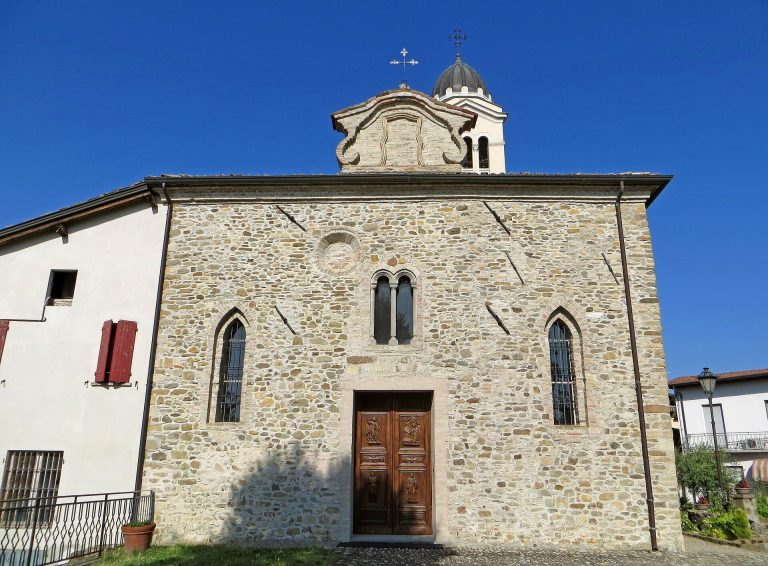
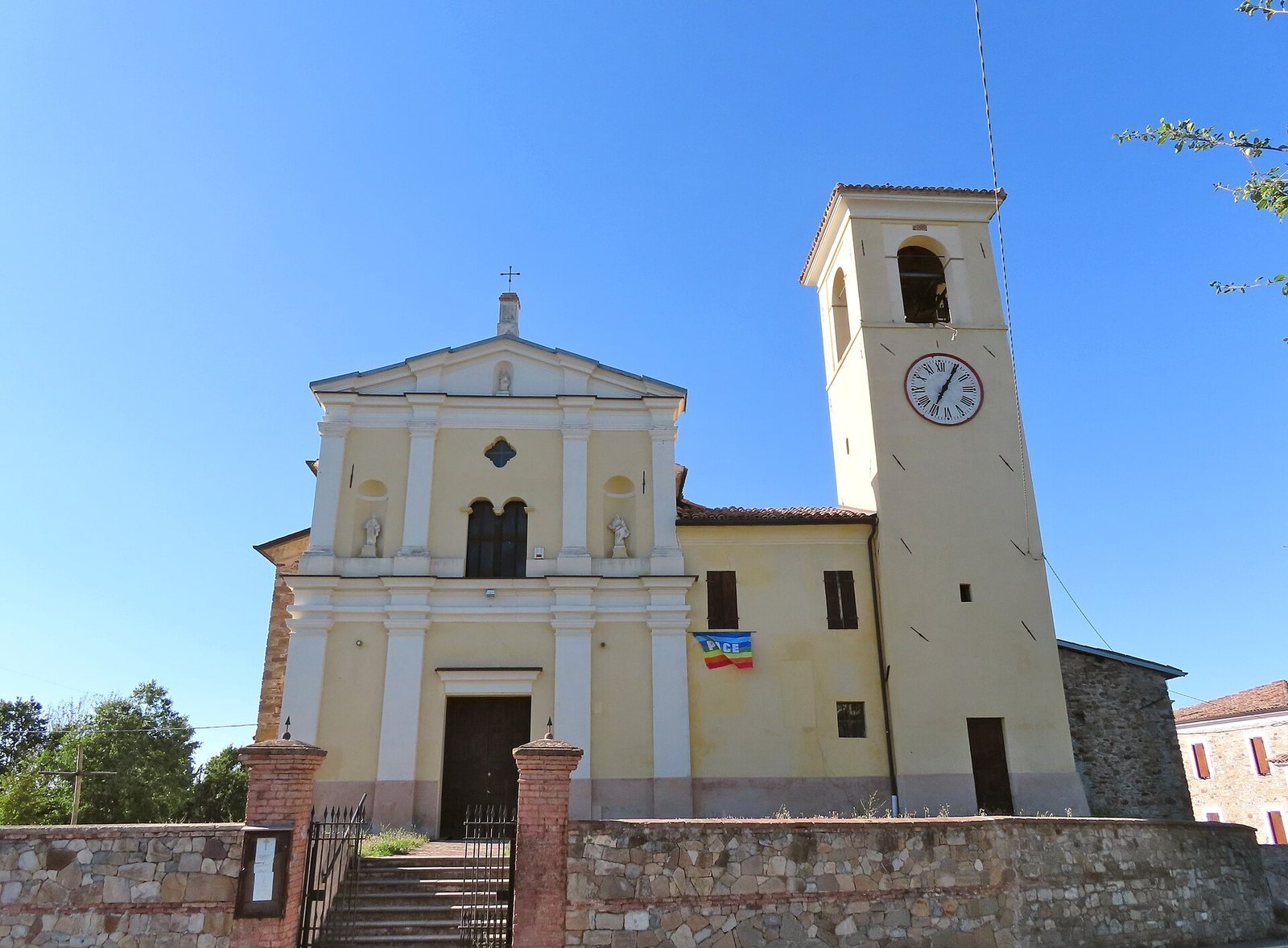
A projecting horizontal cornice, interrupted at its center, divides the facade into two levels. Four pilasters, shallow attached supports with capitals in the classical Doric style, separate the lower level into three bays. The broad central doorway has a raised frame above it. Four more pilasters continue the divisions on the upper level, where a two-opening window has lost its central divider. A cross-shaped opening sits above the window, and round-arched niches with statues flank it. The facade ends in a large, interrupted triangular pediment with a statue set in its central niche.
Rectory and bell tower
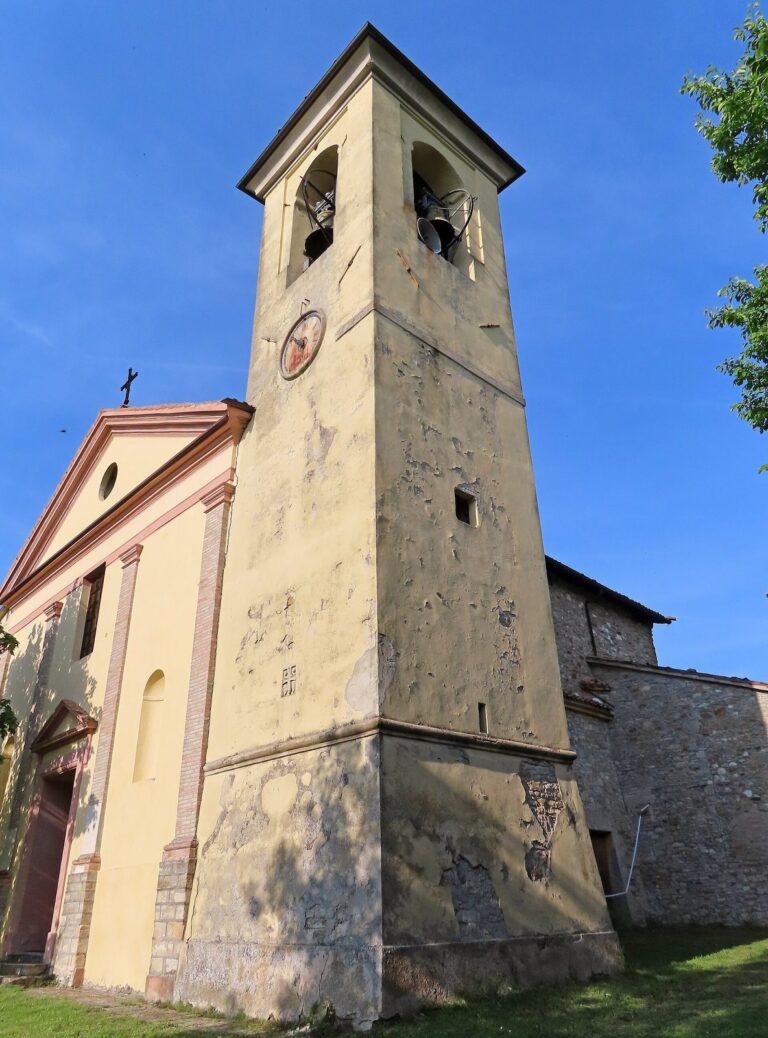
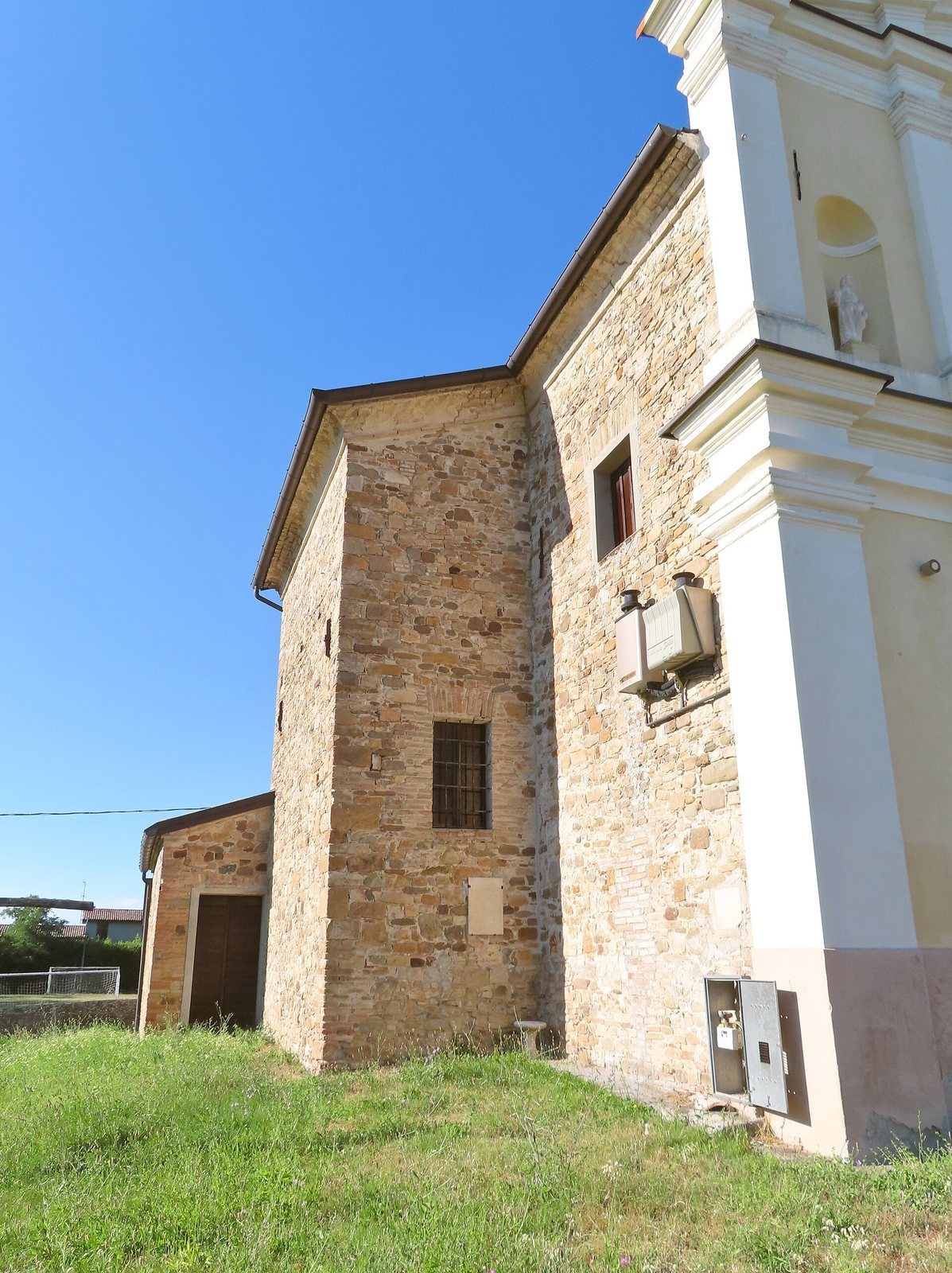
The rectory adjoins the right side of the front facade, and the bell tower stands at the church’s eastern end. Its bell chamber has a large, single-opening round arch on each of its four sides. Stone covers the exposed left flank of the church, from which a side chapel projects.
Interior arrangement
Nave and side chapels
Two painted cross vaults, formed by intersecting vaulted sections, cover the nave. Pilasters line its sides. Each side chapel opens onto the nave through a broad round arch and has a barrel vault, a continuous arched ceiling.
Presbytery
A triumphal arch marks the transition from the nave to the presbytery, which stands slightly higher than the nave. Its ceiling is a barrel vault with lunettes, curved sections set into the vault. A wooden altar in a table-like form was installed there in 1990. Behind it is a late-eighteenth-century altarpiece showing Martin and a beggar.
Altarpieces and furnishings
Altarpieces and paintings
A further eighteenth-century altarpiece has a pediment depicting the Souls in Purgatory, a state of purification after death in Catholic belief. It contains a painting of the Death of Saint Joseph dating from the same period. The church also holds an oval portrait of Saint Louis Gonzaga, made around 1780 and possibly painted by Antonio Bresciani.
Carved woodwork and other furnishings
Andrea Ferrari, an eighteenth-century woodcarver, made numerous Rococo furnishings for the church in the second half of that century. They include an altar with an altarpiece and brackets, a kneeler, a lectern, a chest, doors, choir furnishings, and frames for the Stations of the Cross, devotional scenes from Jesus’ final journey to crucifixion. Six candleholders are shaped as putti, decorative figures represented as children. Other furnishings include an early-eighteenth-century confessional, an eighteenth-century credenza, and a silver chalice from the same century.