Il Redentore: Venice’s Renaissance Votive Church
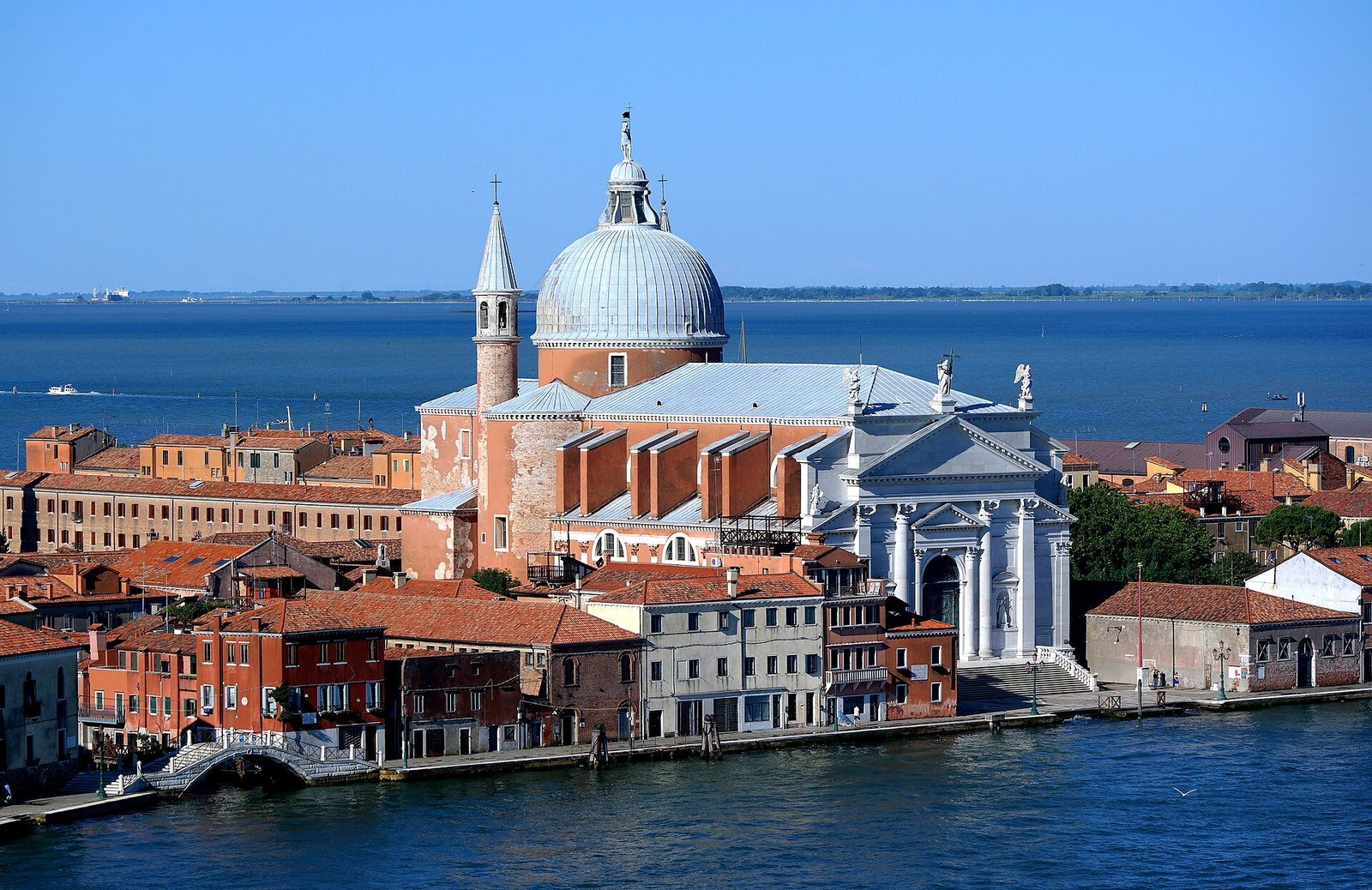
Site at a Glance
- Popularity
- Very High
- Country
- Italy
- Primary era
- Early Modern
- Eras represented
- Early Modern
- Civilizations
- Venetian
- Site type
- Religious
- Remains
- Church
On this page14 sections
History
The plague vow and construction
Il Redentore is a Renaissance votive church on Giudecca in Venice, Italy, built in fulfillment of a public vow. Andrea Palladio designed it in 1576 as Venice sought deliverance from plague, and its dedication to the Redeemer made it an expression of civic thanksgiving as well as a place of worship.
The outbreak began in 1575 and continued into 1577. It killed an estimated 46,000 to 50,000 people, roughly one-quarter to one-third of Venice’s population. On 4 September 1576, the Venetian Senate vowed to build a church if the city was spared. Doge Sebastiano Venier, the elected head of the republic, and the Great Council approved the project, and the Senate commissioned Palladio. The Senate first considered a central-plan church, arranged around a central space. Palladio also proposed a basilican plan, organized around a long nave, or main worship space. Its broader nave better met requirements associated with the Council of Trent, the Catholic council whose reforms shaped church practice.
The Patriarch of Venice, Giovanni Trevisan, laid the foundation stone on 3 May 1577. On 21 May, a procession crossed a temporary pontoon bridge, a floating bridge, from the Piazzetta to an altar at the building site. After the plague receded that summer, Venice held a thanksgiving procession on 20 July. Palladio died in 1580, and Antonio da Ponte continued construction according to his design. The church was completed in 1592 and consecrated on 27 September that year.
Religious use and annual observance
At the urging of Pope Gregory XIII, the church was entrusted to the Capuchins after its consecration. The Capuchins are a branch of the Franciscan religious order. A monastery was attached to the church, and a small community of monks continues to live there. Il Redentore also remains an active parish church within the Patriarchate of Venice, the local Catholic jurisdiction.
The annual Festa del Redentore, held on the third Sunday of July, commemorates Venice’s deliverance and continues the thanksgiving tradition. A pontoon bridge links the Zattere with Giudecca; fireworks take place on the preceding evening, followed by a procession and Mass. In earlier celebrations, the doge and senators crossed the bridge to attend Mass, and the Patriarch of Venice blessed the city.
Remains
Setting and plan
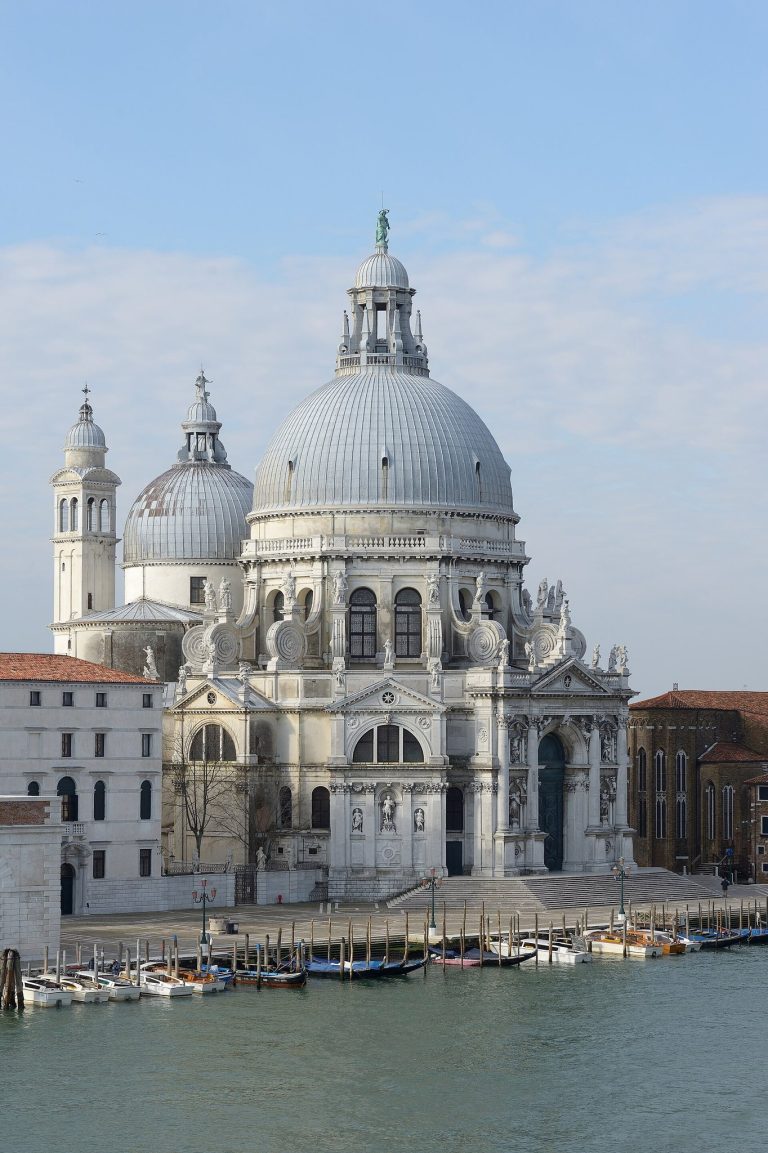
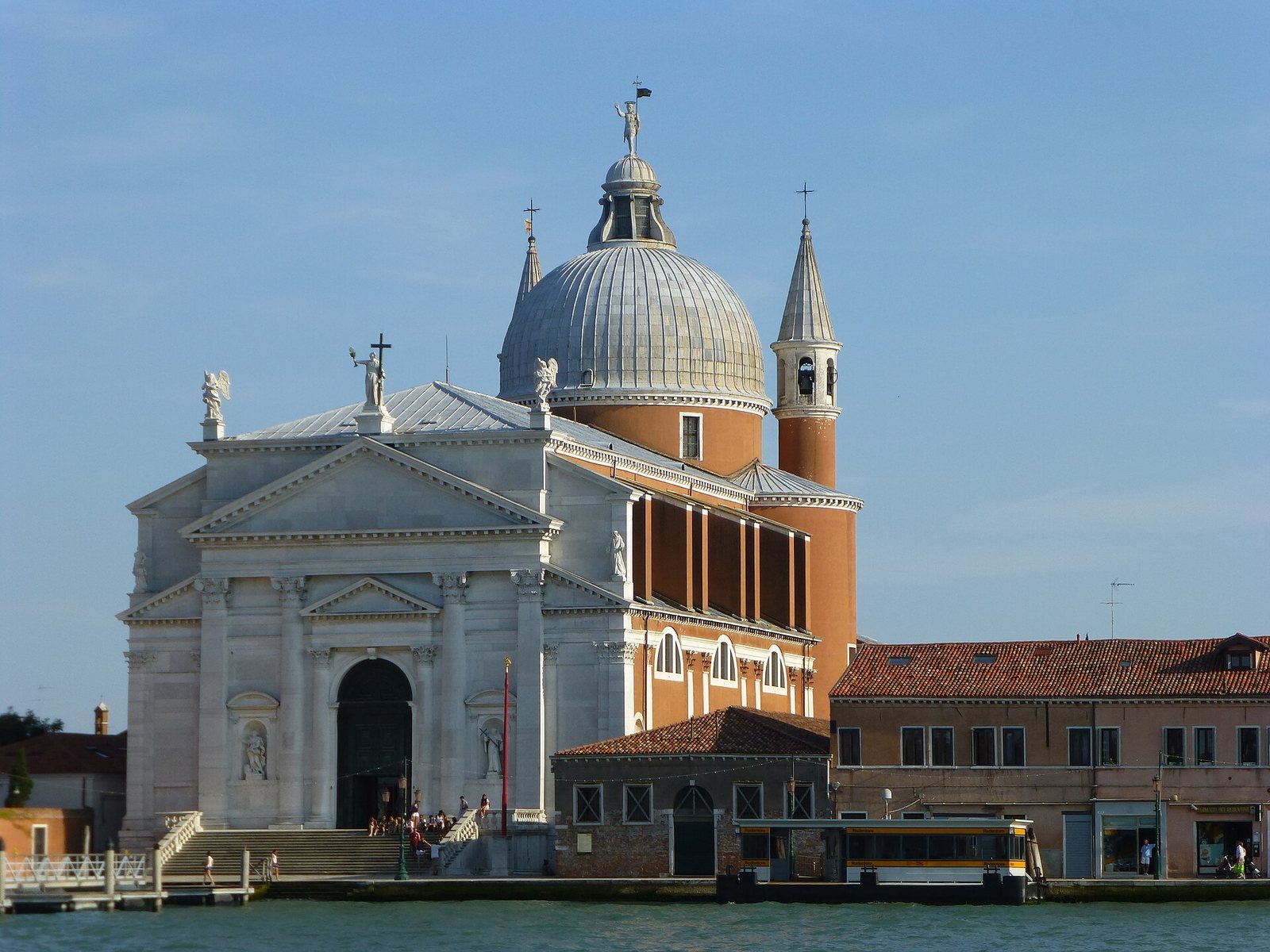
The brick church stands on Giudecca’s waterfront beside the Canale della Giudecca, facing the canal route toward the Piazzetta. It is a prominent feature of the island’s skyline. The building measures 75 metres long and 30 metres wide. Its plan has a single nave, three side chapels on each side, a dome, and two exterior bell towers.
Exterior
Façade
Fifteen steps lead to the façade, which rises from a broad base. Its overall height is four-fifths of its width, while the central portion’s width is five-sixths of its height. Palladio arranged a large triangular pediment, or roof-end feature, above the smaller pediment over the entrance. Sloping roof sections add further triangular forms, and small curved pediments sit above the statue niches. An upper wall rises above the main pediment. A statue of the Savior crowns it, while niches beside the entrance hold figures of Saint Mark, Venice’s patron saint, and Saint Francis of Assisi.
Interpretations of the façade connect it with Rome’s Pantheon and with the Roman treatment of the façade at San Giorgio Maggiore. Palladio also used ancient Roman triumphal-arch forms at San Francesco della Vigna. The church’s façade and dome share design similarities with San Giorgio Maggiore, which Palladio sought to complement in Venice’s southern skyline. The cathedral façade at Villafranca di Verona closely follows Palladio’s design.
Dome and bell towers
A statue of the Redeemer stands atop the dome. The two bell towers, each 48 metres high, have forms compared to minarets, the towers of mosques. Their appearance has prompted suggestions of eastern influence.
Façade damage in 2022
On 15–16 May 2022, vandals painted an area roughly three metres wide pink and added an equation to the façade. An attempt to wash the paint away with water drove it further into the stone. Government art officials were assigned to carry out restoration.
Interior
Nave and crossing
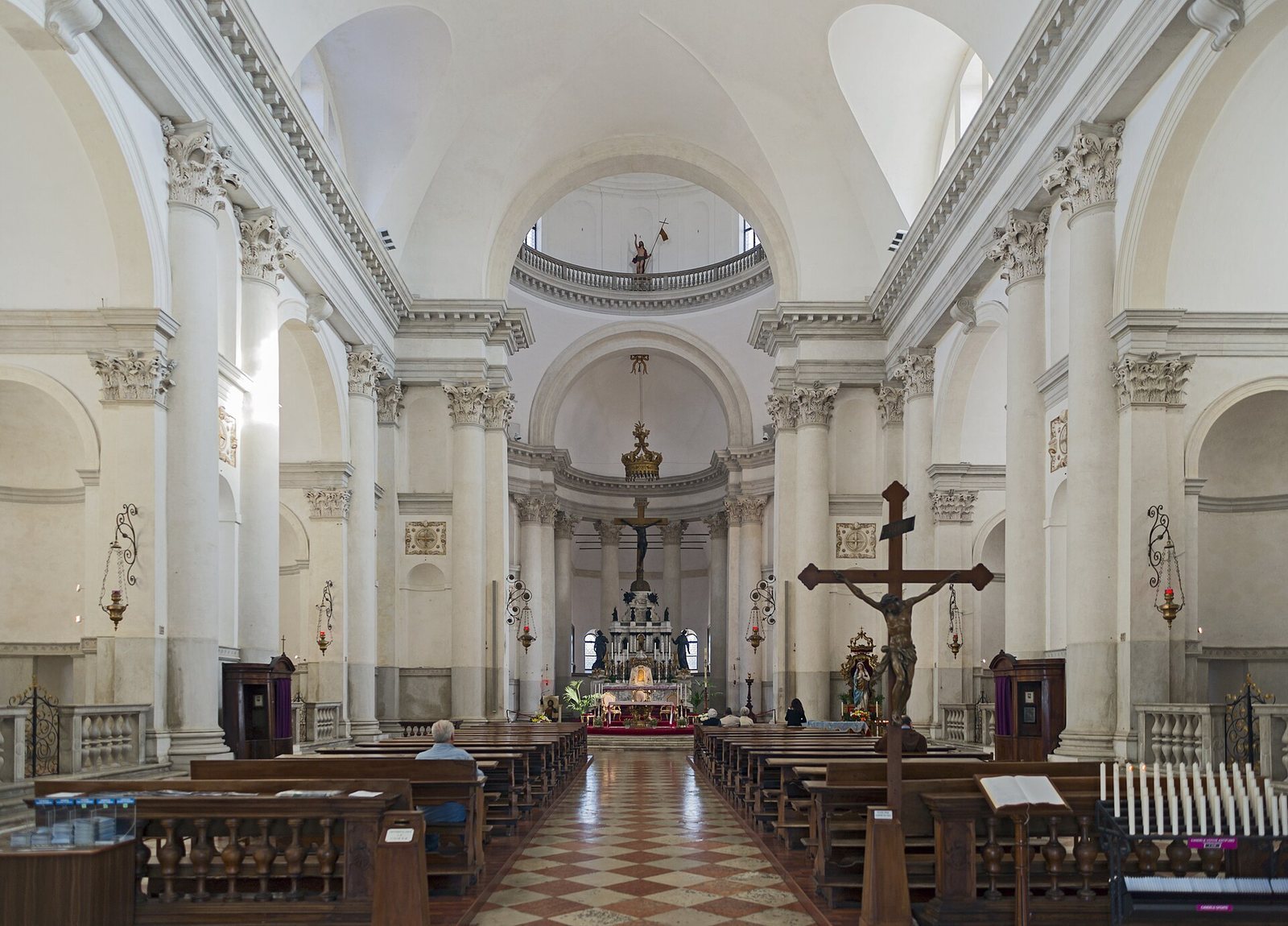
The interior combines a long nave with a short transept, the section that crosses the nave, and a light-filled domed crossing where the two meet. White stucco plaster and gray stone cover the interior, while a continuous Corinthian column style, with capitals decorated by acanthus leaves, runs around it. Semicolumns, or half-columns set against walls, line the nave and support the dome, which opens above an arch. Large semicircular windows in the side chapels and upper nave admit abundant light.
Sanctuary and altar
The church’s three main areas had distinct purposes. The presbytery, the area reserved for clergy, was intended for the monks; the apse, the church’s end space, and main altar served votive purposes; and the nave was for parishioners. A Corinthian colonnade frames the apse and altar while leaving a view through to the choir behind them. The Baroque main altar is decorated with a crucifix and statues by G. Campagni.
Paintings and sacristy
Paintings inside the church include works by Tintoretto and his workshop, Paolo Veronese, Jacopo Palma the Elder and Palma the Younger, Francesco Bassano, Jacopo Bassano, Alvise Vivarini, Antonio Vivarini, Pietro della Vecchia, Lazzaro Bastiani, Carlo Saraceni, Leandro Bassano, Francesco Bissolo, and Rocco Marconi. The sacristy contains Antonio Vivarini’s Madonna with the Sleeping Child and wax heads of Franciscans made in 1710. A 1561 oil painting on canvas by Veronese, Baptism of Christ, is also associated with the church.
Painted views of the church
Canaletto painted views featuring Il Redentore. One oil painting shows it with San Giacomo, a church since demolished, visible on the right; a notable Canaletto view is held at Woburn Abbey in England. J. M. W. Turner’s 1841 painting of three Giovanni Bellini paintings arriving at the church in a gondola procession portrays an event that almost certainly never took place. The hazy sketch anticipates Impressionism and abstraction. Duncan Grant also painted a work titled Il Redentore in 1948.