Maon Synagogue: An Ancient Jewish Place of Worship in the Western Negev
Site at a Glance
- Popularity
- Medium
- Country
- Israel
- Primary era
- Medieval
- Eras represented
- Medieval
- Civilizations
- Byzantine
- Site type
- Religious
- Remains
- Synagogue
On this page16 sections
History
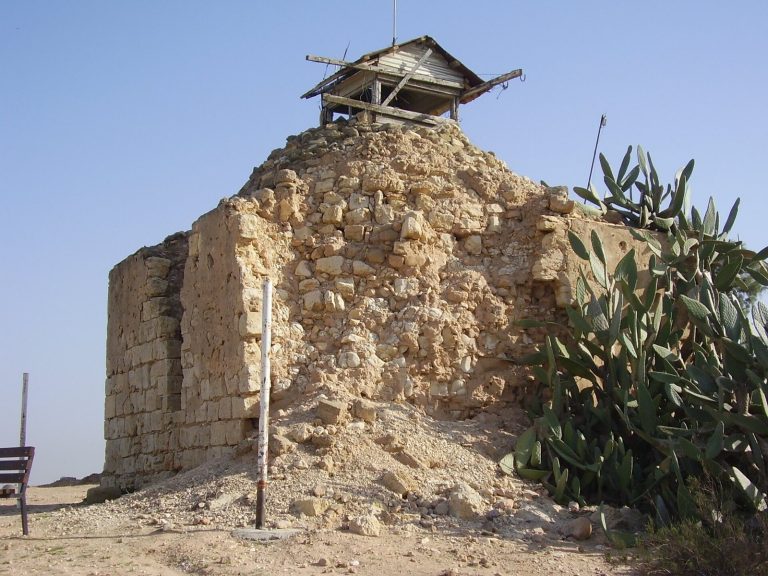
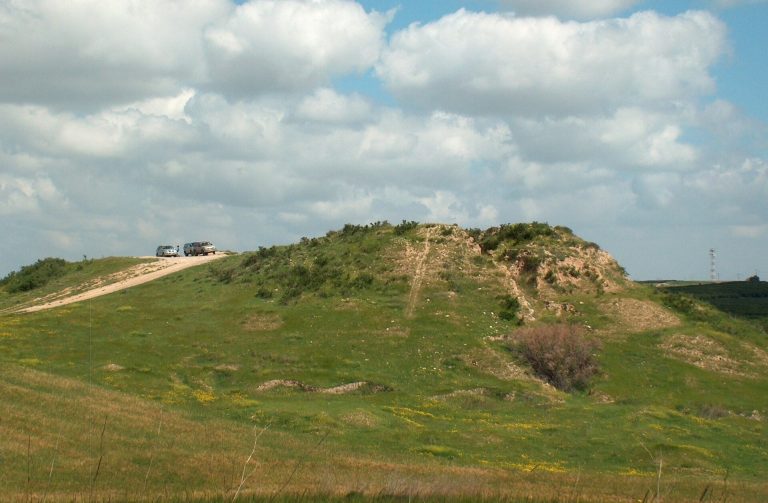
The Maon Synagogue is an ancient Jewish place of worship in the western Negev of Israel, near Kibbutz Nirim and Kibbutz Nir Oz, about 20 km south of Gaza. It belonged to a Jewish settlement that reached its height in the fifth and sixth centuries. The synagogue’s construction date is uncertain, and it is one of three ancient synagogues discovered in the western Negev.
Settlement and identification
One identification places the synagogue at Hellenistic Menois, a settlement from the period of Greek cultural influence after Alexander the Great, and connects it with a place shown on the Madaba Map, a Byzantine-era mosaic map of the Holy Land. The Byzantine period was that of the eastern Roman Empire. An alternative places the late-antique fort of Menois, from the transition between the classical Roman world and the early Middle Ages, at Chirbet Ma’n, while locating the Byzantine settlement at Abesan, 3.5 km away.
Sixth-century alterations
During the sixth century, the synagogue was remodeled. Builders opened a breach in its northeast wall, added an apse facing Jerusalem, raised the floor, and installed marble columns and a mosaic floor. These changes mark a major phase in the building’s development, although its original construction date remains unknown.
Excavation and discovery
Road construction exposed part of the mosaic in February 1957. Shalom Levy led salvage excavations from March to May that year and returned to excavate in April 1958. The work revealed the synagogue, and Levy published a brief report in 1960. In 1957, artist Naomi Henrik was commissioned to make a copy of the mosaic for the President’s House.
Remains
Building and settlement layout
Synagogue plan
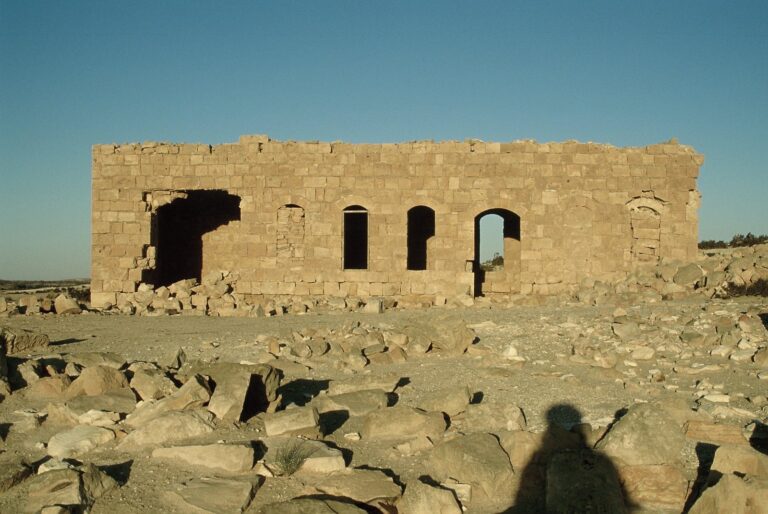
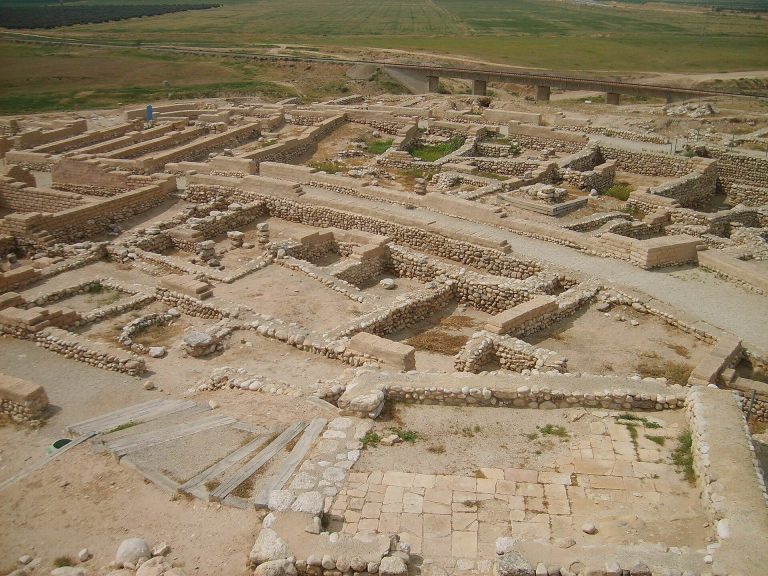
The synagogue measures about 17 by 15 m and survives only in a basic, weathered condition, with brick walls. Levy interpreted it as a basilica, a long hall with a central nave and side aisles. In his reconstruction, two rows of four columns separated the three aisles, the mosaic occupied the central aisle, and the side aisles had stone paving. The roof, he proposed, rested on wooden beams and was made of clay. Another interpretation draws on parallel wall lines excavated by Ora Yogev in 1980, almost 20 m apart. Since those lines were too far apart to support a roof, they may have enclosed a courtyard, with the interior limited to the area of the mosaic.
Sanctuary and nearby features
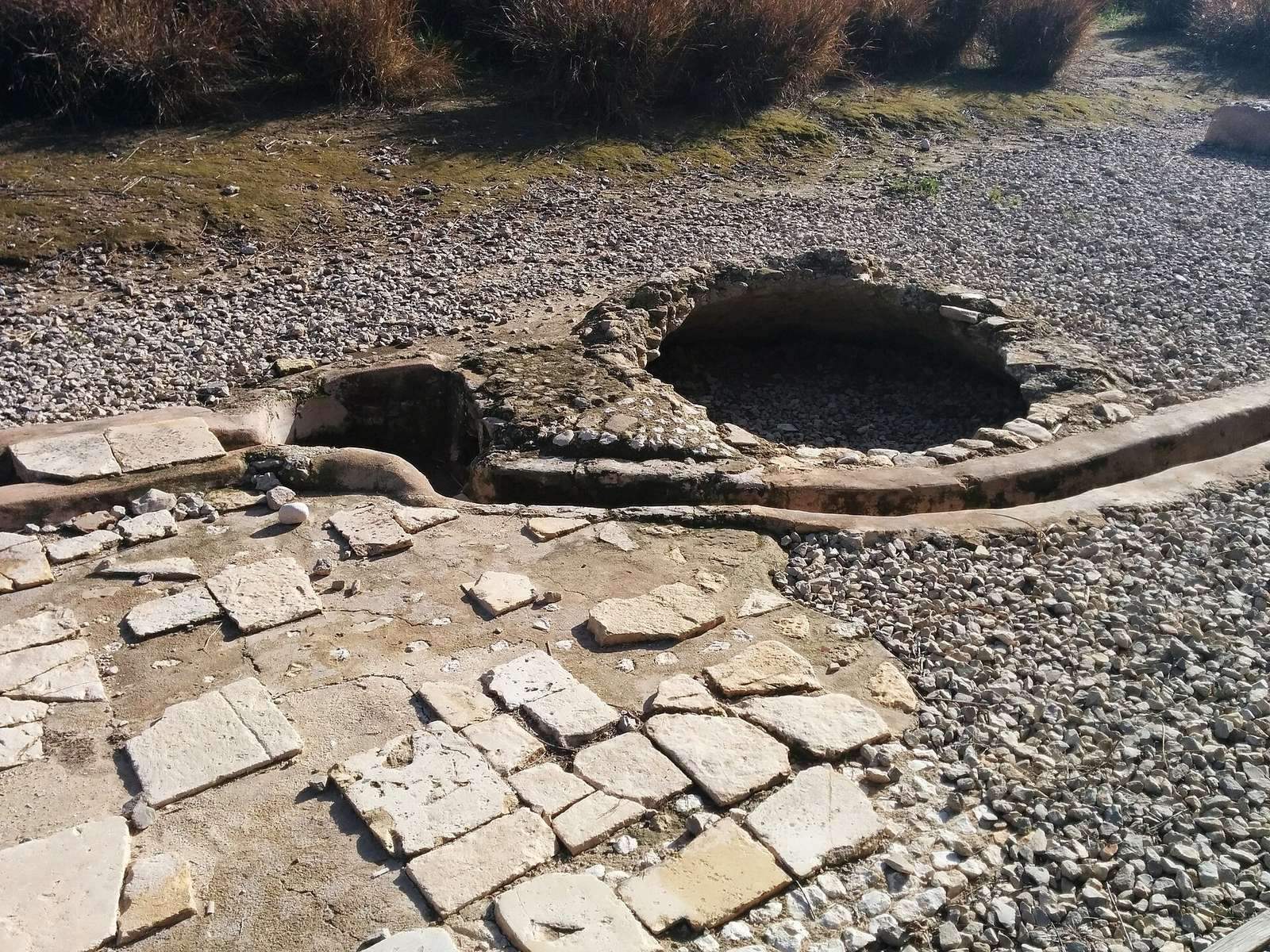
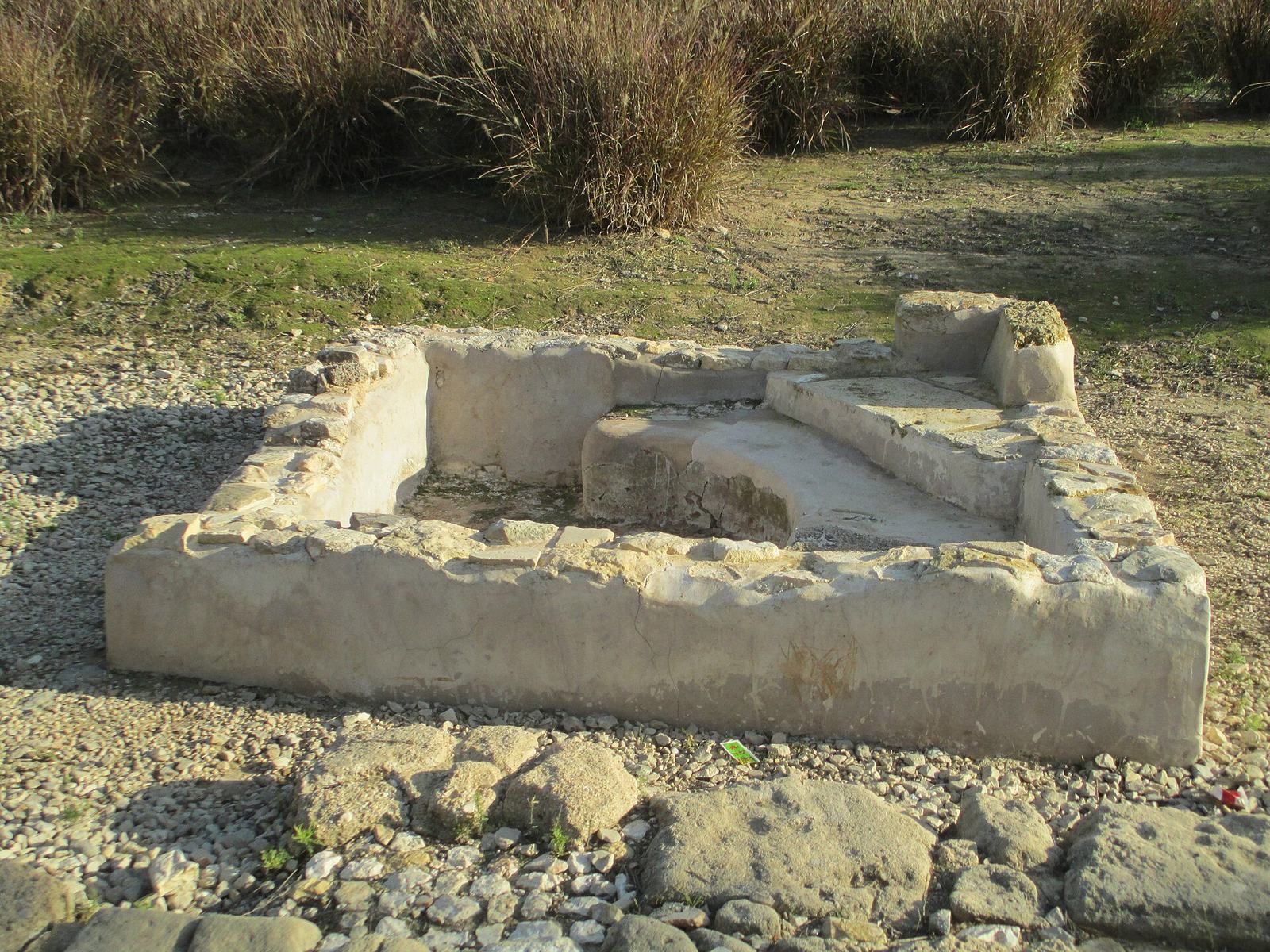
The apse, a projecting sanctuary end, faces northeast toward Jerusalem and was intended to hold the Torah Ark, the cabinet for Torah scrolls. A bema, or raised platform, stood in front of it. A cistern, water channels, and a mikveh, a Jewish ritual bath, lie beside the synagogue ruins. Remains of two other buildings are also present at the settlement.
Mosaic floor
Layout and decoration
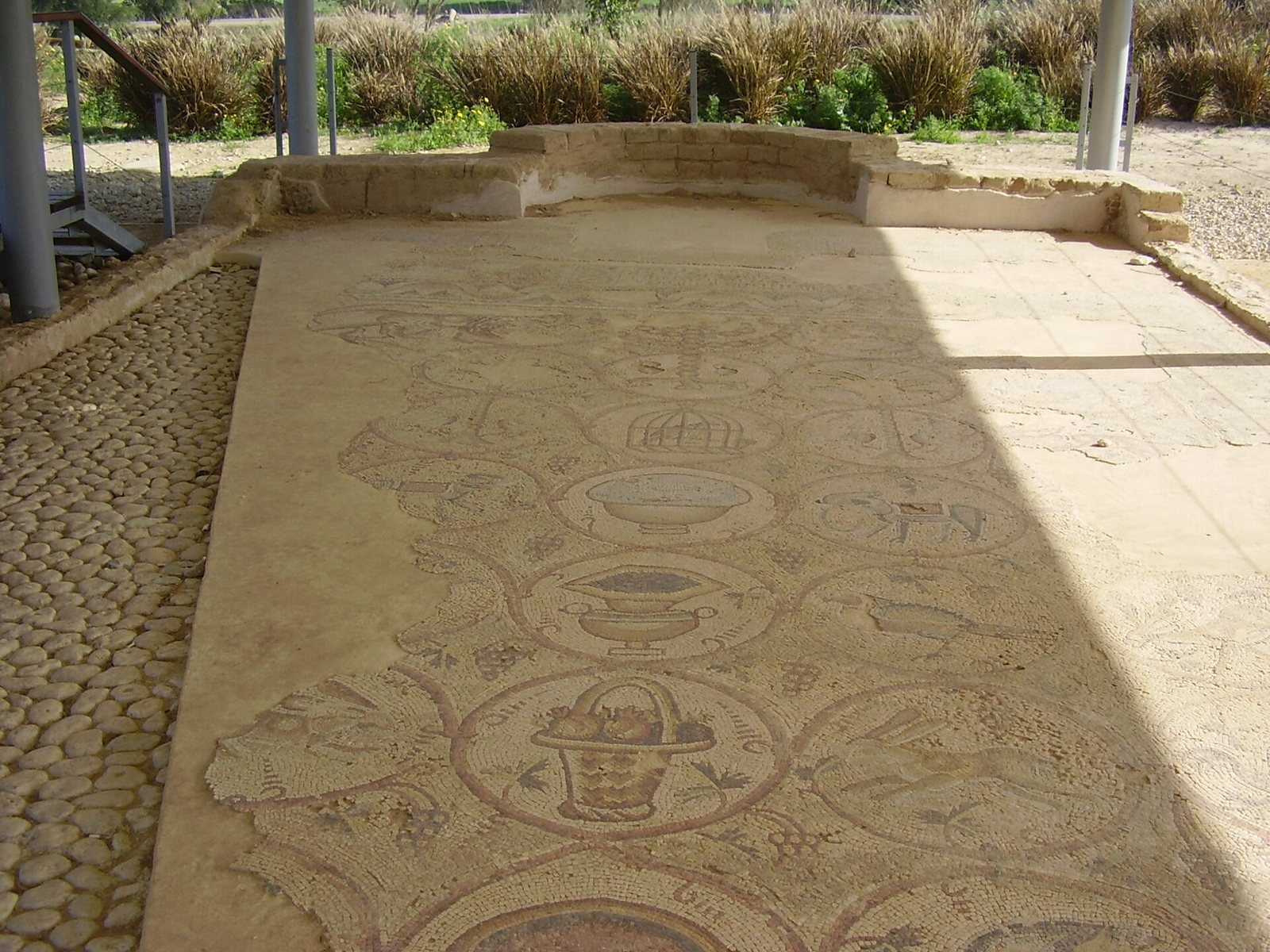
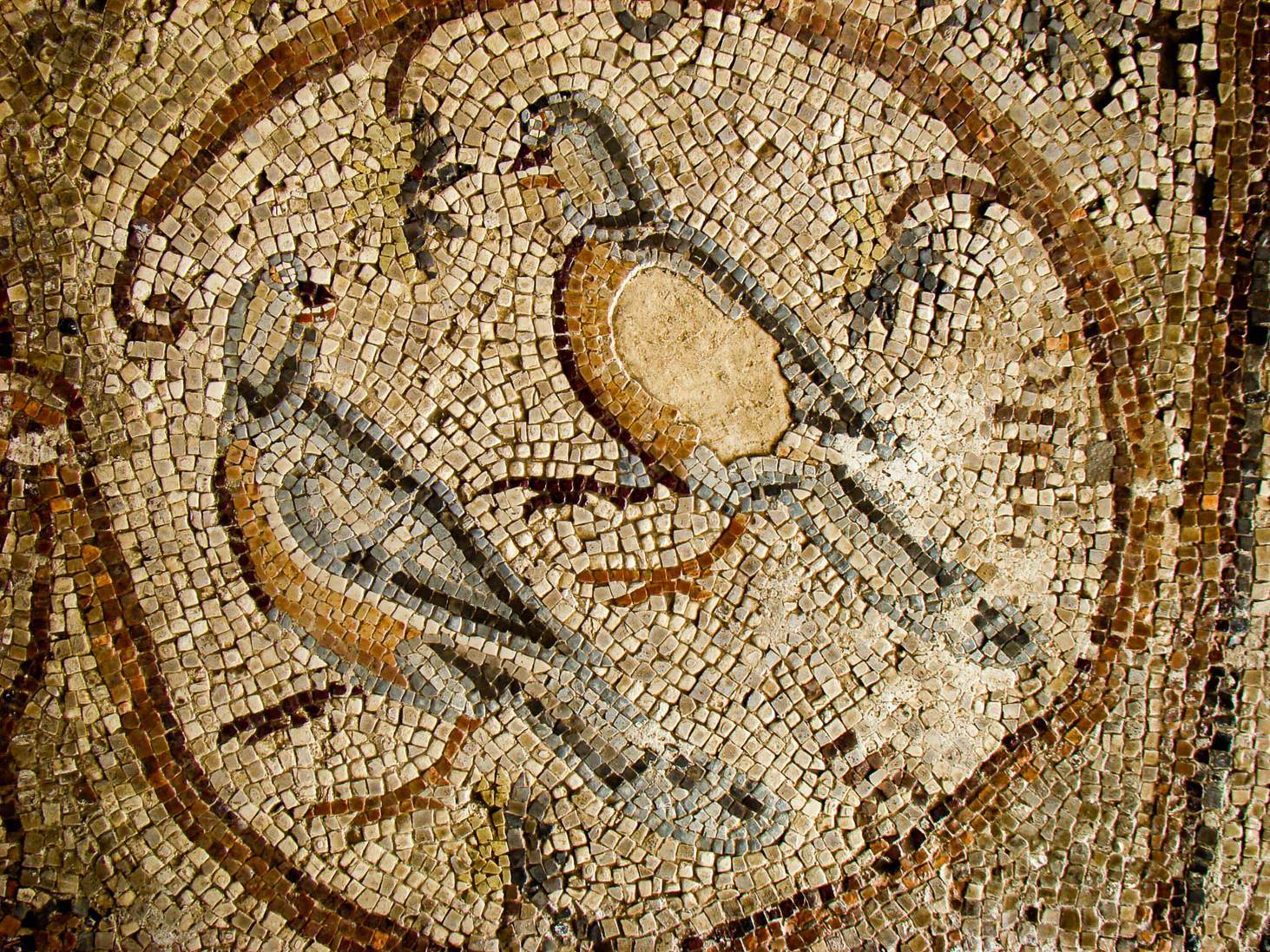
The floor mosaic occupied the synagogue’s central area and measured 10.2 by 5.4 m. Its medallions were arranged symmetrically along a central axis in 11 rows, within a floral border. Of the original 55 medallions, 18 are lost, and the mosaic’s lower portion had already been destroyed before its discovery. A vine grows from an amphora, a large two-handled storage vessel, and loops around the medallions. The designs include vessels, some containing fruit, and images that may depict stages of winemaking. At the lower end, an amphora is flanked by two peacocks.
Animals and birds
Mammals pictured include a hare, an Israeli gazelle, a fallow deer, a leopard, a lion, a zebu, a fat-tailed sheep, a greyhound, and an elephant carrying a riding carpet. The birds include a desert partridge, a pin-tailed sandgrouse, a grey crane, a greater flamingo, a quail in a cage, domestic fowl, a domestic goose, a helmeted guineafowl, a common pheasant, an Indian peacock, and a golden eagle. The eagle wears a collar and locating bell associated with falconry.
Jewish symbols and inscription
A seven-branched menorah, or candelabrum, stands on three legs shaped like lion paws, with glass lamps attached. Two stylized palm trees and two lions flank it. Nearby images include the emblem of the tribe of Judah, two etrog fruits (citrons used in Jewish ritual), two shofar horns (ram’s horns), and a lulav, a bundle of palm fronds used in Jewish ritual. An incomplete Aramaic dedication above the menorah sits in a tabula ansata, a panel with handle-like projections. It blesses the community and honors three donors, though its wording is difficult to interpret.
Comparisons and conservation
The mosaic resembles a church floor at Khirbet Shallal, about 9 km east of Maon. An inscription there dates the church mosaic to 561 or 562; the two floors may have been made by the same artist in the third quarter of the sixth century. A similar floor is also known from an ancient synagogue in Gaza. After its discovery, the Maon mosaic deteriorated. In 2006 it was removed for conservation at the Rockefeller Museum laboratories in Jerusalem, cleaned, and fixed to a new foundation. It returned to the site in 2009, when a protective shelter was built over it.
Finds from the apse
Objects associated with the Torah Ark
Excavations in the apse area recovered coins, bone and metal objects thought to be connected with the Torah Ark or its decorative curtain, and fragments of glass and ceramic lamps. Other finds included fragments of a bronze candelabrum, glass candlesticks, ivory carvings, and iron nails that may have come from decorative inlay on a wooden Ark.
Amulets and inscribed objects
The excavated objects also included dozens of amulets, some used by women seeking good health, along with inscribed metal plates and 20 inscribed metal cylinders. Three cylinders opened in the 1980s contained magical formulae in Aramaic. Their position near the Torah Ark may have been intended to give them magical power temporarily, but they were more likely deposited permanently as offerings after the people concerned recovered from illness.