Lerna: A Prehistoric Settlement and Sanctuary in Greece
Site at a Glance
- Popularity
- Very High
- Country
- Greece
- Primary era
- Bronze Age
- Eras represented
- Stone Age, Bronze Age, Classical
- Civilizations
- Roman
- Site type
- City
On this page20 sections
History
Lerna is an archaeological site near the modern village of Mili on the eastern coast of the Peloponnese in Greece, where settlement began by the fifth millennium BCE. It stood beside the Argolic Gulf, between mountains and the sea, on an ancient route linking the Argolid with the southern Peloponnese. This position may have helped shape its importance, and during the Bronze Age Lerna became a fortified centre before later use as a cemetery.
Water, myth, and worship
Greek traditions connected Lerna’s springs with Poseidon, the sea god, and Amymone, one of Danaus’s daughters. The waters were thought to have healing properties, and ancient stories also linked the wells to the Danaids, the daughters of Danaus. Four wells were considered sacred even though water was abundant throughout the area. Lerna was also associated with an entrance to the Underworld, the realm of the dead in Greek myth.
The Lernaean Hydra, a water monster, was said to guard that entrance. Heracles killed it as the second of his labours. Pausanias described the creature as unusually large and poisonous but believed it had only one head. He attributed its familiar many-headed form to the poet Pisander of Camirus, who had made the monster more frightening. Another tradition treated the Hydra as the Underworld’s gatekeeper.
The Alcyonian Lake was linked to Dionysus, a god associated with wine and ritual, and to his descent to recover his mother, Semele. The story said that Prosymnus guided him. Pausanias described the lake as perilous for swimmers and said that no one had reached its bottom. Even the Roman emperor Nero, he recounted, had failed to measure its depth with a long rope weighted with lead.
Lerna also held mysteries sacred to Demeter, goddess of agriculture and fertility, and celebrated the Lernaea festival in her honour. Tradition credited their foundation to Philammon, but Pausanias relayed Arriphon’s argument against the attribution. Arriphon reasoned that the poem and accompanying prose linked to Philammon could not be his work because they were written in Doric, which he argued the Argives did not speak in Philammon’s time. Pausanias also described annual nighttime rites for Dionysus beside the lake, whose sacred details he declined to reveal.
In another Dionysian rite, the god was summoned as Bugenes, meaning Son of the Bull, with an archaic trumpet. A lamb was cast into the water as an offering to the Underworld’s gatekeeper. The lake’s ritual purifications were also associated with the saying a Lerna of ills.
Neolithic occupation and the Bronze Age centre
People occupied Lerna from the Neolithic, by the fifth millennium BCE at the latest, followed by an interval of abandonment before settlement resumed in the Bronze Age. Its archaeological sequence is divided into seven phases. Lerna I belongs to the Early Neolithic; Lerna II includes Middle and Late Neolithic remains as well as traces of Early Helladic I. Early, Middle, and Late Helladic are period names for Bronze Age archaeology on the Greek mainland.
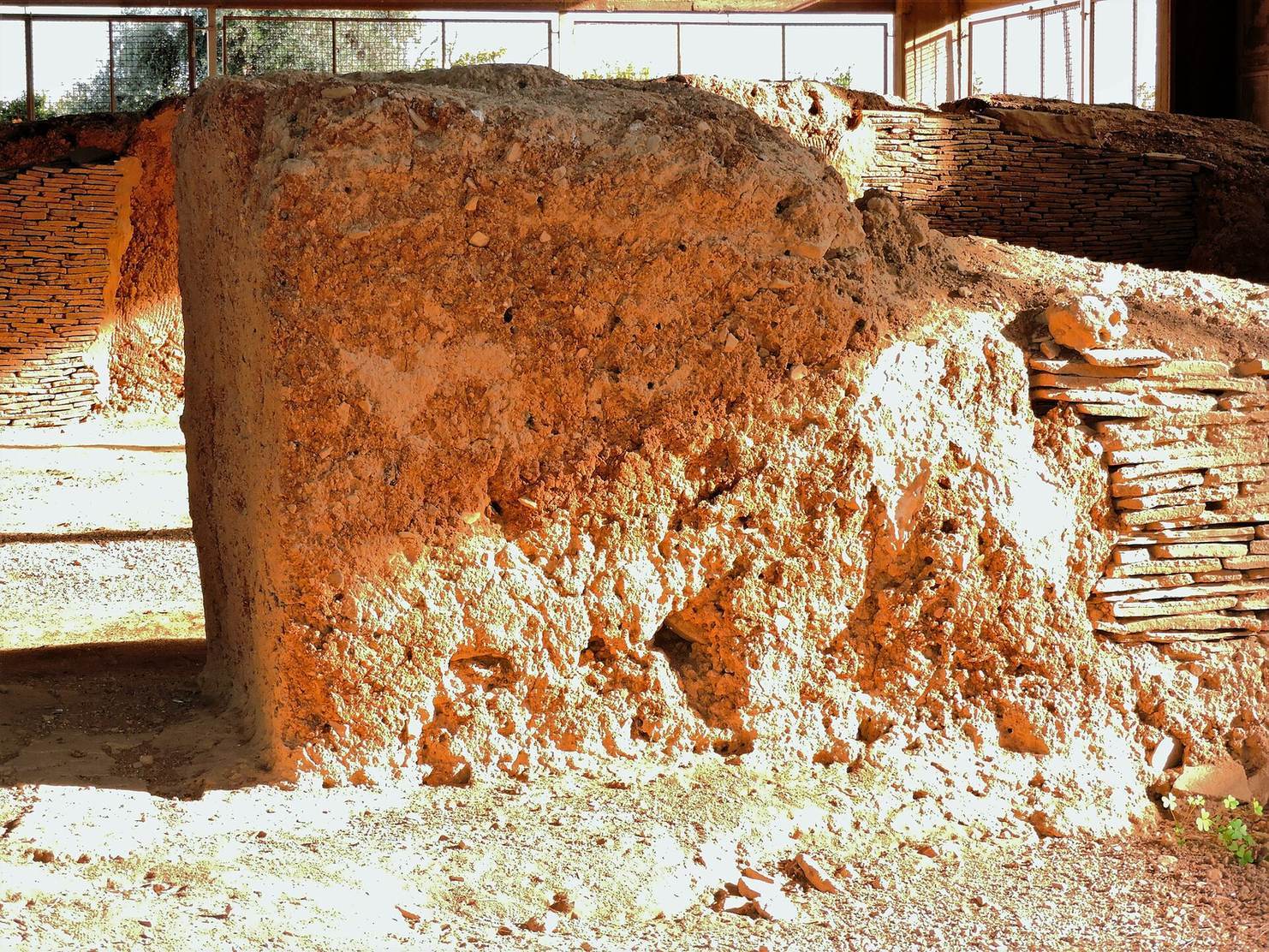
Lerna III, of Early Helladic II, marked a major change from the earlier settlement, with no clear continuity in its finds from the preceding layers. The community built a fortified centre that included the House of the Tiles, an administrative building in use during the third millennium BCE. Fire destroyed it at the end of Early Helladic II, and it was not rebuilt. An earthen mound covered the remains. At the end of the Middle Helladic period, people cut shaft graves into the mound, suggesting that the building’s earlier importance had been forgotten.
From town to cemetery
Lerna IV, associated with Early Helladic III, represented a change from a fortified centre of authority to a small town. By the end of this phase, a decline in obsidian from Melos points to reduced long-distance trade. Lerna V, in the Middle Helladic period, continued the settlement but brought new pottery styles and increased imports. Burials in pits within or between houses became common.
The later sequence includes Lerna VI, spanning the end of the Middle Helladic and Late Helladic I, and Lerna VII, associated with Late Helladic IIIA and IIIB and the Iron Age. In the Mycenaean period, which corresponds to the Late Helladic era, Lerna served as a cemetery. The site was abandoned shortly after 1250 BCE.
Excavation and the changing lake
John L. Caskey began excavating Lerna in 1952. His publications on the Bronze Age layers, Lerna I–V, encouraged further investigation. Geological work, including core drilling, later identified the location of the vanished Lake Lerna. Deforestation increased the silt entering the lake and transformed it into a malarial marsh. Its remaining waters dried up during the nineteenth century.
Remains
The site’s prehistoric remains are centred on a large mound built up during a long period of Neolithic occupation. In Early Helladic II, builders levelled and enlarged its crest for a new settlement. Lerna’s physical record includes the fortified centre, successive residential areas and burials, pottery, and features associated with the former lake and its sacred landscape.
The mound and fortified centre
Mound and defenses
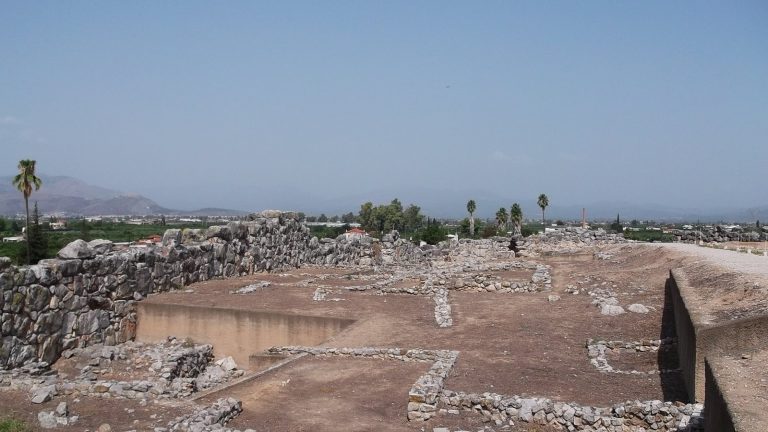
The mound measures about 180 by 160 metres. Its crest was prepared for the Early Helladic II settlement, which included two circuits of defensive walls with towers. Two smaller houses also belonged to this phase, alongside the larger House of the Tiles.
House of the Tiles
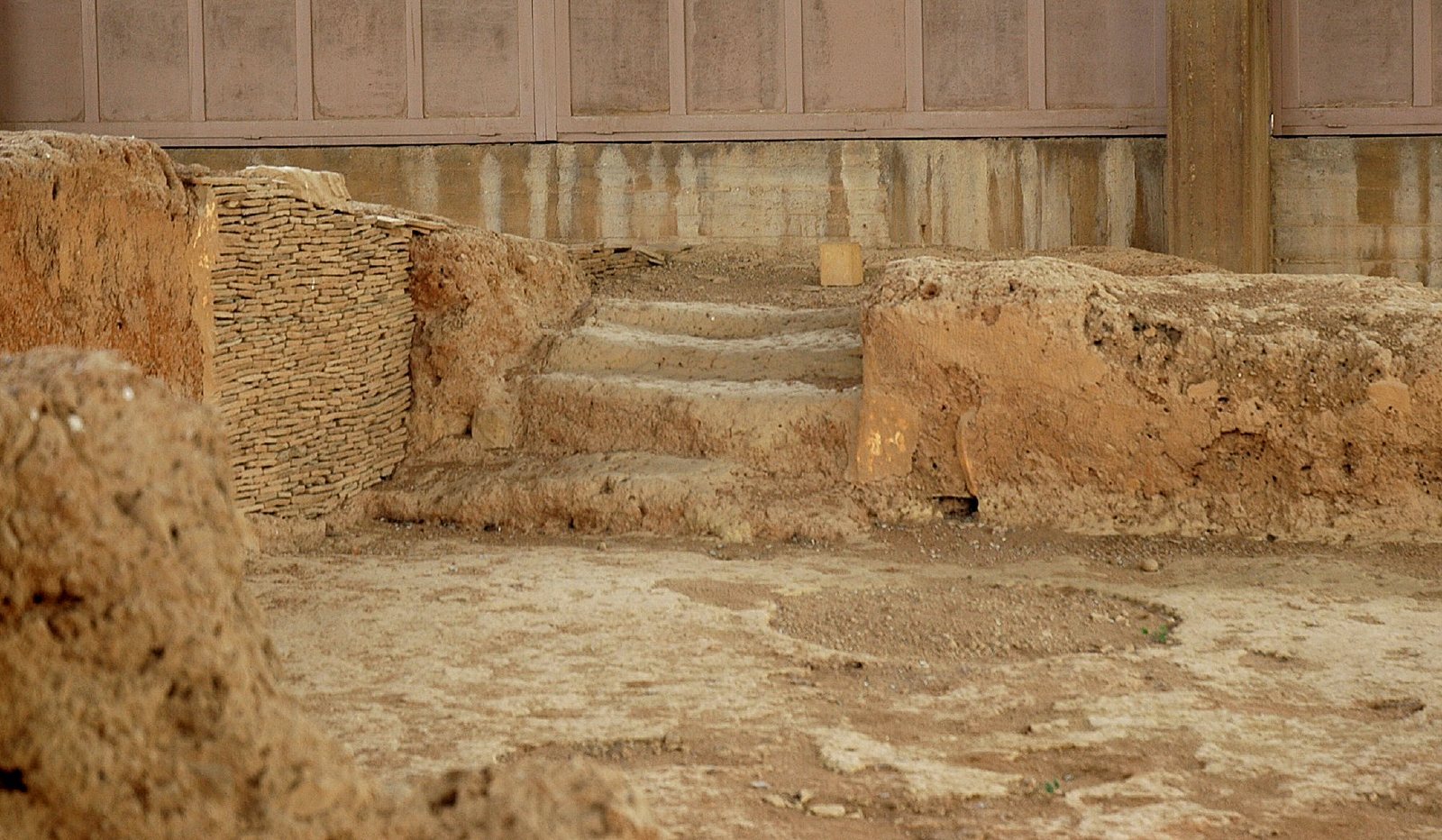
The House of the Tiles was a two-storey building about 25 metres long and 12 metres wide. Its walls reached roughly one metre in thickness, and stairs connected the floors. Terracotta tiles covered the roof, giving the building its modern name.
Residential areas and burials
Lerna IV houses and lanes
Most Lerna IV houses had two or three rooms, with crude-brick walls resting on stone foundations. Some contained a circular hearth at the centre. Narrow lanes ran between the buildings. Many unlined pits gradually filled with rubbish, animal bones, pottery fragments, and sometimes complete vessels. This phase also included a circular, often domed structure known as a tholos, as well as two houses.
Later houses and graves
Lerna V included five houses, while two shaft graves belong to Lerna VI. Lerna VII includes an oven dated to the Roman period. These features form part of a settlement record that also reflects Lerna’s later use as a burial place.
Pottery and household evidence
Lerna III pottery
Lerna III pottery included spouted pouring vessels called sauceboats, bowls with inward-curving rims and flat or ring-shaped bases, and broad saucers, sometimes with glazed rims. Jars and water-carrying vessels had rounded profiles. Painted decoration was limited, though some fragments bear patterns stamped with cylindrical seals. Impressions from the same seals have also been found at Tiryns and Zygouries.
Lerna IV pottery
The pottery of Lerna IV differed markedly from that of the preceding phase. Vessel forms changed, and regular spiral grooves on bases and parallel incised lines point to increasing use of the potter’s wheel. A characteristic style used dark-glaze lines on a pale surface. Caskey identified early examples resembling Minyan ware, a distinctive type of Bronze Age Greek pottery. Among the relatively few imports was a winged jar thought possibly to have come from Troy IV, an archaeological phase at Troy.
Lerna V pottery
Lerna V pottery included matte-painted vessels and a thick-coated Argive version of grey Minyan ware. Imports became more numerous and included pottery from the Cyclades and Minoan Crete. The Cretan material was associated with Middle Minoan IA, a phase of the Bronze Age civilization of Crete.
Lake and sacred landscape
The lake and springs
Lake Lerna was a freshwater coastal lake, separated from the Aegean Sea by barrier dunes. Its estimated diameter in the Early Bronze Age was 4.7 kilometres. Pausanias later described a marsh with reeds and grass along its edge and a calm-looking surface. He gave its circumference as no more than three stadia, an ancient Greek measure of distance. Karst springs, where groundwater emerges through soluble rock such as limestone, remain in the region.
Grove, temples, and images
Pausanias described a grove of plane trees extending from Pontinus Hill almost to the sea, between the Pontinus and Amymone rivers. He said the hill absorbed rainwater that might otherwise have flowed to the sea and that the Pontinus River issued from it. On the hilltop stood a temple to Athena, of which ruins remained; Pausanias also described foundations belonging to the House of Hippomedon. He placed marble images of Demeter Prosymna, Dionysus, and a small seated Demeter in the grove. A seated wooden image of Dionysus as Savior stood inside a temple elsewhere, while a marble Aphrodite by the sea was reputed to have been dedicated by Danaus’s daughters. Tradition also credited Danaus with building a temple to Athena beside the Pontinus.
Springs and mythic places
Near the source of the Amymone, a plane tree was traditionally identified as the place where the Hydra was born. Pausanias also described the spring of Amphiaraus and the Alcyonian Lake, which he treated as a marsh. These water sources and associated places formed part of Lerna’s sacred landscape.