Santi Fermo e Rustico: The Parish Church of Monte in Colognola ai Colli
Site at a Glance
- Popularity
- Low
- Country
- Italy
- Primary era
- Early Modern
- Eras represented
- Early Modern, Modern
- Civilizations
- Italian, Venetian
- Site type
- Religious
- Remains
- Church
On this page18 sections
History
Santi Fermo e Rustico is the Roman Catholic parish church of Monte in Colognola ai Colli, Italy, dedicated to the Christian martyrs Fermo and Rustico, venerated particularly in the Veronese tradition. The present church was built between 1611 and 1627, with a classical design and a neoclassical facade. It belongs to the Diocese of Verona and its East Veronese vicariate and Pieve Pastoral Unit, local groupings of parishes.
Medieval church and parish status
By 1145, a church dedicated to Saints Fermo and Rustico stood at Colognola. Its elevated, fortified position served a security purpose. In the fifteenth century, the church became the parish church and was enlarged. In 1456, the older parish church of Colognola, a pieve (historic parish church serving a surrounding district), was placed under its authority. This was an institutional change, not a transfer of the older church building.
The present church and bell tower
The current church replaced the earlier building between 1611 and 1627. Its early-fifteenth-century bell tower remained in use after the new church was constructed, until 1754. A replacement tower was built between 1754 and 1770 using material from the older structure.
The bells and their history
Bells were in use at the church by the thirteenth century. In 1232, after the Veronese army destroyed and sacked the castle, a large bell made by Don Giò Batta Bonaventura was removed from the castle tower. Until the middle of the eighteenth century, two bells at the church were used to warn residents of danger.
In 1770, Larducci of Verona supplied bells for the new tower. Two broke within four months, and he cast five replacements the following year. After further breakages, Giuseppe Ruffini was commissioned in 1776 to make an eight-bell peal, an ensemble arranged for coordinated ringing. Its largest bell weighed about 1,500 kilograms. The peal was among the early groups to reach eight bells, as the Veronese ringing system, a method of swinging bells in coordinated sequences, began moving beyond five-bell groups. In 1845, Antonio Selegari recast the two largest bells and added a new one, known as the Campanone or Rengo di Colognola. The resulting nine-bell peal was the first of its kind.
After four bells broke, the archpriest Don Carlo Vicentini authorized the Cavadini foundry to recast them in 1872. The bells were shown at the 1873 Vienna Universal Exposition, where they received a gold medal for merit. Residents from across the municipality contributed to the project, and Empress Caroline Augusta of Bavaria gave 600 lire. The bells reached Verona by train on 8 January 1874 and were inaugurated at Colognola on 19 April.
The Cavadini firm replaced the bells’ wooden support frame with a metal one in 1906. During the Second World War, a plan to take 50 to 60 percent of bell-peal weight for Italian army cannon production would have removed 4,310 kilograms from Colognola’s bells. Archpriest Monsignor Alessandro Marangoni alerted Ettore Cavadini, who came to the town. The peal’s German-language diploma and its 1873 gold medal helped avert its destruction. Allied forces also used the visible tower as a reference point for air raids; Colognola was not bombed.
Organ and later work
The church’s first organ was made by Fedrigotti. In 1870, an instrument from Gaetano Zanfretta’s firm replaced it. Mascioni made the present organ in 1939; it was restored in 1986 and inaugurated again on 7 February 1987. The facade was restored in 2011 and 2012.
Remains
The church has a classical interior arranged around a single nave and a Latin-cross plan, in which the nave and transept form a cross shape. Four side chapels, two on each side, extend the interior. Outside, the neoclassical facade and the separate bell tower preserve features and materials from earlier phases of the church and town.
Facade and churchyard
Facade and inherited stonework
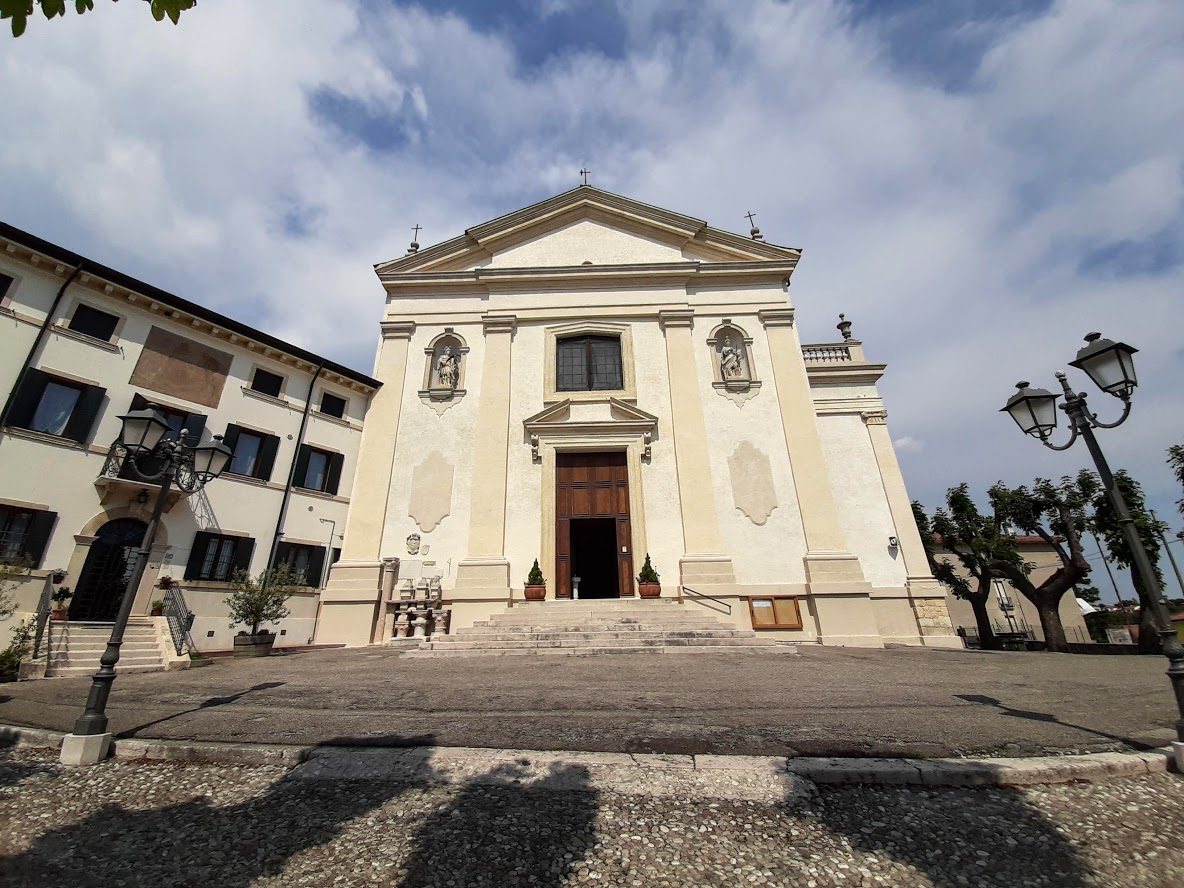
Bernardo Avogaro designed the neoclassical facade, which Giacomo Zandomeneghi and Francesco Felisi carried out. Its shallow, wall-attached pilasters rise to a triangular pediment at the top of the facade. Statues of Saints Fermo and Rustico are attributed to local sculptor Luigi Antonio Zandomeneghi, who also made the staircase leading to the churchyard.
Low on the facade, stone fragments and several capitals of Red Verona marble came from the earlier Gothic church. The capitals bear the dates 1450 and 1468, and the municipality’s coat of arms, dated 1558, also originated in that building. A stone cross made by Antonio Tinelli in 1772 stands in the churchyard.
Bell towers and bells
Earlier tower
The early-fifteenth-century tower stood where the altar of Saint Blaise is now. It was about ten metres high and had Romanesque-Gothic features, with single-opening windows in the bell chamber. A plaque bearing the Nogarola family arms stated that the family had ruled Colognola for more than 300 years before the Scaliger dynasty governed Verona. The Nogarola were a Veronese aristocratic family; the Scaligers, also called the Della Scala, were Verona’s medieval ruling dynasty.
Present tower
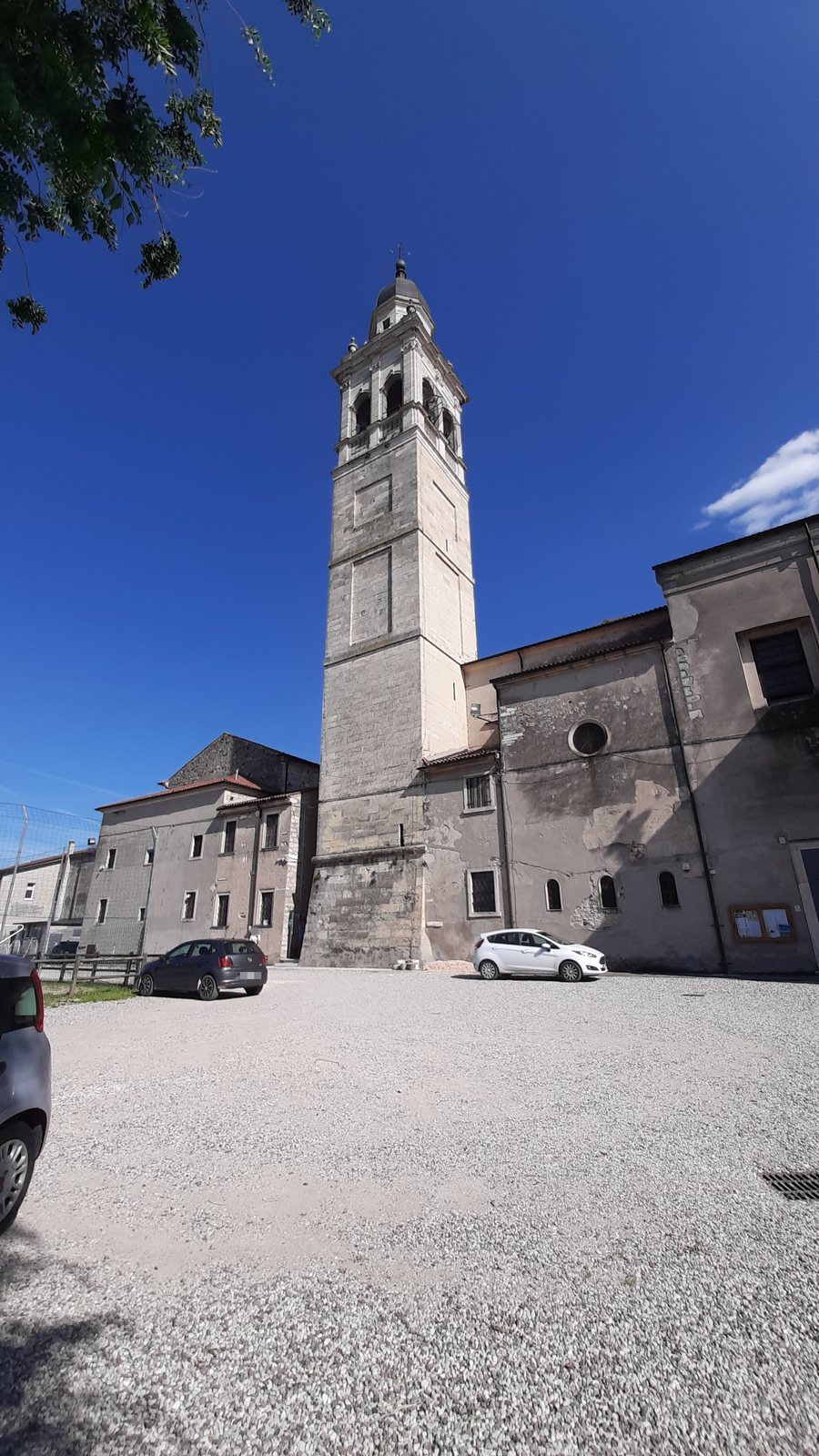
The present tower rises 50 metres. Its lower section is built of tuff, rock formed from consolidated volcanic ash, and its upper section of white marble. Each side of the bell chamber has a window divided into two openings. Above it, a balustrade has tuff vases at its four corners. Four statues once stood at the centres of the tower’s sides: Our Lady of the Rosary, Saint Blaise, Saint Zeno and Saint Victor. They were removed in 1980 because they had become unsafe. An octagonal spire and an eight-section cupola covered in copper top the tower.
Nine-bell peal
The nine bells hang in the Veronese system and are tuned to B-flat 2. Together they weigh 7,142 kilograms, making the peal the third heaviest in the province of Verona, after those at Verona Cathedral and the parish church of Cadidavid. The largest bell, B-flat 2, has a diameter of 1,534 millimetres and weighs 2,040 kilograms; it is the fifth heaviest bell in the Veronese area. At the other end of the set, the C 4 bell measures 668 millimetres across and weighs 177 kilograms. The four largest bells can be rung only by hand. The five smaller ones also have a motor-powered swinging system.
Each bell has a clapper arrangement patented by Luigi II Cavadini. After striking, the clapper moves slightly away from the bronze, a design that improves resonance and reduces wear.
Interior and furnishings
Nave and painted decoration
A large ceiling painting, The Apotheosis of Saints Fermo and Rustico with Saint Blaise and Our Lady of the Rosary, was painted by Giuseppe Bevilacqua in 1899. More recent painted decoration also covers the ceiling. Five late-eighteenth-century side-wall paintings depict episodes from the lives of Fermo and Rustico. Made in tempera, a pigment paint bound in an emulsion, they remain clearly legible and may be the work of more than one artist.
Side chapels
The four chapels date from 1926 to 1930. On the left are the chapel of Saint Blaise, completed in 1930, and the Rosary chapel, dated 1927. On the right are the Crucifix chapel, dated 1927, and the Immaculate Conception chapel, dated 1926.
The Saint Blaise altar dates to 1644. Its marble front incorporates three reliefs from the older church, depicting the fifteenth-century Martyrdom of Saint Blaise. Their carving combines delicate detail with forceful expression. Above the altar is a painted wooden Pietà, Mary mourning the dead Christ, made by Gualfardo Sughi in 1846. Two eighteenth-century white-marble panels on the side walls show the Crucifixion, the Deposition and the Annunciation.
The same chapel contains a statue of Saint Anthony Abbot by Bartolomeo Giolfino, dated 1433, and a statue of Saint Nicholas of Bari, probably dating to 1455, whose maker is uncertain. The Saint Nicholas figure retains late-Gothic features, while the Saint Anthony statue has early Renaissance elements, especially in the face.
Matteo Pezzi made the Rosary chapel altar in 1644, with a frame of yellow marble from Torri del Benaco. Its gilded wooden Madonna, made by a local artisan in 1761, is surrounded by fifteen small seventeenth-century panels showing the Mysteries of the Rosary, scenes from the lives of Jesus and Mary used in the Catholic devotion to the Virgin. The Crucifix chapel has an eighteenth-century altar by Adriano Cristofali, brought from Bovolone. Above it is a painted wooden crucifix made in 1812 by Antonio Righetti, known as Lugarìn. The Immaculate Conception chapel’s altar came from the Franciscan convent of San Bernardino in Verona.
Baptistery
Designed by Don Giuseppe Trecca and inaugurated in 1947, the baptistery is a space set aside for baptism. Its baptismal font, the vessel used in the rite, is dated 1470. Gino Tregnaghi made its eight copper sections and the bronze figure above its cover. Scipione Ballarini made the stained-glass windows, and Pietro Negrini painted the Baptism of Christ on the vault in the first half of the twentieth century.
High altar and presbytery
The neoclassical high altar dates to 1866 and bears six bronze medallions. Four, signed by Nereo Costantini, depict Saints Fermo and Rustico, Our Lady of the Rosary and Saint Blaise. Giuseppe Barbieri designed the dome above the presbytery, the area around the altar used for church services. To the left of this area, near a holy-water stoup of Red Verona marble, stands a Baroque gilded wooden reliquary, a container for relics, of the church’s patron saints.
Organ
The present Mascioni organ, catalogue number 522, has 1,706 pipes and 21 stops, each of which selects a set of pipes to produce a particular sound. The first Fedrigotti organ stood above a side door near the Crucifix chapel, where an old confessional is now located.