San Regolo, Vagli Sotto: A Medieval Parish Church in Italy
Site at a Glance
- Popularity
- Very Low
- Country
- Italy
- Primary era
- Medieval
- Eras represented
- Medieval, Early Modern, Modern
- Civilizations
- Italian, Republic of Lucca
- Site type
- Religious
- Remains
- Church
On this page13 sections
History
San Regolo is the Roman Catholic parish church of Vagli Sotto, Italy, with origins broadly dated to the 12th-13th centuries. It now belongs to the Archdiocese of Lucca and the Garfagnana pastoral area. In its early history, it was subordinate to the parish church at Piazza al Serchio and part of the Diocese of Luni, a church district governed by a bishop.
Medieval origins
The church’s beginnings are uncertain. It may be the church of Santa Maria, meaning the Virgin Mary, mentioned at Vagli Sotto in 1154. A more specific proposal dates its origin to the third quarter of the 13th century, after Lucca’s conquest of Garfagnana in 1248 and amid a period of crisis in the 1270s. Its first known written mention dates to 1296.
Dedication and later alterations
The dedication to San Regolo, the Italian form of Saint Regulus, is linked to a nearby church dedicated to Saint Augustine. During a pastoral visit in 1588, Bishop Benedetto Lomellini recorded that the church was dedicated to both Mary and San Regolo. Alterations and an enlargement took place in the 1580s. In 1795, the church was enlarged again, its walls raised, and its decoration renewed.
Modern changes and damage
A new floor was installed in 1954. In the 1970s, a post-conciliar altar was added for worship following changes associated with the Second Vatican Council. The church’s decorative work was restored in 2009. An earthquake on 23 January 2013 damaged the building.
Remains
The church stands on a raised, sloping base and has a gabled exterior with Romanesque features and a pointed Gothic-style window. Inside, a single nave with side chapels leads to a shallow sanctuary bay. The building’s stonework, vaulted ceiling, and surviving furnishings reflect several phases of construction and decoration.
Exterior
Southwest façade and main entrance
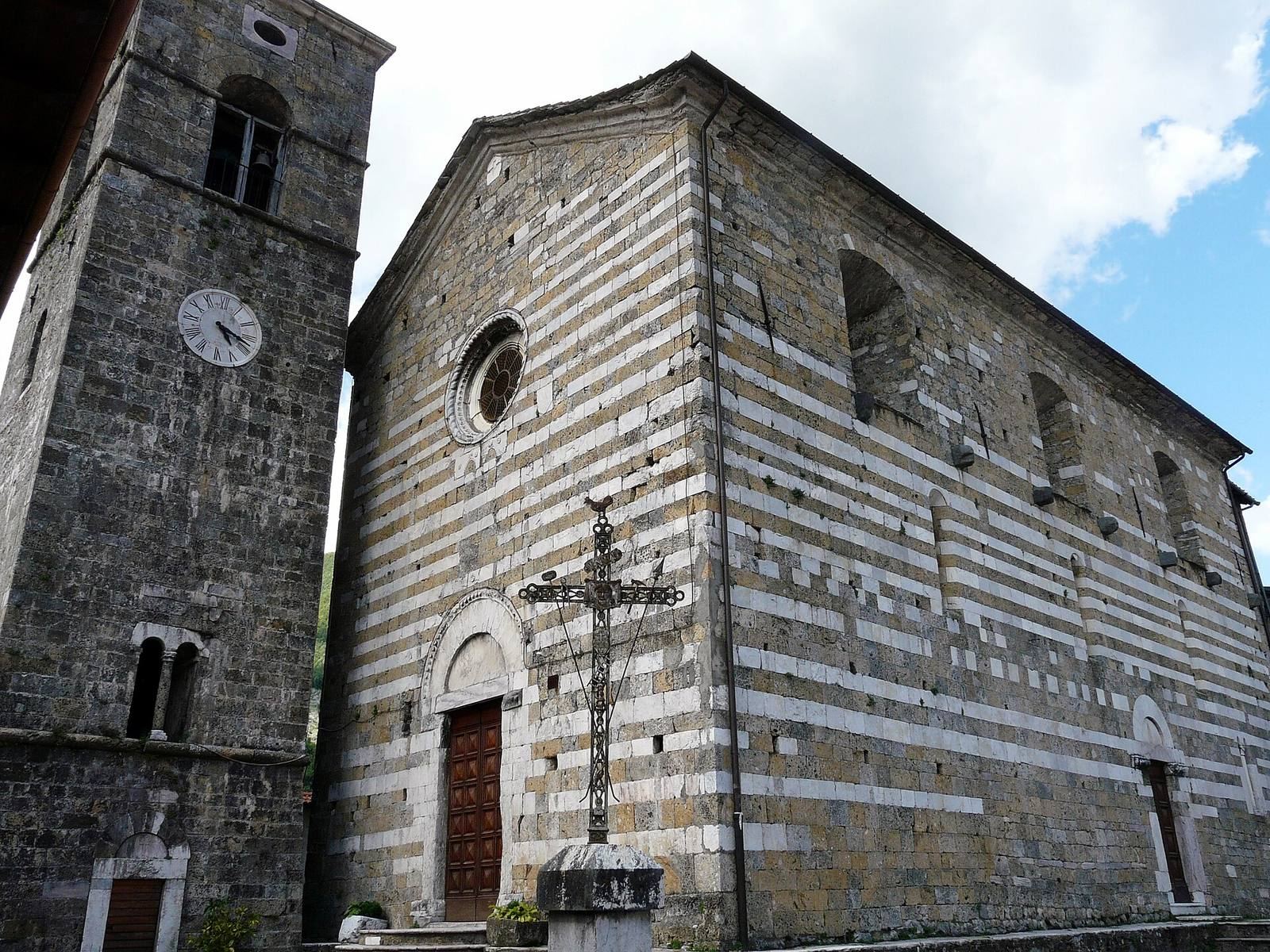
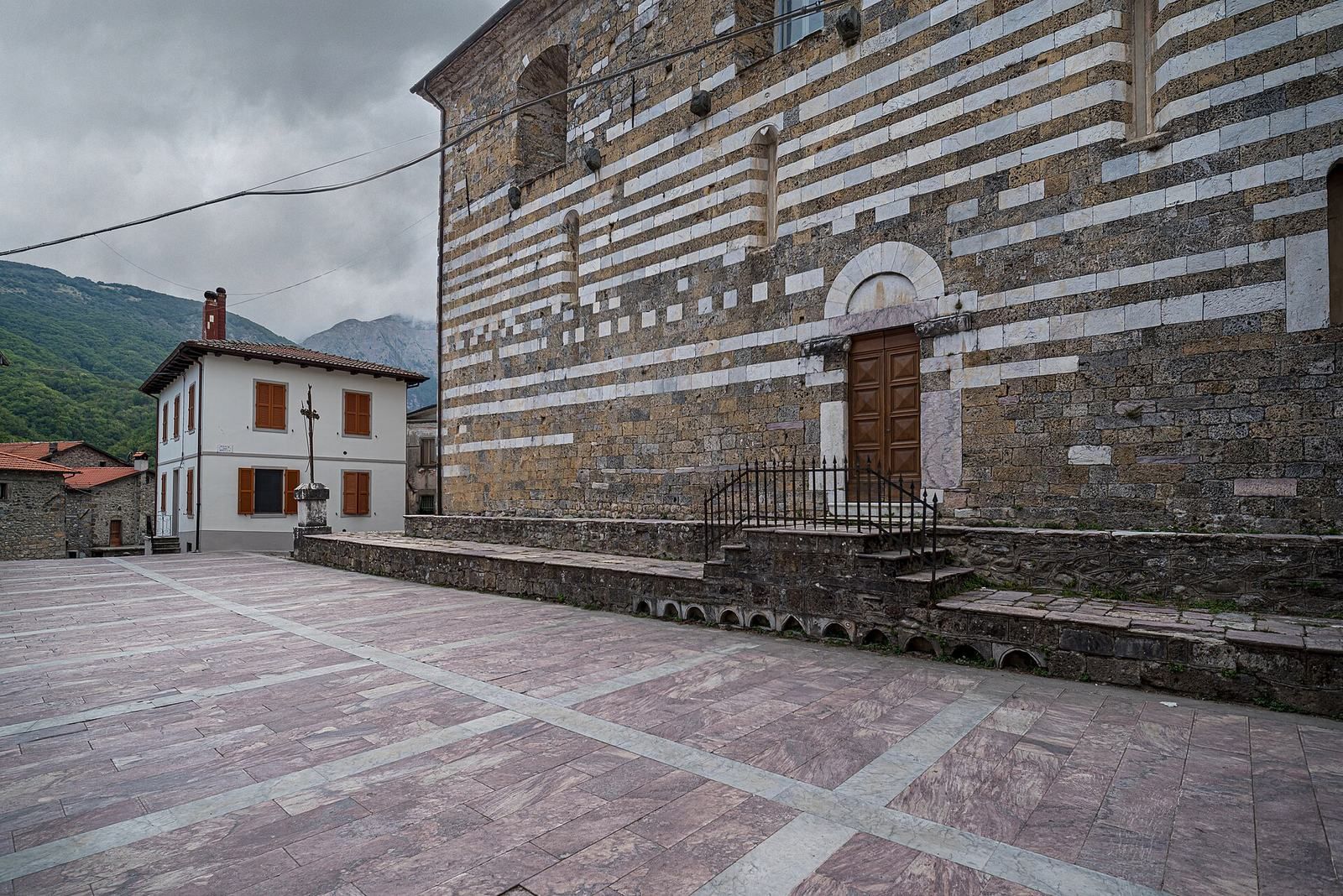
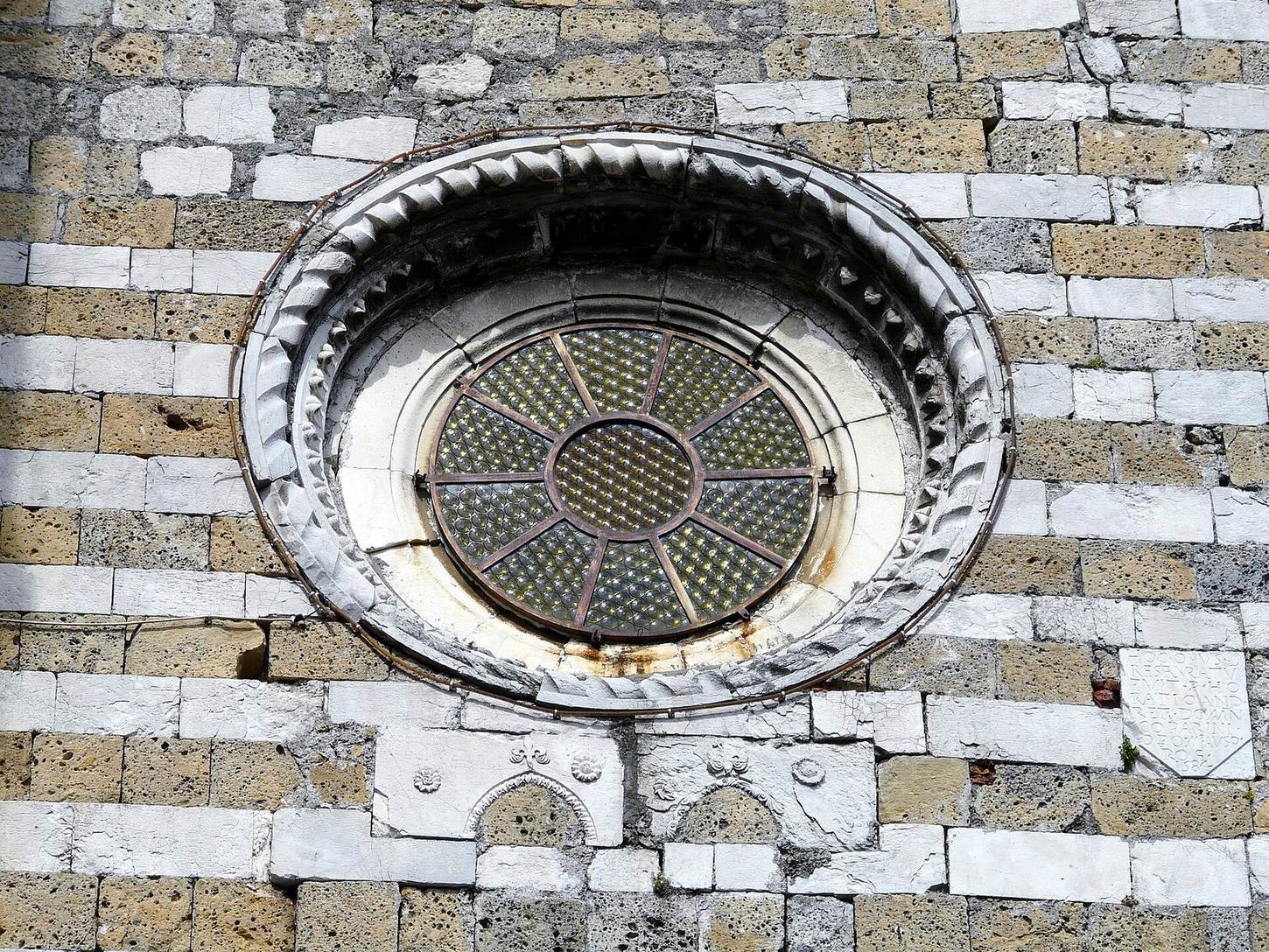
The southwest-facing façade and the sides visible from public spaces are patterned with alternating bands of white marble and cavernous limestone. A circular staircase stands before the main entrance. Its doorway has a semicircular panel above it, single-stone doorjambs, and a carved arch frame decorated with foliage.
A circular rose window sits above the entrance, surrounded by moulded stonework and more elaborate foliage ornament. Its decoration indicates that it was made in the 14th century, after the church’s medieval beginnings.
Side elevations and portal
The side wall has windows with single openings and stone arch frames, each with its own decoration. At the lower right, a pointed window is divided into two openings by a central column topped with a water-leaf capital, a column top decorated with stylized leaves.
The side doorway is simpler than the main entrance. Two stone slabs beside it carry animal carvings in an old-fashioned style, although the slabs date from the church’s construction.
Bell tower
A square-based bell tower stands beside the façade. Its lower level has a plain doorway and a two-opening window divided by a central column with a water-leaf capital supporting a round arch. The belfry has one round-headed opening on each side and is topped by a four-sided hipped roof.
Interior and furnishings
Nave and sanctuary
The main body of the church, or nave, is divided into three structural bays and accompanied by small side chapels. Shallow wall supports called pilasters rise to a projecting cornice. Above it, the ceiling alternates between barrel vaults, which are continuous arched ceilings, and low domes. At the end of the nave, a shallow sanctuary bay contains the high altar.
Crucifix, font, and statues
A 14th-century crucifix of the sorrowful type is attributed to the Master of the Crucifix of Camaiore, an artist associated with a crucifix at Camaiore and a follower of Giovanni Pisano. Compared with Pisano’s work, the figure’s body is less integrated and its expression less intense. Its modelling is also harder and more abbreviated than that of other examples from the Lucca area and the Serchio valley.
The church also holds a 15th-century holy-water font and statues of Christ and the Virgin Mary. The statue of Mary is a wooden Madonna and Child dated to the 13th-14th century.
Lavabo in the sacristy
The sacristy contains a Renaissance lavabo, a basin used for washing, supported by a projecting stone bracket carved with an angel’s head and outspread wings. Its front bears a relief of two male profiles and a ring set with a diamond, encircled by carnation leaves. The ring is an emblem of Ercole I d’Este, Duke of Ferrara from 1471 to 1505. The relief may have been taken from a sarcophagus and reused for the lavabo; it is attributed to a workshop from the Po Valley active in northwestern Tuscany.