Belfry of Saint Sophia Cathedral: Novgorod’s Orthodox Bell Tower
Site at a Glance
- Popularity
- Medium
- Country
- Russia
- Primary era
- Medieval
- Eras represented
- Medieval, Early Modern, Modern
- Civilizations
- Novgorod Republic, Russian
- Site type
- Religious
On this page12 sections
History
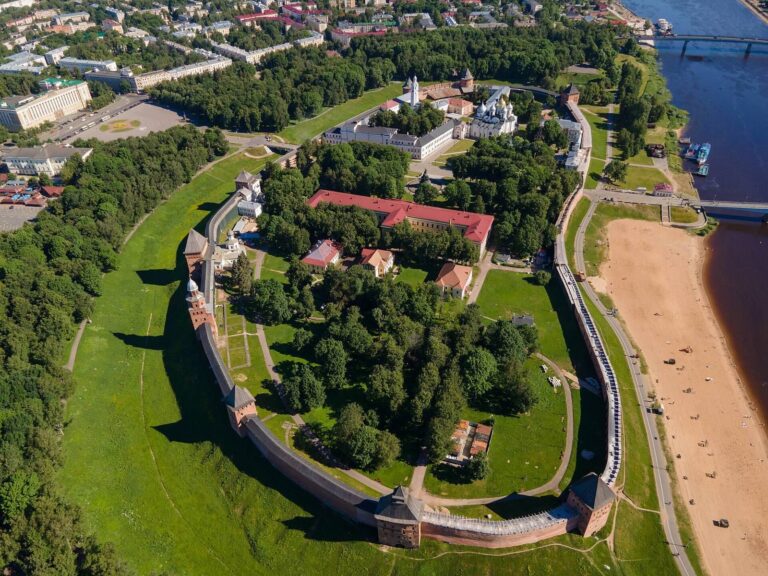
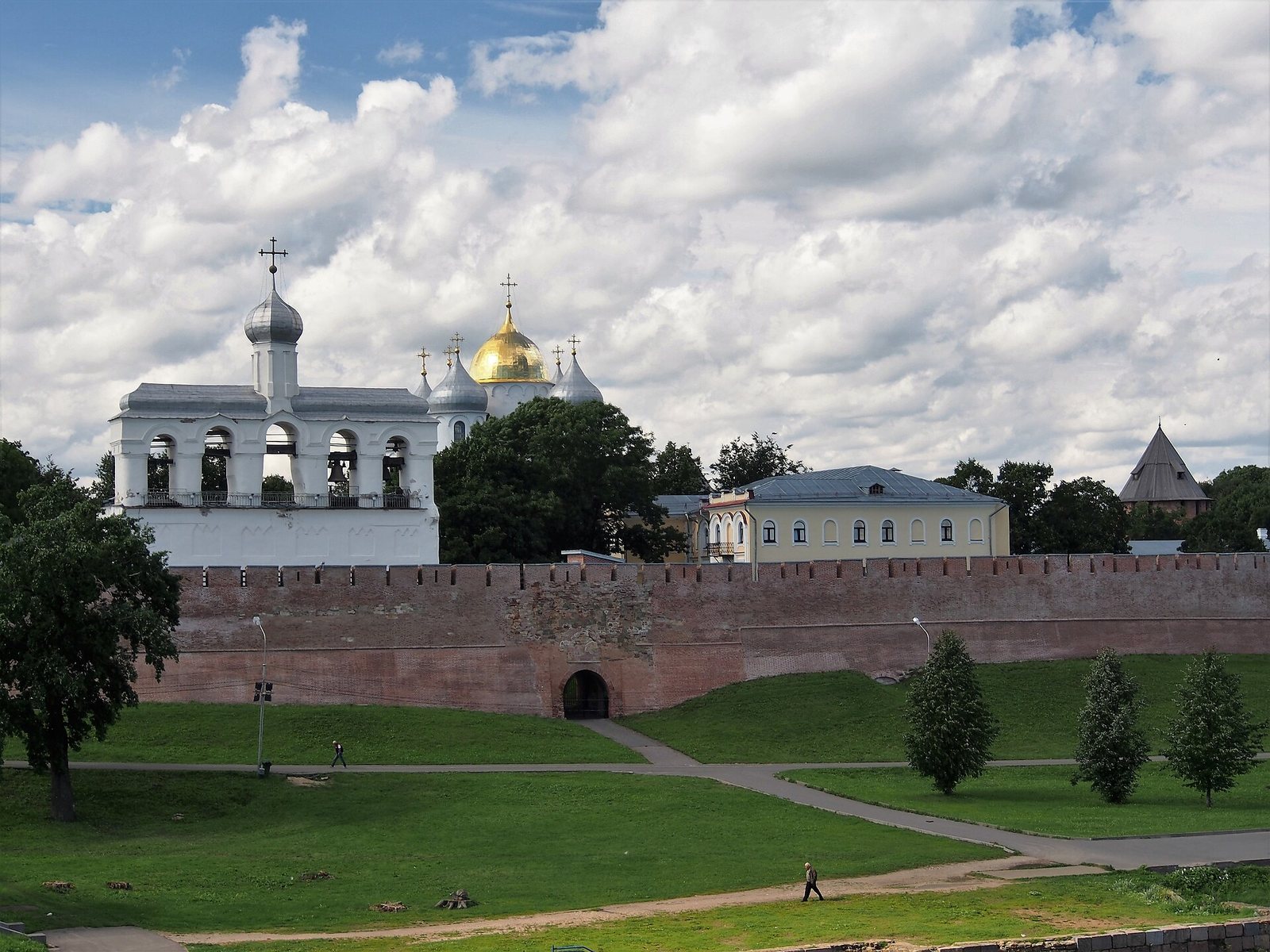
The Belfry of Saint Sophia Cathedral is an Orthodox bell-hanging structure in Novgorod, Russia, within the Detinets, the fortified central part of the medieval city. Its history includes a fifteenth-century rebuilding, successive alterations, and severe wartime damage.
Origins and dating
A belfry at the site is first mentioned in a chronicle in 1437, when a flood carried it and part of the fortress wall into the Volkhov River. In 1439, Archbishop Euthymius II ordered a stone belfry built in its former position on the wall.
A separate construction date of 1455 has also been proposed. Tree-ring analysis in 1995 dated timber supports beneath the foundations to 1437, evidence that supports the rebuilding ordered in 1439. The date of 1455 may refer to another belfry at the cathedral’s southwest corner.
Rebuilding and legend
Major rebuilding in the 1530s and 1540s took place as the fortress wall was reconstructed and advances in bell casting made larger bells possible. The belfry was changed again in the second half of the seventeenth century, and its upper part was rebuilt in the mid-eighteenth century. Its roof was altered in the early twentieth century, followed by urgent repairs in the early 1930s.
A legend links the belfry to Ivan the Terrible, the sixteenth-century Russian tsar. As he crossed the Volkhov on horseback over the Great Bridge, the story says, the bell-ringer rang the largest bell so loudly that the horse reared and threw him. Ivan supposedly ordered all the bell’s suspension loops, called its ears, to be cut off except the central one. The bell was then known as the Earless bell.
War damage and later history
In August 1941, as German forces approached Novgorod, an order was given to evacuate the bells. Bombing struck a barge carrying the three largest bells, which sank in the Volkhov; two other large bells were buried near the Kremlin. A bomb hit the small building attached to the belfry, and the blast severely damaged the structure. Artillery fire destroyed its porch. The belfry was restored in 1948, with further restoration work in 2007.
The belfry remains in use for bell-ringing. It is a federal cultural-heritage monument and forms part of the UNESCO World Heritage property Historic Monuments of Novgorod and Surroundings: Historic Centre of Novgorod (western part) and the Novgorod Kremlin, inscribed in 1992 under criteria ii, iv and vi.
Remains
Structure and additions
Layout and main structure
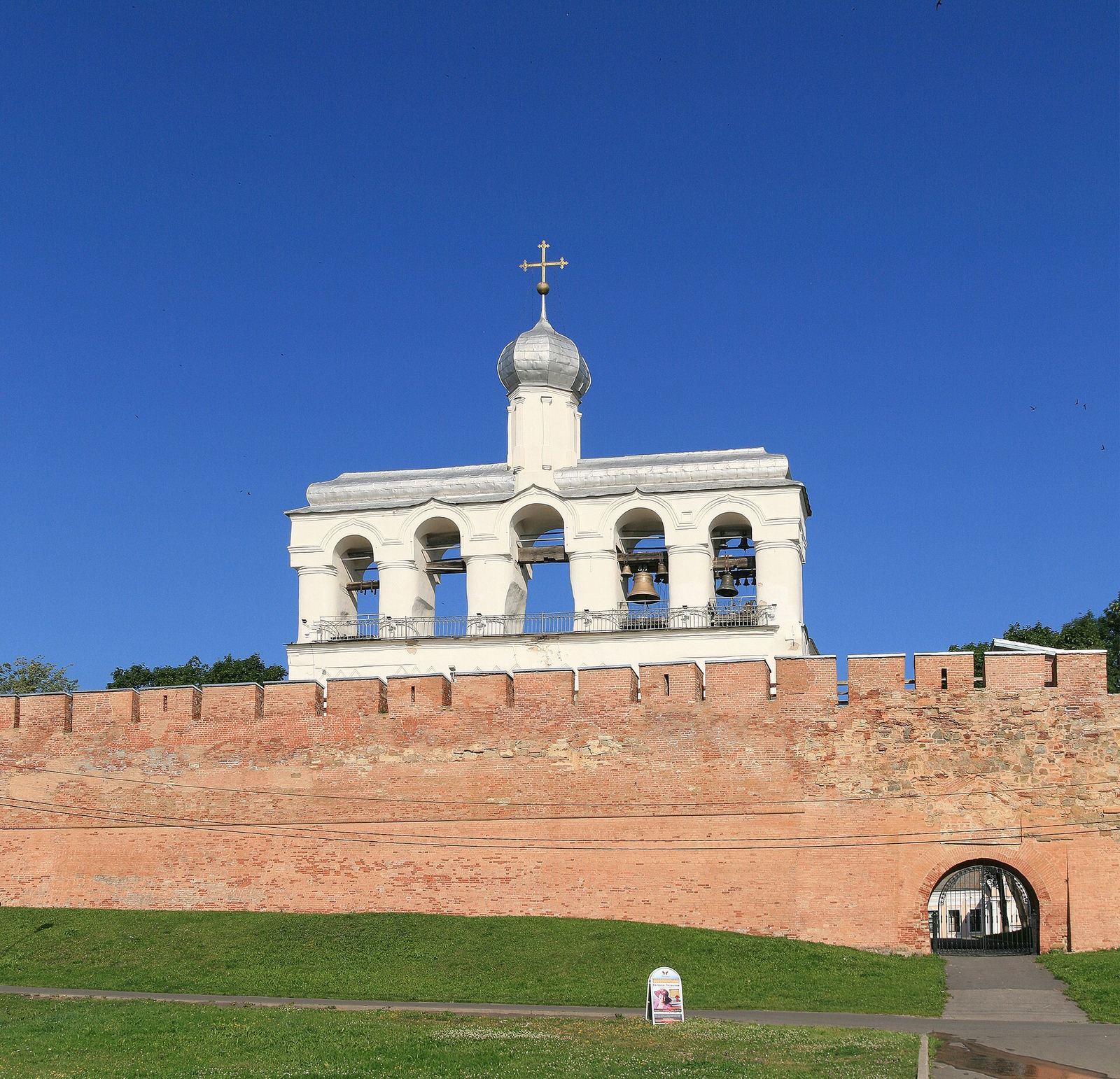
The belfry is a long, narrow, wall-like structure with openings for bells. It stands just inside, and almost against, the eastern wall of the Detinets. The building measures 22.5 metres long and 3.4 metres wide, and lies several metres north of a nineteenth-century arch built after the Prechistenskaya Tower fell in 1745.
Its earlier form had three openings between four pillars. During the rebuilding of the 1530s and 1540s, it grew to five openings and six pillars, and the level for hanging bells was raised. Five eight-sided, tent-shaped brick roofs were added above it; these were later replaced by tall, peaked roofs. The mid-eighteenth-century rebuilding gave the upper part its present form, including a central dome on a cylindrical base.
In the early twentieth century, the ceiling was replaced by two shallow, flat brick vaults and the roof was covered with asphalt. Repairs in the early 1930s removed the vault over an extension, rebuilt part of its western wall and added an iron roof. An observation platform occupies the upper part.
Wall chambers and extensions
Three chambers with arched ceilings lie between the belfry and the fortress wall. Their date is disputed. Repairs in the 1940s placed them in the earliest construction, while architect Dmitry Petrov attributed them to the late fifteenth century, when new fortress walls were built.
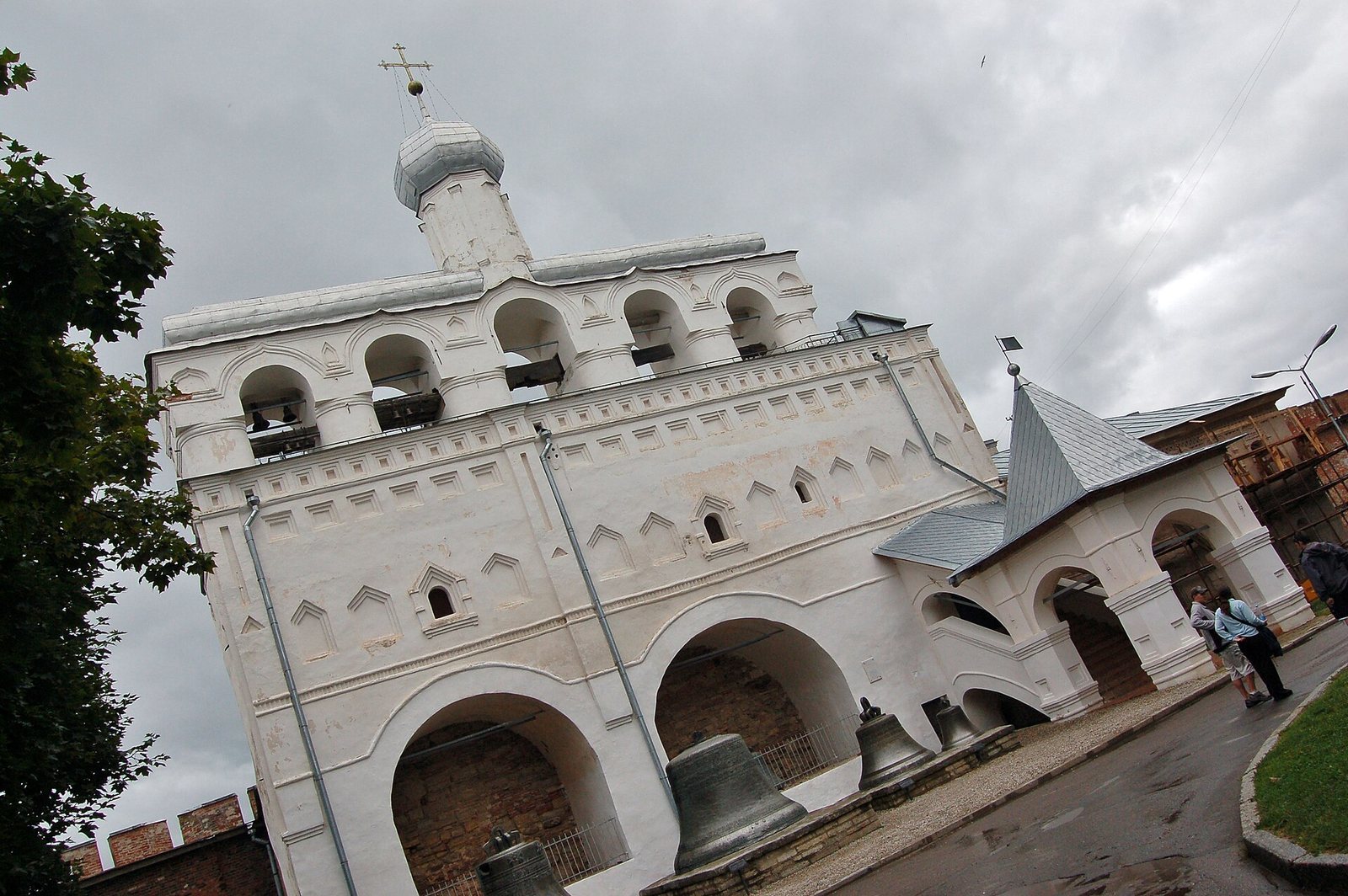
A single-storey extension was probably added on the inner side of the Detinets around the time of the major sixteenth-century rebuilding. In the second half of the seventeenth century, a western extension gained a second storey, and a stone porch was built on its south side. Supports were adapted for larger bells, while a small building was attached to the belfry’s southern wall toward the Prechistenskaya Tower.
Decoration and depictions
Niches and horizontal bands on the belfry have details resembling Gothic work. Petrov suggested they might reflect the involvement of Western European craftsmen, possibly including people who worked on Novgorod’s Vladychnaya Chamber in 1433, the archbishop’s residence and administrative building. An image on Patriarch Nikon’s omophorion, an Orthodox bishop’s vestment, shows the belfry with three openings; the icon Vision of the Sexton Tarasius shows its later five-opening form. A late-seventeenth-century icon of the Sign of the Mother of God depicts a belfry at the cathedral’s southwest corner, an image associated with the proposed separate structure mentioned in connection with 1455.
Bells
Large bells
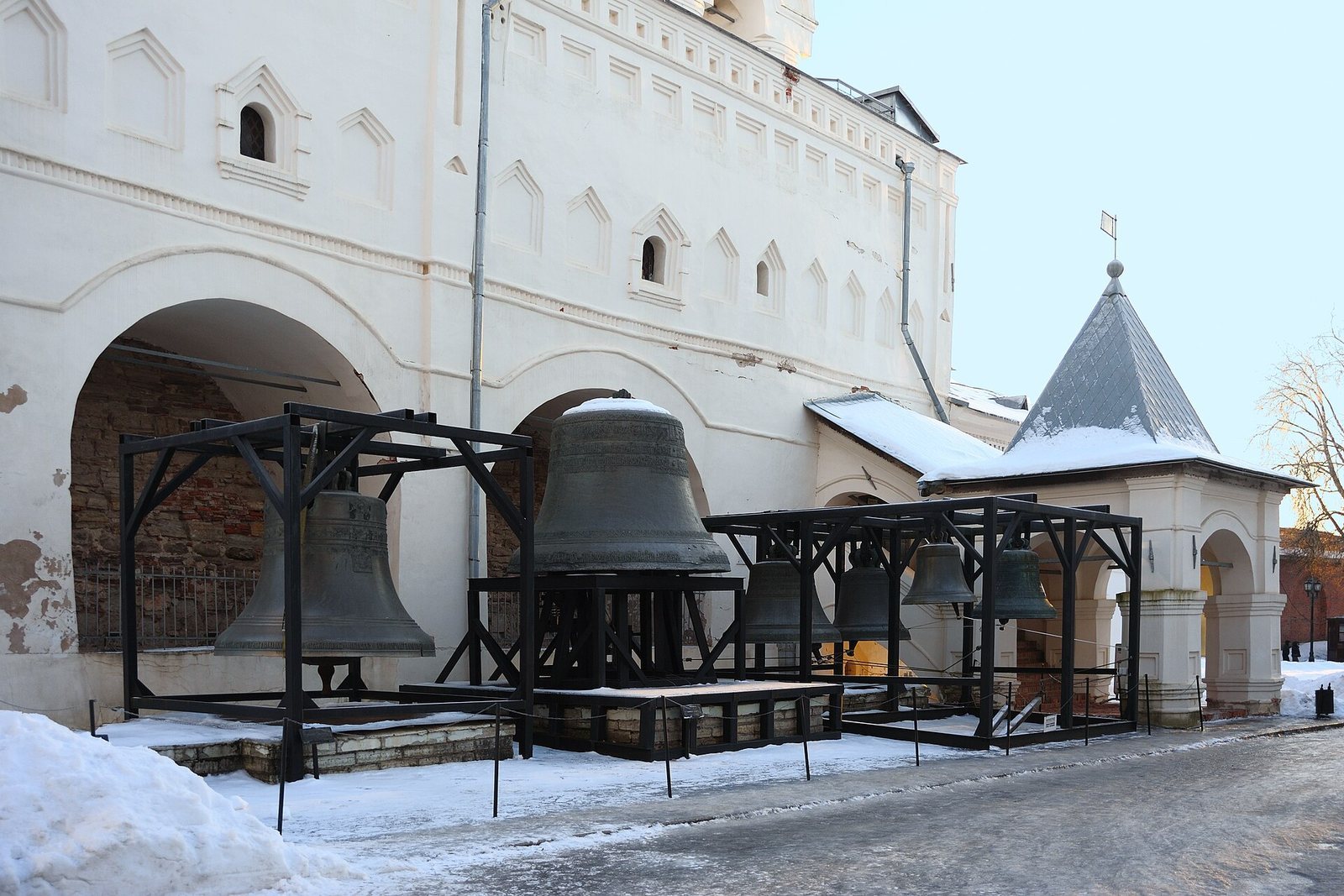
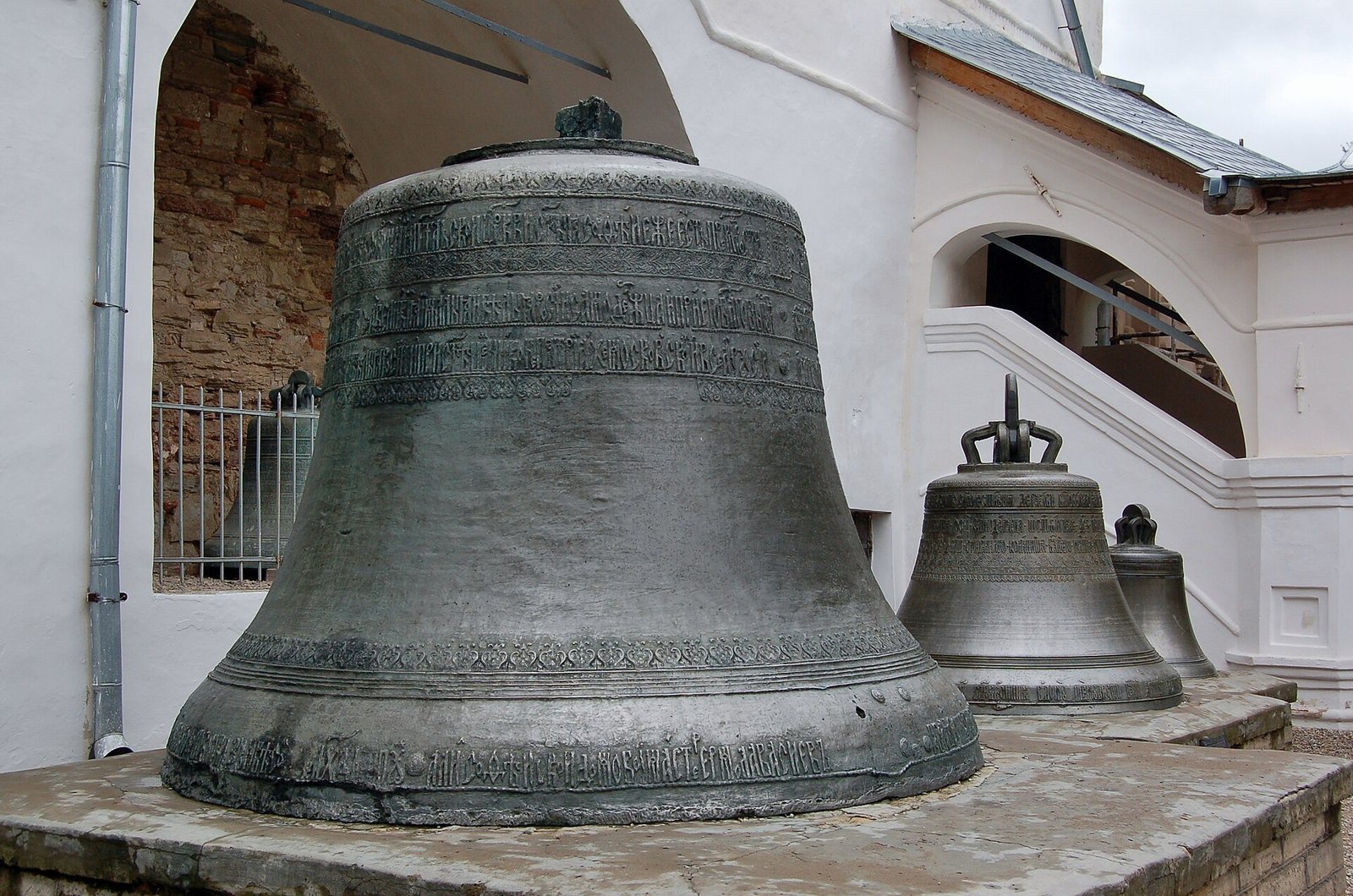
Five large bells are installed near the belfry. Their weights are given in poods, a historical Russian unit of about 16.4 kilograms. One, weighing 100 poods, was cast in 1589 and given by Boris Godunov to the Holy Spirit Monastery. A 200-pood bell was cast in 1599 for Khutyn Monastery by Vasily Ivanov, Afanasy Pankratyev and Ioakim Ivanov. The largest weighs 1,614 poods and was cast in the Novgorod Detinets in 1659 by Yermolay Vasilyev; it is known as the Festive bell. The other two weigh 300 poods and date to 1677, and 590 poods and date to 1839. A nineteenth-century bell is called the Sunday bell, while other seventeenth- and eighteenth-century bells are described as everyday bells.
Exhibition and commemorative bell
An exhibition in the belfry includes 14 bells weighing from 1.5 to 20 poods. Another bell was cast in Voronezh and consecrated there on 18 September 2009, during celebrations for Novgorod’s 1,150th anniversary. Its inscription marks the anniversary and names President Dmitry Medvedev, Governor Sergei Mitin, Mayor Yuri Bobryshev and Patriarch Kirill. Archbishop Lev of Novgorod and Staraya Russa consecrated it, and Medvedev struck it first.