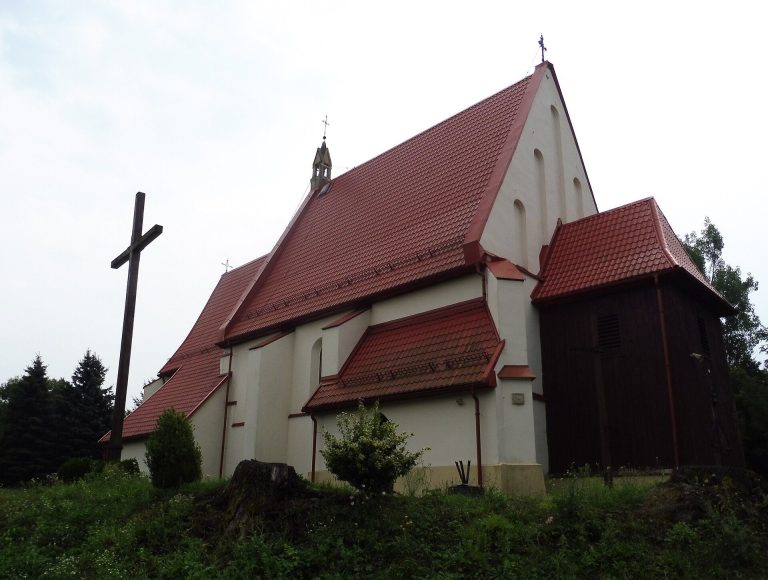
Church of the Nativity of Mary in Borzęcin: A Roman Catholic Parish Church
Site at a Glance
- Popularity
- Low
- Country
- Poland
- Primary era
- Early Modern
- Eras represented
- Early Modern, Modern
- Civilizations
- Austria-Hungary, Habsburg, Polish–Lithuanian Commonwealth
- Site type
- Religious
- Remains
- Church
On this page12 sections
History
The Church of the Nativity of Mary in Borzęcin is a Roman Catholic parish church in Poland, serving a community dedicated to the Nativity of the Blessed Virgin Mary. Its present building was completed in 1680 and combines an eclectic design with surviving Baroque features. The parish belongs to the Diocese of Tarnów and the Szczepanów deanery. Its feast, commemorating Mary’s birth, is celebrated on September 8.
Construction and rebuilding
The church’s construction is dated either to 1612 or, more probably, to 1680, and was undertaken at the initiative of parish priest Krzysztof Rogoziński. A fire destroyed the building in 1802. Rebuilding continued until 1854, when Józef Alojzy Pukalski, Bishop of Tarnów, consecrated the reconstructed church.
Expansion in the 20th century
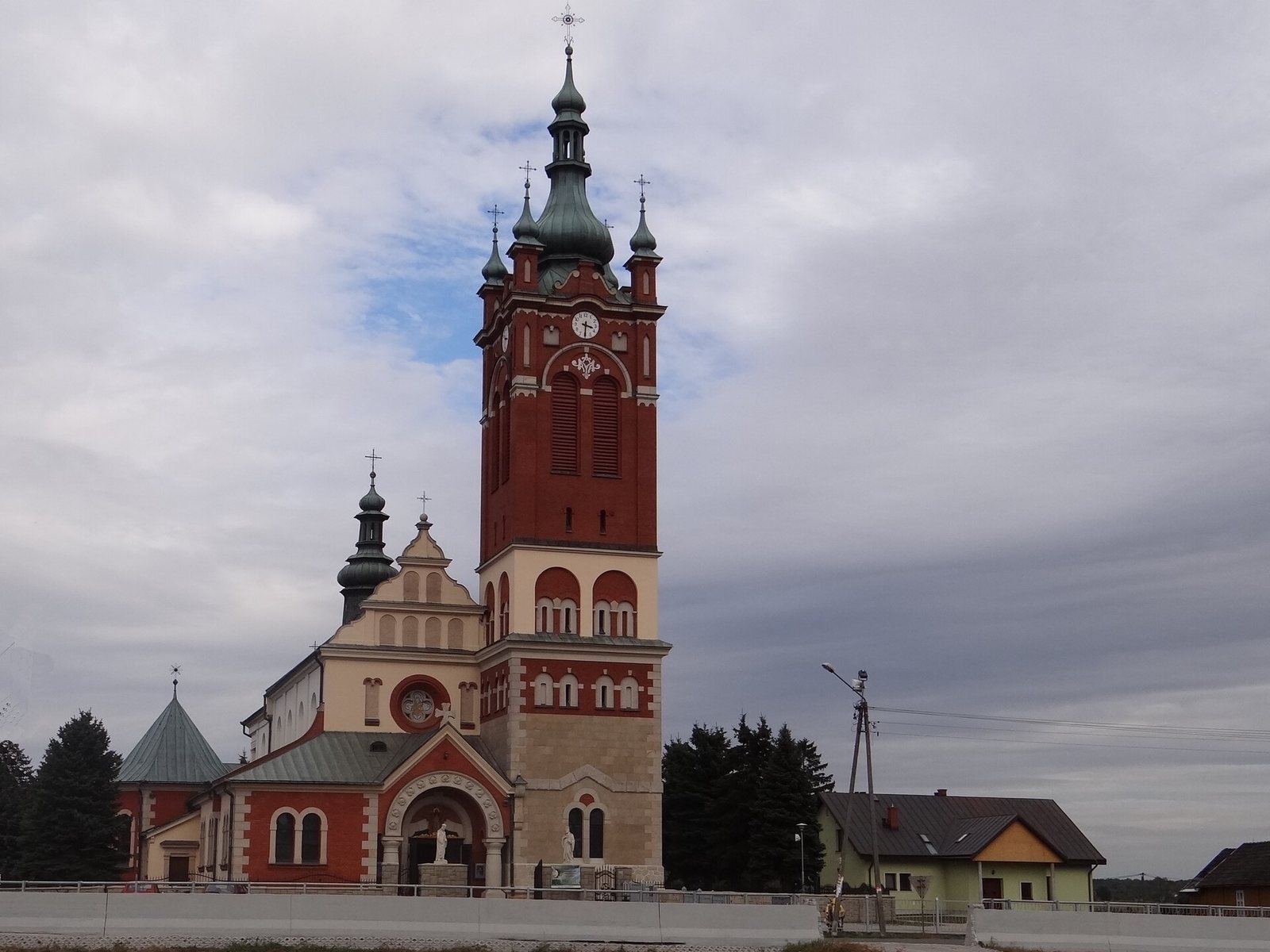
By the early 1900s, the growing parish needed a larger church. Major alterations and an enlargement followed between 1912 and 1917, based on a design by architect Jan Sas-Zubrzycki. Work on the tower continued after that campaign and was completed in 1922.
Remains
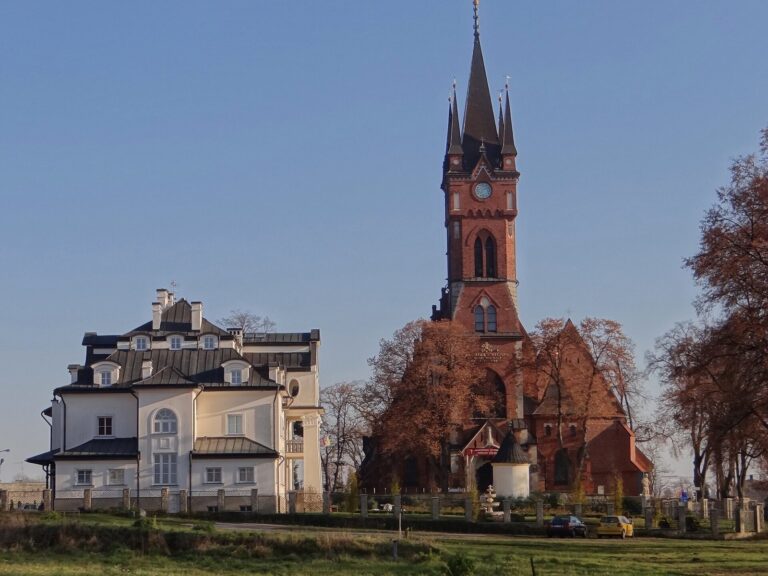
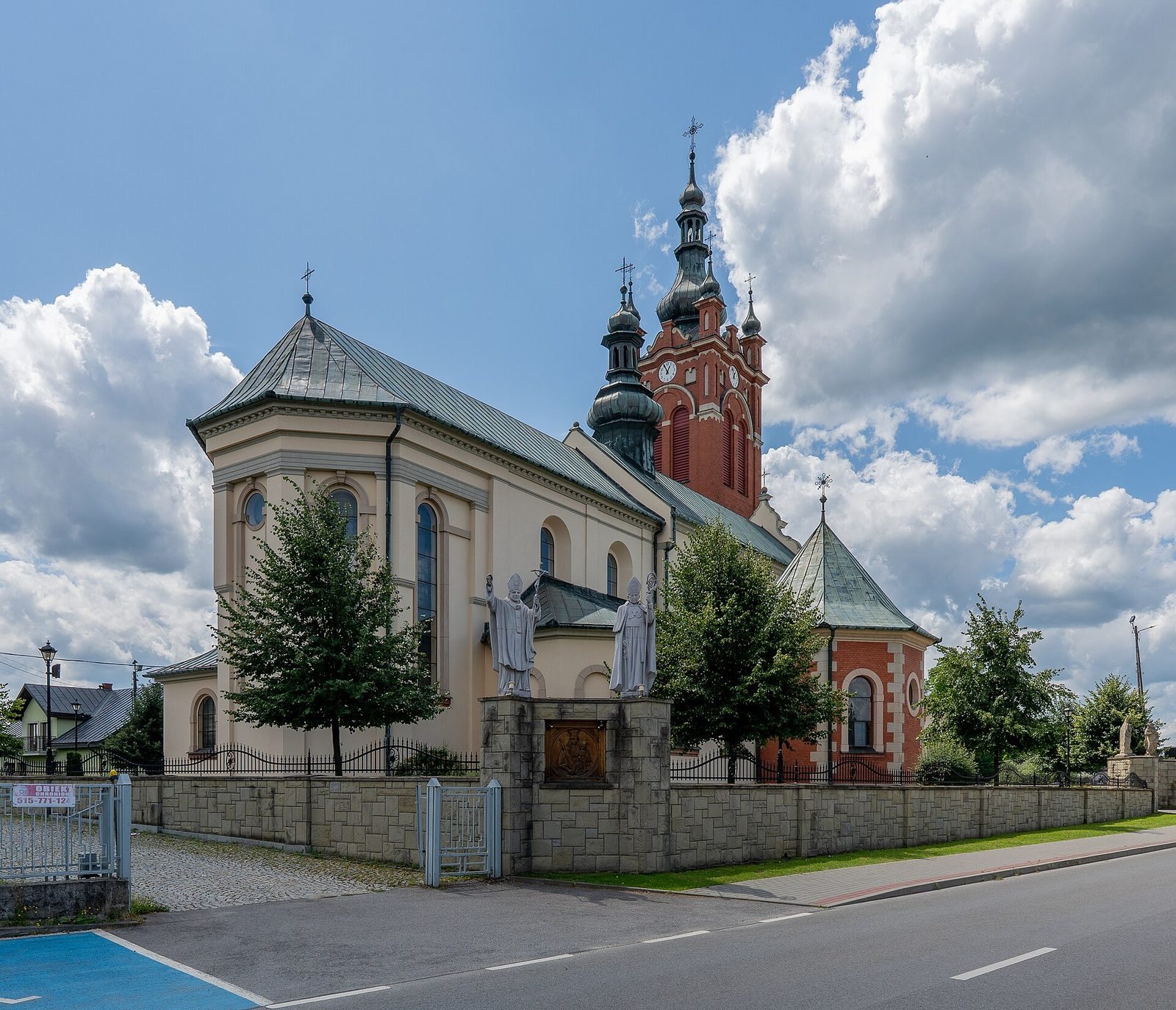
The brick-and-stone church has an eclectic appearance with Baroque elements. Its basilica plan, with a high central nave and lower side aisles, leads east to a presbytery, the area around the altar, which ends in three sides. Chapels and entrance spaces extend the main body of the building.
Plan and exterior
Church plan
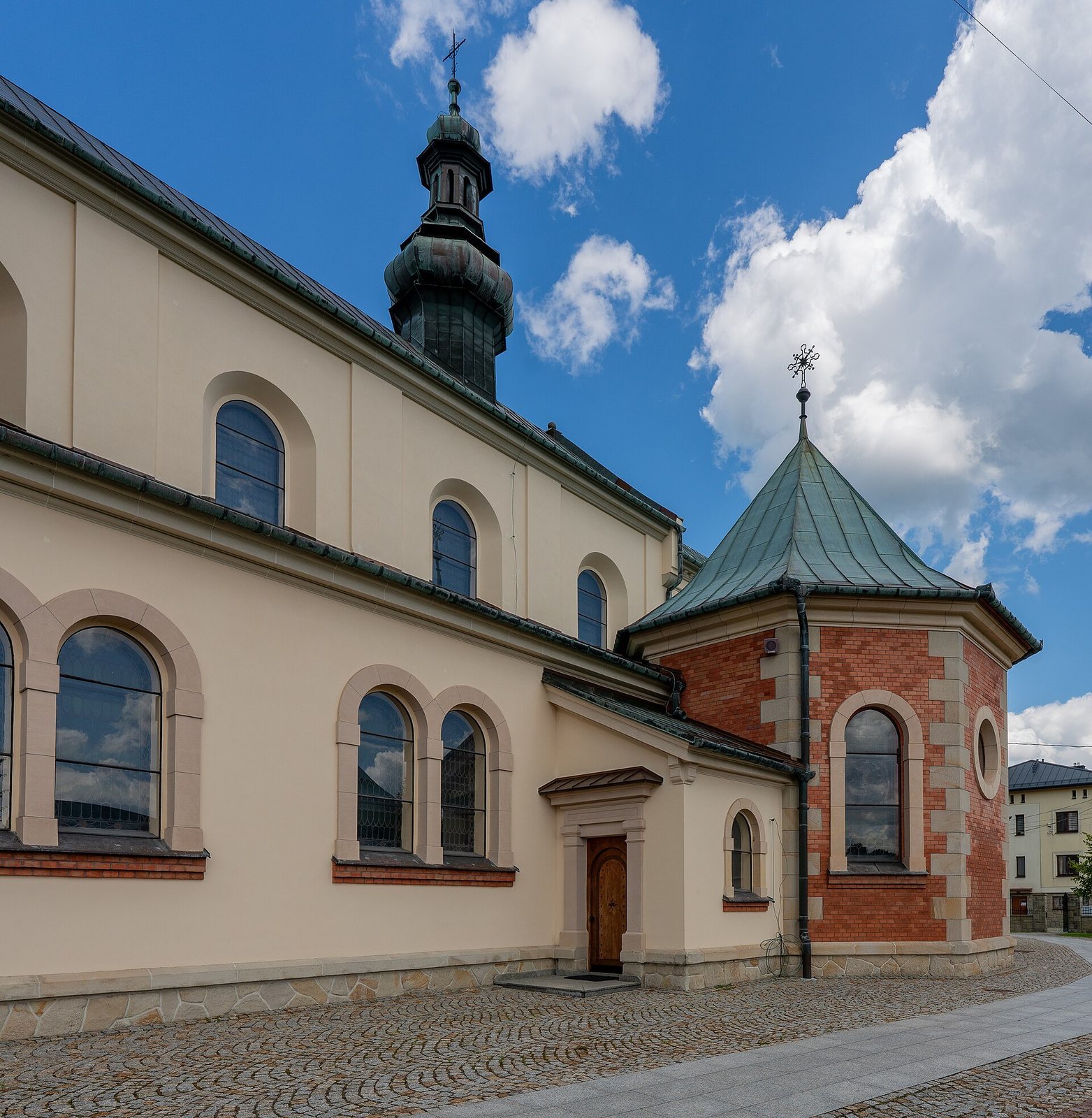
A sacristy stands south of the presbytery, while a three-sided chapel on its north side extends the side aisle. Two more chapels, set symmetrically beside the main body, also have three-sided ends. At the front, a vestibule sits behind a deep recess intended for the main portal. A storage room adjoins the entrance on the north, and the tower rises on the south.
Facade and tower
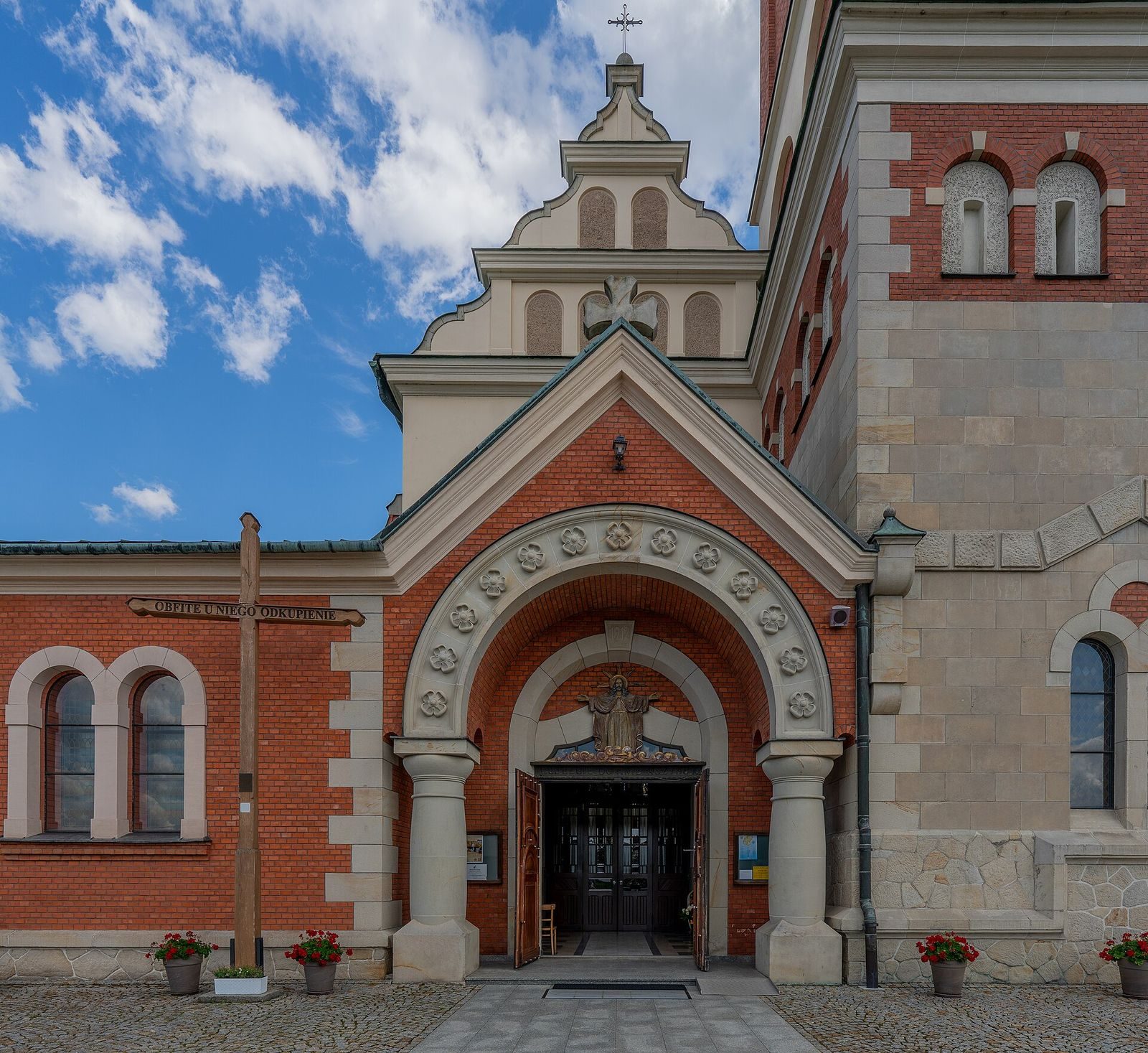
The facade has a two-tier Renaissance Revival gable divided by arcades, with a rose window below. The main Romanesque Revival portal rests on two columns and bears a relief of Christ blessing in the tympanum, the panel above the doorway. The tower has several stories of differing heights and a bulbous dome topped by a lantern, a small crowning structure. Four corner turrets, each with a bulbous dome, flank it.
Roofs
Gabled roofs cover the nave and presbytery. A Baroque-form bell turret with a lantern rises over the nave. The side aisles and front annexes have single-sloping roofs, while the side chapels have tent-shaped ones.
Interior and furnishings
Vaulting and painted decoration
The main nave and presbytery have barrel vaults, curved ceilings with a continuous rounded profile, and curved sections called lunettes. Transverse arches divide the bays. In the older eastern part, the arches rest on groups of pilasters, flat supports attached to the walls, beneath a horizontal entablature. A star-patterned rib vault covers the presbytery’s end, while intersecting curved vaults cover the side aisles. Rounded arcades connect the central nave and aisles. Paweł Mitka created the church’s multicolored figural wall paintings in 1964.
Altars and sacred images
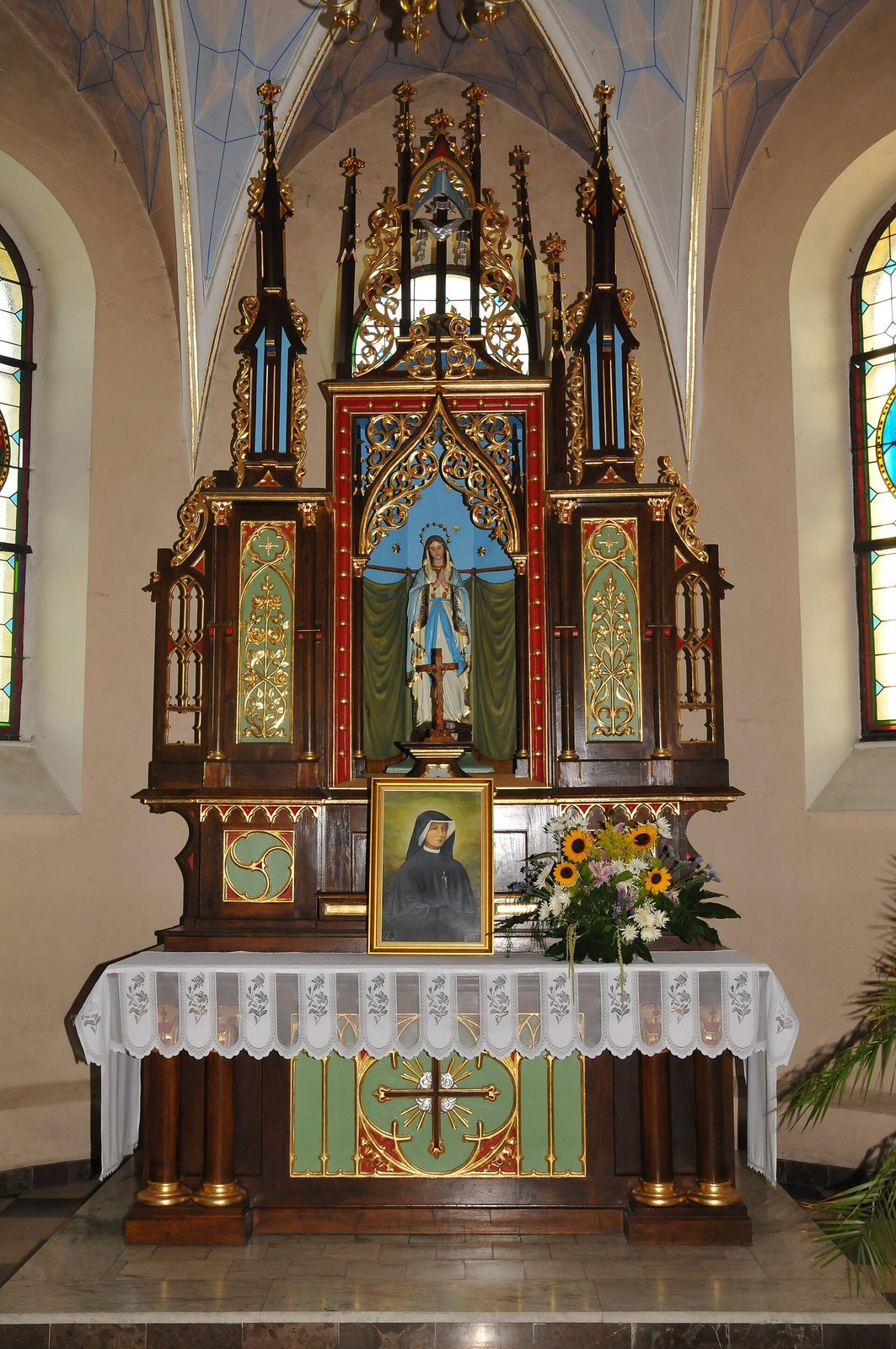
The main altar, made after 1945 in the Baroque Revival style, contains a locally venerated image of the Madonna and Child, probably painted in the 16th century. A newer image of Christ appears on its covering, and a sculpted Crucifixion stands above. Among the side altars is a late Baroque work from the first half of the 18th century. Another, made in the 19th century in the Baroque tradition, is attributed, probably, to Franciszek Wyspiański. Four further altars, in Gothic Revival and Romanesque Revival styles, were made by Stanisław Rogóż in the 20th century. One altar contains a carved Pietà, showing Mary holding the dead Christ, from the first half of the 16th century. A late Baroque sculpted Crucifixion group, dated to the 18th or 19th century, stands at the chancel arch, which separates the nave from the altar area.
Other furnishings and sculpture
A marble Baroque font dates to the second half of the 17th century. The organ, made by the Rieger-Jaegerndorf company in 1926, has 23 pipes. The church’s sculptures include four crucifixes: three Baroque examples dated between the 17th and 19th centuries, and one in a folk style. A sculpture of Saint Sebastian dates to the second half of the 19th century. Of the three bells, one was probably cast in 1661; the other two were made in 1938 at the Szwabe bell foundry in Biała.