Basilica of Sant’Ubaldo: Shrine of Gubbio’s Patron Saint
Site at a Glance
- Popularity
- High
- Country
- Italy
- Primary era
- Early Modern
- Eras represented
- Early Modern, Modern
- Civilizations
- Duchy of Urbino, Italian, Papal States
- Site type
- Religious
- Remains
- Basilica
On this page16 sections
History
The Basilica of Sant’Ubaldo is a Roman Catholic shrine on Mount Ingino outside Gubbio, Italy, dedicated to Ubaldo Baldassini, the city’s twelfth-century bishop and patron saint. The church is Baroque, a European style associated with dramatic forms and elaborate ornament. Construction began in 1513 on the sites of an earlier church dedicated to Ubaldo and a parish church dedicated to Saints Gervasius and Protasius.
Building and early stewardship
The building campaign received support from Elisabetta and Eleonora Gonzaga, duchesses of Urbino, and Pope Julius II. By 1627, the church, convent, and cloister were complete. Their care was entrusted to the Canons Regular of the Lateran, clergy who live according to a shared religious rule. Ubaldo had belonged to this order.
Changing religious communities
Passionist Fathers served the basilica from 1786 until religious communities were closed or dissolved under Napoleonic governments. Reformed Friars Minor followed them. From 2013, two priests of the Diocese of Gubbio cared for the shrine. On January 6, 2020, the Lateran Canons returned at the direction of Gubbio’s bishop, Luciano Paolucci Bedini, after 234 years away. They formed a single chapter, or body of canons, with the canons of San Secondo, an ancient canonry where Ubaldo had prepared for the priesthood.
Twentieth-century changes
The church acquired its present form in the early twentieth century. In July 1919, Pope Benedict XV granted it the title of minor basilica, an honorific distinction given to certain churches by the pope. Bombing during the Second World War destroyed much of the Baroque stucco decoration, and the interior was subsequently reconstructed.
The Festa dei Ceri
Gubbio’s annual Festa dei Ceri, or Festival of the Candles, honors Ubaldo. On the first Sunday in May, the Ceri are brought into the city and displayed at the Palazzo dei Consoli. On May 15, three teams carry them through Gubbio to its gates, then race up Mount Ingino to the basilica. The teams represent masons, merchants, and peasants, and carry statues of Ubaldo, Saint George, and Saint Anthony, respectively. The Ceri remain at the basilica until the following May.
Remains
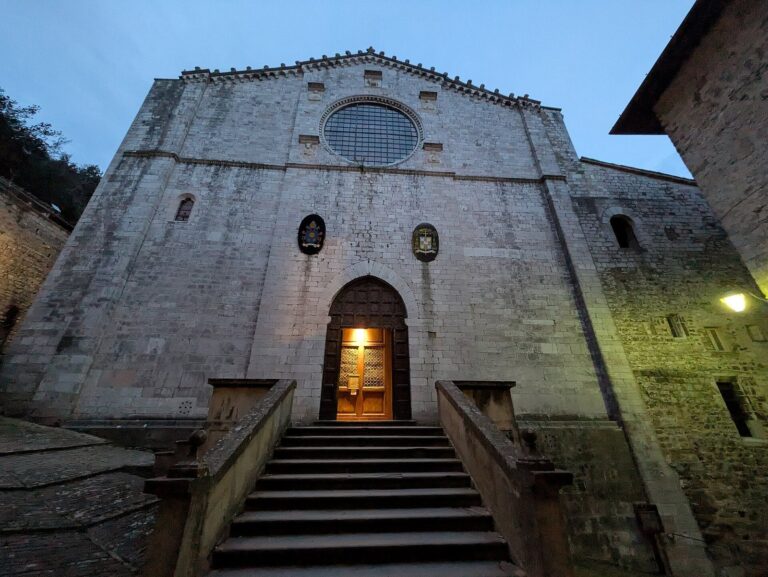
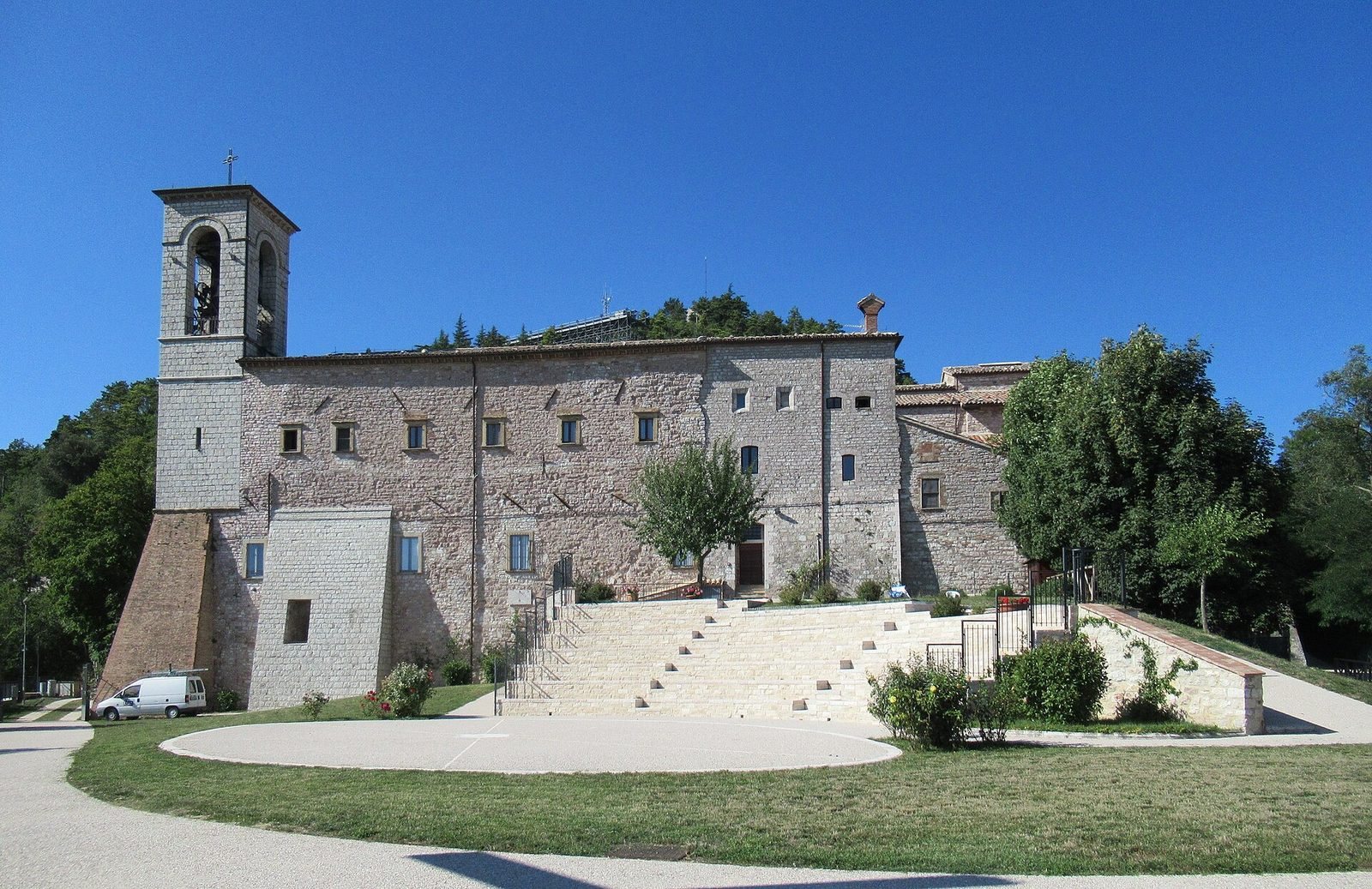
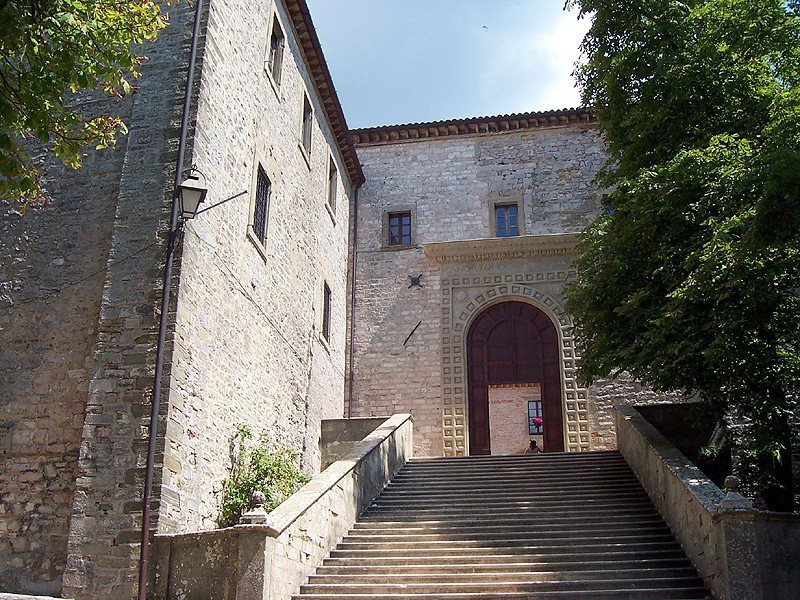
The basilica stands on Mount Ingino beyond central Gubbio, with its church and adjoining brick cloister forming the main surviving complex. A broad staircase rises to the church entrance. Inside, the church is divided into five naves, or lengthwise sections, and ends in a semicircular apse, a recess at the end of the building.
Entrance and cloister
Church entrance
Beside the entrance, flat, column-like pilasters stand on bases of pale marble. Shallow carvings on them show the arms of the Montefeltro family, Gubbio’s civic arms, and a Christogram, a monogram representing Christ. Five doors open into the church. The three central doorways are carved from gray sandstone and retain their original carved wooden doors.
Brick cloister
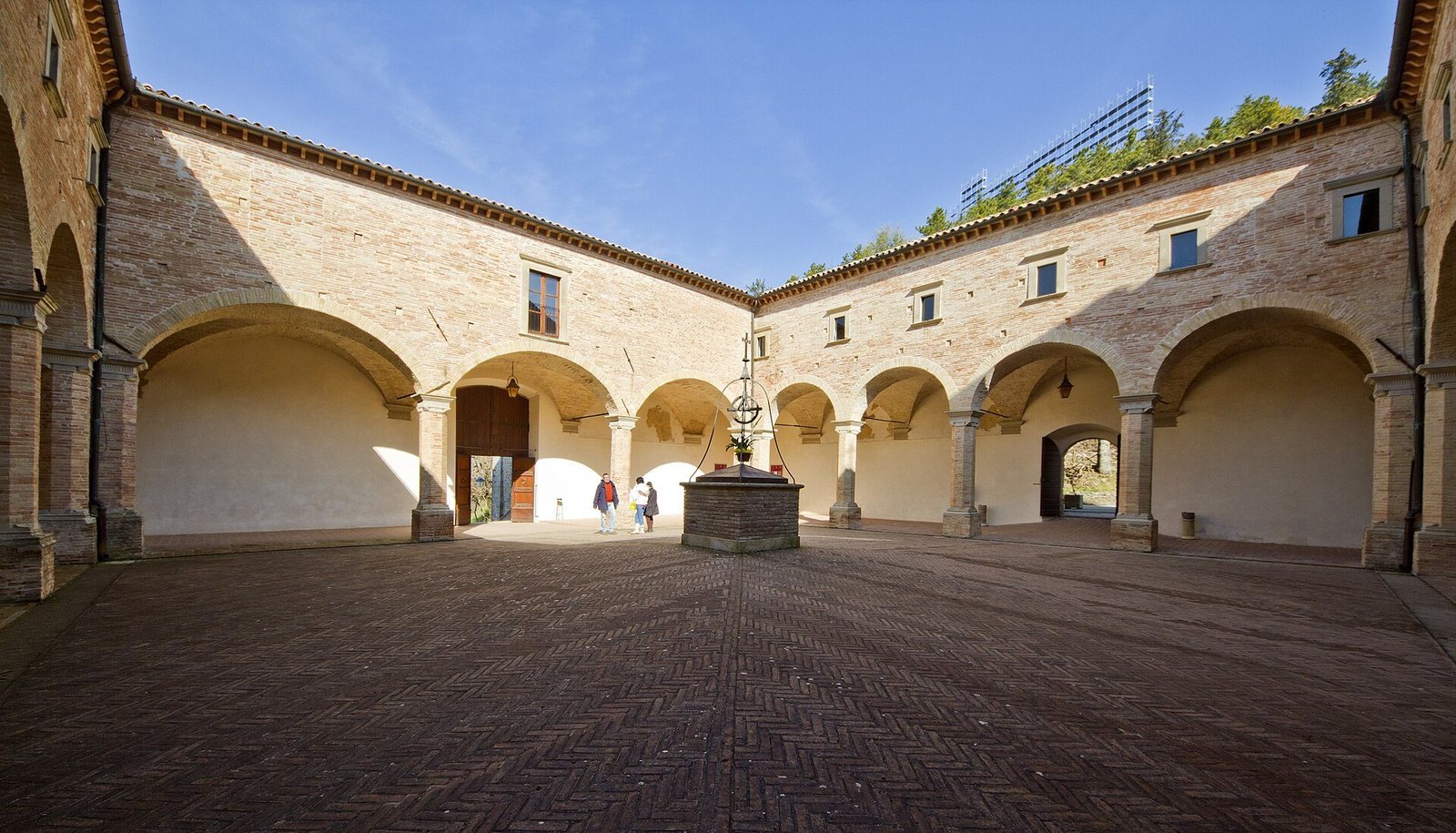
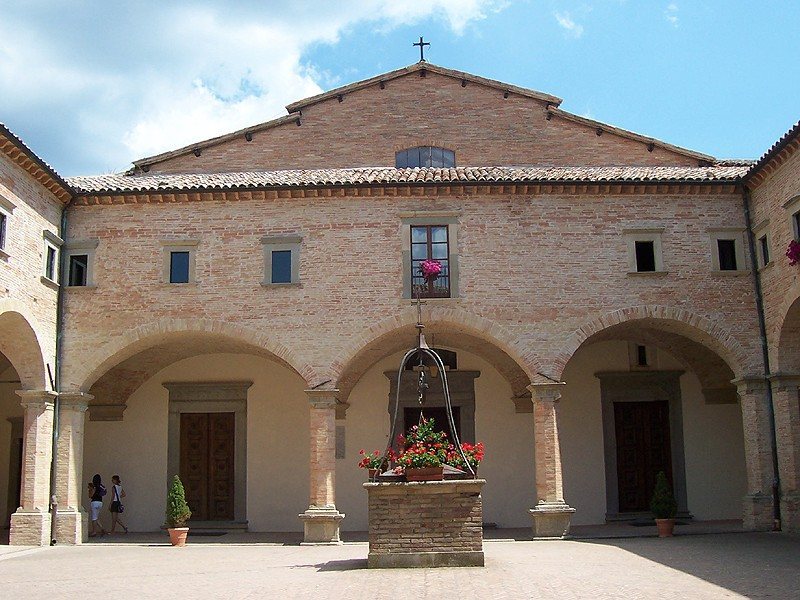
The adjoining cloister has arched openings and vaulted ceilings formed where two barrel vaults intersect. Traces of sixteenth-century wall paintings remain in the lunettes, semicircular wall areas within the vaults.
Church interior
Layout and decoration
The five-nave interior contains wall paintings from the sixteenth and eighteenth centuries. Stained-glass windows made by Mossmeyer in 1922 depict episodes from Ubaldo’s life and cast light onto the altar from behind.
Paintings
The church contains Giovanni Maria Baldassini’s Transfiguration and Saints (1585), Felice Damiani’s Baptism of Christ (about 1599), and Salvio Savini’s Madonna and Child in Glory between Saints Ubaldo and John the Baptist (1610). Other works include Avanzino Nucci’s Saint Augustine Delivering the Rule of His Order (1619), Pietro Paolo Tamburini’s Visitation (1620), and Francesco Allegrini’s Martyrdom of Saint Ursula and the Virgins (1655–57). Later paintings are Tommaso Maria Conca’s Virgin of Sorrows (1789) and Camilla Filicchi’s Ecstasy of Saint Francis Receiving the Stigmata, Comforted by Two Angels (1816).
Main altar and urns
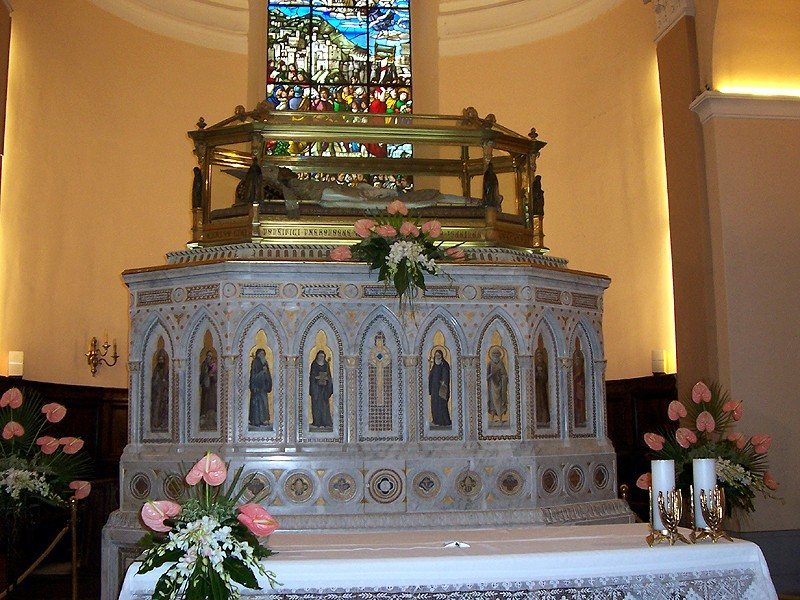
Made in 1884, the main altar is a large Neo-Gothic structure, using a revival of medieval Gothic design, with decoration imitating mosaic. Eight small statues of saints associated with Gubbio stand above it. Higher up, Ubaldo’s body rests in an urn displayed on a marble base beneath a glass case. Two earlier urns, one from the thirteenth century and another from the eighteenth, are also displayed in the church.
Ceremonial objects
The Ceri
The basilica preserves the three large ceremonial structures carried during the Festa dei Ceri. Once made of wax, they have been wooden since the sixteenth century. Each carries a statue of a saint and weighs nearly 900 pounds.
Reliquary cloth
A ceremonial cloth made in 1240 for the public display of Ubaldo’s relic is also kept at the basilica. Holy Roman Emperor Frederick II commissioned it from artisans in Palermo, who were friends of the emperor and his son Henry. Its woven patterns are described as typically Arabic.