San Matteo (Lecce): A Roman Baroque Church and Parish
Site at a Glance
- Popularity
- High
- Country
- Italy
- Primary era
- Early Modern
- Eras represented
- Early Modern, Modern
- Civilizations
- Kingdom of Naples, Spanish
- Site type
- Religious
- Remains
- Church
On this page12 sections
History
San Matteo, formally titled Santa Maria della Luce in San Matteo, is a Roman Catholic church in Lecce, Italy, built in the second half of the seventeenth century in the Roman Baroque style. It belongs to the Archdiocese of Lecce, a church territory governed by an archbishop, and is dedicated to Saint Matthew the Apostle and Madonna della Luce, or Our Lady of Light. A relic of Saint Matthew is kept in the church.
Construction and design
The church replaced a fifteenth-century chapel dedicated to Saint Matthew, which stood with a Franciscan convent, belonging to the Catholic religious order founded by Saint Francis of Assisi. Bishop Luigi Pappacoda commissioned the new building and laid its first stone in 1667. Achille Larducci, an architect from Salò and a nephew of Francesco Borromini, designed it. The design drew on Borromini’s Roman Baroque work at San Carlo alle Quattro Fontane in Rome. Construction was completed in 1700; completion after Larducci’s death is tentatively attributed to the Lecce architect Giuseppe Zimbalo.
Parish church
On 30 April 1810, San Matteo became the seat of the parish of Santa Maria della Luce. The parish had been established on 16 March 1606 in a church of the same name outside Lecce’s walls. It moved to San Matteo after the Franciscan monastery was suppressed.
Remains
Façade
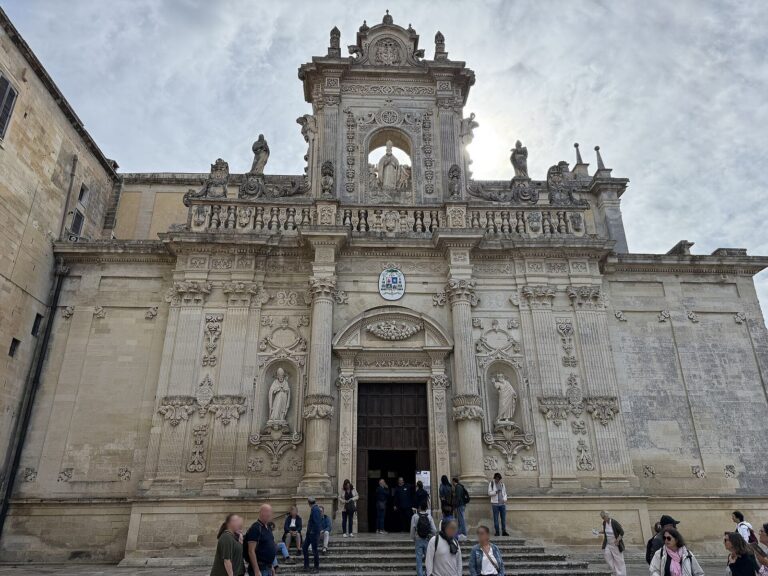
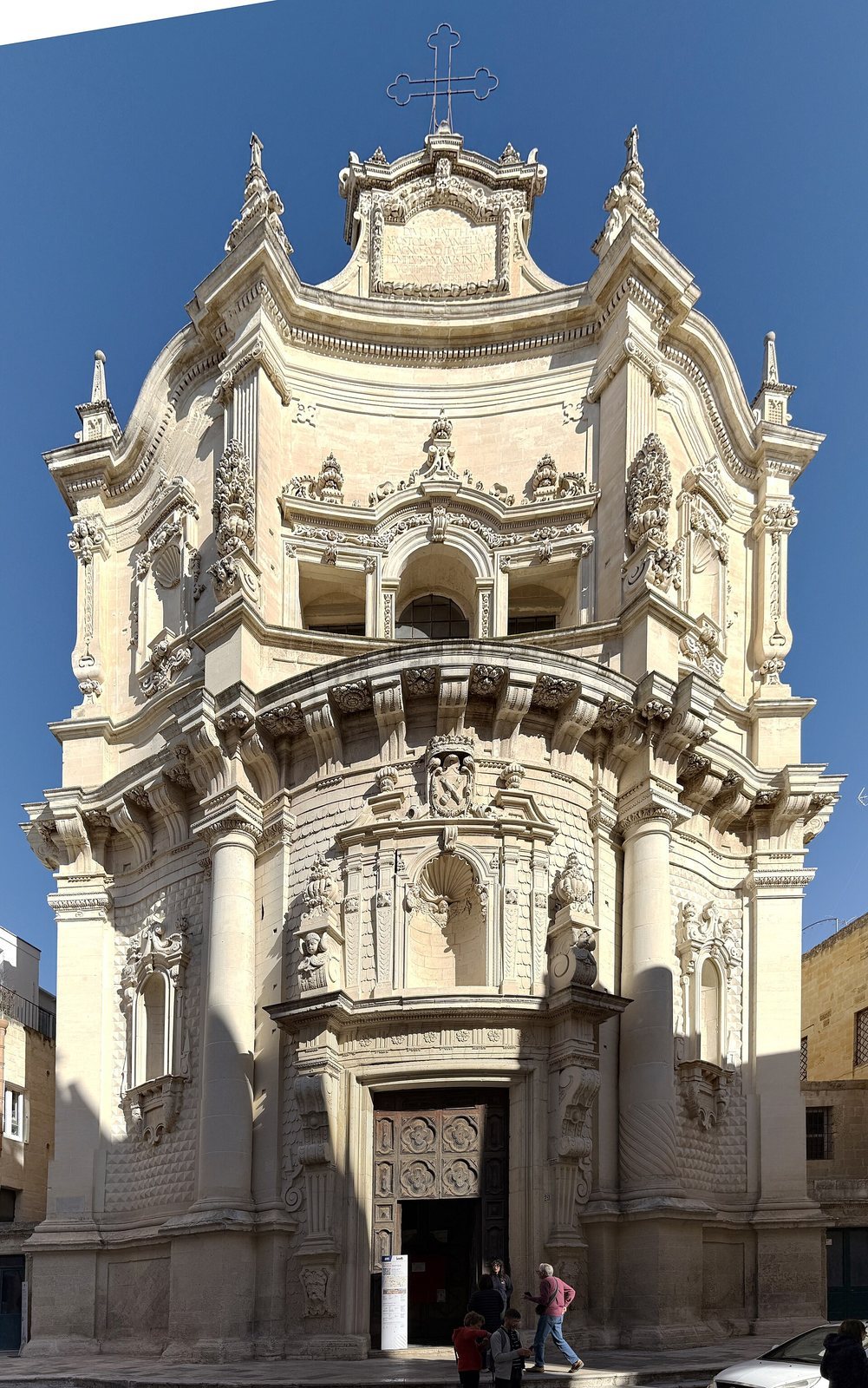
The façade has a pronounced, wave-like profile: its lower storey curves outward, while the upper one bends inward. This arrangement departs from the usual forms of Lecce Baroque and recalls Borromini’s façade at San Carlo alle Quattro Fontane. Two columns on tall square bases divide the lower storey into three sections. In the centre, scale-like ornament surrounds an elaborate portal, set beneath a small shrine-like frame with an empty niche and crowned by the Franciscan coat of arms. The two side niches sit against diamond-point decoration.
Above, a three-part opening with a central arch and flanking sections is accompanied by a continuous moulding and two richly ornamented niches. Pinecone and floral motifs embellish the central opening. A curved cornice of mixed profiles and a tall crowning feature complete the façade.
Interior
Nave and chapels
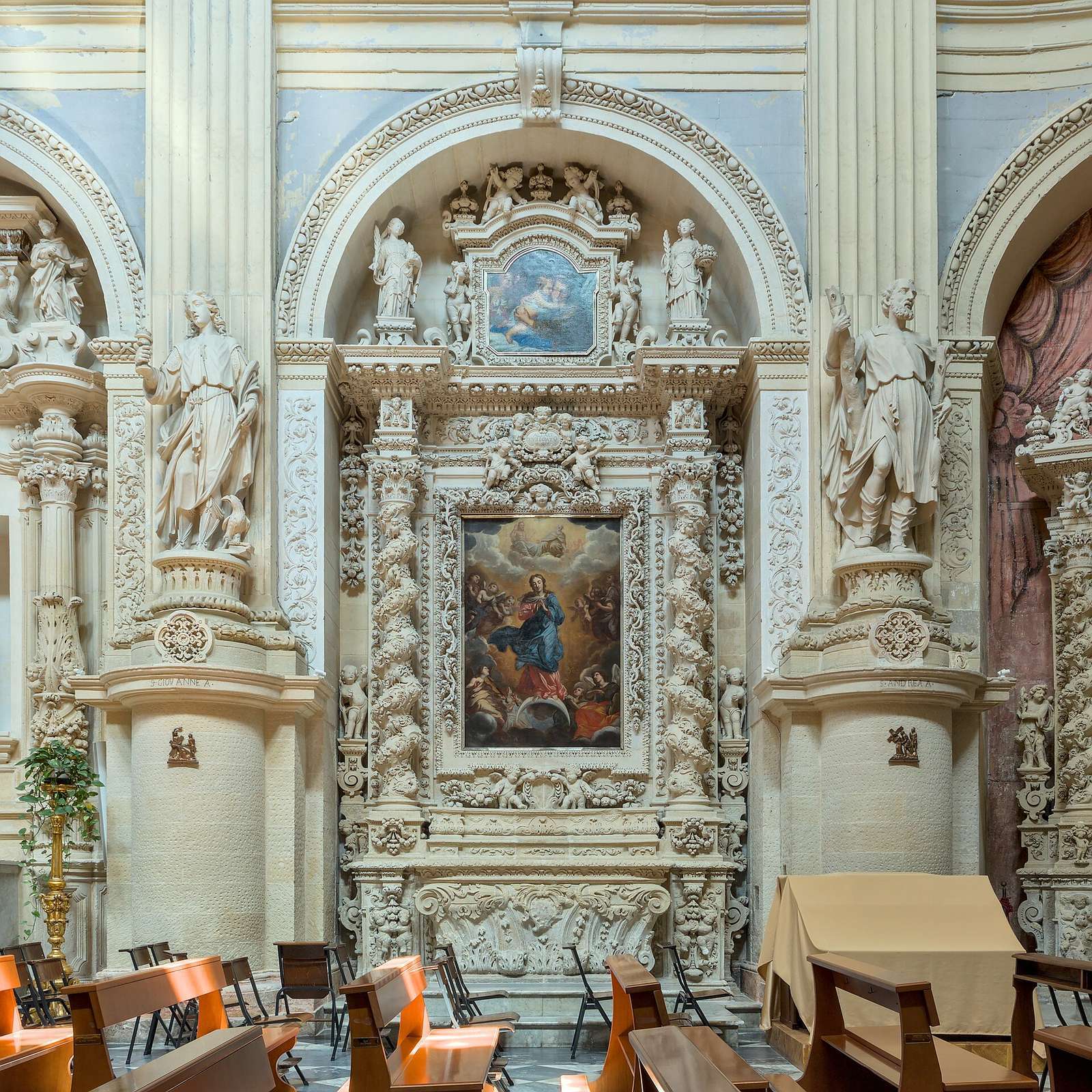
The interior has a single elliptical nave, the church’s main space, with shallow side chapels opening along its walls. Wall-attached supports, or pilasters, with tall semicircular bases divide the chapels. The bases carry twelve stone statues of the Apostles, sculpted by Placido Buffelli in 1692. Ten pairs of windows, each protected by an iron grille, correspond to the chapels; nuns used them to attend services. The original wooden ceiling was replaced in the early nineteenth century. A twenty-first-century restoration left the ceiling in concrete.
Altars on the left
The Lecce Baroque altars, known for elaborate local stone carving, are attributed to the school of Giuseppe Cino. On the left side of the nave, they are dedicated in sequence to Saint Agatha, Saint Francis of Assisi, Saint Rita of Cascia, the Immaculate Madonna and the Pietà, a representation of Mary with the dead Christ. The Saint Agatha altar has an 1813 painting of her martyrdom by Pasquale Grassi. The Saint Rita altar holds a papier-mâché statue made by Raffaele Caretta, while the Pietà altar contains a polychrome wooden statue made in Venice in 1693.
Altars on the right
Altars on the right side are dedicated to Madonna della Luce, Saint Anne, the Holy Family and Saint Oronzo, Lecce’s patron saint. The Madonna della Luce altar includes a sixteenth-century fresco transferred from the former church of Santa Maria della Luce. It depicts the Virgin and Child, with a small coral-horn amulet hanging at the Child’s neck. Serafino Elmo painted the works on the Saint Anne and Holy Family altars; the Saint Oronzo altar has an altarpiece dated 1736.
Pulpit
A carved wooden pulpit stands between the altars of Saint Anne and the Holy Family. Four stone allegorical statues flank it.
Apse and high altar
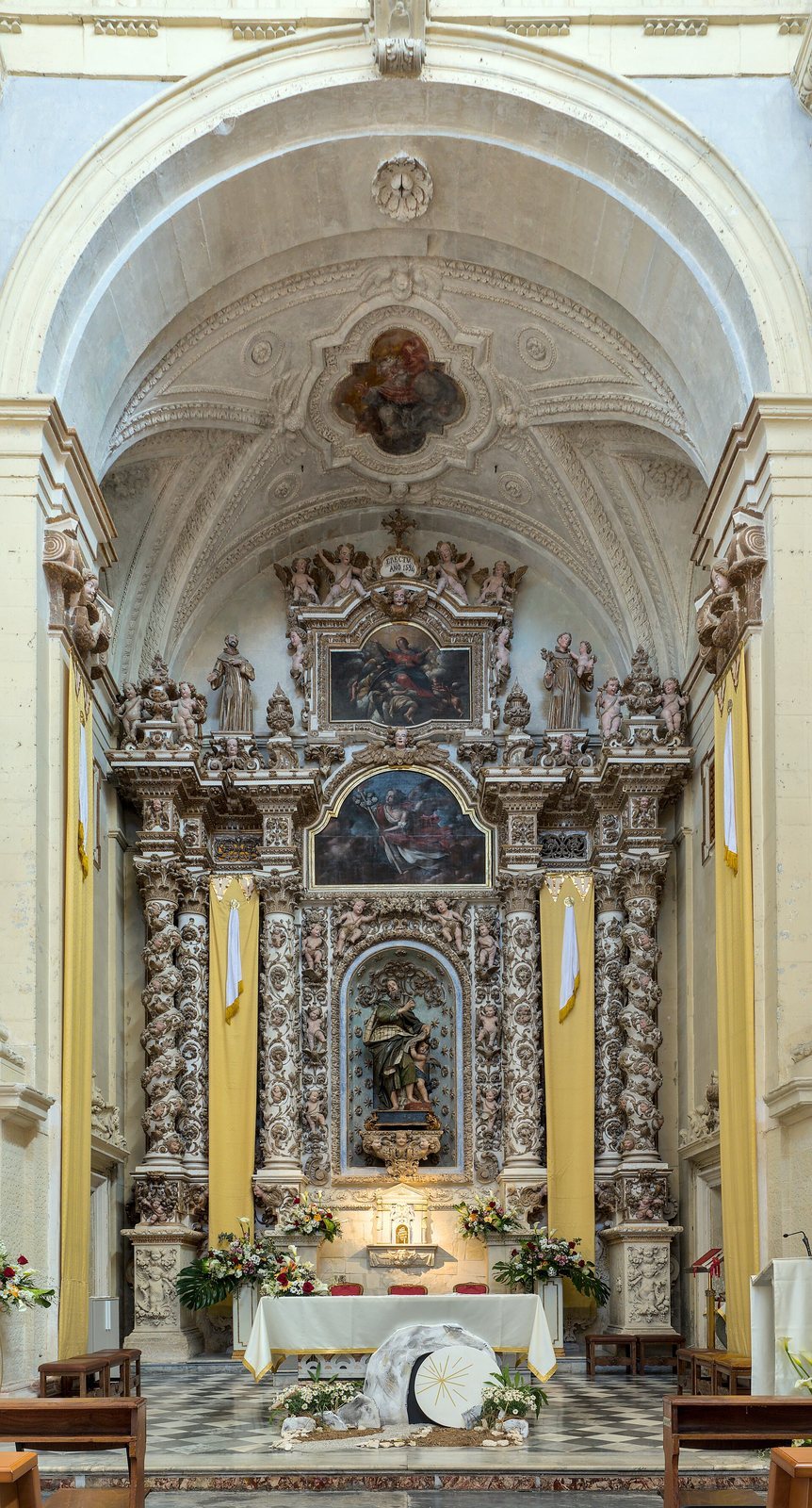
The apse, the sanctuary-end section of the church, is covered by a star vault whose ribs form a star-like pattern. The richly ornamented high altar has small statues of saints between its columns. A central niche holds a wooden statue of Saint Matthew the Apostle, sculpted by Gaetano Patalano in 1691.
Organ case and other altars
Above the entrance is the carved and gilded wooden covering of an eighteenth-century organ from the Basilica of Santa Croce. The church also has altars dedicated to the Assumption, the belief that Mary was taken into heaven, and the Nativity.