Khotiml Hillfort: A Medieval Fortress in Russia
Site at a Glance
- Popularity
- Low
- Country
- Russia
- Primary era
- Medieval
- Eras represented
- Medieval
- Civilizations
- Kievan Rus
- Site type
- Military
- Remains
- Fort
On this page10 sections
History
Foundation and early role
Khotiml Hillfort is a medieval fortified settlement near the village of Khotiml-Kuzmenkovo in Oryol Polesye National Park, Russia. It was founded in the 11th century, after the Vyatichi, an East Slavic people of the Oka region, became part of Kievan Rus, a medieval East Slavic polity centered in Kyiv. Khotiml belonged to the Karachev Principality, one of the principalities of the upper Oka region. It may have served as a fortified estate, protecting a local lord from hostile neighbors or dependent peasants.
The town was probably destroyed in 1310 by a force of Rus troops and the Mongol-ruled Golden Horde, led by Vasily Mikhailovich, prince of Bryansk. The force sacked Karachev and killed its prince, Svyatoslav Mstislavich. Khotiml nevertheless remained a stronghold until the 17th century. Its defenses may also have sheltered local people during raids by Crimean Tatars, whose attacks affected parts of southern Russia. The stronghold’s military role ended as the threat of Tatar raids in the Oryol region declined.
Written records and administration
Khotiml first appears in a written record on 26 March 1499, when Alexander Jagiellon, grand duke of Lithuania, granted administration of the Khotiml volost, a local territorial unit, to Simeon Ivanovich, prince of Mozhaisk. Simeon transferred his allegiance to Ivan III, grand prince of Moscow, in 1500, along with the lands he had received. The volost appears as a Moscow possession in records from 1508 and 1523. During the 16th and 17th centuries, Khotiml was the center of the volost in Karachev County, a larger administrative district.
Church and heritage status
A land register from 1626-1627 lists a village church dedicated to the Dormition of the Mother of God, a Christian feast commemorating Mary’s death, with a side chapel for St. Paraskeva, a saint venerated in Eastern Orthodox churches. A presidential decree dated 20 February 1995 designated the hillfort as an archaeological monument of federal significance.
Remains
Setting and fortifications
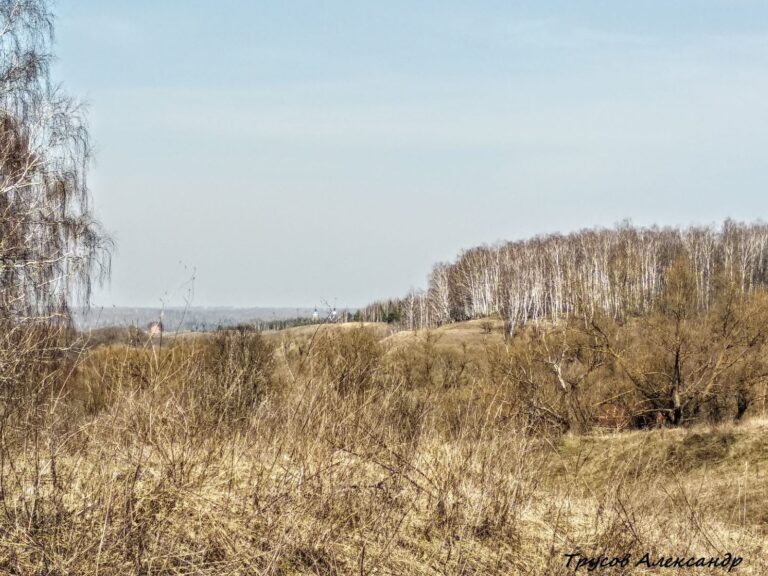
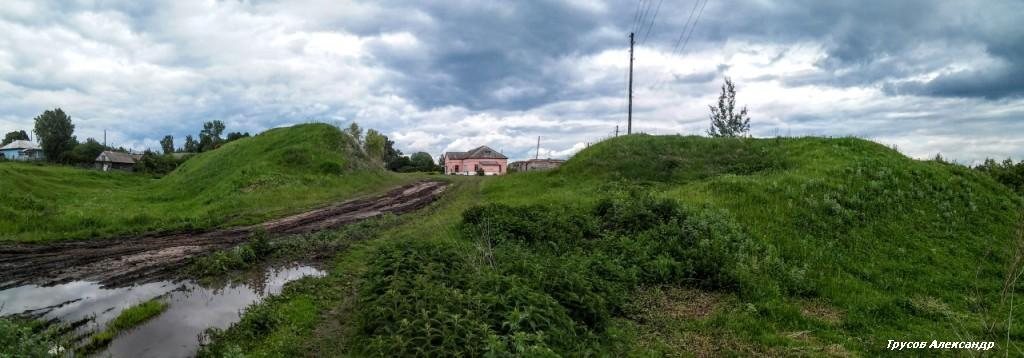
The hillfort covers an oval area measuring 200 by 170 metres, raised about 4-5 metres above an unnamed stream on its right bank. The stream is a left tributary of the Vytebet River. A ring-shaped earthen rampart encloses the site and reaches about five metres high in places; a ditch outside it is up to two metres deep. A timber wall made of logs, with towers, followed the rampart. Gates on the east and west gave access to the enclosure. Khotiml was the largest fortress in Oryol Region, and its defenses were comparable in size and strength to those at Karachev.
Water system
A spring within the enclosure fed a pond. Excess water flowed from the pond to the stream through a deliberately cut channel, supplying the fortress with abundant water. This arrangement was unique among the region’s medieval Rus fortresses.
Archaeological deposits
Excavations revealed a cultural layer (accumulated soil containing evidence of human activity) as much as two metres thick. Finds included pottery from the late medieval Rus period and a small number of pottery and other craft objects.
Burial mounds
Two groups of burial mounds lie about 1.5 kilometres from the western edge of the village. One group has three mounds and the other has four. Annual ploughing is gradually damaging them.
Village church
The earlier church was wooden. Its brick replacement was built in the village center in the early 20th century. The replacement’s bell tower was never completed, and its upper section was dismantled in the 1960s.