Onezhsky Krestny Monastery: A Patriarchal Orthodox Monastery on Ki Island
Site at a Glance
- Popularity
- Medium
- Country
- Russia
- Primary era
- Early Modern
- Eras represented
- Early Modern, Modern
- Civilizations
- Russian
- Site type
- Religious
- Remains
- Monastery
On this page13 sections
History
Foundation and early development
Onezhsky Krestny Monastery was a monastery for men on Ki Island in Onega Bay of the White Sea, Russia. Founded in 1656 as the Monastery of the Elevation of the Cross of the Lord, it was placed directly under the patriarch’s authority, a status known as stavropegial, and governed by archimandrites, senior monastic superiors. This unusual arrangement gave the monastery direct ties to the head of the Russian Orthodox Church.
Its founding tradition begins in 1639, when Nikon, then a hieromonk, or monk ordained as a priest, was caught in a storm near the mouth of the Onega River while travelling from Solovetsky Monastery. He found shelter on Ki Island, raised a cross in gratitude, and vowed to establish a monastery there. In 1652, Nikon returned as Metropolitan of Novgorod, a senior bishop, carrying the relics of Saint Philip from Solovetsky for transfer to Moscow. He renewed his vow and established a chapel beside a cross near the island’s mainland-facing end.
After becoming patriarch, Nikon secured Tsar Alexei Mikhailovich’s permission to found the monastery. The royal charter is dated 13 June 1656. Nikon raised about 6,000 rubles for construction, and work on the first buildings continued from 1656 to 1659. Monastic elders Nifont Terebinsky and Isaiah, together with the court official Vasily Poskochin, oversaw the work as a monastic community took shape.
An inventory from 1657 lists a wooden church, probably dedicated to the Elevation of the Cross. It was rededicated in 1661 as the Church of the Synaxis of the Archangel Michael, an Orthodox feast celebrating a saint or group of saints. A wooden church dedicated to the Iveron Icon of the Virgin Mary was built in 1659. During 1660, Nikon spent nearly a year on the island directing construction and arranging a freshwater collection system modelled on those used by Palestinian monasteries. He consecrated the central Cathedral of the Elevation of the Cross on 2 September and the Church of All Saints on 8 September, then left for Moscow late that month and did not return.
The monastery was intended as a political alternative to Solovetsky Monastery, then one of the centres of the Old Believers, Orthodox Christians who resisted changes to church rites and books in the seventeenth century. It received part of Solovetsky’s estates and serfs, while its own holdings included Borovskaya. Its direct patriarchal status and governance by archimandrites set it apart from many monasteries of the period.
Eighteenth-century decline
In 1730, Leo Yurlov, formerly Bishop of Voronezh, was sent to the monastery under strict supervision after losing his rank and monastic status. He remained confined there until Elizabeth Petrovna became empress in 1741.
Church-property secularization under Catherine II weakened the monastery. In 1756, a timber-trading exchange and customs office opened on its grounds to support trade with foreigners in timber and related goods. Both operations later closed when the monastery was restored. After the 1764 secularization, the monastery’s control over peasants from mainland Vorzogory diminished but continued in part. The peasants passed under state control and were assessed dues to support the island community.
War, damage, and closure
During the Crimean War of 1853 to 1856, in which Russia fought an alliance that included Britain, France, and the Ottoman Empire, a British squadron reached the island on 9 July 1854. Eighty men landed in six boats and plundered the monastery, taking valuable church objects and a bell weighing six poods, a traditional Russian unit of weight. They removed two of the monastery’s seven large cannon, threw three into a well, and left the other two when they could not carry them away. The monastery’s treasury had been sent to the mainland in seven chests when the war began, while less valuable objects had been buried on the island.
A fire damaged the buildings in 1855, after which they were restored with support from the Russian government. Soviet authorities closed the monastery in 1922, and its abolition is dated to 1923. It was plundered during the Soviet period, and monastic life did not resume. The Ki Cross, a cross-shaped container for sacred relics commissioned by Nikon, was later moved from the island. After passing through the Museum of Religion and Atheism and storage at Moscow’s Historical Museum, it was placed in 1991 in the Church of Saint Sergius of Radonezh in Krapivniki, Moscow. The monastery is recognized as a cultural heritage site of federal significance in Russia.
Remains
Stone churches and buildings
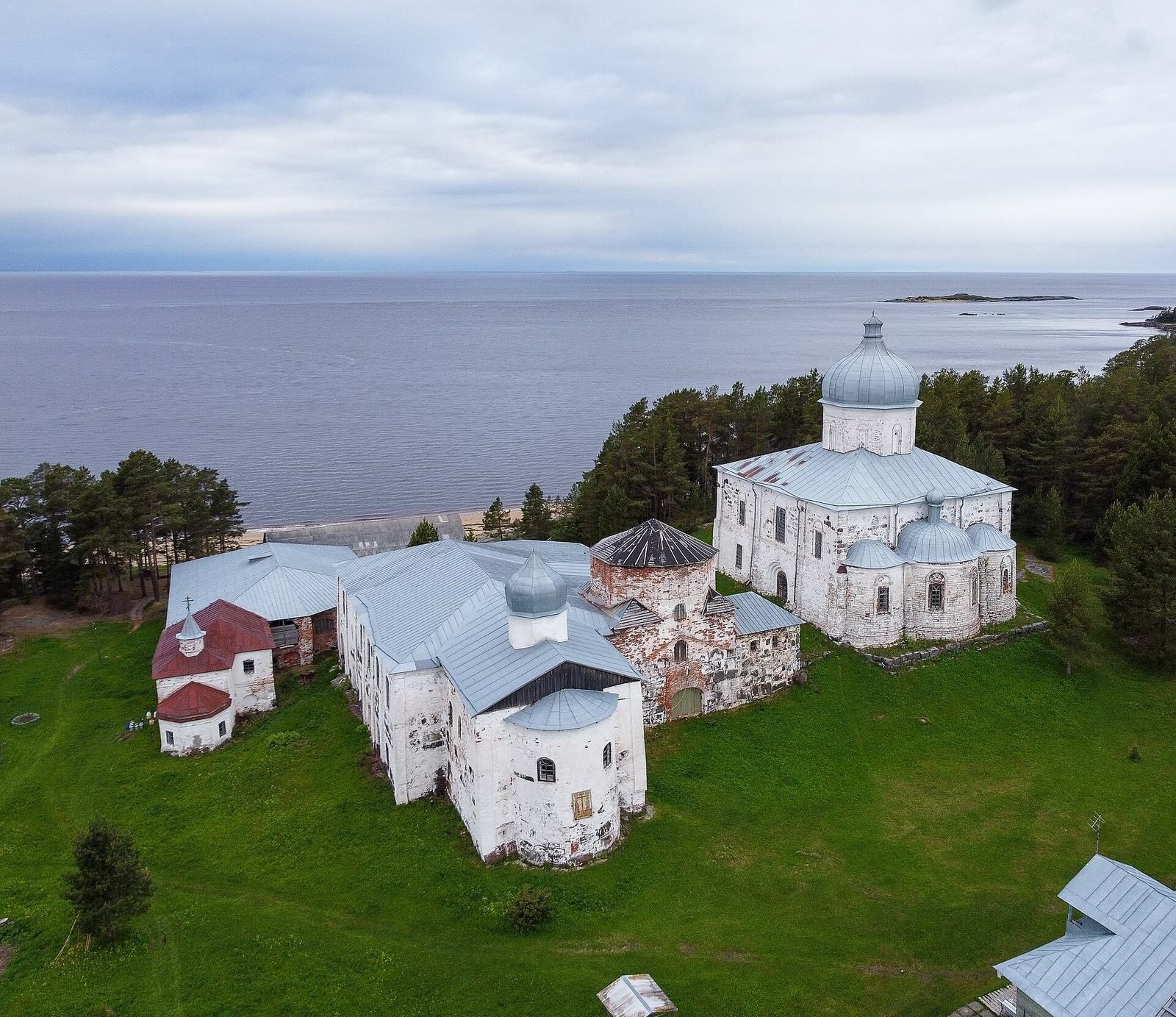
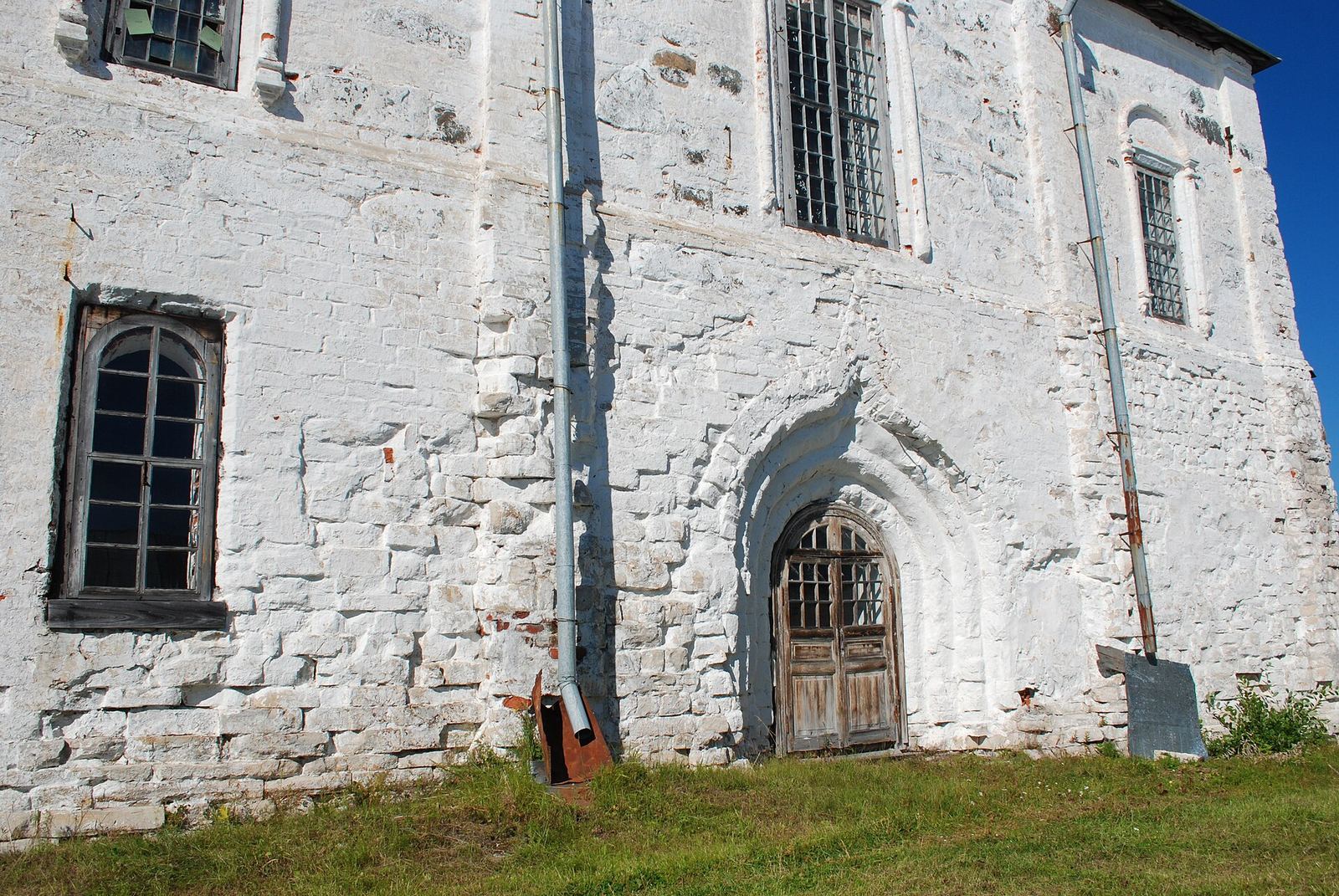
The surviving ensemble on rocky Ki Island includes stone churches and service buildings, wooden residences, chapels, and a fragment of the wooden enclosure. The Cathedral of the Elevation of the Cross occupies the island’s highest point. Other stone buildings include the Church of the Procession of the Precious Wood of the Life-Giving Cross, built over a well, and the Church of the Nativity of the Virgin with its refectory and bell tower. The buildings survive in varying condition.
Cathedral of the Elevation of the Cross
Built and consecrated in 1660 under Nikon’s direction, the cathedral was constructed by architects brought to the island after work at Iveron Monastery on Lake Valday. Its stonework is tentatively attributed to master builder Averky Mokeev. The lower, heavily loaded courses of the walls use imported limestone, while brick and granite boulders form the upper walls. The building has a square central space, four interior supports, and three apses, projecting ends that contain the sanctuary. Its entrances were framed by multiple arches.
The cathedral was probably designed with five domes. Fires and collapses reshaped the design into a three-dome arrangement. The two eastern dome bases are now ruined and covered by a high roof, while the central dome remains visible. The central octagonal drum, the structure supporting the dome, was originally lit through windows first fitted with mica and later with glass. The openings were bricked up because of concern that drafts through them could intensify a fire. Simplification of the structure beneath the central dome lowered the building by about two metres.
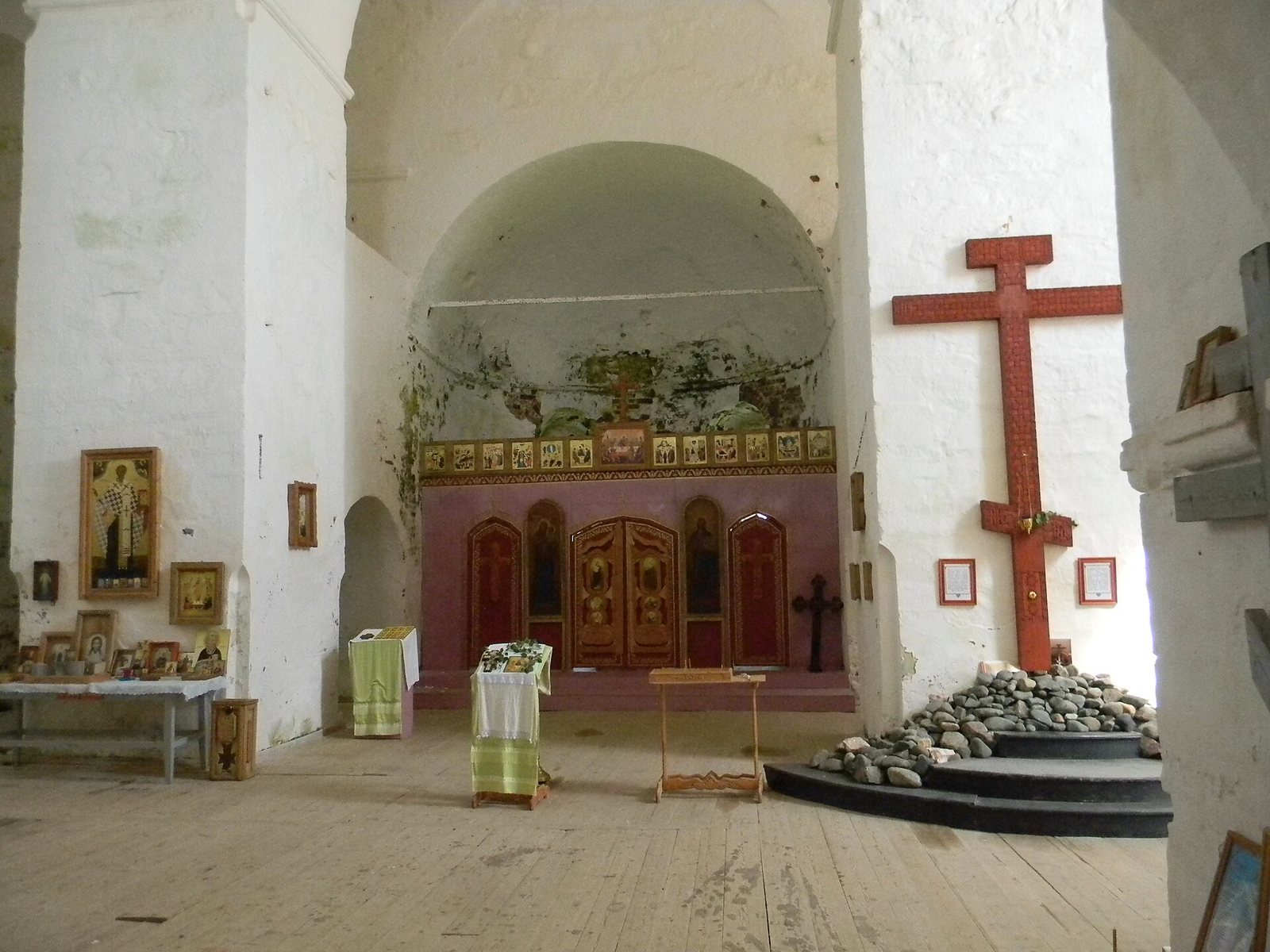
Inside, a tall iconostasis, a screen of icons separating the sanctuary from the main worship space, once occupied as much as a third of the floor area. The Ki Cross stood where the principal church icon would be placed. Wall paintings adorned the underside of the dome, known as the “sky.” A large gallery for the choir occupied the second level, with a central position possibly reserved for Nikon. Stairs within the walls, which reach up to two metres thick, lead to the gallery from the north and west. A narrow spiral stair in the northwest corner served a gallery beneath the dome, where Nikon’s large chandelier could be maintained. Two chapels were later partitioned at the northern and southern ends of the choir gallery.
The island’s rest home later reused the cathedral as a cinema booth. The cathedral was subsequently reconsecrated and fitted with a small icon screen.
Church of the Procession of the Precious Wood of the Life-Giving Cross
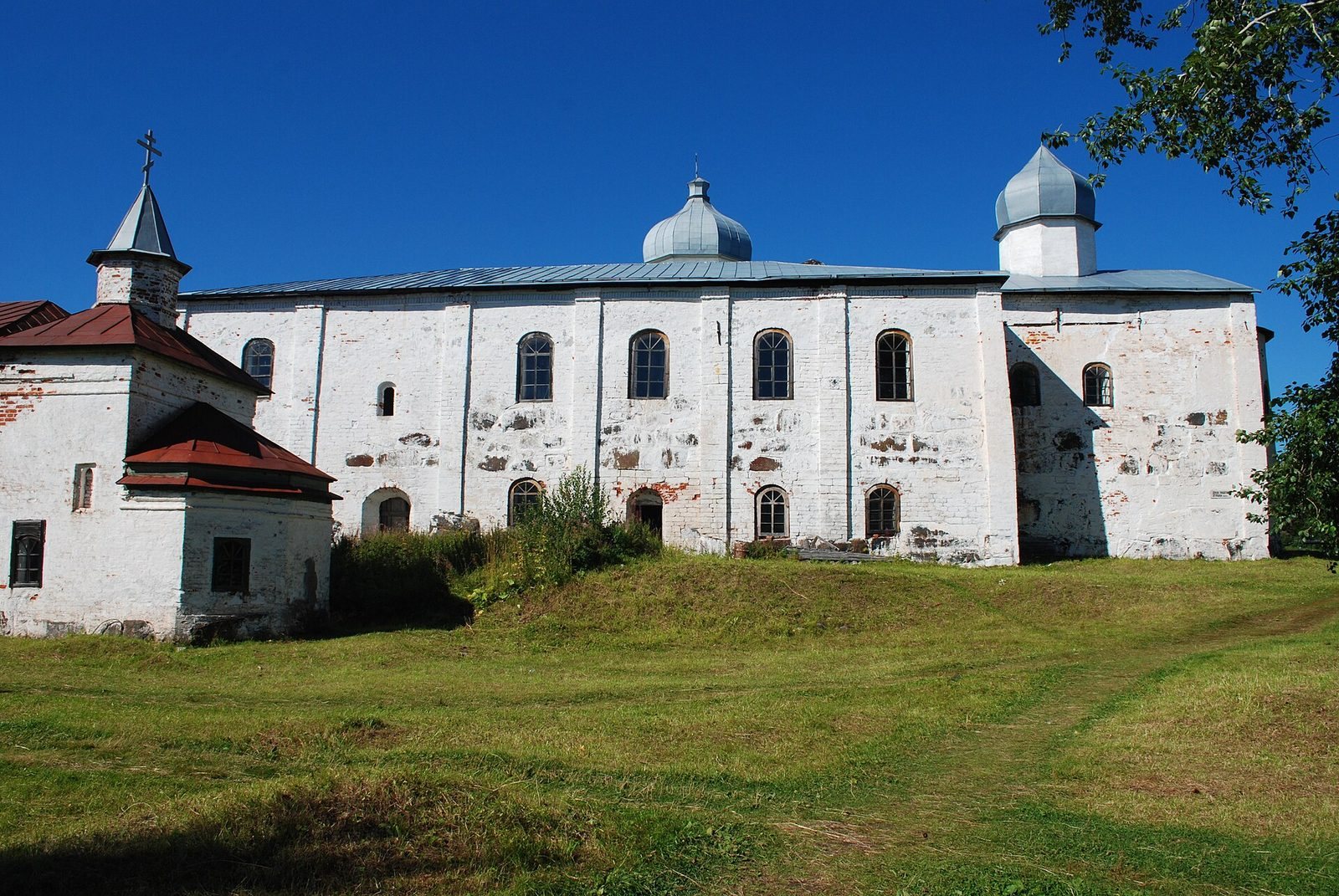
Dating to 1660, this church is named for an Orthodox observance venerating the Cross. It stands over a well and is joined to a single-storey service-and-cell building dating to about 1715. The attached building had service rooms on its ground floor.
Church of the Nativity of the Virgin and refectory
The Church of the Nativity of the Virgin dates to 1689 and is joined to a stone refectory, or communal dining hall, on its western side. The refectory is square, with sides about 15 metres long, and was modelled on the one at Solovetsky Monastery. A bell tower stands to the northwest of the church. A burial chapel for monastery superiors adjoins the tower, while monks were buried in a separate cemetery.
Wooden buildings, chapels, and spring
Church of All Saints and wooden structures
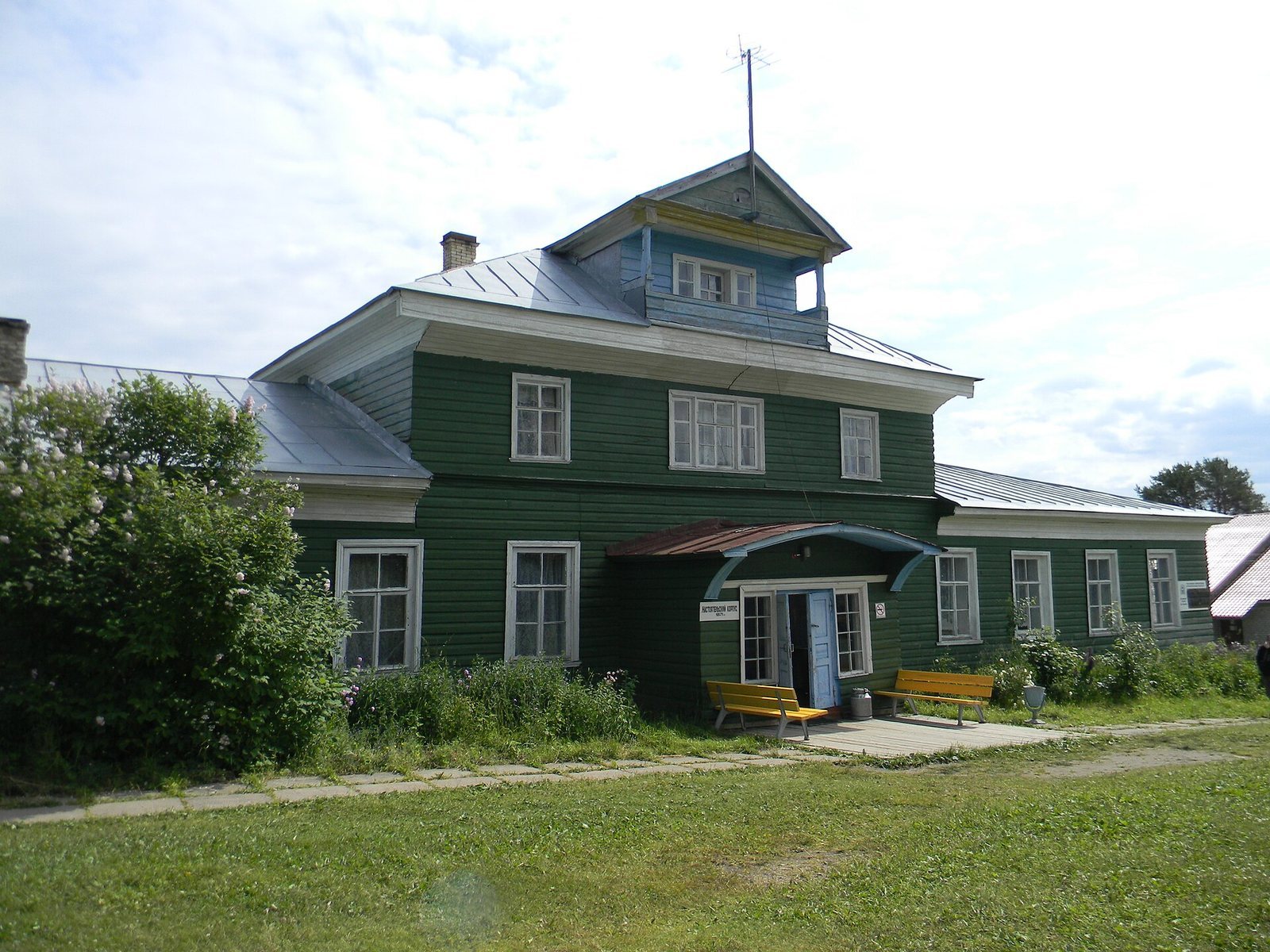
The wooden Church of All Saints was consecrated in 1660 and later converted into residential accommodation for a rest home. Other surviving timber buildings include the abbot’s quarters, dated to 1871, and a brotherhood building. A fragment of the monastery’s wooden enclosure also remains.
Chapels
The right-hand chapel is dedicated to the Nativity of Christ and dates to 1874. The left-hand chapel is dedicated to Metropolitan Philip of Moscow and was built in 1869.
Spring
A ten-metre-deep spring lies on the monastery grounds. It was regarded as miraculous and tradition attributed its discovery to Nikon.