Meadowcroft Rockshelter: A Prehistoric Archaeological Site in Pennsylvania
Site at a Glance
- Rating
- 4.8
- Popularity
- Medium
- Country
- United States
- Primary era
- Stone Age
- External website
- Open
- Eras represented
- Stone Age
- Civilizations
- Unclassified
- Site type
- Domestic
- Remains
- House
On this page9 sections
History
Meadowcroft Rockshelter is a natural shelter near Avella, Pennsylvania, in the United States, with human occupation dating to about 16,000 years ago (14,000 BCE) and a disputed possibility of occupation as early as about 19,000 years ago (17,000 BCE). The earlier proposed date would place people there before the Clovis tradition, known especially for its fluted stone projectile points, and, if valid, make Meadowcroft one of the earliest known sites of human presence in the Americas.
Early occupation and the dating debate
Radiocarbon dating supports the proposed early chronology, but archaeologists disagree about it. In a 2013 Society for American Archaeology survey, 38 percent of respondents supported the early dates and 20 percent rejected them. Critics have argued that ancient carbon from coal-bearing layers in the watershed could have contaminated samples. An independent geomorphologist found no evidence of groundwater movement in the samples, while accelerator mass spectrometry, a method of radiocarbon measurement, produced results supporting the earlier dates. Critics also point out that organic substances extracted from charcoal samples with alkali yielded older ages than the charcoal itself.
The name Meadowcroft comes from a nearby village, which is also a historical park. Evidence from the shelter indicates occupation across the Paleoindian, Archaic, and Woodland periods, broad labels for successive stages of North American prehistory. Native American occupants left during the American Revolutionary War, the struggle for independence from Britain.
Later prehistoric life and the Miller complex
People at Meadowcroft hunted smaller game and gathered plants, including corn, squash, fruits, nuts, and seeds. The site’s Miller complex, an archaeological grouping defined by a distinctive set of stone tools, has helped researchers compare proposed pre-Clovis assemblages. Meadowcroft-style blade tools and small, many-sided cores used to strike blades have also been found at the Krajacic site, about 10 miles southeast. Similar leaf-shaped points occur at Cactus Hill in Virginia, where they are classified as Early Triangular, and at Page-Ladson in Florida. The Miller complex’s tools distinguish it from later regional assemblages centered on fluted points. Some scholars have proposed that Clovis, Folsom, another Paleoindian tradition, and other fluted-point traditions may have developed from older traditions using unfluted leaf-shaped points.
Discovery, excavation, and recognition
Albert Miller found the first artifacts in a groundhog burrow in 1955. He delayed reporting the discovery to discourage vandalism, then contacted archaeologist James M. Adovasio. The University of Pittsburgh’s Cultural Resource Management Program excavated the site from 1973 to 1979, and university field-school work continued through 1989. Since the 1990s, Adovasio has also conducted work through the Mercyhurst Archaeological Institute. The excavation methods were regarded as state of the art, and Meadowcroft is considered among the most carefully excavated archaeological sites in North America.
Meadowcroft is operated as a division of Pittsburgh’s Heinz History Center, a history museum and research institution. It was added to the National Register of Historic Places, a federal inventory of historic places, in 1978, and designated a National Historic Landmark in 2005, a status for places judged to have exceptional national historical importance. It is also recognized as a Pennsylvania Commonwealth Treasure, a state-level heritage designation.
Remains
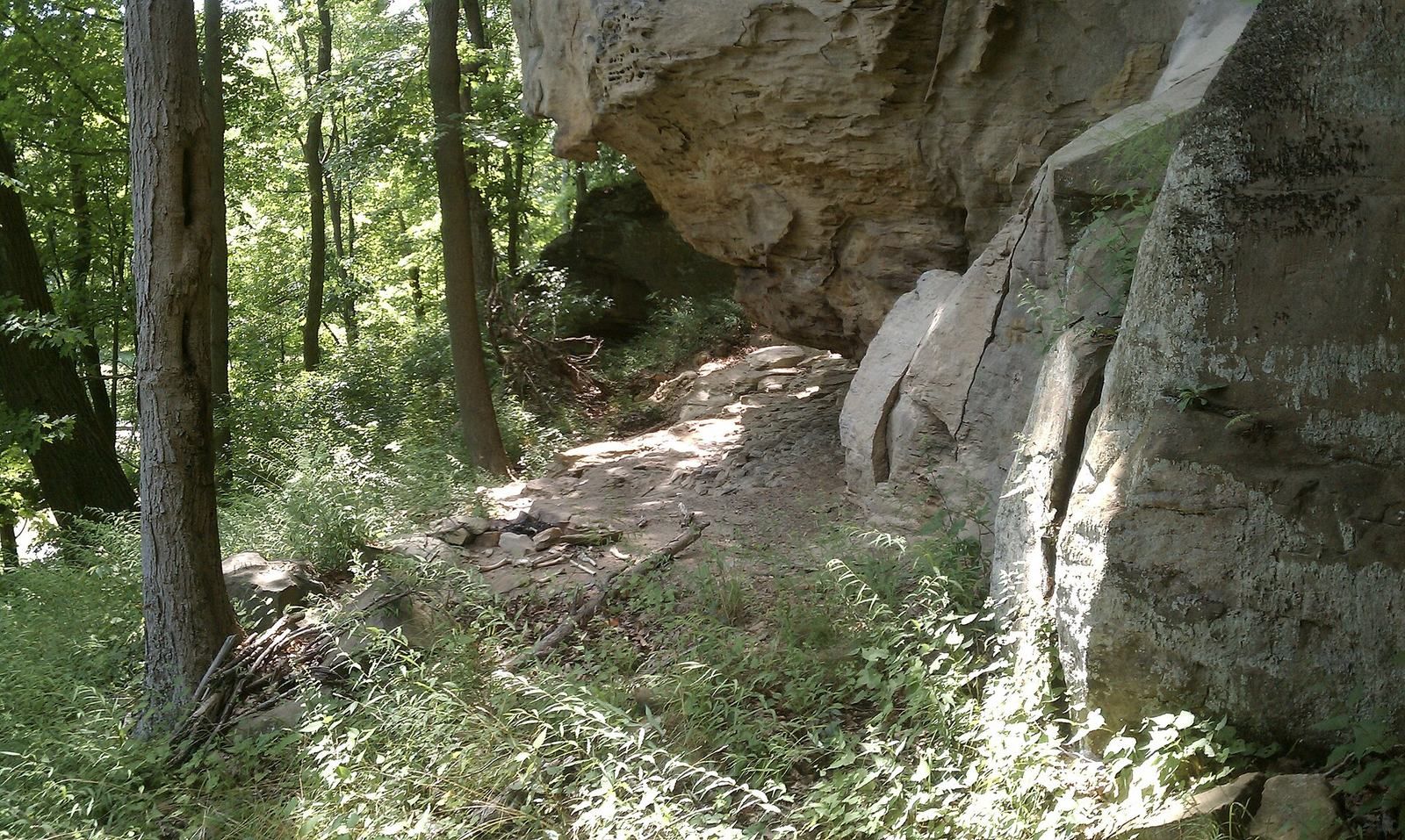
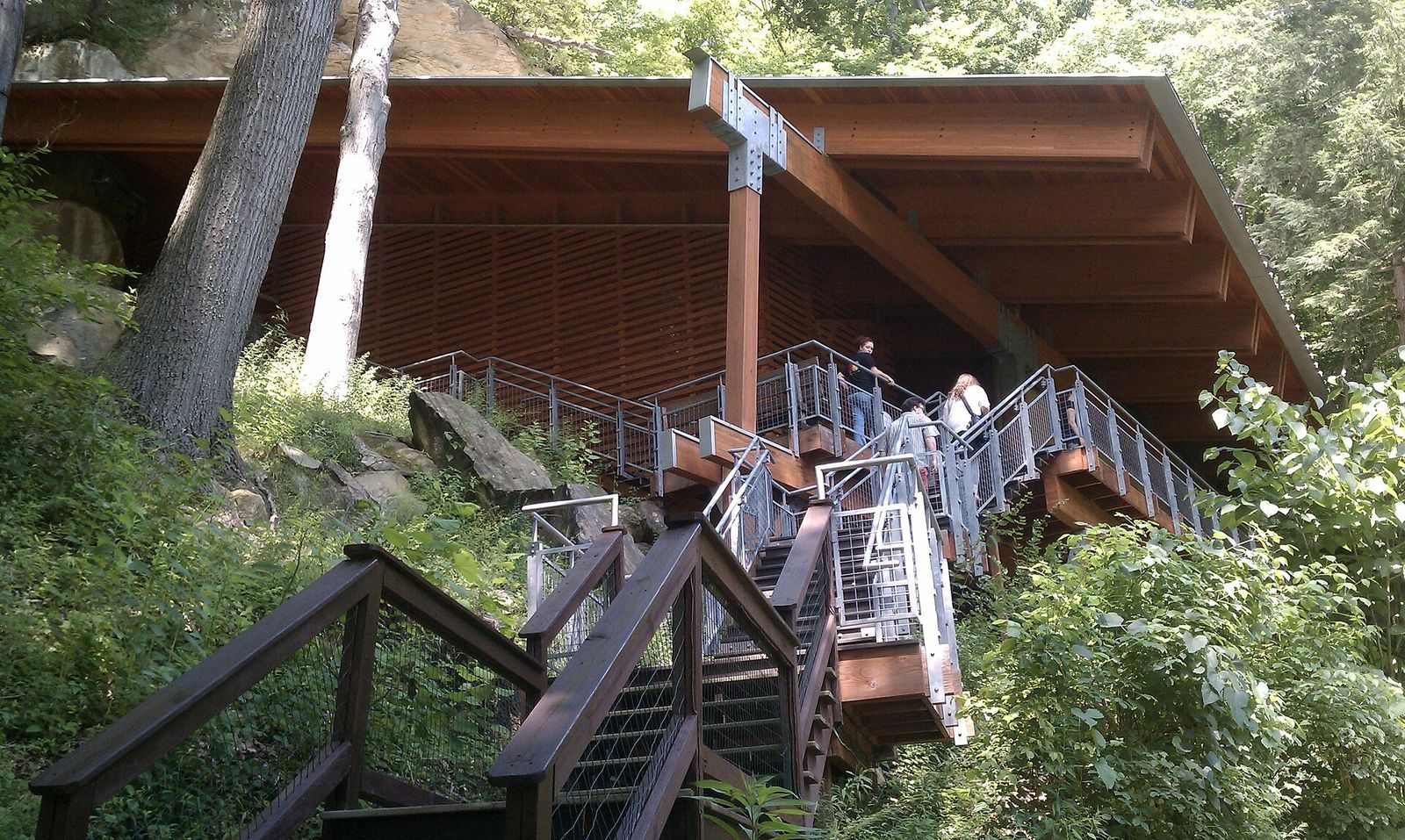
The rockshelter lies beneath an overhanging cliff of thick, brown Morgantown-Connellsville sandstone from the Pennsylvanian, a period within the Carboniferous. It occupies a bluff overlooking Cross Creek, a tributary of the Ohio River, on the Allegheny Plateau northwest of the Appalachian Basin. The site also includes a museum and a reconstructed village representing the Monongahela, an Indigenous culture of the upper Ohio Valley, around the 1570s.
Shelter and archaeological deposits
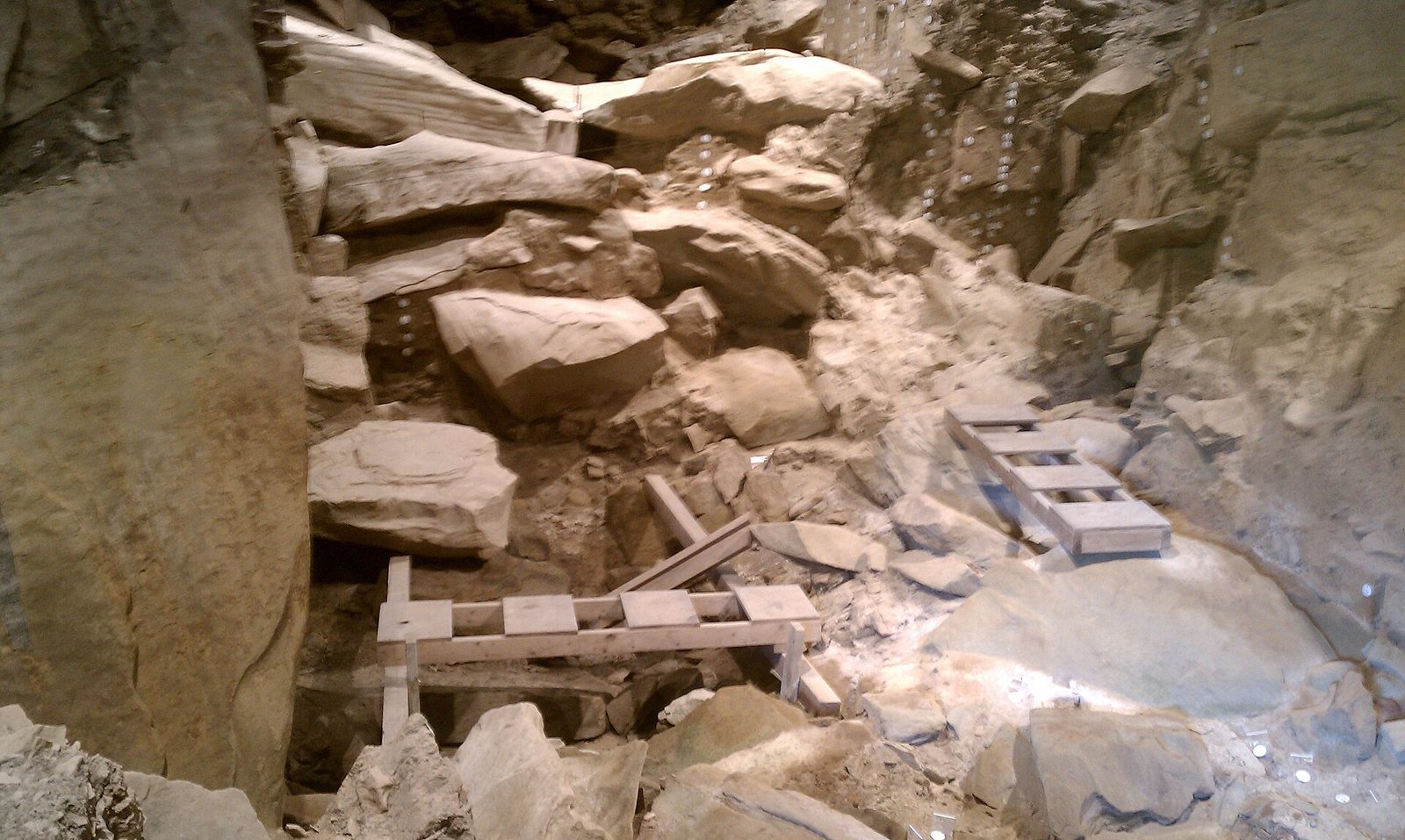
Archaeological deposits extend as deep as 11.5 feet (about 3.5 metres) below ground, including material that may belong to the period before Clovis. At least one basin-shaped hearth was used repeatedly. The shelter’s dry conditions have preserved botanical material particularly well.
Artifacts and environmental evidence
Stone tools and other artifacts
The finds include pottery, possibly from later periods, stone tools shaped on both faces, fragments of such tools, elongated stone blades, fluted projectile points, and stone debris from toolmaking. The Miller-complex assemblage includes thin two-faced tools, small prismatic blades, retouched flakes and blades, and debris from the final stages of shaping stone cores and tools. Its unusual leaf-shaped projectile point is called the Miller Lanceolate. Materials from distant areas include flint from Ohio, jasper from eastern Pennsylvania, and marine shells from the Atlantic coast, evidence of mobility and long-distance exchange.
Plant and animal remains
Animal remains represent 149 species. Evidence of animal use includes deer, reindeer, bird eggs, and mussels; Paleoindian occupants also hunted large game, including horses that later became extinct in North America. The shelter has yielded the largest collection of plant and animal material recovered from a single location in eastern North America.