Jędrzejów Abbey: Poland’s First Cistercian Monastery
Site at a Glance
- Popularity
- High
- Country
- Poland
- Primary era
- Early Modern
- Eras represented
- Medieval, Early Modern
- Civilizations
- Kingdom of Poland, Polish–Lithuanian Commonwealth
- Site type
- Religious
- Remains
- Monastery
On this page12 sections
History
Early origins and foundation
Jędrzejów Abbey is a Cistercian monastery in Jędrzejów, Poland, founded in 1140. Its oldest structures are Romanesque, a medieval architectural style. The monastery grew from an early-twelfth-century church dedicated to St. Adalbert, a missionary bishop venerated as a patron saint of Poland, and a nearby residence built by the Jaksa-Gryfita family near the springs of the Biała Nida and the Brzeźnica. Maurus, bishop of Kraków, consecrated the church, and his successor, Radost Gaudensjusz, endowed it. The residence and church may have served as the seat of Janik Jaksa-Gryfita, a canon, or member of Kraków’s cathedral clergy.
Janik established a Cistercian community there in 1140, with his brother Klemens of Klimontów, a palatine, or senior territorial and court official, also named as a co-founder. Monks from Morimond, one of the principal abbeys founded from Cîteaux, the Cistercian order’s founding monastery, formed the community. By 1149 the monastery had abbey status. It was the first Cistercian monastery in Poland and the twenty-first daughter house, meaning a monastery founded from another abbey, of Morimond. It was also called Morimondus Minor. Jan Gryfita endowed it with part of the family estate, while ruler Bolesław IV the Curly granted a privilege exempting the abbey from dues and ducal obligations.
The foundation document called the area Brzeźnica. The Cistercians organized a settlement there that developed into Jędrzejów, also known as Andreovia. The latter name may allude to St. Andrew and the “Way of St. Andrew,” a phrase associated with the monks’ mission in the east. The monastery also had a duty to provide customary lodging and food to people entitled to its hospitality.
Medieval abbey and town
The abbey church was dedicated to the Assumption of the Virgin Mary, the Christian belief that Mary was taken into heaven, as well as to St. Adalbert and Blessed Wincenty Kadłubek. Wincenty, then bishop of Kraków, consecrated a new church in 1210. He later lived at the monastery, resigned his bishopric in 1218, and died there in 1223. The abbey became closely associated with his memory as his residence.
The settlement grew into a town under Abbot Jan II. In 1271, Bolesław V the Chaste granted it a charter based on Środa law, a town-law model associated with Środa Śląska. The monastery was plundered in 1260 during the Mongol invasion of Poland by the Golden Horde, a Mongol khanate that ruled parts of eastern Europe.
Abbot Mikołaj Odrowąż of Rembieszyce planned a major rebuilding in 1447. By 1475 the monastery had been reconstructed with cloisters, and Gothic, a medieval architectural style, had been added to the Romanesque church. A separate residence for the abbot and a hospice were also built. In 1479 a new Gothic church dedicated to the Holy Trinity replaced a ruined twelfth-century parish church. Sculptor Veit Stoss and Kraków goldsmiths Mikołaj Kregler and Mikołaj Breimer also worked at the abbey.
Baroque transformation
A devastating fire led to extensive rebuilding and interior work during the eighteenth century. The campaigns took place in 1728–1730, 1732–1742, and 1751–1754, introducing Baroque, an early modern style known for dramatic forms and ornament. In 1737 the Concordat of Wschowa, an agreement between the Holy See and a secular authority, gave Poland’s kings the right to appoint commendatory abbots. Such an abbot was appointed to administer the monastery and its revenues rather than chosen by the monastic community.
Suppression and return
A fire in 1800 damaged the monastery and destroyed its library. In 1819 Alexander I suppressed the Cistercian community. A military hospital occupied the former monastic buildings in 1831, and the last Cistercian, Wilhelm Ulawski, died in 1855. Reformed Franciscans, members of a reform branch of the Franciscan order, took over pastoral duties. Russian authorities expelled them in 1870 for supporting the January Uprising, the 1863–1864 Polish revolt against Russian rule. That same year Jędrzejów lost its town rights, and a teacher-training school opened in the former monastery in 1872.
The Cistercians returned in 1945. The monastery became a priory in 1953 and regained abbey status in 1989. In 1934, the parish of Blessed Wincenty Kadłubek had held the first diocesan Eucharistic Congress, a Catholic gathering within a diocese centered on the Eucharist.
Remains
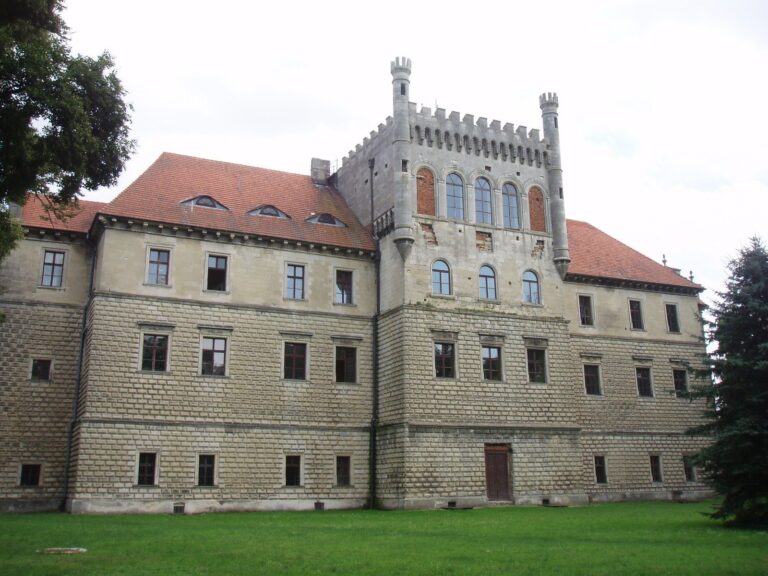
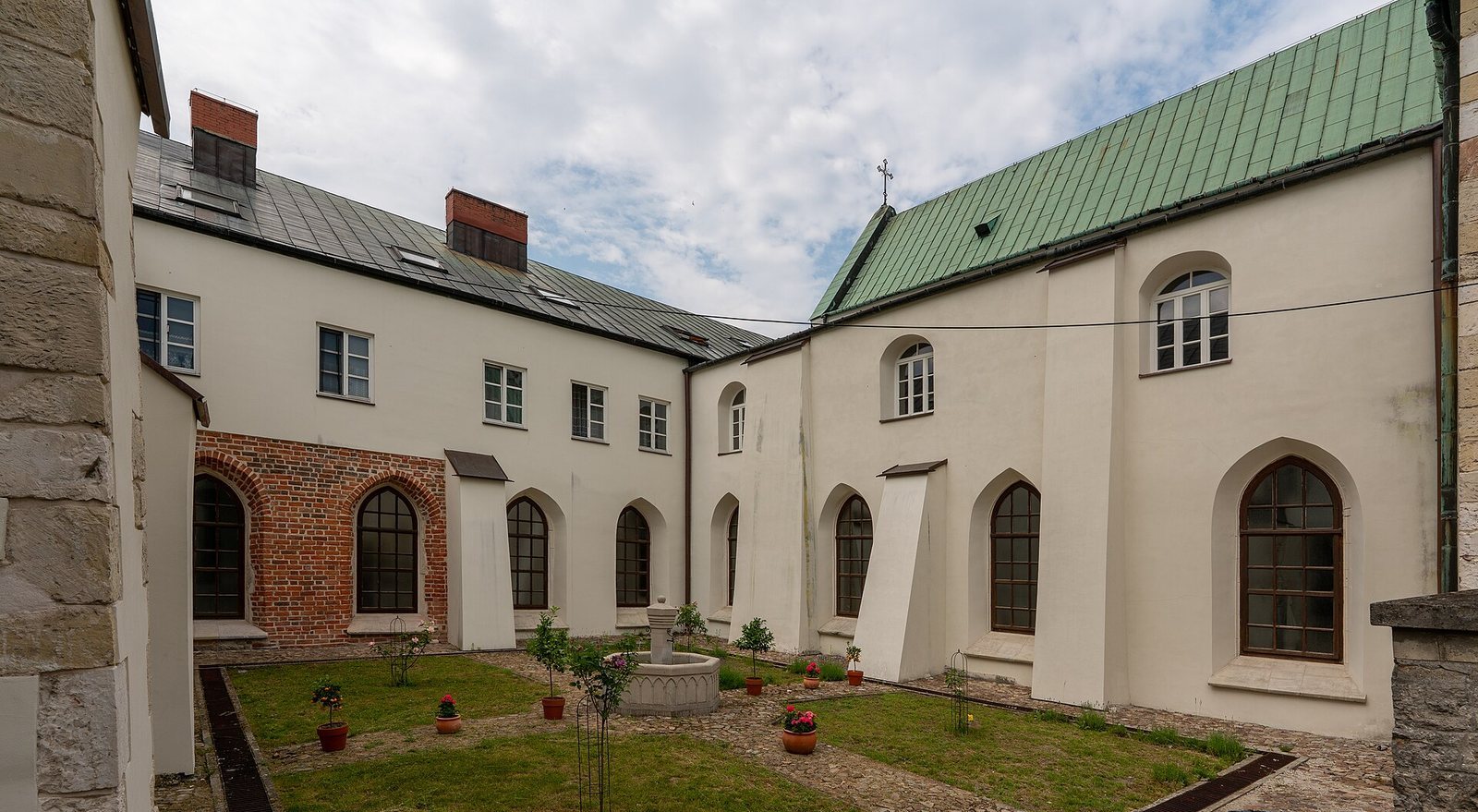
The abbey began as a fortified complex, built with stone brought from the Skowronna area. Its oldest surviving structures are Romanesque. The church and adjoining monastic ranges form the main parts of the complex, which includes cloisters and a courtyard.
Abbey church
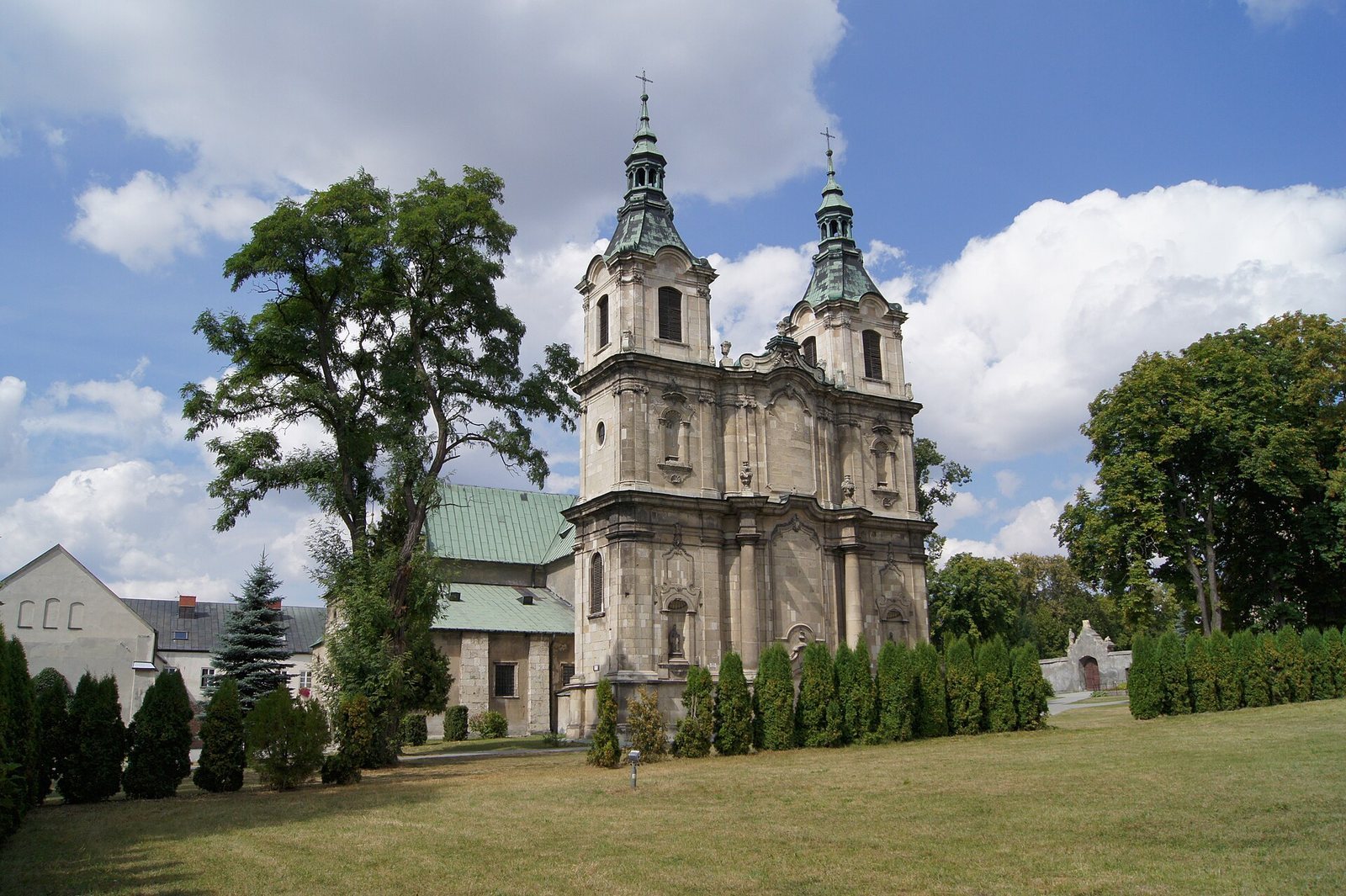
The church incorporates parts of the Romanesque complex in its west wall. Its four-bay nave is supported by piers, and a crosswise transept has two side chapels at each arm. Baroque alterations added a blind façade, a decorative front without openings, and towers at the east end.
Monastic precinct
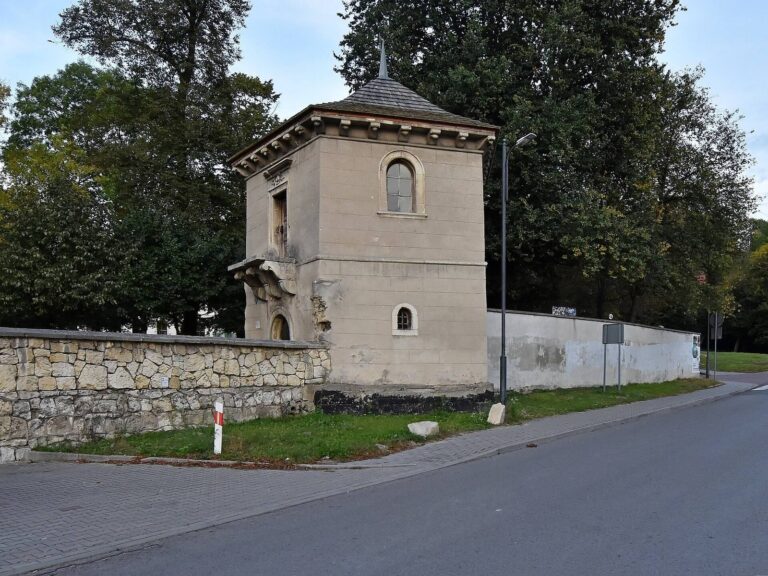
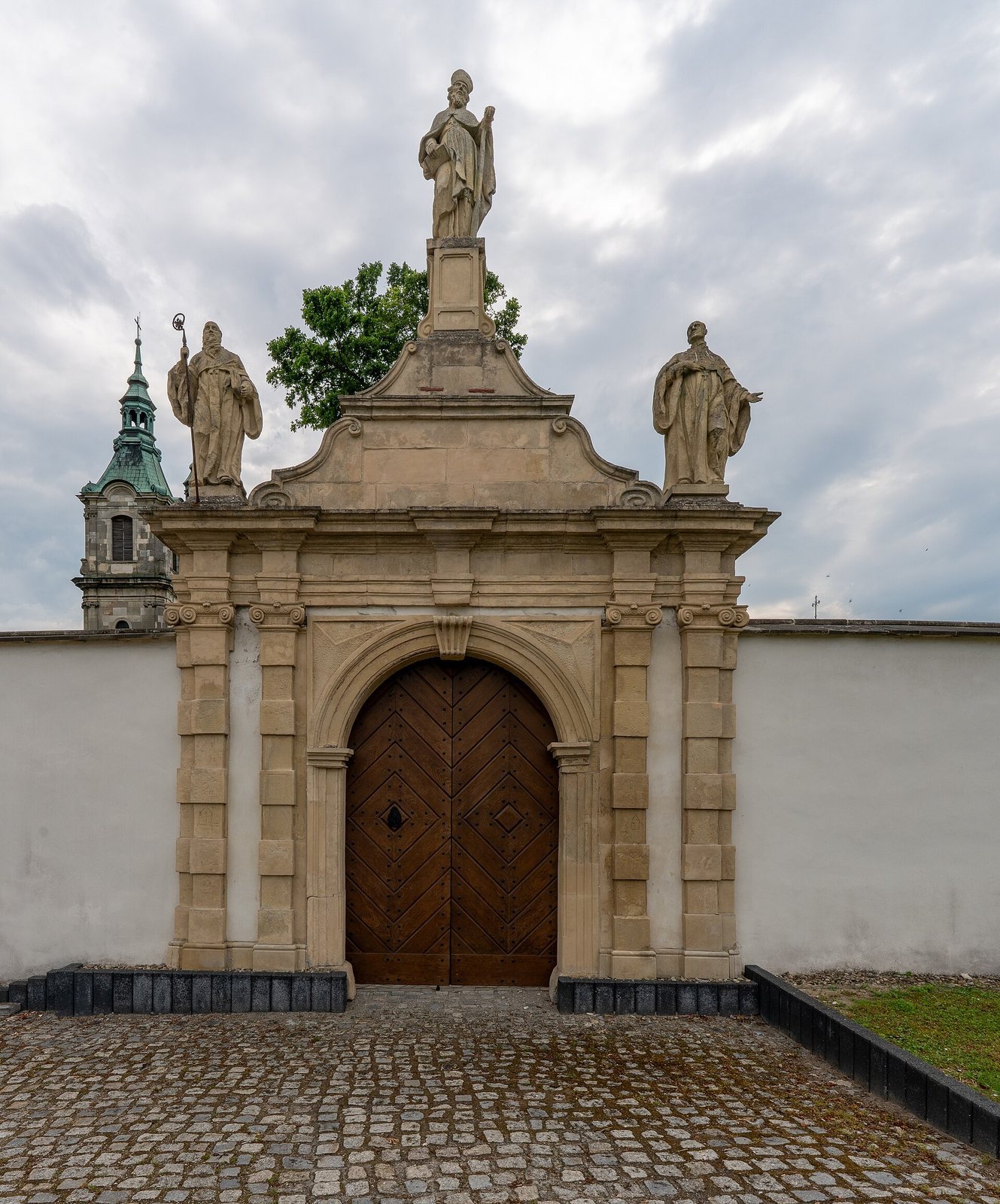
The cloister buildings stand to the right of the church and enclose a courtyard with covered walkways. The precinct also includes a late-Baroque monastery gate and bell tower. Some of the monastic buildings were dismantled in the early twentieth century.
Interior and furnishings
Church furnishings
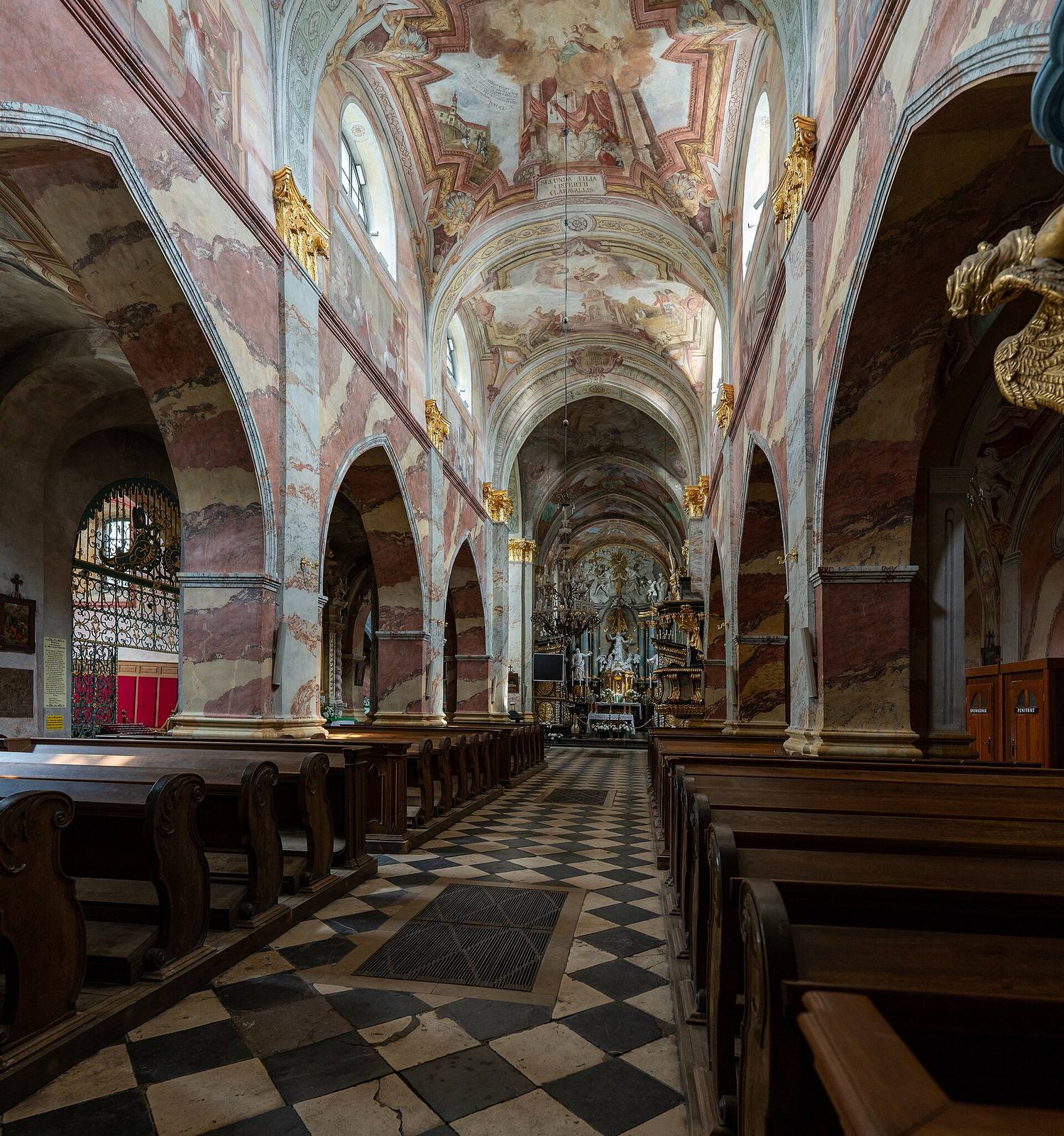
The late-Baroque interior includes choir stalls, rows of seats for clergy or monks, a pulpit, an organ, and a high altar. Together these furnishings form part of the church’s richly decorated interior.
Paintings and organ façade
Paintings in the church commemorate the Cistercians’ long history. Andrzej Radwański painted the multicolored Baroque decoration between 1734 and 1739. Józef Sitarski made the organ façade between 1745 and 1752.
Wincenty Kadłubek memorials
A side chapel contains Blessed Wincenty Kadłubek’s relics, with a reliquary associated with him. His cell is also preserved within the complex. In 1633 his relics were exhumed and transferred to an altar.