Our Lady of the Rosary Church: A Dominican Religious Complex in Milazzo
Site at a Glance
- Popularity
- Low
- Country
- Italy
- Primary era
- Early Modern
- Eras represented
- Classical, Early Modern, Modern
- Civilizations
- Kingdom of Sicily, Roman, Spanish
- Site type
- Religious
- Remains
- Monastery
On this page21 sections
History
Our Lady of the Rosary Church is a Sicilian Renaissance church and former Dominican complex in the old quarter of Milazzo, Italy. Construction began in 1538, and the church was completed around 1630.
Foundation and Dominican community
The church replaced the fifteenth-century Church of San Leonardo. Promoted by Giovanni Macrì and directed by Dominican architect Antonio Frini, its construction received support from the city and the royal treasury. Major building work continued until 1580, while finishing, consolidation, and decoration carried on into the first decades of the seventeenth century. The name Colle Giudeo, associated with the surrounding area, derives from a Jewish community there engaged in shipbuilding.
A Dominican convent was founded beside the church in 1539, the order’s twenty-eighth house in Sicily. It became a priory in 1589. The community spread devotion to the Rosary, conducted popular missions, and established a school of arts for lay students. The convent also hosted Dominican chapters and the Academy of the Revived, which the Sicilian priest and historian Antonio Mongitore described in 1709–1711.
Confraternity, civic events, and later changes
The Congregation of the Most Holy Name of Jesus was established in the old quarter in 1547 by laypeople and artisans. Pope Pius V confirmed it in a bull dated 20 July 1570. Formerly called the Ave Maria association, it had adopted its later name by the seventeenth century. Its members supported charitable work and mutual aid, promoted Eucharistic worship, organized the Corpus Christi procession, and arranged Christian burials in crypts beneath their oratory chapel.
The convent also housed the Tribunal of the Holy Office, a Catholic church court that investigated and judged heresy. During the Spanish attempt to reconquer Milazzo in 1718–1719, it served as the headquarters of the Savoy general staff. The Tribunal remained there until 1782. In the eighteenth century, the church and convent underwent substantial changes, including stucco decoration made in 1787 by Letterio Crisafulli of Messina. The convent passed into municipal ownership in 1888. Burials connected with the congregation continued almost to that year, when a funerary chapel was established at the new monumental cemetery.
The church became a parish in 1968 and was entrusted to Capuchin friars, a branch of the Franciscan order; it later returned to the Diocese of Messina. Roof and floor restoration took place in 1984. The church serves within the Milazzo vicariate and archpriesthood of the Archdiocese of Messina-Lipari-Santa Lucia del Mela. The vicariate is under the patronage of St Francis of Paola.
Remains
The church has a three-aisled plan, with a central nave, side aisles, and a rectangular apse. Its Renaissance exterior and interior furnishings include later alterations and works from the eighteenth and nineteenth centuries. The adjoining convent has a rectangular cloister, while a late Roman reservoir lies beneath the church.
Exterior
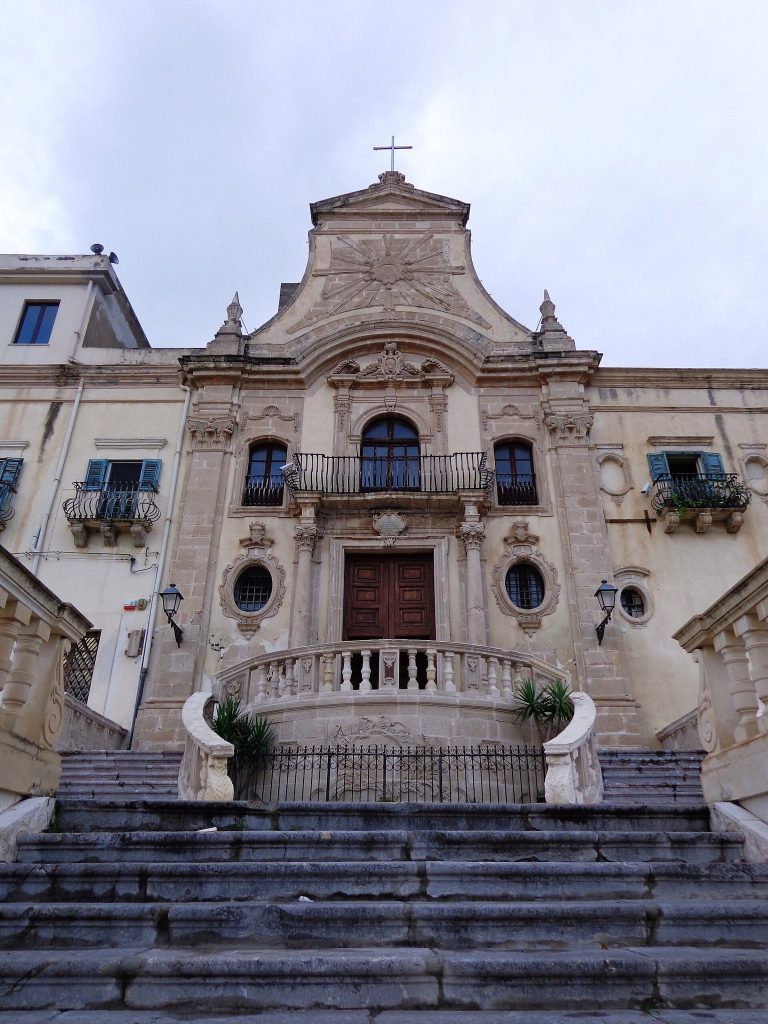
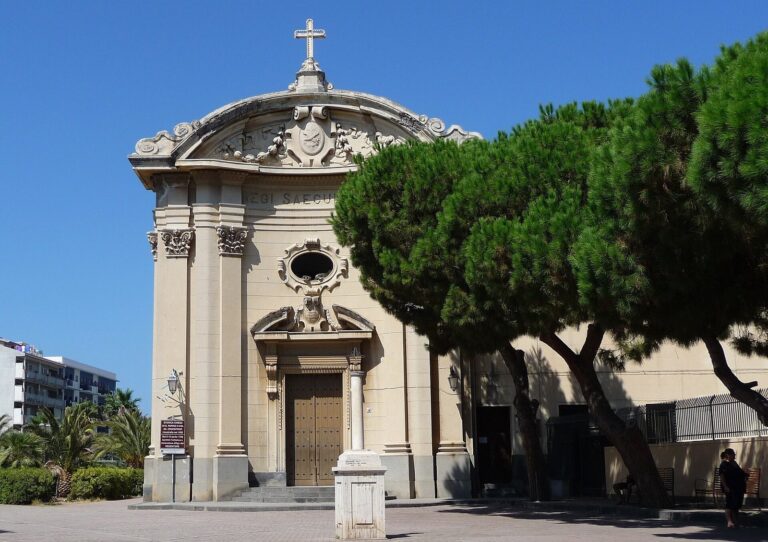
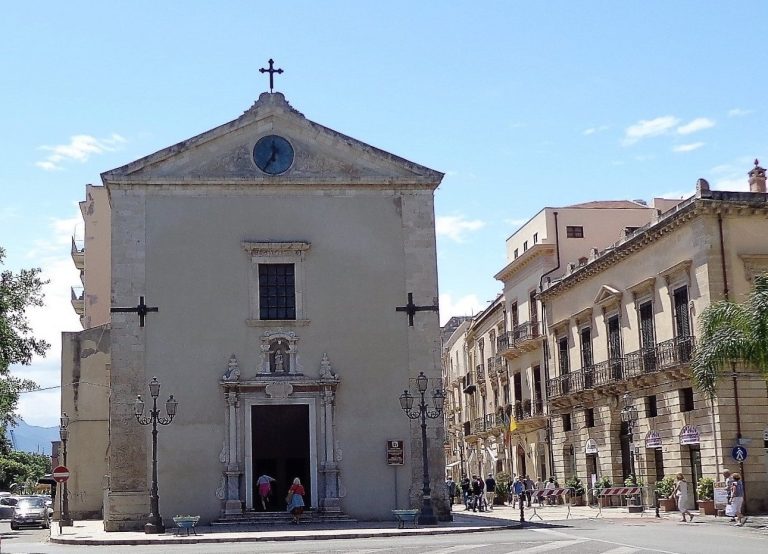
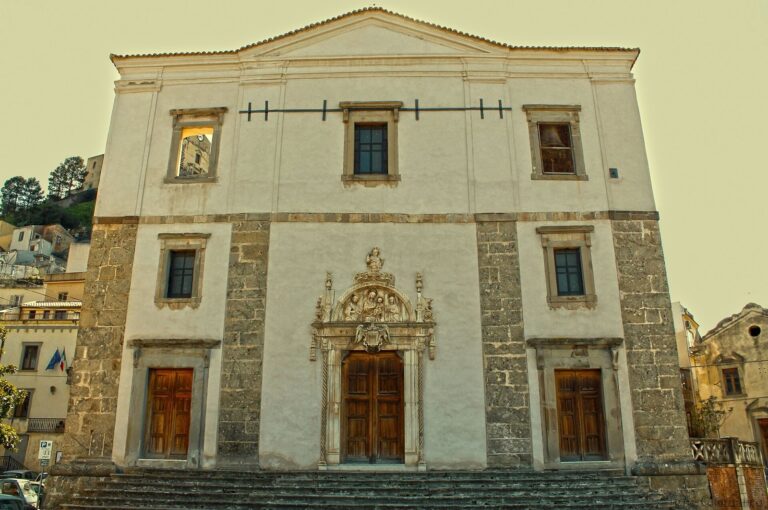
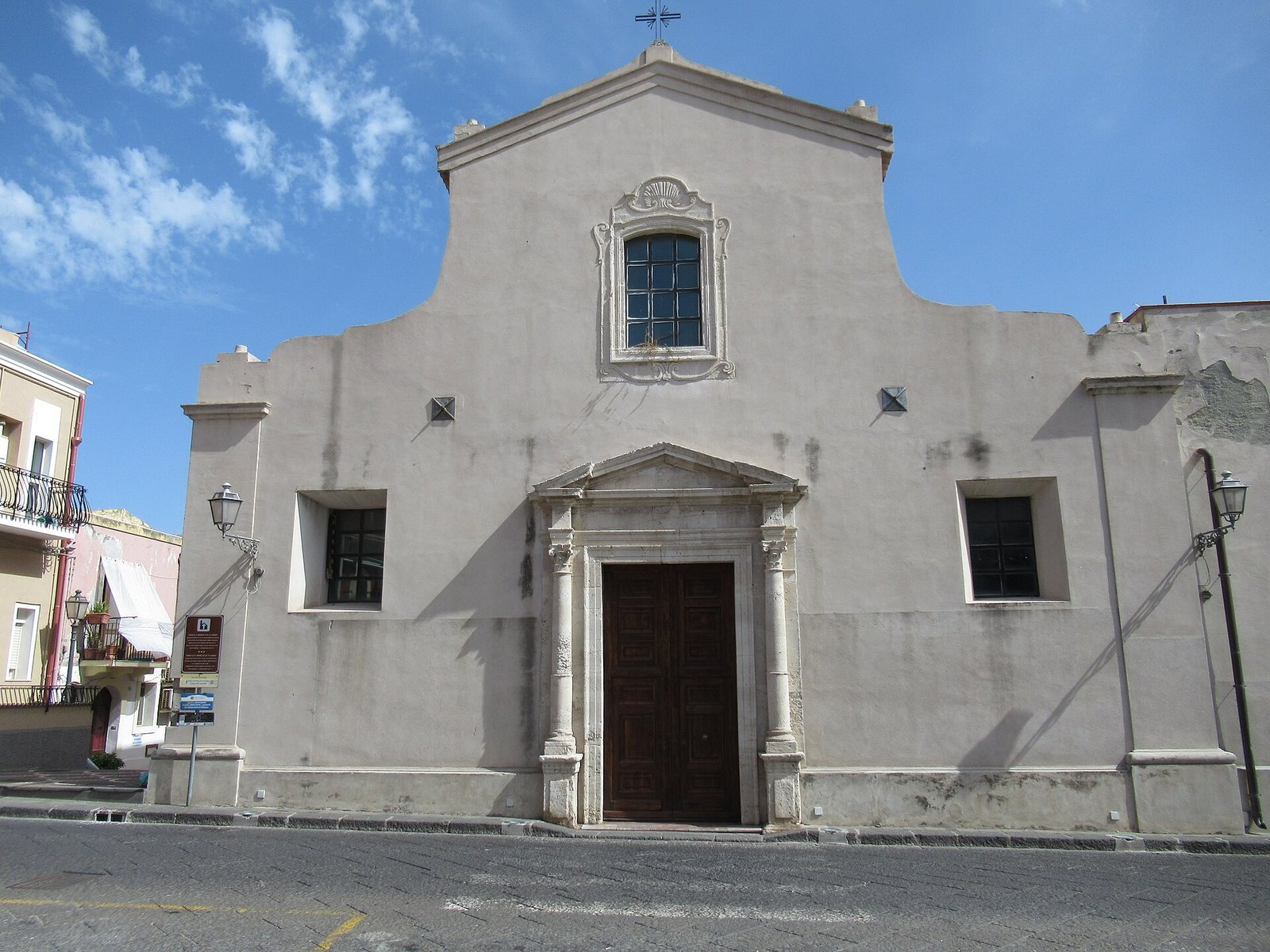
The plain façade has a central portal framed by two semi-columns with Corinthian capitals and two superimposed broken pediments. Curved sections joining the façade’s lower and upper levels survive from larger ornamental scrolls removed during eighteenth-century restoration. Stone pinecone ornaments stand on small plinths at the façade’s outer ends, and a bell gable rises at the rear. The upper oculus was changed into a rectangular framed window in 1705; in 1790 the side windows were altered in a similar shape, without frames. The side portal, which replaced a simpler entrance in 1705, and two white-marble holy-water stoups from San Marco d’Alunzio complete the entrance area.
Interior
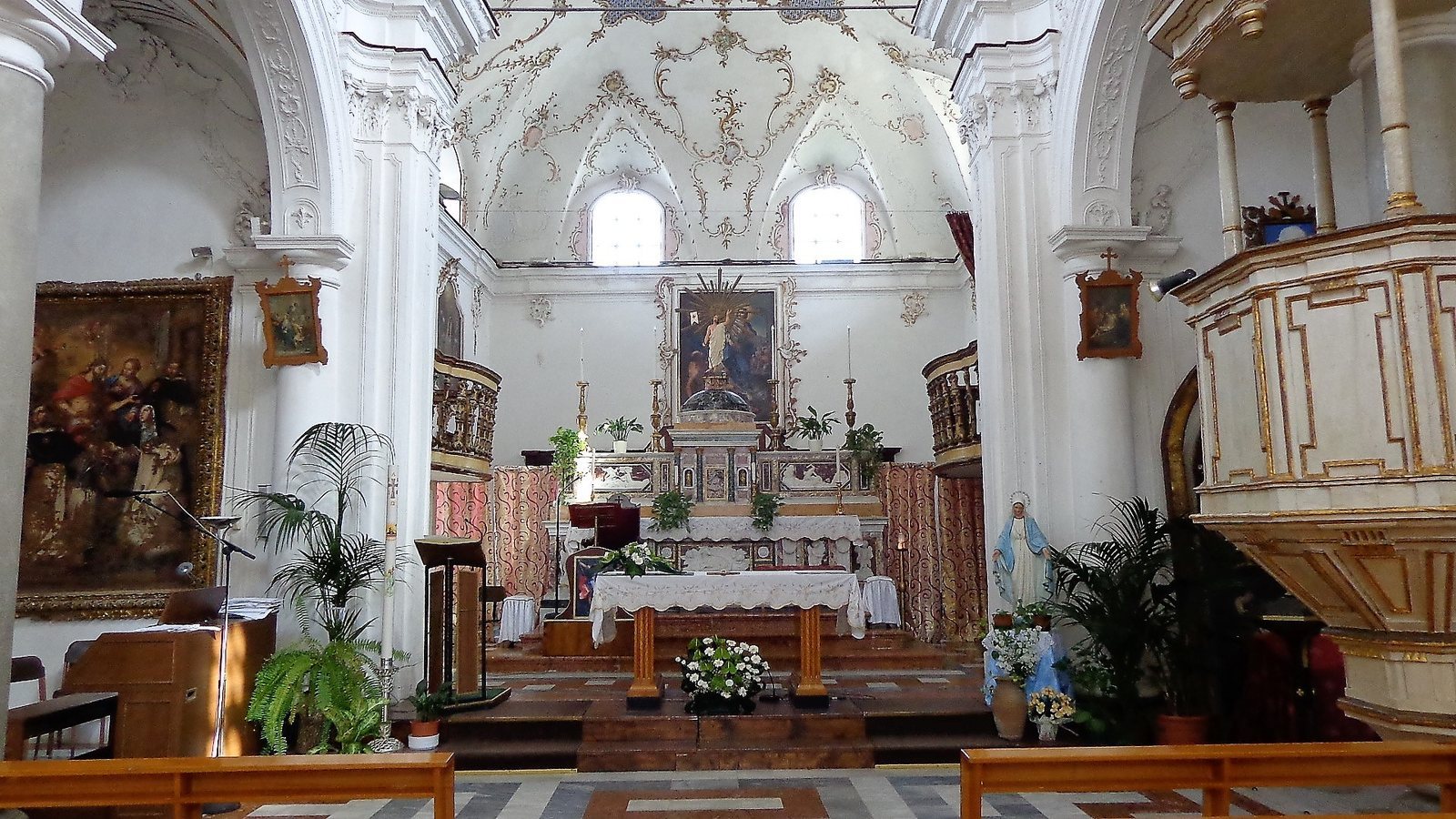
Five round arches rest on columns between the central nave and side aisles. Each aisle ceiling is divided into five eighteenth-century groin vaults, formed by the intersection of two barrel vaults. Eight altars are arranged in the side aisles. The nine original altars were wooden, and were gradually replaced with masonry or marble versions; some surviving wooden altar frontals are made of painted or decorated fabric.
Nave, presbytery, and high altar
Three frescoes dated 1789 by Domenico Giordano of Messina decorate the central nave ceiling: the Glory of St Dominic, St Dominic Burning the Books of Heretics, and St Dominic with Saints Peter and Paul. Giordano also painted the Assumption of the Virgin on the presbytery vault. A stucco coat of arms on the triumphal arch shows a dog holding a torch in its mouth, accompanied by the Dominican motto "Dogs of the Lord."
The free-standing high altar, made of polychrome marble in a Neoclassical style, was erected in 1809 at the direction of Dominican provincial Rosario Colonna of Milazzo. It replaced a deteriorated wooden altar made in 1596 by local woodcarver Vincenzo Paolo and donated by Baron Vincenzo Crisafi. Two white Carrara marble reliefs above the altar table depict Jacob’s dream and Cain killing Abel. A columned shrine shelters the tabernacle and is crowned by a small dome and a figure of the Risen Christ with a radiating halo. Wooden statues of St Dominic and St Thomas Aquinas occupy niches beside the tabernacle door.
Right aisle: first bay
The first bay contains the Chapel of St Vincent Ferrer, patronized by the Lo Presti family. A statue of the saint stands in a raised niche and is attributed to Filippo Quattrocchi. A polychrome wooden statue of St Vincent Ferrer is dated to the fifteenth century; whether it is the figure attributed to Quattrocchi is uncertain.
Right aisle: second bay
A painting of the Madonna of Itria, also called Hodegetria, is displayed in the second bay. Hodegetria is a Byzantine image type of the Virgin and Child. The painting shows the Virgin carrying the Christ Child, borne on the shoulders of two Basilian monks, members of a monastic tradition associated with St Basil. The image came from the former Capuchin church. Its tradition is linked to the ancient Eastern Church and Constantinople, and it is attributed to St Luke.
Right aisle: third bay
The third bay opens toward the convent precinct. A 1676 painting of Our Lady of the Forsaken hangs on the door leading to the cloister and former sacristy rooms. It came from the third altar on the left in the former Capuchin church and was donated by Milazzo residents belonging to the Valencian community of the Spanish nation.
Right aisle: fourth bay
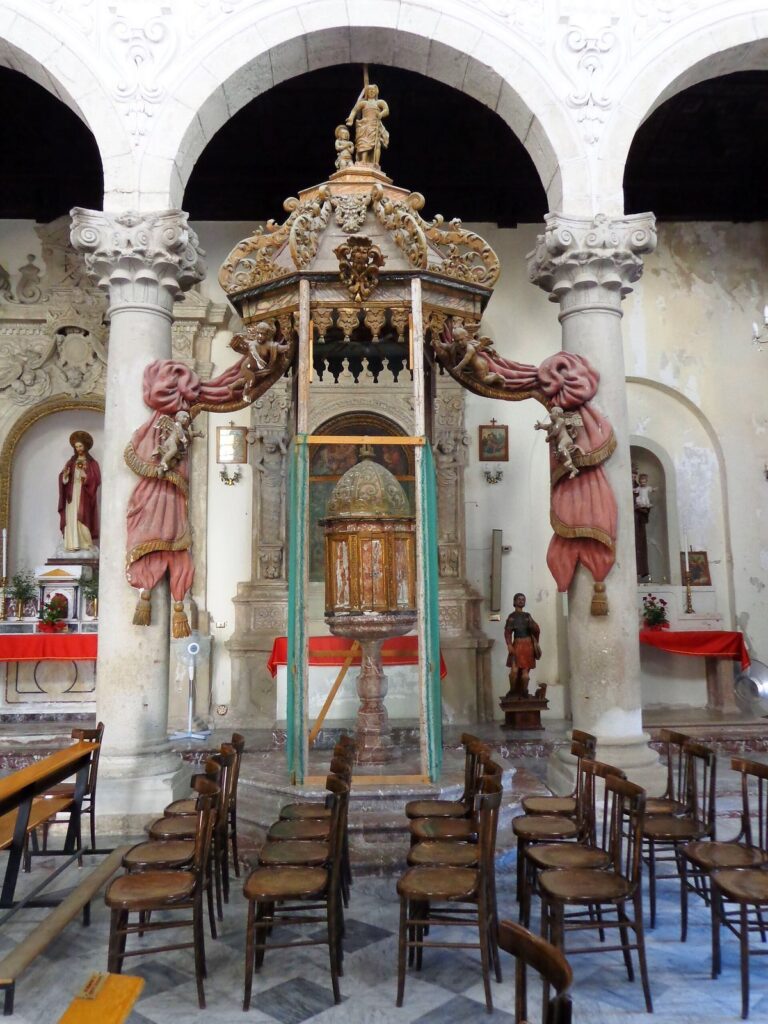
The former Chapel of St Catherine of Siena contains a wooden ciborium, a canopy-like shrine associated with an altar, brought from the high altar of the former Capuchin church. Its three-part base supports three tiers that narrow upward. The tabernacle door is inlaid with mother-of-pearl; acanthus leaves decorate the frontal beneath it. Twisted columns, recessed niches, scrolls, molded cornices, projecting entablatures, and miniature balustrades articulate the upper tiers. The shrine’s original arrangement also included statues of St Peter and St Paul and other apostles on projecting supports.
Above the bay are an eighteenth-century canvas of St Bonaventure of Bagnoregio, also from the former Capuchin church, and a painting of St Anthony of Padua. An octagonal wooden pulpit from the second half of the eighteenth century is attached to a column.
Right aisle: fifth bay and head
The former Chapel of St Dominic of Guzman contains St Jerome Penitent, painted by Giovanni Tuccari in 1694 and moved here from the fourth bay of the opposite aisle. A painting of St Dominic made in 1687 was restored in 1891 and stolen in 1972. At the head of the aisle, another painting shows the Virgin with St Dominic, St Thomas Aquinas, Dominican saints, Pope Pius V, and St Vincent Ferrer, identified by the sun on his chest.
Left aisle: first bay
The first bay is the Chapel of the Most Holy Crucifix. Its polychrome wooden crucifix was made by Capuchin sculptor Innocenzo da Petralia during the last two years of his stay in Milazzo, from 1643 to 1645. The chapel was first patronized by the D’Amico family and later by the Cumbo family. A blue-and-gold wooden altar frontal bearing the Cumbo coat of arms was transferred to the former Chapel of St Jerome when a marble altar was built here in the late nineteenth century.
Left aisle: second and third bays
A painting of the Glory of St Dominic is displayed on the wall of the second bay. The third bay contains a side exit and the Stairway of St Dominic. Above the doorway lintel is a small eighteenth-century canvas of St Dominic and the Angel, a work dated 1789 and attributed to Domenico Giordano.
Left aisle: fourth bay
The former Chapel of St Jerome has a wooden altar frontal decorated in blue and gold with the Cumbo family arms. It was transferred from the neighboring Chapel of the Most Holy Crucifix. St Jerome Penitent, once displayed above the frontal, is now in the fifth bay of the right aisle.
Left aisle: fifth bay and head
The Chapel of the Virgin of the Rosary contains a painting commissioned by members of the Rosary confraternity and dated to about 1750. It depicts the Virgin with St Dominic, St Catherine of Siena, St Thomas Aquinas, and other figures. Fifteen oval scenes of the Mysteries of the Rosary surround the painting in a monumental frame with shell-like Rococo ornament. The joyful mysteries are on the left, the sorrowful above, and the glorious on the right, although their arrangement has since changed. The D’Amico family patronized the chapel, and their double coat of arms decorates its marble altar frontal, made in the early eighteenth century. The painting draws on a 1695 work by Carlo Maratta in Palermo’s Oratory of the Rosary of Santa Cita. Both works follow an image scheme conceived by Antoon van Dyck after the plague in Palermo and the discovery of St Rosalia’s relics.
At the head of the left aisle, a painting shows Jesus and the Virgin Mary with St Vincent Ferrer, whose chest bears the sun and who holds a book, alongside Dominican saints and a sovereign. A statue of Our Lady of the Rosary, made in the early twentieth century by Luigi Guacci of Lecce, is carried in procession.
Crypt
Marble funerary slabs in the crypt bear family coats of arms and inscriptions. The space also contains a marble sarcophagus dated 1625 and tombs associated with the Impallomeni, Zirilli, Ventimiglia, and Marullo families.
Convent and oratory
Cloister
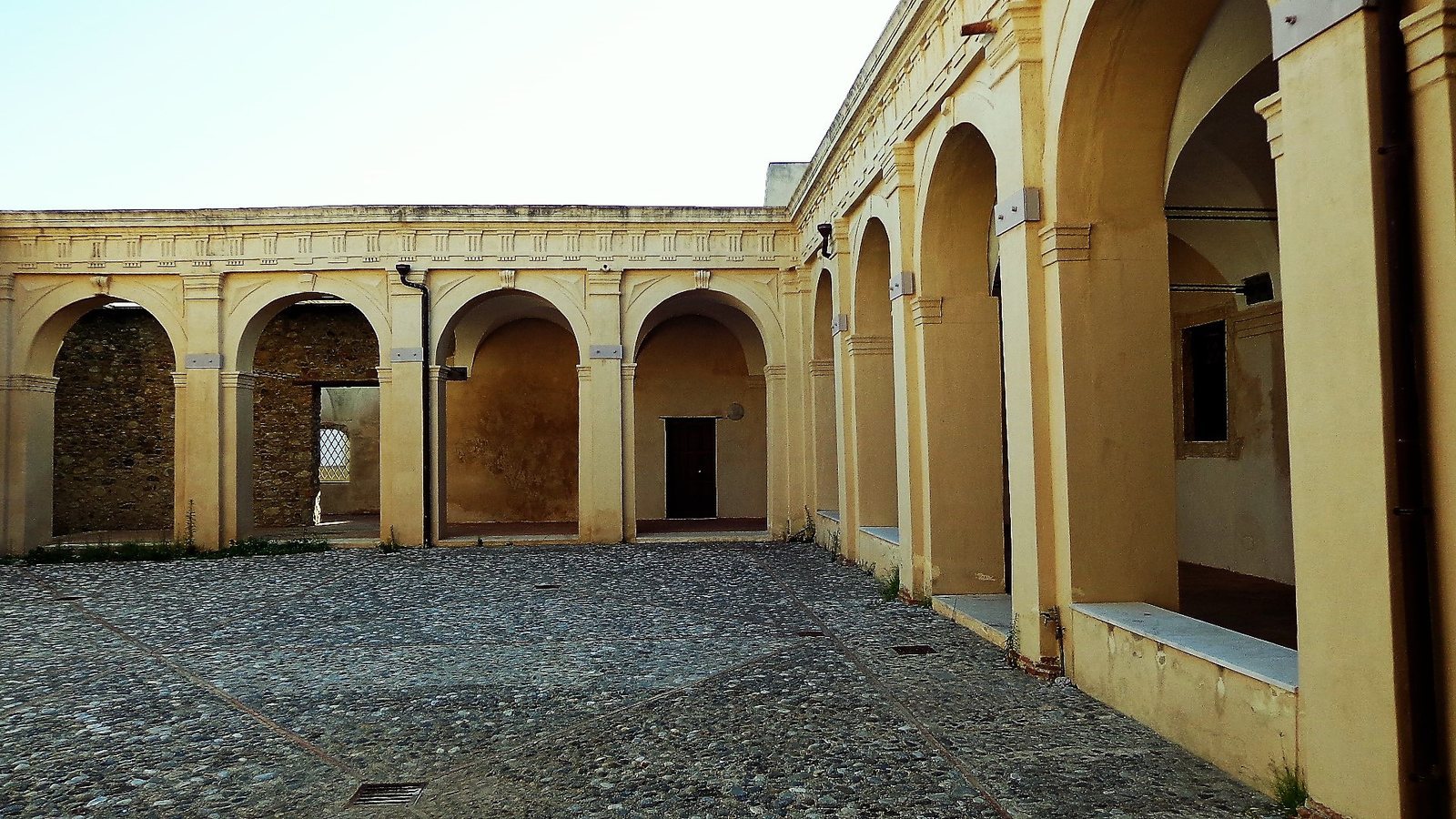
The convent’s rectangular cloister adjoins the church on its right side. Arcaded corridors enclose the space, with three pillars along each short side and four pillars along each of the longer sides, where they correspond to five arches on the north–south axis.
Oratory of the Most Holy Crucifix
The Oratory of the Most Holy Crucifix occupies part of the western area of the cloister. Its furnishings include paintings, sculptures, and liturgical vestments from the eighteenth and nineteenth centuries.
Archaeological remains
Restoration work uncovered a large late Roman reservoir beneath the church, probably used to store food. Its presence points to settlement before the walled city and the early medieval fortified settlement. The archaeological section of the Messina Superintendency for Cultural and Environmental Heritage presented the reservoir beneath a glass cover.