Santa Maria Assunta: The Former Cathedral and Co-Cathedral of Santa Lucia del Mela
Site at a Glance
- Popularity
- Low
- Country
- Italy
- Primary era
- Early Modern
- Eras represented
- Medieval, Early Modern, Modern
- Civilizations
- Italian, Kingdom of Sicily, Norman, Spanish
- Site type
- Religious
- Remains
- Cathedral
On this page22 sections
History
Santa Maria Assunta is a Catholic church in Santa Lucia del Mela, Italy. The present building was reconstructed and enlarged between 1592 and 1642, continuing the site’s earlier role as the cathedral of the local church jurisdiction. Its history spans a medieval foundation, centuries of rebuilding, and service as a cathedral and later a co-cathedral.
Medieval foundation
In 1094, Roger I of Sicily, the Norman ruler who led the conquest of Sicily, built an earlier church at the site as a vow of thanks for a battle victory over Muslim forces. Dedicated to Saint Lucia, it later became the cathedral of the Prelature of Santa Lucia del Mela, an ecclesiastical jurisdiction outside a regular diocese. The settlement had been under Arab rule from 837 until shortly before the church’s foundation. Architectural remains are cited as evidence of that period.
Reconstruction and ecclesiastical standing
The church underwent a major rebuilding and enlargement from 1592 to 1642, under the direction of architect Vincenzo Ferriati. Prelates Rao Grimaldi, Antonio Franco, and Vincenzo Firmatura oversaw the work. An inscription in the apse records a phase begun by Antonio de Franchis in 1618 and completed by Firmatura in 1641. The church was completed and consecrated in 1642.
Rao Grimaldi, prelate from 1602 to 1616, promoted the cathedral’s development with Ferriati. In 1608 he also commissioned the adjoining Prelatial Palace, which was built under the architect’s direction. Grimaldi obtained permission for the abbot of Santa Lucia del Mela to wear pontifical vestments, special garments and insignia used by a bishop during solemn services.
In 1769, Prelate Scipione Ardoino Alcontres consecrated the church again and raised it to the rank of basilica. The consecration inscription granted an indulgence of one year to the faithful and one of forty days to those attending on the anniversary. These periods were traditional measures of remission, not the length of time for which a grant remained in force.
Santa Maria Assunta was the cathedral of the Prelature of Santa Lucia del Mela. After the prelature joined the Archdiocese of Messina, the church became one of that archdiocese’s cathedral churches, or a co-cathedral. It is now a parish church within the Archdiocese of Messina-Lipari-Santa Lucia del Mela, dedicated to the Assumption of Mary, Saint Lucia, and Saint Blaise. The Assumption is the Catholic belief that Mary was taken body and soul into heaven at the end of her earthly life.
Earthquakes and repair
Repeated rebuilding and repair were attributed principally to earthquakes. Major regional earthquakes associated with the church’s history occurred in 1169, 1295, 1542, 1613, and 1638. Restoration after the 1693 Val di Noto earthquake introduced late-Baroque, or Sicilian Baroque, elements. The 1783 southern Calabria earthquake severely affected the area’s artistic heritage and led to the reconstruction of the Prelatial Palace.
The 1908 Messina earthquake damaged the church, and Prelate Salvatore Ballo Guercio arranged repairs. Damage from the Gulf of Patti earthquake on 16 April 1978 prompted structural consolidation and a major restoration.
Remains
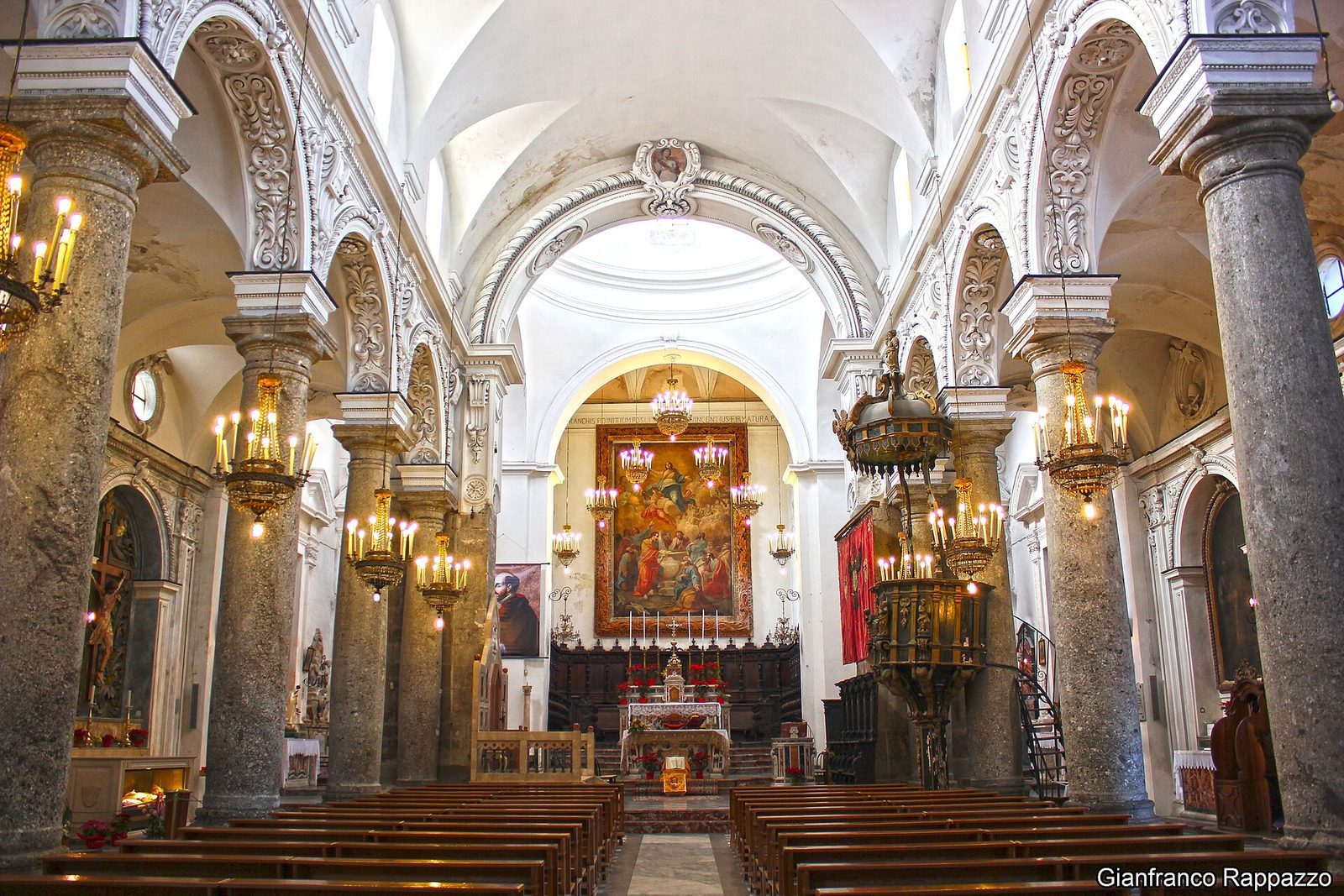
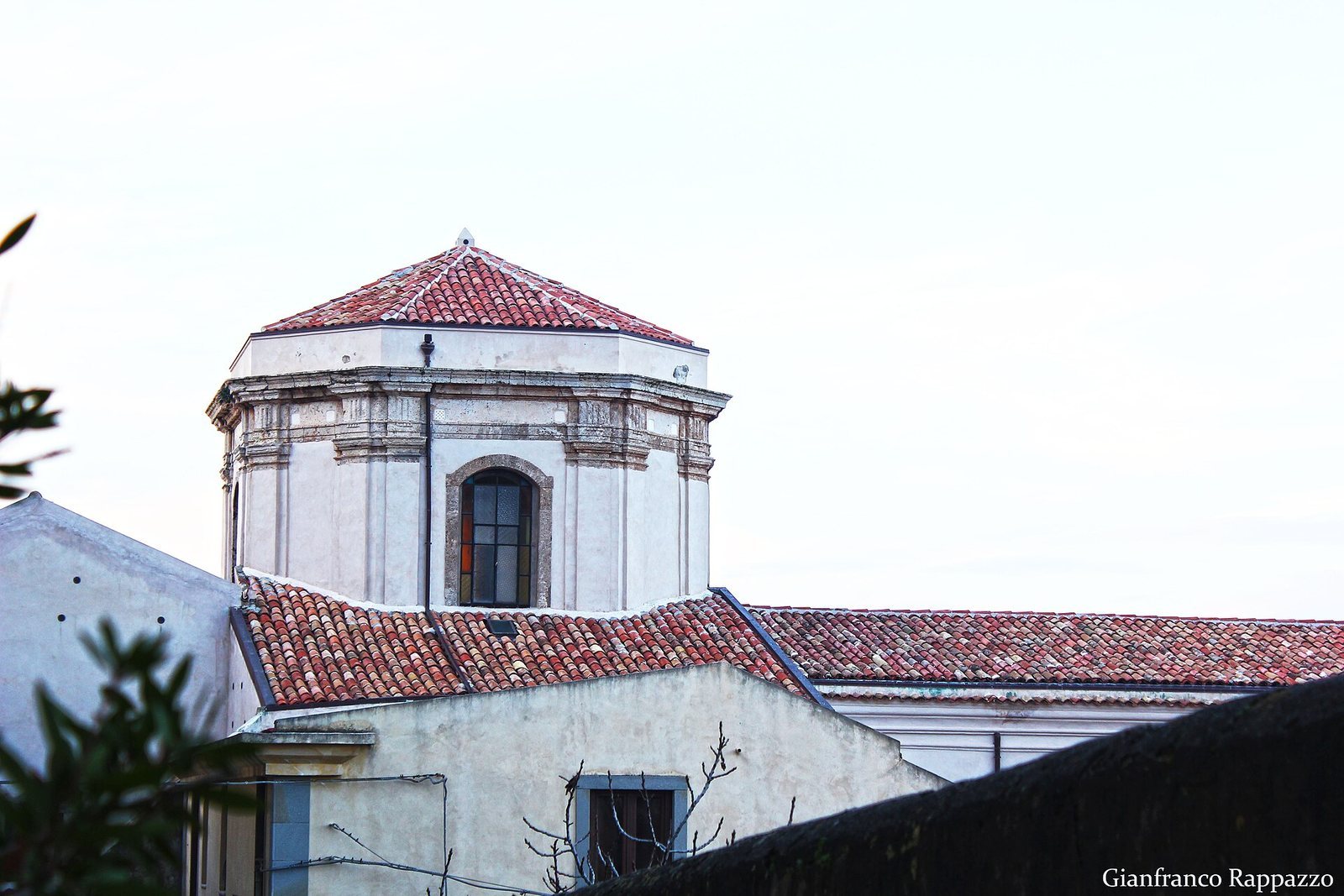
The church combines a Latin-cross plan, shaped like a cross, with three naves, the lengthwise sections of the building, and a crosswise transept. The crossing is where those parts meet, while the apse forms the sanctuary end. Two rows of round arches, supported by twelve granite columns of Tuscan design, divide the interior. Stucco decorates the arches and parts of the barrel-vaulted ceilings, which have curved recesses known as lunettes. An eighteenth-century dome rises above the crossing.
Foundations and exterior
Plan and medieval foundations
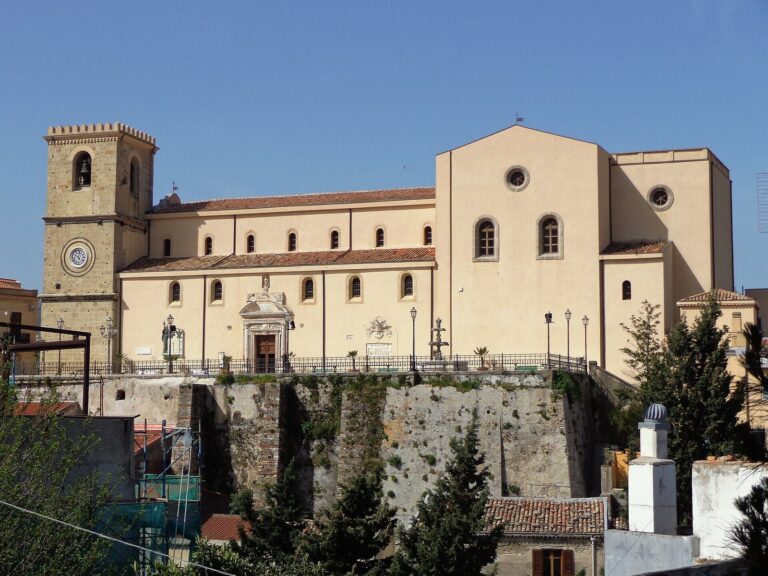
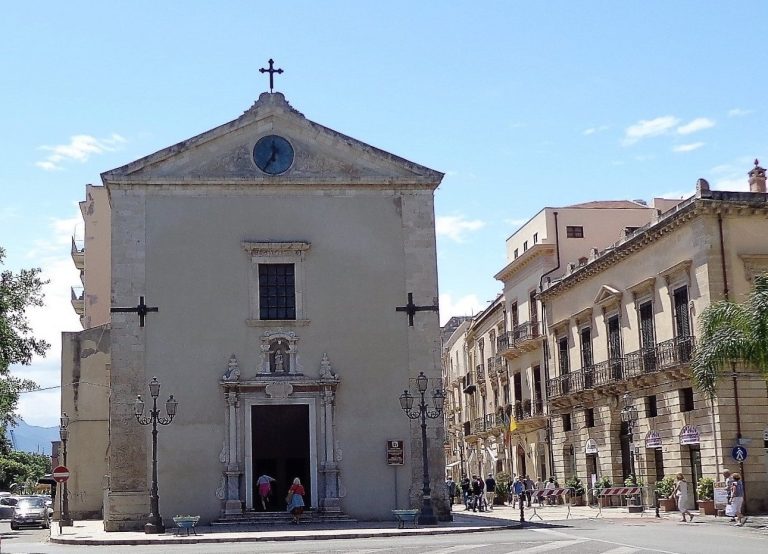
Foundations of the earlier, single-nave church survive beneath the present floor. That building faced the Prelatial Palace, with its entrance to the east. During reconstruction, the church’s axis was turned 90 degrees counterclockwise; the current main entrance faces north. The present church stands beside the palace, and its principal façade faces Piazza Beato Antonio Franco. It is the largest church in Santa Lucia del Mela.
Façade and portals
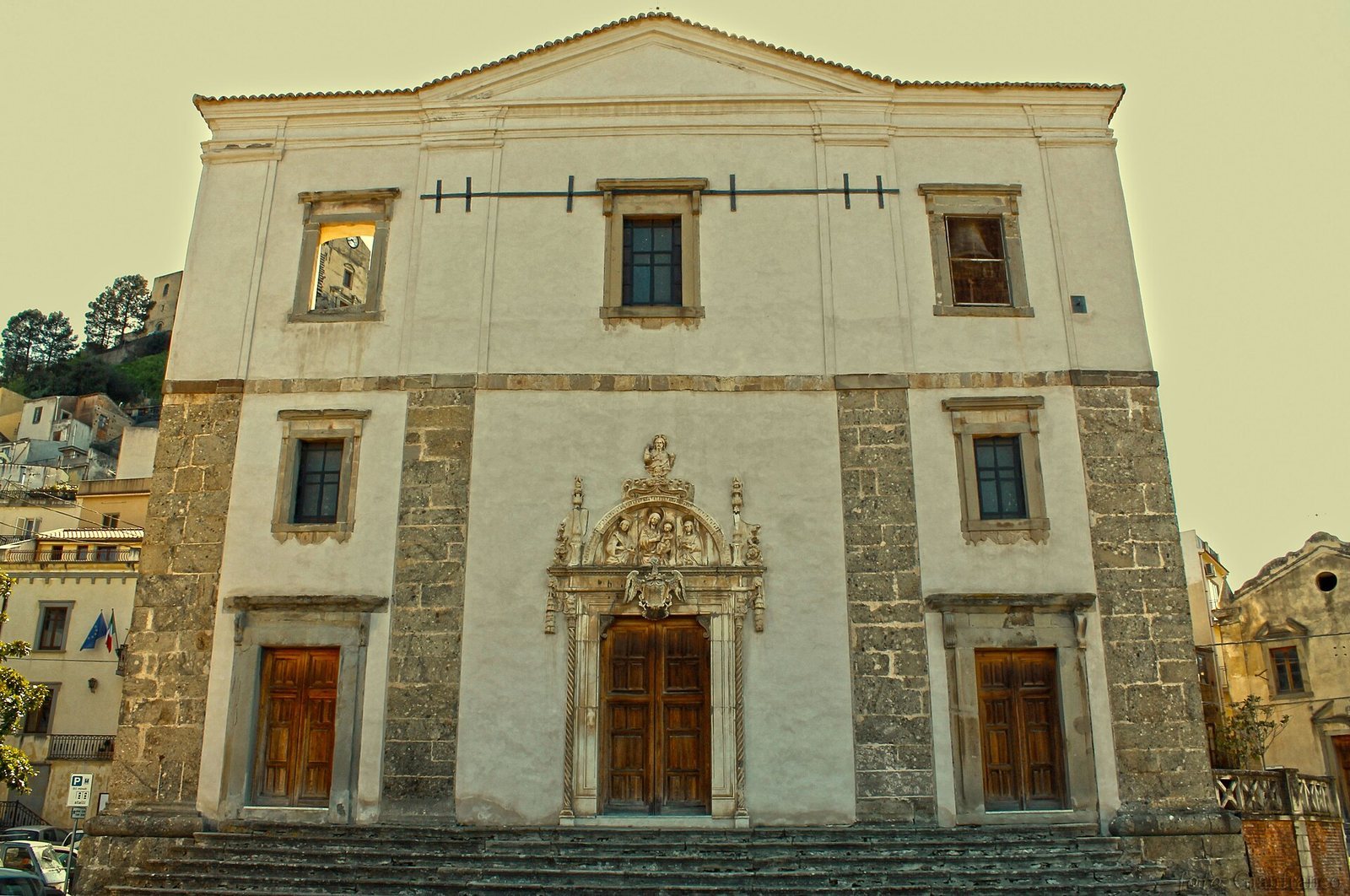
The gabled façade has four shallow wall supports, or pilasters, that remain in exposed stone up to the cornice above the second level. Molded capitals crown them, and a triangular, gabled pediment tops the central section. Windows in the upper levels align with the entrances. The top level has three windows, though its two outer windows are decorative, since the side naves have no corresponding upper level.
The central portal is older than the two side entrances and rises above them. Slender twisted columns frame it, while its crosspiece bears a crowned eagle and a coat of arms. Eagles also appear on interior hangings, indicating royal patronage, the crown’s formal support for the religious institution. Pinnacles, tassels, and symmetrical scrolls frame an arched panel of the Madonna and Child with Saints Lucia and Agatha. A figure of the Almighty giving a blessing appears above it. The panel’s sculpture is tentatively attributed to Gabriele di Battista. The side portals and windows have simpler moldings supported by small scroll brackets.
Naves and furnishings
Right nave
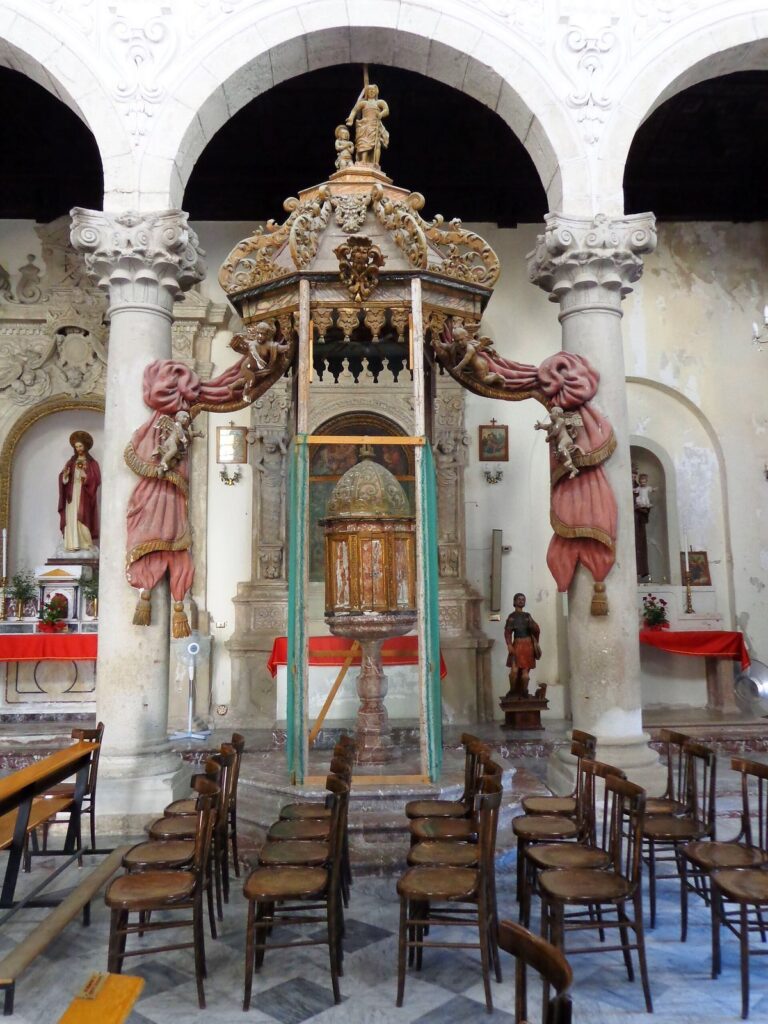
A Baroque wooden pulpit stands midway along the right nave. Beneath the triumphal arch are five wooden seats belonging to the Luciese Senate, Santa Lucia del Mela’s municipal governing body. The seats date to 1748 and sit below a red velvet hanging bearing the imperial eagle of Frederick II of Hohenstaufen, dated 1791. Opposite them is an episcopal throne of polychrome marble in the Neo-Romanesque style.
In the first bay, the Rosary altar has a painting of the Virgin between Henry Suso, a fourteenth-century Dominican friar, and Saint Lawrence the Martyr, a Roman deacon. A Good Friday procession float depicting Jesus praying in the Garden of Olives is also kept there. Locally called the Vara ranni, it is a structure carried in a religious procession. The second bay contains the altar of Saint Sebastian, with a seventeenth-century painting of his martyrdom by Giuseppe Salerno. The third bay is the western entrance, above which a stucco-framed fresco depicts the Martyrdom of Saint Lucia.
The fourth bay holds the Ecce Homo altar, whose alabaster statue, dated 1771, is attributed to Ignazio Marabitti. The statue’s drapery has gilded folds, and it stands on an agate pedestal inside a niche decorated with acanthus-leaf stucco and a carved wooden frame. Above it hangs Deodato Guinaccia’s panel of Saint Mark, dated 1581. In the fifth bay, a painting of Saints Peter and Paul is attributed to Alonso Rodriguez and dated to the sixteenth century.
Left nave
A holy-water stoup attributed to Gabriele di Battista stands in the left nave. Its first bay contains a gated baptismal area with a wooden cover from the seventeenth century. The font, dated 1485 and also attributed to di Battista, has a shaft decorated with four winged torsos and an octagonal basin divided into panels. One panel bears the shield of Giovanni Martino Vitale. Beneath the arch is a painting of the Madonna of Mount Carmel with Saints Simon Stock, Dionysius the Areopagite, and Anthony of Padua.
The second bay contains the altar of Saint Gregory, with a painting of Saint Gregory Thaumaturgus signed by Pietro Novelli. Its painted scroll begins with the Latin words VNUS DEUS PATER VERBI. Above the eastern entrance in the third bay is a stucco-framed fresco of the Martyrdom of Saint Lucia. The fourth-bay altar of the Madonna of the Presentation has a seventeenth-century painting from the Sicilian school showing the Virgin with Saints Catherine of Siena and Rose of Lima.
The fifth bay contains the Crucifix altar, with a wooden crucifix from the sixteenth century and prominent high-relief acanthus-leaf stucco. The altar arch bears the inscription FRANCISCVS CVCVZZA. After Antonio Franco’s beatification on 2 September 2013, his remains were moved beneath this altar. A chapel altar formerly held a metal-and-crystal urn containing his incorrupt body.
Chapels and transept
Chapel of Saint Lucia
At the end of the right nave, the chapel of Saint Lucia has elaborate stucco and fresco decoration. Its altar, with fluted columns and Corinthian capitals, frames a niche adorned with garlands of flowers and fruit. The marble statue of Saint Lucia in the niche dates to the late fifteenth century. Its style is often associated with Domenico Gagini, although some critics attribute it to Francesco Laurana. The chapel also contains monuments to Monsignor Francesco Barbara and Monsignor Salvatore Ballo Guercio.
Transept altars
The altar in the left arm of the transept is dedicated to Saint Blaise. It has a broken pediment, a central coat of arms, and an inscription. Commissioned by the Confraternity for the Dying, Pietro Novelli’s 1645 altarpiece depicts the Trinity, the Virgin, Saint Blaise, and souls in purgatory, a state of purification in Catholic teaching for those destined for heaven.
In the right arm, stucco pilasters with Corinthian capitals support an altar with a broken pediment. Filippo Jannelli’s 1676 painting above it depicts the Immaculate Conception, the belief that Mary was conceived without original sin, alongside Saints Cecilia, Rosalia, Lawrence, and James the Greater. Two inscriptions beside the altar commemorate Monsignor Pedro Solera Montoya and Bishop Raimondo de Moncada. Nearby stands a funerary monument to Monsignor Marcello Moscella.
Chapel of the Blessed Sacrament
The left transept chapel is dedicated to the Blessed Sacrament, the consecrated Eucharist. Fragments survive of Domenico De Gregorio’s 1886 frescoes depicting Old Testament stories. The polychrome-marble altar has paired columns with Corinthian capitals, a broken architrave, two kneeling angels, and a blessing figure of the Creator. A statue of the Sacred Heart, a devotion to Jesus that represents divine love, stands above the tabernacle. Beneath the altar table is a single-block marble relief of the Last Supper, attributed to Valerio Villareale and based on Leonardo da Vinci’s composition.
Sanctuary, choir, and organ
Presbytery and apse
The raised altar of polychrome marble in the presbytery was installed after the Second Vatican Council. Farther into the apse is a marble tabernacle altar dated 1739. A large painting of the Assumption of Mary by Fra Felice da Palermo, dated 1771, hangs in a monumental carved wooden frame decorated with acanthus leaves. The Virgin appears among angels, while thirteen figures gather around a source of life. Saint Peter is interpreted as a self-portrait of the painter.
Choir stalls and memorial furnishings
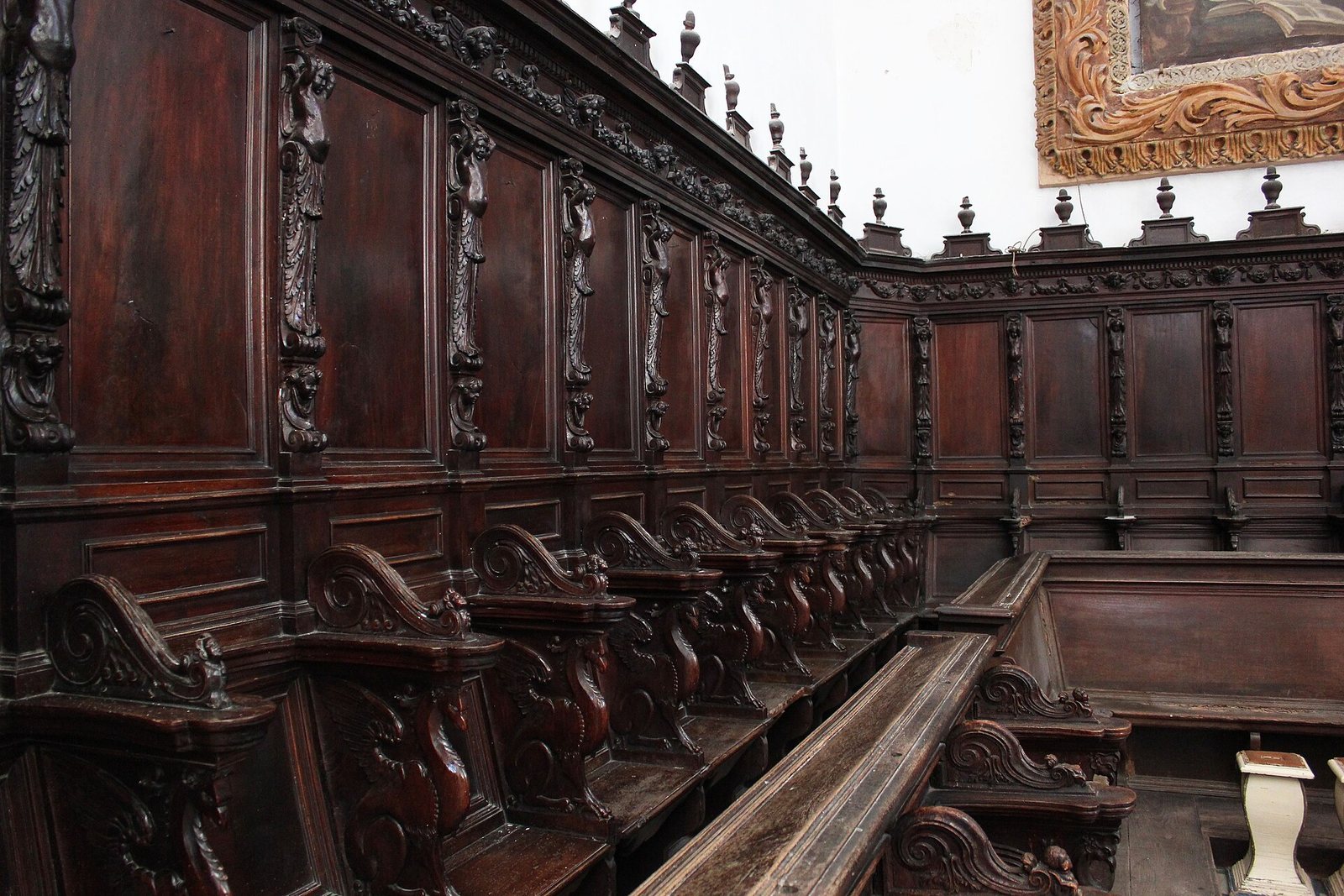
The apse choir is made of finely carved walnut and attributed to Giovanni Gallina of Nicosia. Dating to the seventeenth century, it has 39 stalls arranged in two tiers and connected by steps. Child figures, ornamental bands, and griffins decorate the seating. At the center, a pyramid-shaped lectern once held handwritten parchment books used by the choir.
A marble stand for the Paschal candle, dated 1661, bears the coat of arms of Prelate Martino La Farina and stands against the pillar beside the Blessed Sacrament chapel. Opposite it, a marble plaque with a slate portrait commemorates Monsignor Vincenzo Firmatura. A separate tombstone bears a papal tiara but no inscription.
Organ
Tamburini built the organ in 1962 as opus 445. It stands in the choir loft above the entrance and has electric action, 16 stops that control groups of pipes, two 61-note keyboards, and a 32-note curved-radial pedalboard played with the feet. Rocking tablets above the second keyboard operate its stops and couplers.
Sacristy and collections
Sacristy
The sacristy, entered from the right side beyond the fifth bay, contains carved walnut cabinets dated 1650 and attributed to Giovanni Gallina. They hold vestments embroidered with gold and silver. Other objects associated with the sacristy include a metal-and-crystal case containing Antonio Franco’s iron chain, a silver-gilt reliquary connected with a goldsmith’s cross from the first half of the sixteenth century, and an eighteenth-century wooden statue of Saint Lucia with gilding and silvering. The statue is usually kept at the Church of San Nicola and is displayed in the sacristy occasionally.
Prelatial Palace and museum collection
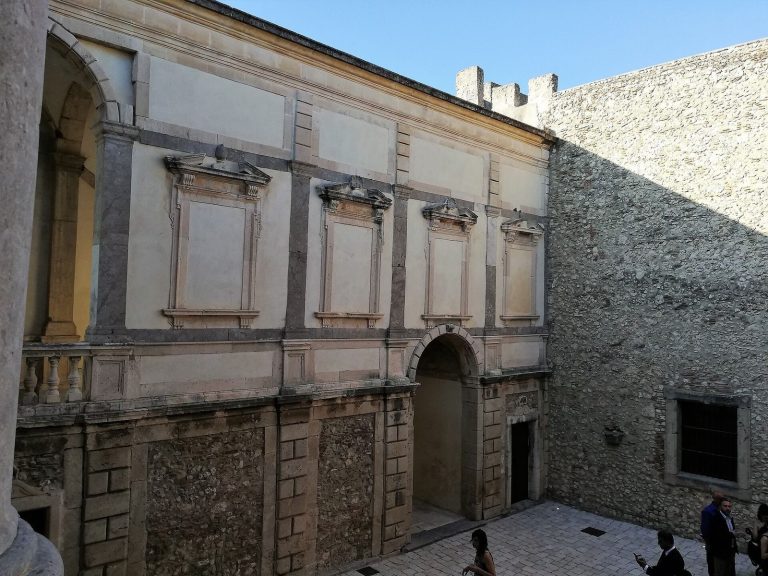
A passage connects the adjoining Prelatial Palace directly to the cathedral. The palace houses the diocesan museum, whose collection brings together objects and artworks from the prelature’s religious buildings, including some that were destroyed or decommissioned. Its treasury includes a silver-gilt reliquary of the Holy Thorn made by a Messina goldsmith in the fourteenth century and a silver hand containing a relic of Saint Lucia, made by Messina silversmith Francesco Bruno in the seventeenth century. The collection also includes liturgical vestments.