Church of Santa Maria Maddalena: Parish Church of Desenzano del Garda
Site at a Glance
- Popularity
- Medium
- Country
- Italy
- Primary era
- Early Modern
- Eras represented
- Medieval, Early Modern, Modern
- Civilizations
- Austrian Empire, Habsburg, Holy Roman Empire, Italian, Venetian
- Site type
- Religious
- Remains
- Church
On this page20 sections
History
The Church of Santa Maria Maddalena is a Roman Catholic parish church in Desenzano del Garda, Italy, also known as the Duomo di Desenzano del Garda. Dedicated to Mary Magdalene, it belongs to the Diocese of Verona. Construction of the present church began in 1585 under architect Giulio Todeschini and was completed around 1611. Its west-facing façade is Baroque, an elaborate style prominent in the seventeenth and eighteenth centuries.
Medieval parish
The earliest known document concerning the parish church dates to 878. In a diploma issued by Carloman of Bavaria, a ruler of East Francia and Bavaria, the church and Desenzano’s castle were subject to the Abbey of San Zeno in Verona. A papal bull of 1145 recorded a different ecclesiastical arrangement: Pope Eugene III placed the parish church, together with its dependent chapels, under the Bishop of Verona.
Rebuilding and the present church
The earlier place of worship was rebuilt in the late fifteenth century and renovated in 1586. Work on the present church had started the previous year, in 1585, and continued until about 1611. During pastoral visits in the first half of the sixteenth century, Bishop of Verona Gian Matteo Giberti found the parish led by Valerio Boni, a priest from Brescia who delegated pastoral care to other priests. The church had associations of lay worshippers devoted to the Blessed Sacrament and the Rosary, six altars besides the main altar, and two chapels built by the community. One honored Saints Vincent, Benignus, and Anastasius; the other was dedicated to Saints Peter, Paul, and Andrew.
Bishop Alberto Valier consecrated the new church on December 6, 1611, the feast of Saint Nicholas. It then had eight altars in addition to the main altar. These included the Pace family altar and altars dedicated to Augustine, the Holy Rosary, Nicholas of Tolentino, Michael, the Holy Trinity, Catherine of Alexandria, and either Ursula or Angela Merici.
Angela Merici and later chapels
The town commissioned an altar honoring Angela Merici and Saint Ursula in 1608. Work ceased in 1628 after Pope Urban VIII prohibited the veneration of people considered saints before their beatification, the formal recognition that permits such public veneration. Angela Merici was beatified in 1768, and the municipality commissioned a new altarpiece that year.
A chapel of the Blessed Sacrament opened in 1738. A separate chapel dedicated to Angela Merici, patroness of Desenzano, dates to 1881. Luigi di Canossa, a cardinal and Bishop of Verona, blessed it in 1884.
Modern changes and conservation
Following the Second Vatican Council, the Catholic Church council held from 1962 to 1965, the church’s liturgical arrangement was adapted. Later work under architect Gualtiero Rizzi addressed the entrance portal in 2008–09 and the interior walls and presbytery vault in 2010–11.
Remains
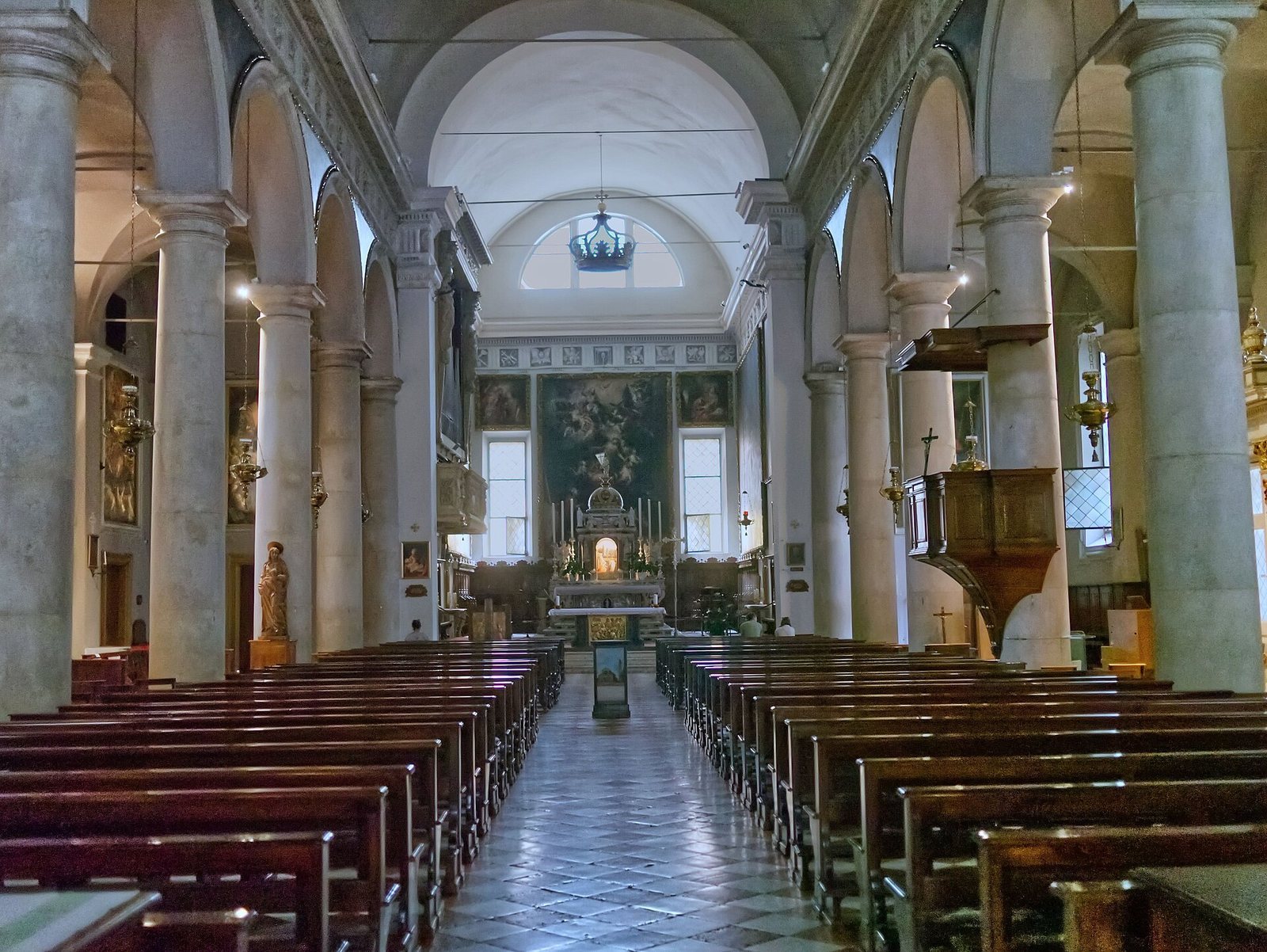
The church has a west-facing façade and a three-nave interior, with the central nave flanked by two aisles. Marble columns and arches define the interior, while chapels, altars, paintings, and the presbytery occupy distinct parts of the building. The church also retains its bell tower and a historic organ.
Exterior and plan
Façade
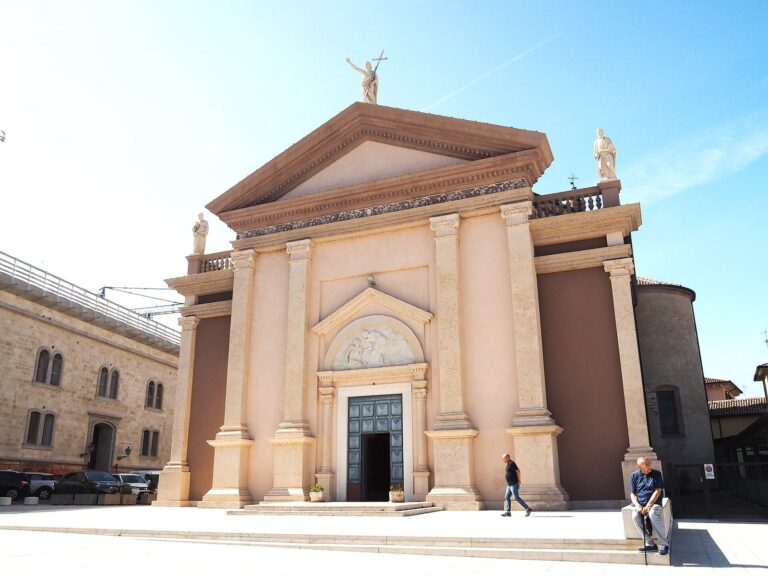
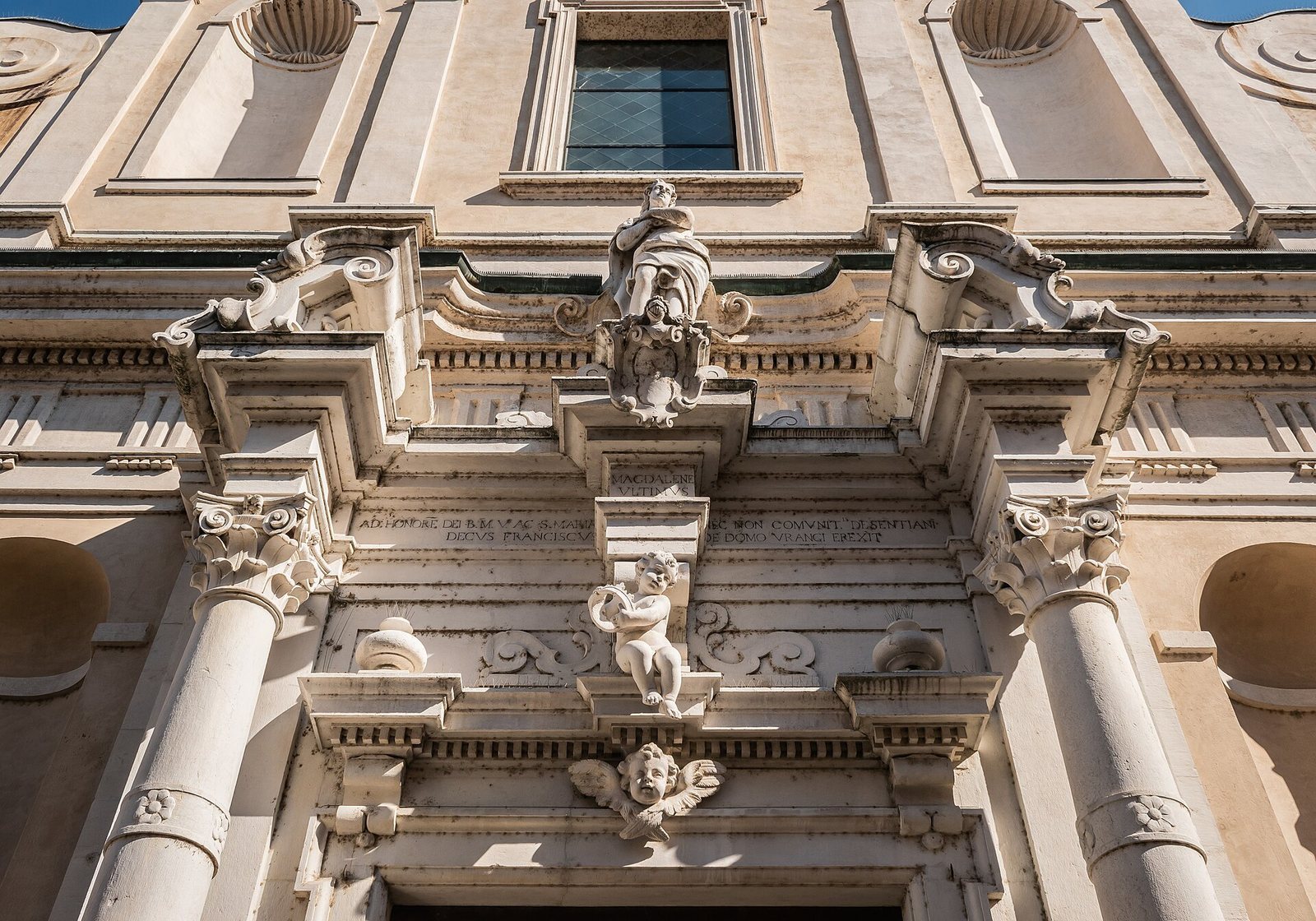
The Baroque façade is arranged in two tiers, joined by two side buttresses with spiral scrolls. In the lower tier, four pairs of Doric pilasters, shallow wall-mounted columns, support a horizontal band decorated with triglyphs, or grooved blocks, and metopes, the panels between them. The elaborate central portal dates to 1699. Above it, a statue of Mary Magdalene on a broken arch is a late-seventeenth-century work attributed to Sante Calegari the Elder. Niches flank the entrance, while rectangular windows sit farther out between the pilasters.
Four Corinthian pilasters divide the upper tier. A large rectangular window occupies its center, with an empty niche on either side and a triangular pediment above. Together, the two levels form the church’s principal west-facing elevation.
Bell tower
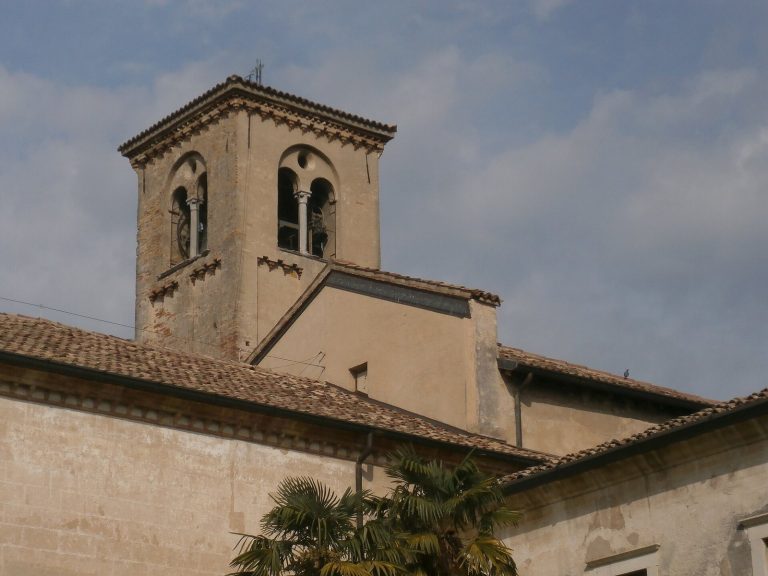
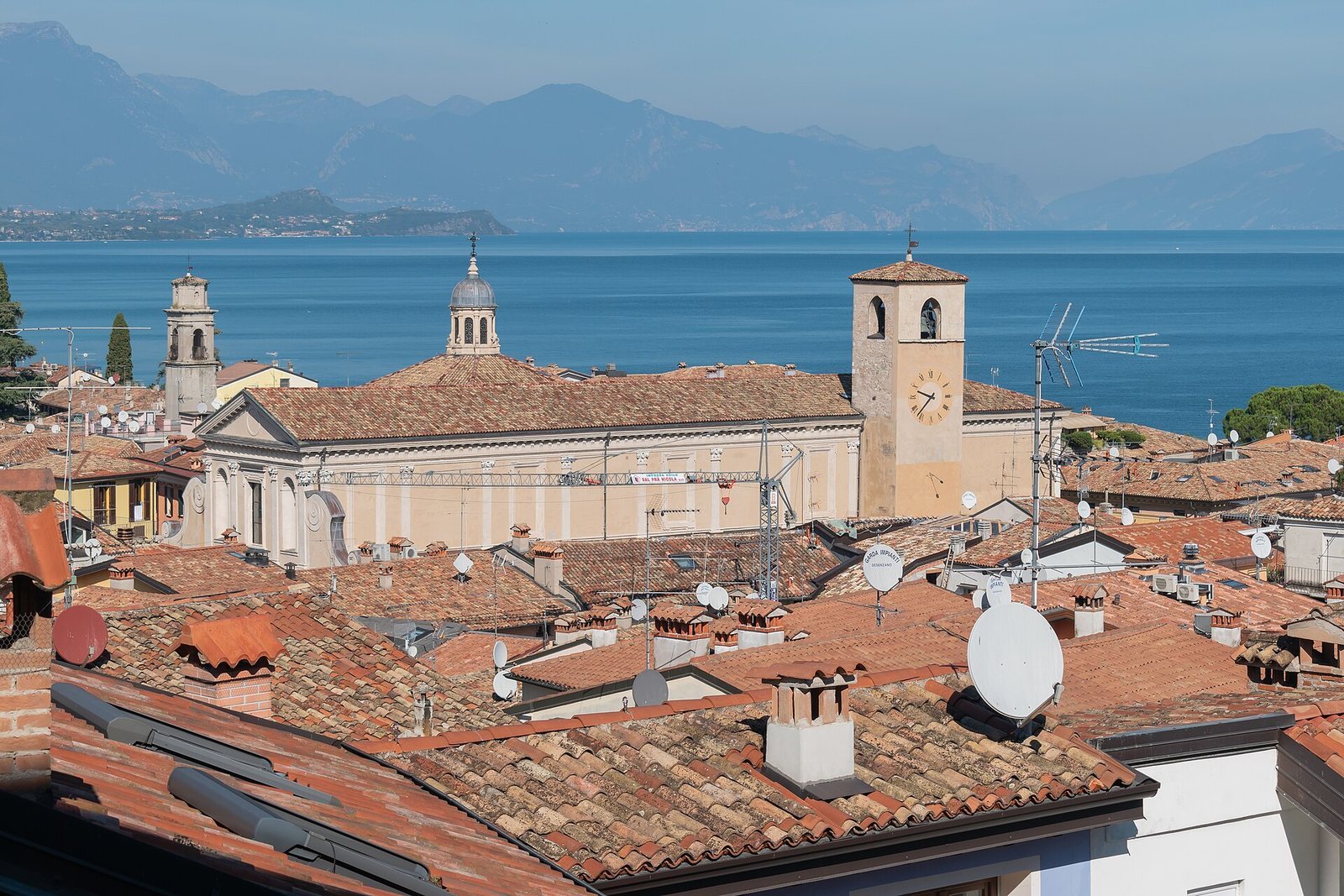
The square bell tower adjoins the church’s left wall and is partly incorporated into it. Its shaft is plastered in light beige. The Romanesque bell chamber, in a medieval style, has a pointed-arch window with a single opening on each side. Terracotta tiles cover its four-sided roof, which is topped by a metal cross and weather vane.
Naves and side altars
Nave and aisles
Six Botticino-marble columns line each side of the central nave, separating it from the aisles. Botticino is a pale stone quarried near Brescia. Round arches rest on Doric columns between the naves, and a high ornamental band, made by Lombard craftsmen in the late sixteenth century, continues along the central nave into the presbytery, the area around the altar. The band features metopes and triglyphs. In the aisles, wall-mounted pilasters align with the columns and support arches above the minor altars.
The central nave has a curved barrel vault, while cross-shaped vaults cover the aisle bays. Each aisle is divided into six bays. The central floor is laid in diagonal courses of red Verona marble alternating with white stone; the aisles have panels of pink nembo stone. Rectangular windows in the aisles and façade admit natural light. At the flat rear wall of the presbytery, two rectangular windows and a semicircular-headed window provide further light.
The inside wall opposite the main entrance, known as the counter-façade, carries Andrea Celesti’s large painting of the Resurrection of Jesus. To the right of the entrance, behind a grille and two steps above the floor, stands a seventeenth-century baptismal font carved from one block of marble. Celesti’s large painting of the Baptism of Jesus, dated 1695, hangs behind it.
Altars and devotional works
The left aisle contains altars dedicated to Nicholas of Tolentino, the Madonna of the Rosary, and Saints Vincent, Benignus, and Anastasius. Battista Lancino made the Baroque altar of Nicholas in 1610 to replace a sixteenth-century altar. Its altarpiece is an earlier painting, dated 1542, by the Veronese artist Donato Zenone. It shows God the Father blessing Saints Nicholas of Tolentino, Peter, and Andrew. The altar honoring Saints Vincent, Benignus, and Anastasius was built in 1885 in place of a sixteenth-century altar; its altarpiece, also by Zenone, dates to the 1540s and depicts the three saints.
On the right, the Pace family altar has a marble table and a carved, gilded wooden altarpiece. Built in 1613, it has a main painting by Giovanni Andrea Bertanza, dated 1614, showing the Redeemer bringing peace to the Pace family. A smaller painting above it depicts Saints Charles Borromeo, Aloysius Gonzaga, Vincent Ferrer, Louis, and Placidus; their relics are kept at the altar. A painting by Bertanza showing the archangel Michael expelling rebellious angels from Paradise hangs on a wall where the former altar of Saint Michael stood.
The right aisle also contains the altar of Anthony of Padua, made of polychrome marble in the Baroque style. Its altarpiece by Giambettino Cignaroli depicts the Blessed Angela Merici in glory with Saints Anthony and Aloysius Gonzaga. The Baroque altar of Joseph, dated 1603, is also made of polychrome marble. Its altarpiece shows the Virgin in glory with Saints Joseph and John the Baptist; a painting by Celesti of Catherine of Alexandria is also associated with this altar.
A seventeenth-century walnut pulpit is attached to the third column. Near the fifth column stands a revered wooden statue of Mary Magdalene. Between the two large chapels opening off the left aisle is an altar with a niche containing a statue of the Madonna of the Rosary.
Side chapels
Angela Merici chapel
The chapel of Angela Merici has a Neoclassical altar of white marble with pink inlay. Its front is faced with gilded sheet metal, with a silver medallion at the center and embossed angels at the sides. The altarpiece, painted in 1882 by the Roman artist Seregni, shows the Blessed Angela and the Vision of Brodazzo, a religious vision associated with her. Angela wears the habit of the Ursulines of Blois, acknowledging their contribution to the chapel. An inscription below the painting reads, “Now I can help you and do you good.”
Six small paintings by Pietro Rizieri of Desenzano, made in 1834, depict episodes from Angela’s life: her family, the Vision of Brodazzo, her reception by Pope Clement VII, her meeting with Duke Francesco Sforza, her return from the Holy Land, and her death. Stained-glass windows made in 1984 by the Cavallini workshop of Verona also portray Angela.
Chapel of the Blessed Sacrament
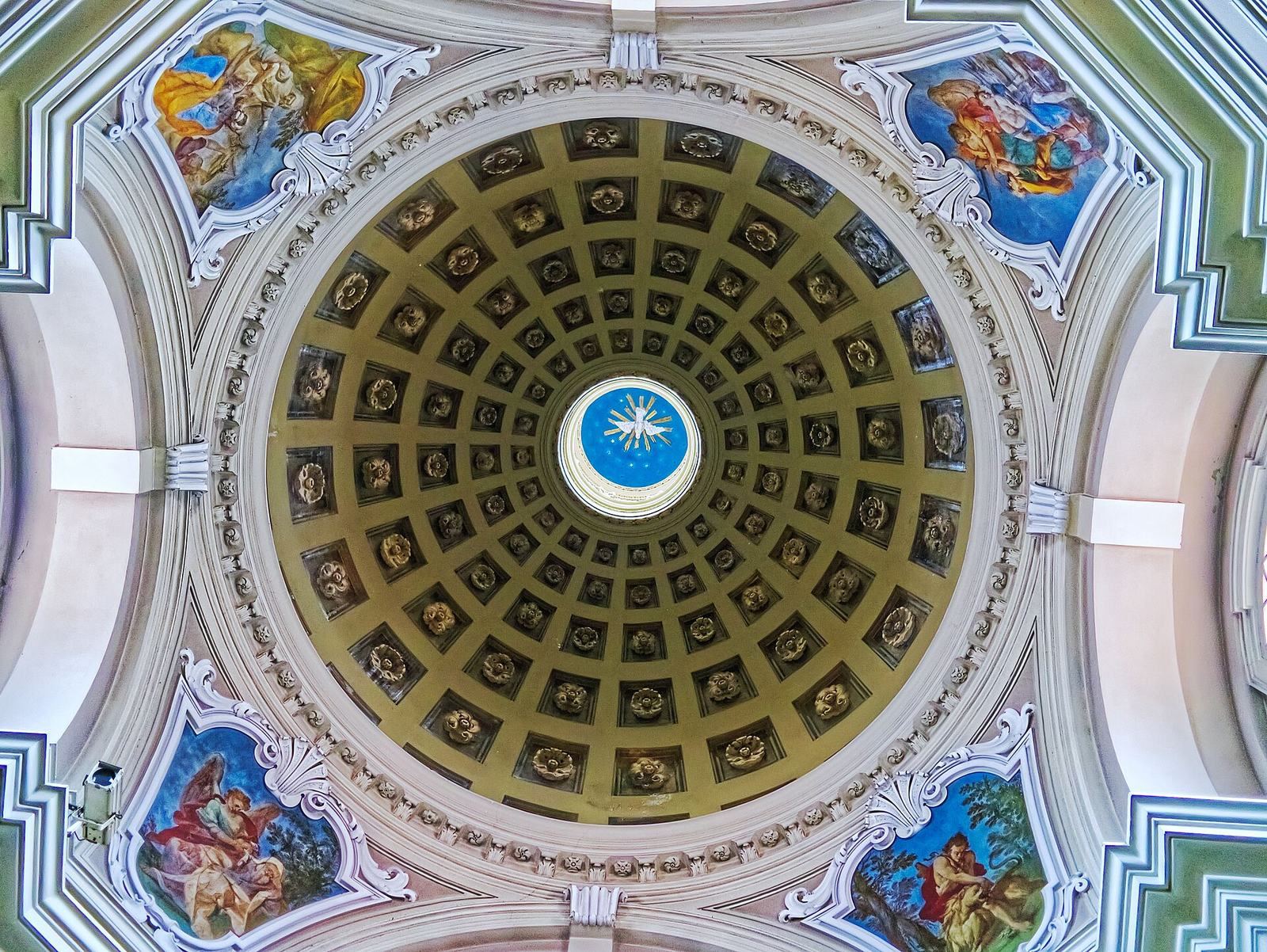
The larger Blessed Sacrament chapel has an octagonal plan, pilasters with composite capitals, four windows, and a circular dome. Its Baroque altar is made of gray marble and pink breccia. The altarpiece of the Last Supper is attributed to Gian Battista Tiepolo, though it may instead be by his son Gian Domenico or a collaboration between them. It may date to the 1740s.
Four statues by Lorenzo Muttoni occupy niches in the chapel and represent the cardinal virtues, with Charity represented twice. Giorgio Anselmi painted four medallions on the curved triangular surfaces supporting the dome and on the arch. Above the statues are paintings of scenes from the Passion of Jesus. A 1775 painting by Costantino Borti depicts Saint Anthony of Padua; it came to Desenzano in 1891 from the demolished church of Sant’Anna dei Bresciani in Rome.
Presbytery, choir, and sacristy
Presbytery and high altar
The rectangular presbytery stands three steps above the nave on white stone. It shares the central nave’s flooring and has a barrel vault. Changes to the liturgical arrangement removed the balustrades and introduced a wooden altar facing the congregation. A wooden stand for readings, called an ambo, was placed forward in the central nave, to the altar’s left; the presider’s chair is aligned with the altar.
The earlier high altar was completed in 1702 and consecrated in 1707. Its marble structure has two tables with inlaid fronts. The table facing the nave served parish celebrations, while the one facing the choir served celebrations of the collegiate clergy, a chapter of clergy serving the church. A temple-shaped tabernacle carries a canopy with a Renaissance-style dome, a revival of classical forms, topped by a small statue of the Risen Christ.
Choir
Late-seventeenth-century stalls of walnut and olive wood line the choir. Large paintings by Celesti from the same period show the Penitent Magdalene at the center, the Raising of Lazarus to the left, and the Supper at the Pharisee’s House to the right. Above the windows are paintings of the Madonna at the Tomb and the Madonna and Risen Christ. Another work, depicting Saint Cecilia, is by Cambi, a pupil of Celesti.
Sacristy
The sacristy occupies the end bay of the left aisle. It contains a portrait of the Blessed Angela Merici by Romanino, painted shortly after her death, as well as works credited to Palma the Younger. These include the Mysteries of the Rosary and a Pietà commissioned by the municipality in 1610 and installed in the sacristy in 1985. Angela Merici also appears in the Pietà.
Other works in the sacristy include four oval paintings of the Annunciation, the Madonna and Child, Anthony of Padua, and Gaetano Thiene; two paintings of bishops; and a seventeenth-century wooden crucifix.
Organ
The Serassi organ, opus 433, stands on a choir loft in the presbytery on the Gospel side. Built between 1835 and 1843, it retains some pipes from earlier instruments made by Matteo Cardinali in 1635 and Giuseppe Bonatti in 1710. Its wooden case, probably made by the Brescia sculptor Antonio Montanino, has seventeenth-century bas-reliefs and moldings dating to the first organ.
The case and choir loft were restored in 2013, and the organ was restored and partly reconstructed in 2014. It has mechanical action, two 58-key manuals, and a reconstructed 22-key pedalboard arranged like a lectern.