San Papino Church and Franciscan Convent in Milazzo, Italy
Site at a Glance
- Popularity
- Low
- Country
- Italy
- Primary era
- Early Modern
- Eras represented
- Early Modern, Modern
- Civilizations
- Habsburg, Italian, Kingdom of Sicily, Spanish
- Site type
- Religious
- Remains
- Monastery
On this page24 sections
History
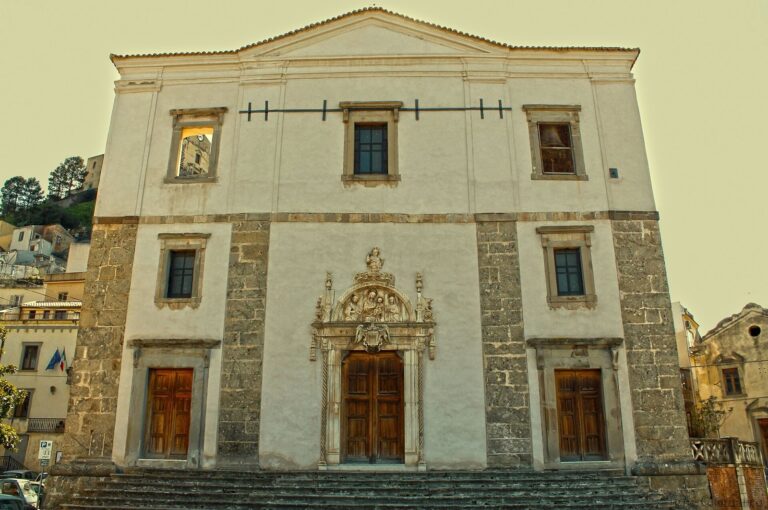
San Papino is a church and attached convent on the western shore of Milazzo, Italy. Built for the Reformed Friars Minor, a reform branch of the Franciscan order, the present church was begun in 1618 and completed in 1620. Its Mannerist and Baroque character reflects a late Renaissance style and an architecture rich in dramatic ornament. San Papino is also the religious center of the Parish of the Most Holy Crucifix.
Traditions and earlier churches
Local tradition says that the relics of the martyr Papino reached Milazzo’s western shore. Devotees built a small shrine for them, and Papino became the city’s patron. The civic senate later erected a church in his honor at the landing place. A cathedral is thought to have stood in the same neighborhood during the Byzantine period, when the area formed part of the eastern Roman Empire. The later transfer of Papino’s relics, the accidental discovery of relics of Saint Stephen the Protomartyr, accounts of Christian martyrdoms dated 251–257, and written evidence have been treated as indications of an active Christian community and a Diocese of Milazzo.
A Renaissance church is known from Milazzo’s Aragonese period, when the Crown of Aragon ruled Sicily. It was rebuilt under Spanish rule, and the civic administration later donated the church, other buildings, and adjacent land. This earlier church was eventually demolished.
Construction and eighteenth-century rebuilding
Construction of the present church followed a donation to Friar Benigno da Genova, the order’s minister general. The building was enlarged between 1621 and 1629, alongside the convent, with funds from civic alms, bequests, and private gifts. At first, it had two altars, dedicated to the Madonna and the Crucifix. In 1650, the convent housed 14 friars, and its grounds included gardens and orchards into the eighteenth century.
The church was bombarded during the Battle of Milazzo on 15 October 1718. Subsequent German reprisals demolished much of it, leaving only a small part of the choir standing. Damage from the Spanish siege of 1718–1719 led to extensive rebuilding between 1720 and 1725, which established the church’s basic present-day layout. Altars near the entrance were added during this phase. The convent was also rebuilt after the siege, although the details of that work are not recorded.
The Crucifix and its commemorations
On 15 April 1798, during a procession seeking relief from a drought that had lasted three months, the faithful believed that the Crucifix wept. Notarial documents preserve accounts of the event, and Milazzo’s archpriest, Pietro Pellegrino, wrote that the people prayed for rain and that the Crucifix answered their plea. The church’s later devotional calendar continued to commemorate this belief.
The annual observance includes a liturgical commemoration on the Tuesday after Easter. On the following Sunday, a procession carries a reliquary associated with the drying of the sacred tears, together with a wooden copy of the image. Processions of the Crucifix also take place on exceptional occasions, jubilees, and special anniversaries. A procession in 1947 marked the end of the Second World War; others followed in 1948 for the 150th anniversary of the traditionally recognized miracle and in 1950 for the Catholic Church’s Holy Year. Further processions marked the second centenary in 1998 and took place on an extraordinary basis in 2007.
The convent and changing ownership
After nineteenth-century suppression laws affected religious houses, the convent was probably intended for use as a barracks, workshop, or cemetery. It was expropriated in 1868 and assigned to the municipality. In 1910, the municipality granted it to the Franciscans under a long-term property arrangement, and ownership passed permanently to them in 1945. The convent hosted provincial chapters of the order and a Seraphic School, which reopened in 1922 and remained active until the 1950s.
Parish and modern conservation
From 1931 to 1934, engineer Giuseppe Mallandrino led extensive restoration and embellishment, including the design of the church’s present façade. Altars dedicated to the Sacred Heart of Jesus and Saint Francis of Assisi were also made during this campaign. The church became a parish in 1965 and belongs to the Archdiocese of Messina-Lipari-Santa Lucia del Mela and the Friars Minor’s Sicilian Province of the Most Holy Name of Jesus, an administrative region within the order.
The church ceiling collapsed in 1994, damaging frescoes in its curved ceiling panels and decoration on the vault. The convent’s cloister was restored in 1986–1987, and a painting in its former refectory was restored in 1993. In 2020, conservation work was carried out on the church façades and major maintenance on the roof. The wooden Crucifix was also restored, but was not returned to its altar because that altar required urgent work.
Remains
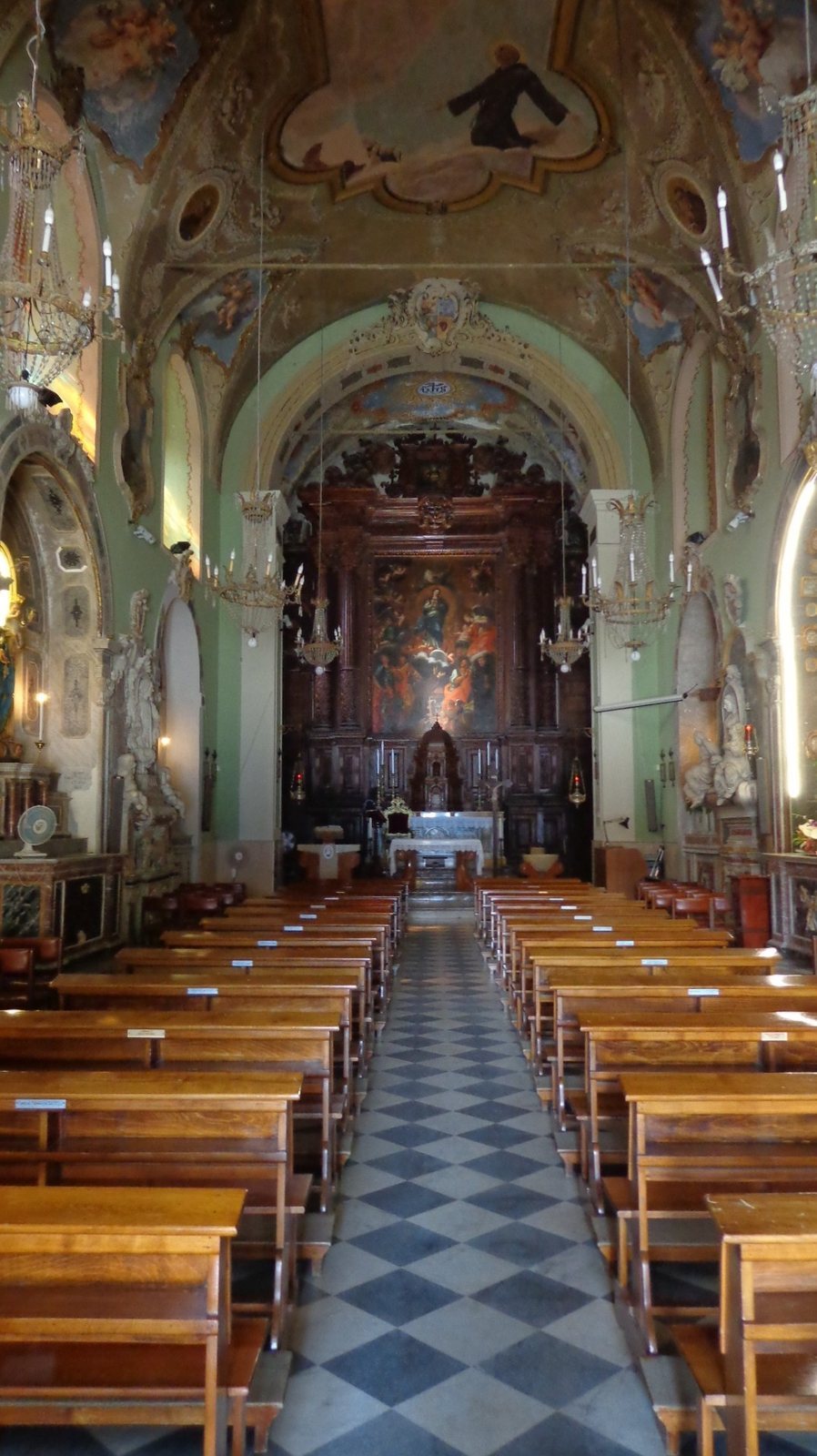
The church and attached convent form a large architectural complex below Milazzo’s castle and within the district of the same name. The church is arranged around a single nave, with six smaller altars along its side walls and a distinct sanctuary. Its design includes Baroque forms and references to Sicilian Renaissance and Rococo, a lighter, highly decorative style.
Façade and entrance
Façade and cross
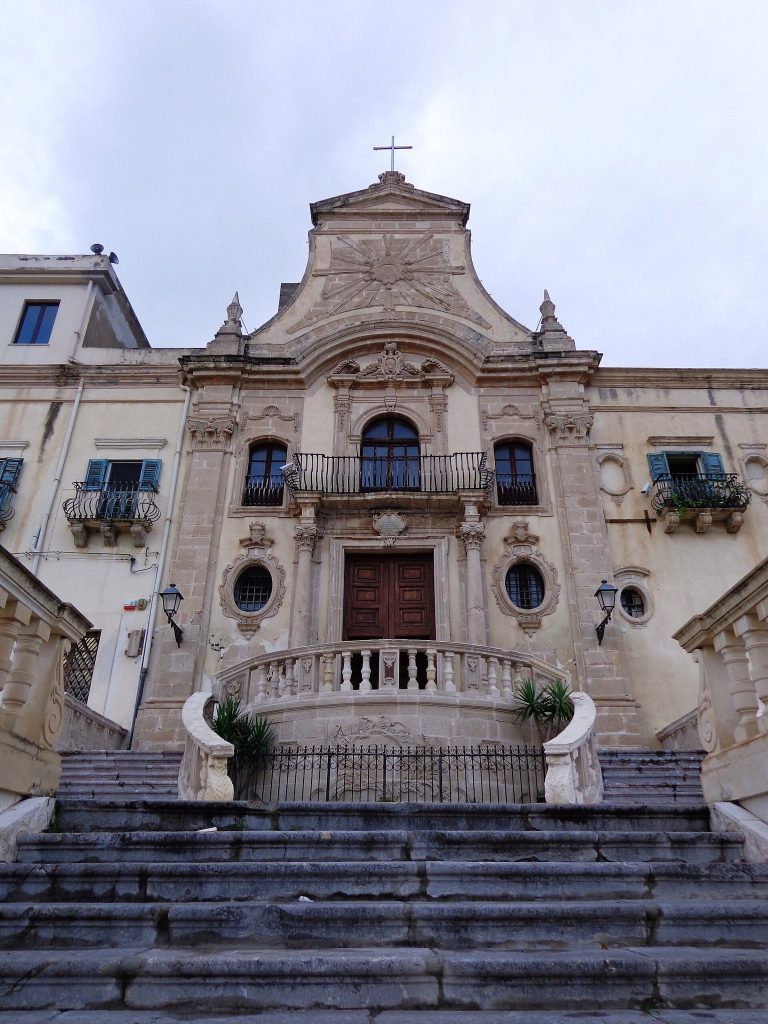
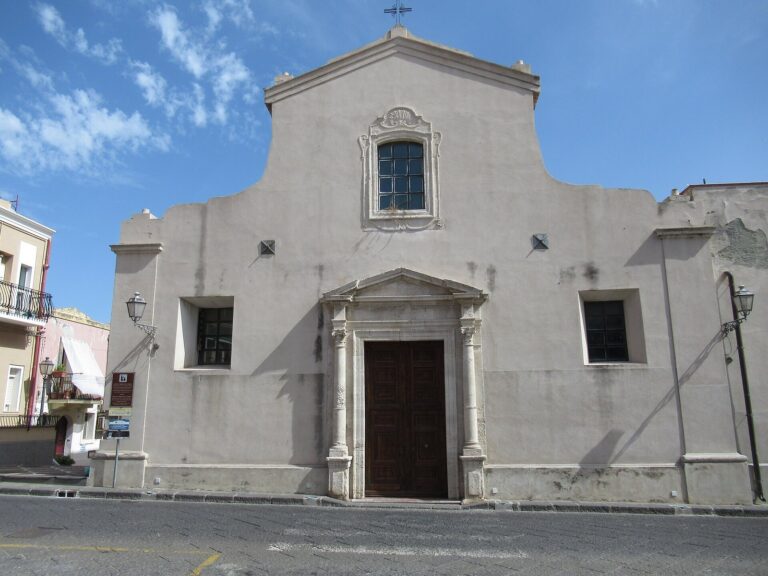
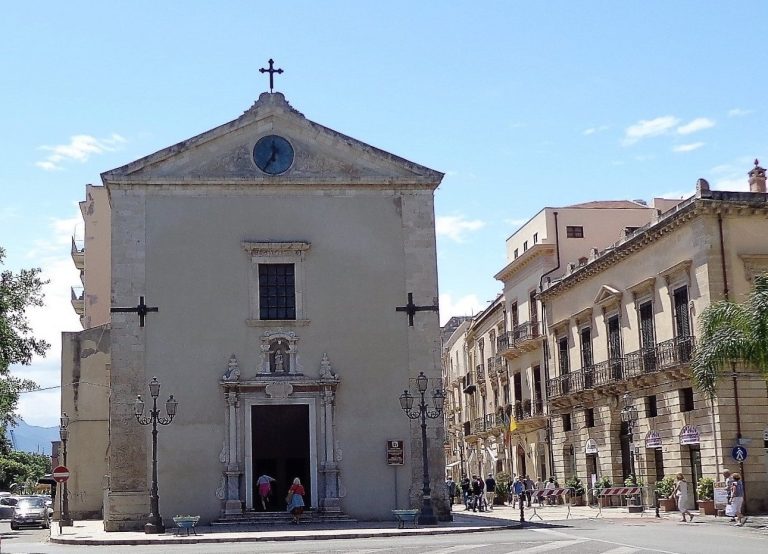
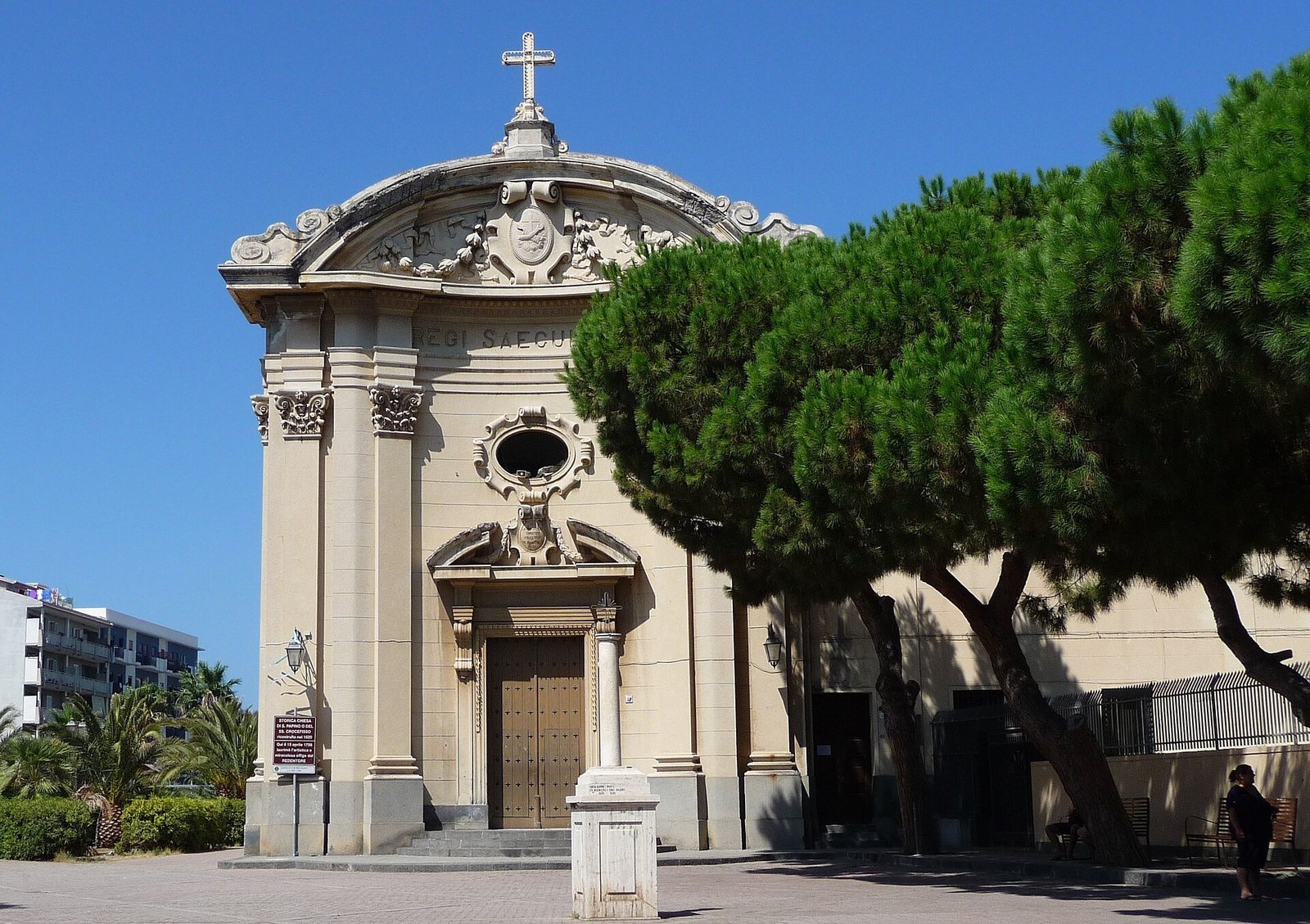
Mallandrino’s façade, completed in 1934, curves inward. Rectangular pilasters, shallow wall supports raised on bases, divide its surface, while two projecting horizontal bands run across it. Paired Corinthian pilasters, with capitals decorated in the ornate classical style, frame the simple doorway. Above it, a split-arch pediment and a festooned inscription lead up to an ornamented oval window. The upper band bears the motto To the King of the Ages. A second split-arch pediment, crowned by a garlanded Franciscan emblem, is flanked by spiral forms and topped with a cross. A shield between the doorway and upper pediment commemorates the traditional belief that the Crucifix wept on 15 April 1798. Opposite the church stands a marble base and column topped by a cross, erected in 1720 in place of an older wooden cross and restored in 1981.
Entry and memorials
The wooden church door came from Santa Maria degli Angeli in Messina, which was destroyed in the 1908 earthquake. Inside the entrance, Alberto Vincenzo Zirilli’s tomb (1730–1769) has a high-relief portrait medallion, a crowned Sacred Heart bearing the Zirilli family arms, and an inscription beneath a shelf. Giuseppe Buceti made the work. On the opposite side, a memorial stele commemorates Tomaso Mariano D’Amico (1804–1885); its Gothic-style arched crown rests on paired columns and is flanked by pinnacles, with a relief coat of arms on the base. A choir loft stands above the entrance hall.
Nave and side altars
Altars on the right side
The first bay on the right holds an altar to Saint Anthony of Padua, with a statue in a niche above the altar table and a relief of the saint on its decorated front panel. The second bay contains the altar of the Most Holy Crucifix. Friar Umile da Petralia carved the cypress-wood Crucifix in 1632–1633; Baron Onofrio Baele sponsored it and its chapel, and the altar arrangement dates to 1635. An associated container for relics holds remains attributed to Saints Emiliano, Costanzo, Beatrice, Corona the Martyr, and Fortunata. Removing a wooden screen during conservation revealed a seventeenth-century fresco, one of the few frescoes associated with the 1908 Messina earthquake that survived; it is displayed with the Crucifix. The third bay has a statue of Saint Francis of Assisi in a niche above an altar whose front bears the Reformed order’s emblem. A pulpit and an entrance to the cloister formerly occupied this position.
Tomb of Caterina Patti Lucifero
Against a pier on the right is the monumental tomb of Baroness Caterina Patti Lucifero, who died in 1750. Its inscription appears on a marble disc framed by acanthus leaves and topped by a sarcophagus with seated female figures. Above it are a high-relief portrait of the baroness and the crowned arms of the Patti and Lucifero families. The tomb is attributed to Giuseppe Buceti.
Altars on the left side
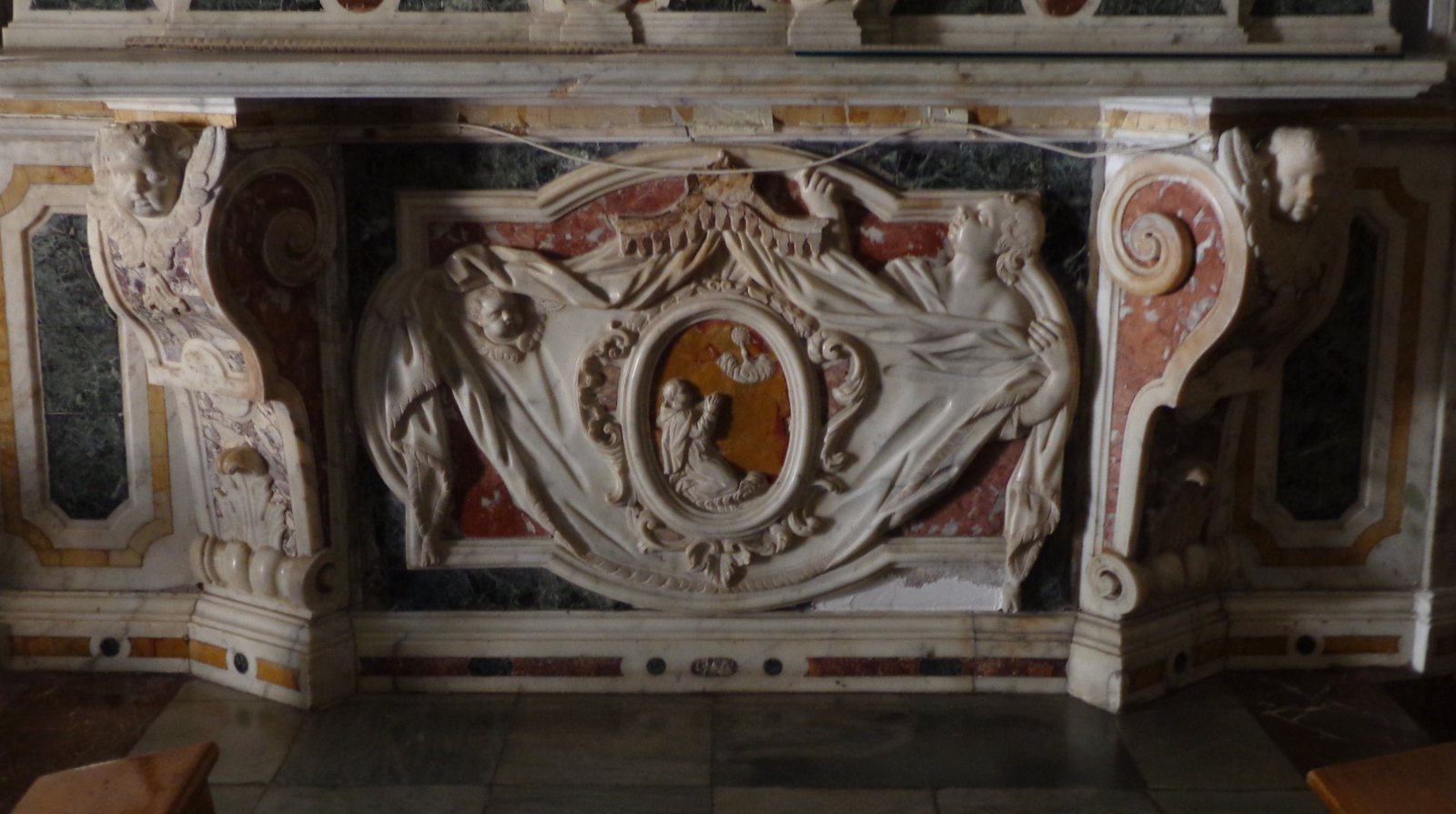
The first bay on the left has an altar to Saint Paschal Baylon. Its wooden statue is signed and dated 1750 by Francesco Antonio De Mari. The marble front panel features angels holding a canopy-like drape around a medallion of the saint in prayer; the Zirilli family sponsored the work. In the second bay, the altar of Our Lady of Providence holds a wooden-and-papier-mâché statue dated 1723. The barons Di Blasi sponsored it after the damage of the 1718–1719 Spanish siege; it replaced an earlier seventeenth-century marble statue. The third bay is dedicated to the Sacred Heart of Jesus. Although its altar front depicts the Sacred Heart, the statue in the niche represents Saint Clare and replaced an earlier image of the Sacred Heart.
Tomb of Antonio d’Amico di Santa Dorotea
A monumental tomb beside the altar of Our Lady of Providence commemorates Antonio d’Amico di Santa Dorotea (1691–1774) and is attributed to Giuseppe Buceti. Above the inscription, a sarcophagus is decorated with acanthus leaves and a lion seizing a skull. Two childlike decorative figures sit on its side supports, while a central medallion carries a high-relief portrait of the deceased. The crowned arms of the D’Amico family appear above.
Ceiling and windows
Salvatore Gregorietti painted the ceiling frescoes in 1934 with help from his brother Guido. The vault depicts the glorification of Saint Francis of Assisi, scenes from his life, and medallions of Saint Bonaventure of Bagnoregio, Saint Elizabeth of Hungary, Saint Louis IX of France, Saint Anthony of Padua, Saint Clare, and Saint Bernardino of Siena. Six curved ceiling panels contain angels, childlike decorative figures, and festoons in an eighteenth-century style. The windows contain coloured stained glass by Father Alberto Farina. A small plaque in the right side of the entrance hall, originally placed outside, recalls the traditional 1798 belief; a second plaque marks its first centenary.
Sanctuary and altar furnishings
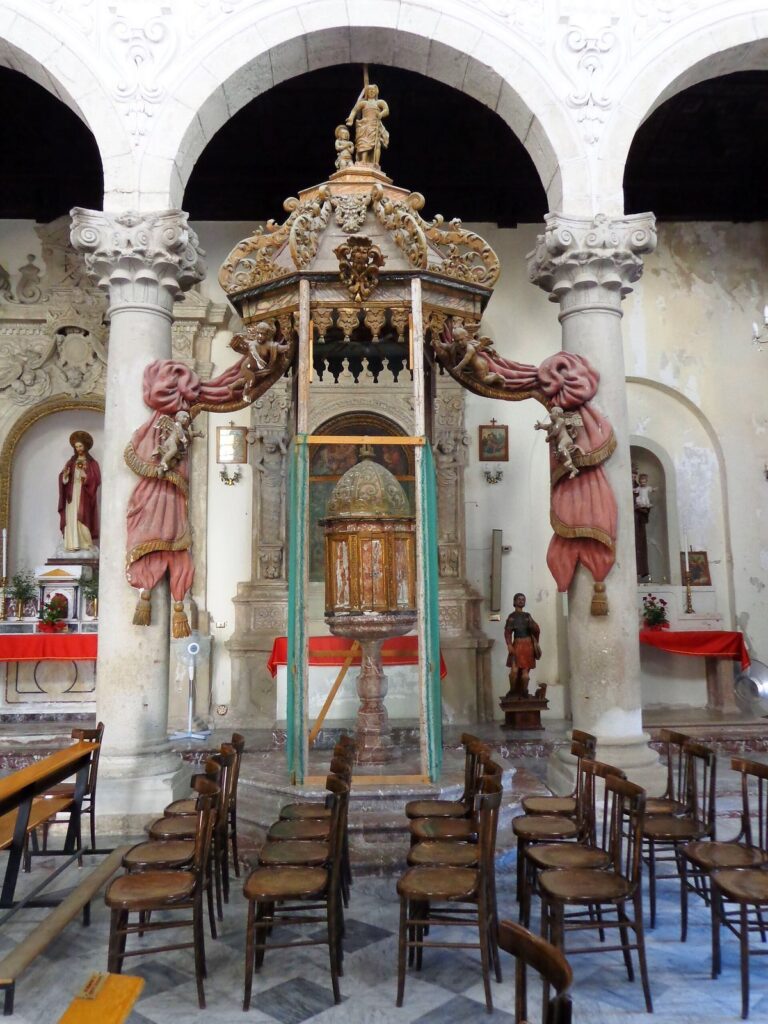
Altar and carved canopy
A large arch bearing a central stucco emblem of the Reformed Friars Minor separates the sanctuary from the nave. The present altar table faces the congregation and replaced an earlier wooden altar. A carved wooden canopy has three compartments on each side; four contain paintings of Saints Bernardino of Siena, Peter, Bonaventure of Bagnoregio, and Paul by an unknown artist. The raised structure has carved and inlaid panels on two tiers of bases, paired columns with floral decoration and fluting, Corinthian capitals, and a split scroll-shaped crown surrounding a small shrine and central coat of arms. Friar Ludovico Calascibetta da Petralia Soprana carved the canopy between 1720 and 1724.
Ciborium and central chapel
A two-tiered ciborium, a canopy-like shrine above the altar, has a three-part dome patterned with scales and topped by a lantern and cross. Its central chapel has a coffered barrel-vaulted ceiling and images of the Virgin Mary, Saint Paschal Baylon, Saint Francis of Assisi, Saint Bonaventure of Bagnoregio, and Saint Clare. The friar Ludovico Calascibetta carved the ciborium as well as the wooden canopy between 1720 and 1724.
Painting of the Immaculate Conception
A large canvas attributed to Onofrio Gabrieli occupies the raised structure above the altar. It depicts the Immaculate Conception with Saints Francis of Assisi, Anthony of Padua, Philip the Apostle, James the Apostle, and Papino the Martyr. Papino appears in a knight’s clothing, following a Spanish tradition of writing about saints that presented him as a defender of Milazzo against raids by Saracen pirates. The lectern stands on the Gospel side, traditionally the side from which the Gospel was read, and the baptismal font on the Epistle side.
Sacristy images
The sacristy holds a late-eighteenth-century figure of Our Lady of Sorrows, made from straw and wax and kept in a display case. In 2011, Pietro Balsamo of Francavilla Fontana made a new papier-mâché image of Papino as a knight and martyr for the sacristy.
Convent and cloister
Rooms and cloister
The convent has 32 cells. Its first floor contained 13 rooms, while the ground floor had 39, including a large frescoed refectory. The cloister’s colonnade consists of 20 sandstone columns in the plain Tuscan classical style. Near its entrance, frescoes by Friar Emmanuele da Como show Gospel episodes and scenes from Franciscan history, arranged in cycles.
Former refectory painting
An oil painting on a curved, half-moon-shaped canvas in the former refectory depicts the Last Supper. The late-seventeenth-century work is by an unknown artist.