Palazzo Comunale: Civic Palace and Museum of San Gimignano
Site at a Glance
- Popularity
- Medium
- Country
- Italy
- Primary era
- Medieval
- Eras represented
- Medieval, Early Modern, Modern
- Civilizations
- Italian, Republic of Florence
- Site type
- Civic
- Remains
- Palace
On this page16 sections
History
Medieval civic government
The Palazzo Comunale, also known as the Palazzo del Popolo, is a medieval town hall in San Gimignano, Italy. Built in the late thirteenth century over an earlier building, it became the seat of the town’s civic government. In 1300, the poet and political figure Dante Alighieri visited San Gimignano as an ambassador of the Florentine Republic. In the palace’s council hall, he spoke to the podestà, the chief civic magistrate, and the general council in support of a league intended to unite Tuscan Guelph communities, followers of a political faction in medieval Italy.
The palace was enlarged in 1323. In 1337, the podestà moved his residence there from the nearby Palazzo Vecchio del Podestà, establishing the new palace as the town government’s seat. Nello de Mino Tolomei, then serving as podestà, commissioned Lippo Memmi’s Maestà in 1317. Torre Grossa, the palace’s tower, was completed in the early fourteenth century. Its height, above that of the town’s other towers, expressed the authority of the civic magistrate.
Museum and restoration
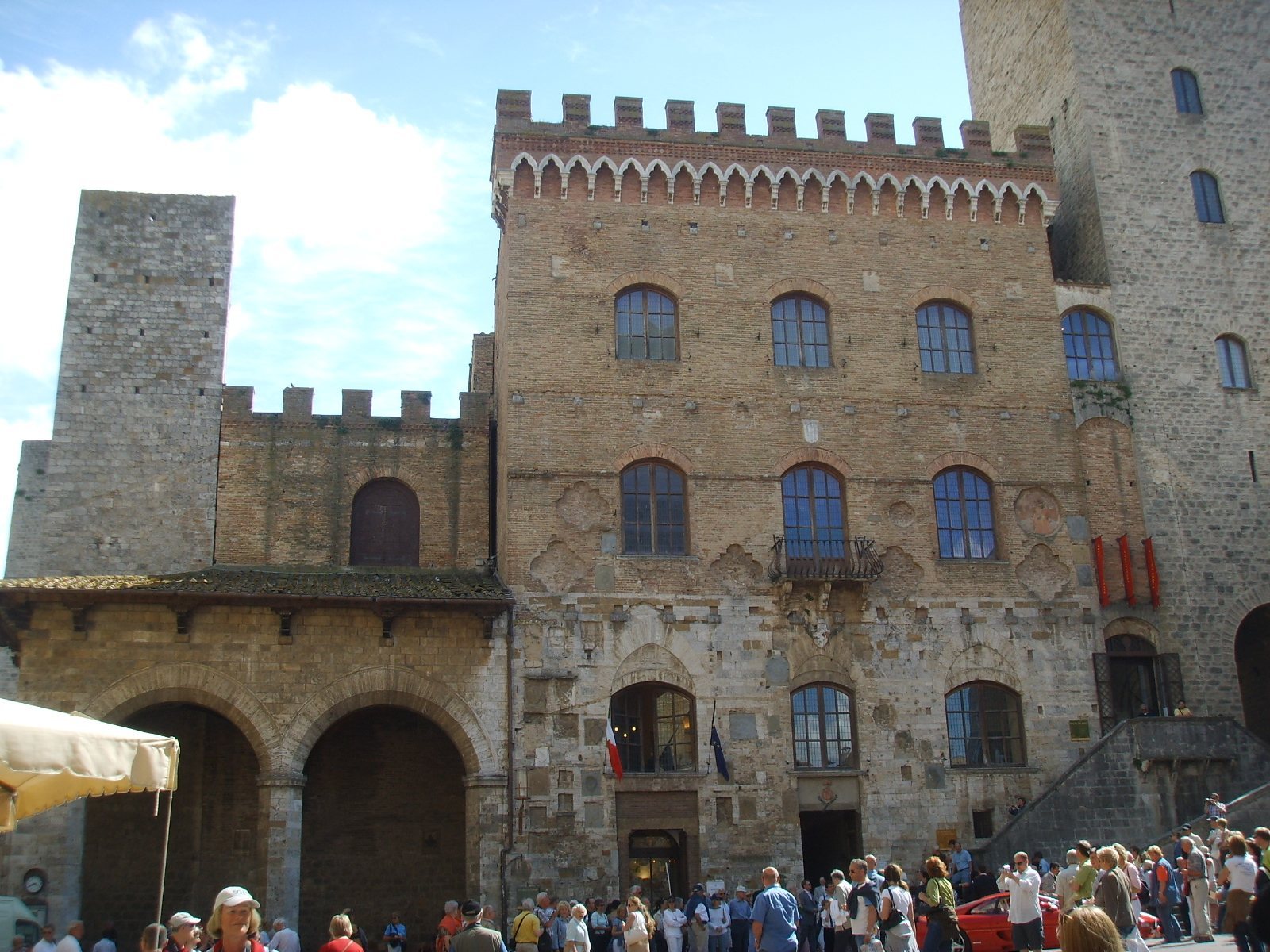
The city museum has occupied the palace since 1852. From 1878 to 1881, Giuseppe Partini led a restoration that added the crenellated crown and other elements. The palace and the nearby Collegiate Church of the Assumption form part of the UNESCO World Heritage Site of the Historic Centre of San Gimignano.
Remains
Exterior and courtyard
Facade and tower
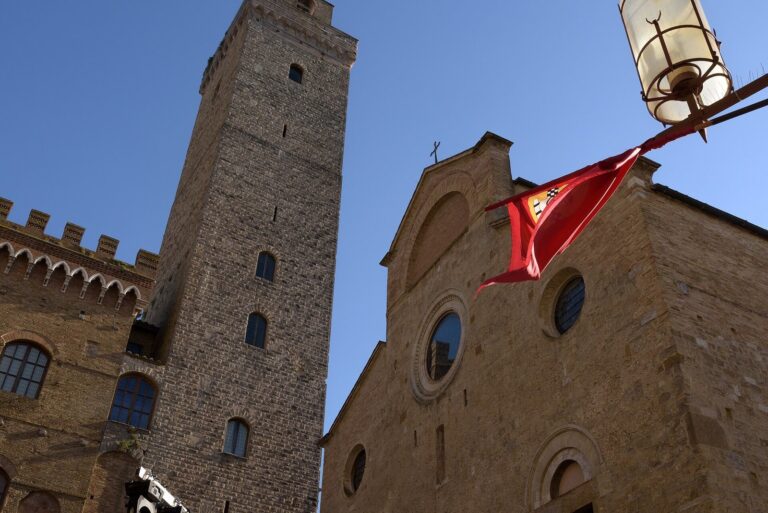
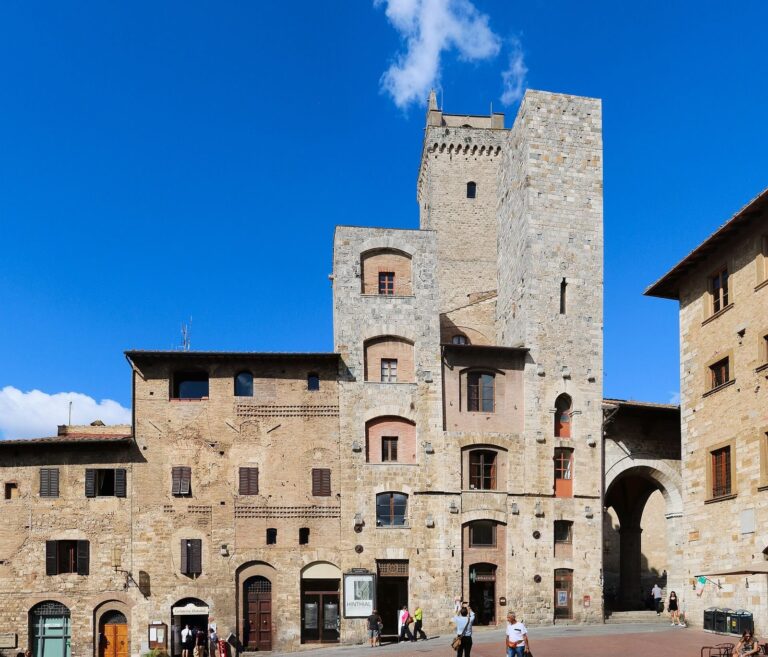
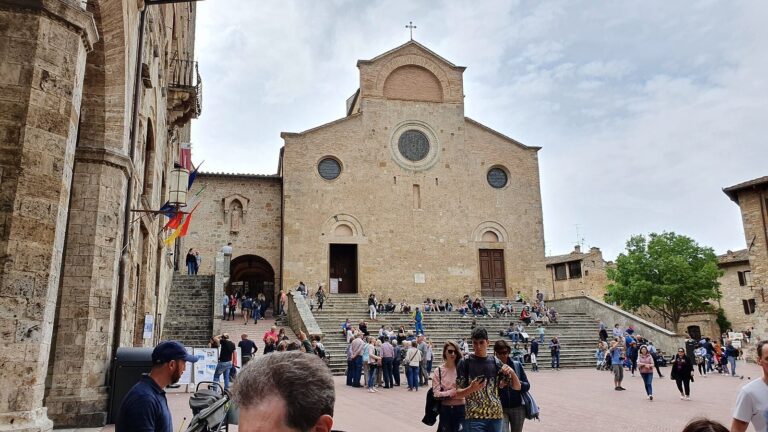
The palace stands on Piazza del Duomo, close to the Collegiate Church of the Assumption. Its facade combines large, squared stone blocks on the lower level with brick above. Nine low-arched windows form three tiers, with three windows in each row. On the first floor, a balcony rests on old brackets that once held a projecting public speaking gallery, where the podestà addressed crowds in the square. A stepped gallery is also found on this level.
Torre Grossa, or the Great Tower, rises 54 metres above the palace and is the tallest tower within San Gimignano’s walls. A staircase connects the palace to the tower, whose entrance is decorated with a fourteenth-century helmet.
Courtyard
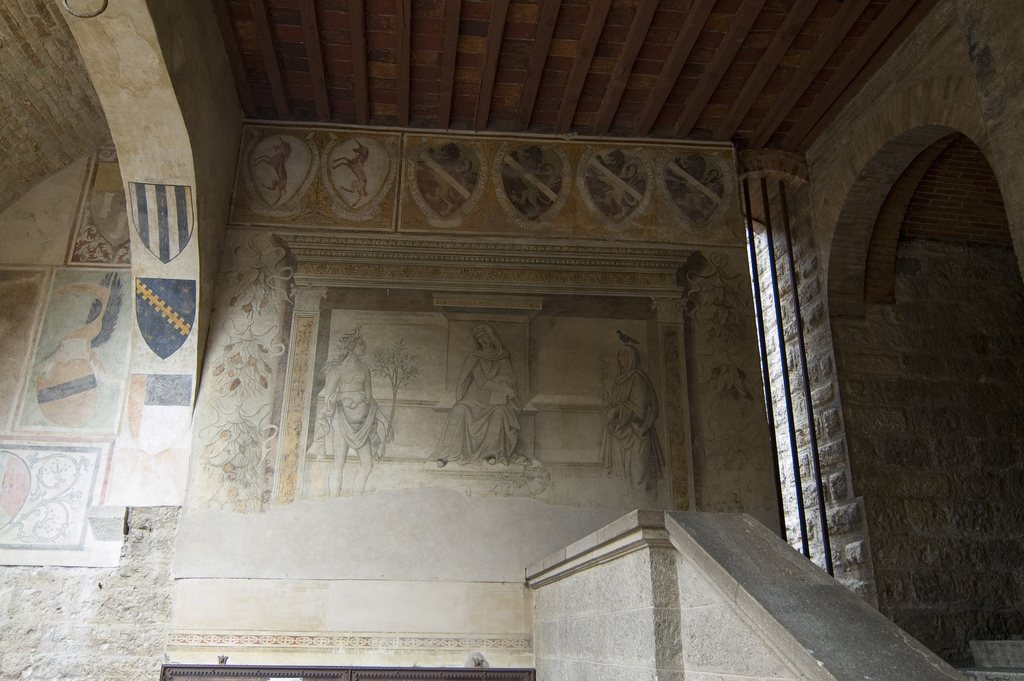
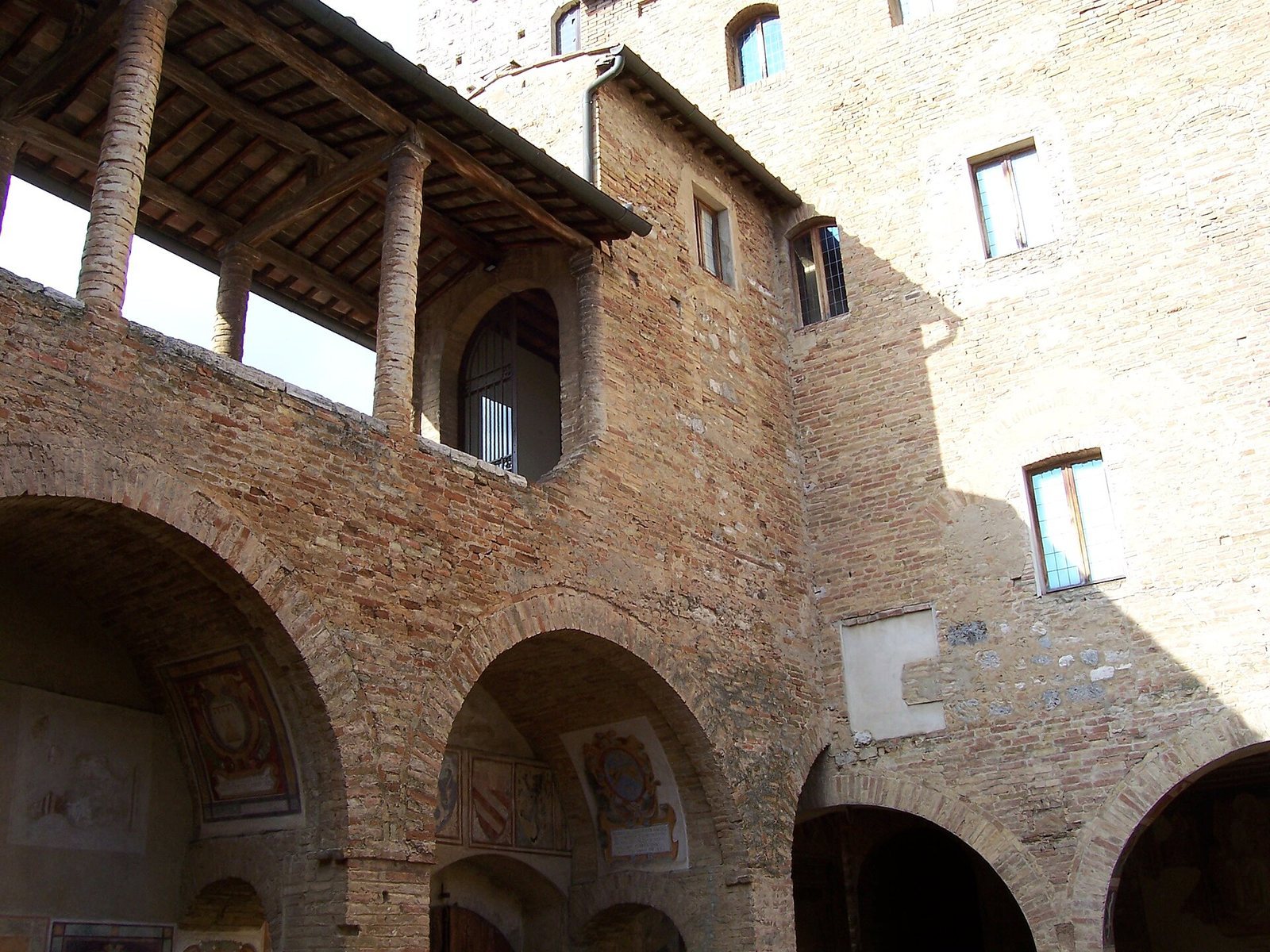
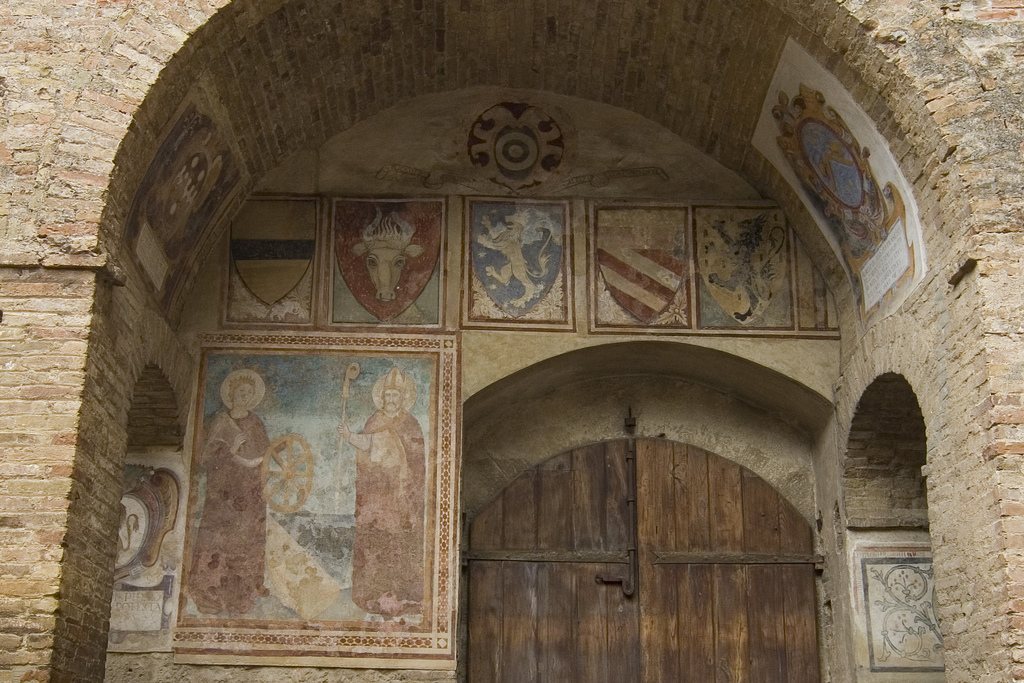
The ground-floor courtyard was built in 1323. Coats of arms, painted or sculpted, commemorate people who held municipal office, while a cistern installed at the courtyard’s centre dates to 1361. The palace’s main civic offices are also on this floor. Among the courtyard paintings are Sodoma’s Saint Ivo Rendering Justice of 1507, a Madonna with Two Saints by an unidentified Sienese painter from the second half of the fourteenth century, and Vincenzo Tamagni’s monochrome Justice Trampling Falsehood from the sixteenth century. An external staircase, supported by brick columns and covered by a canopy, leads from the courtyard to the museum.
Council and government rooms
Council Hall
The large reception room used as the council chamber is called the Sala del Consiglio, or Council Hall, and is also known as the Sala di Dante. Its frescoes include Lippo Memmi’s signed and dated 1317 Maestà, a devotional image of Mary enthroned among saints and angels. Nello de Mino Tolomei appears among the figures. The composition is believed to have drawn inspiration from Simone Martini’s Maestà in Siena’s Palazzo Pubblico.
Podestà’s chamber
The Camera del Podestà contains early-fourteenth-century frescoes by Memmo di Filippuccio. They portray both favourable and unfavourable outcomes of a young man’s initiation into love, including a couple bathing and going to bed. Elsewhere in the palace, hunting and tournament scenes painted by Azzo di Masetto date to about 1290.
Meeting and civic rooms
A room beside the Council Hall served for private meetings. Another government room contains carved and inlaid wooden seats dated 1475 and a coloured terracotta bust of Saint Bartolo, made in the first half of the fifteenth century and set in a niche. A small additional room has a fifteenth-century Florentine terracotta bust identified as Guido Marabottini.
Museum and art gallery
The upper floors house the civic museum and art gallery, with access from both Piazza del Duomo and the courtyard. The gallery occupies the second floor and brings together paintings, sculpture, religious objects, and decorative works.
Early paintings and crucifixes
Among the early works are a late-thirteenth-century Maestà by an unidentified Sienese painter, an altar panel of the Madonna, Child, and saints by Memmo di Filippuccio, and a thirteenth-century Madonna and Child. Two Crucifixion panels from the Florentine school date to the thirteenth and fifteenth centuries. The collection also includes Coppo di Marcovaldo’s shaped wooden Crucifix, made about 1260, Rinaldo da Siena’s Crucifixion with Mourning Figures and Prophets from 1275–1280, and a sculpted Crucifixion by Benedetto da Maiano.
Madonnas, saints, and altarpieces
Madonna and Child images include works by Cenni di Francesco di ser Cenni, an enthroned composition attributed to Guido di Graziano, and paintings by Pier Francesco Fiorentino, Sebastiano Mainardi, and Domenico di Michelino. The latter’s works include a Madonna and Child with saints and an enthroned group with Saints Gregory, John the Baptist, Francis, and Fina. Benozzo Gozzoli is represented by the 1466 Madonna and Child in Humility with Angels and Saints, an enthroned Madonna with Saints John the Baptist, Mary Magdalene, Augustine, and Martha, and a Madonna of Humility with Saints Andrew and Prosper. Other devotional paintings include a Madonna and Child by an anonymous Sienese master, Filippino Lippi’s two 1482 roundels of the Announcing Angel and the Announced Virgin, and Pinturicchio’s 1511 altarpiece of the Assumption of the Virgin with Saints Gregory and Benedict.
Further works include Lorenzo di Niccolò di Martino’s double-sided tabernacle, a small shrine depicting Saints Gregory and Fina, and his Madonna and Child. Memmo di Filippuccio’s enthroned Madonna and Child is surrounded by Saints Peter, John the Evangelist, Catherine, Agnes, John the Baptist, Michael, Francis, and Clare. Taddeo di Bartolo’s works include a fresco fragment showing women’s heads, a Madonna with Child and Saints, and the 1401 Saint Geminian and Scenes from His Life. Other multi-panel works are Niccolò di Ser Sozzo’s polyptych of the Assumption and Saints, the Saint Julian Enthroned triptych attributed to the Master of 1419, and Lorenzo di Niccolò di Martino’s 1401 Saint Bartholomew the Apostle Enthroned and Scenes from His Life.
Later works and decorative objects
The gallery also holds a Madonna of Humility attributed to the Master of San Jacopo a Mucciano; a Madonna with Saints Justus and Thomas by Pier Francesco Fiorentino; and a Madonna and Child with angels and saints by Jacopo da Firenze. Benedetto da Maiano’s carved altar step features cherubim. A fresco by Cenni di Francesco shows the Madonna and Child with angels alongside coats of arms of podestà dated 1525–1528. Other works include a Madonna and Child by Leonardo da Pistoia and Sebastiano Mainardi’s triptych Pietà with the Symbols of the Passion.
Among the later paintings are Vincenzo Tamagni’s 1528 fresco of the Madonna and Child, a Taddeo di Bartolo polyptych, and additional Madonna and Child paintings by Pier Francesco Fiorentino and Neri di Bicci. Decorative and devotional objects include a rare fourteenth-century Mamluk carpet, knotted in Cairo in a cross shape that imitates three overlapping carpets; a polychrome wooden reliquary bust of Saint Ursula by Mariano d’Agnolo Romanelli; and an early-fifteenth-century decorated marriage chest.
Chapel by the tower exit
A chapel lies beside the exit from Torre Grossa into the courtyard. Its works by Pier Francesco Fiorentino include the Holy Trinity and Christ in the Tomb frescoes, as well as a large altarpiece of the Virgin Mary and Saints Francis and Dominic adoring the infant Christ. The chapel also contains a Madonna and Child by Neri di Bicci and three Madonna and Child works by Sebastiano Mainardi, one of them accompanied by Saint John the Baptist.