Łęczyca Castle: A Gothic Royal Fortress in Poland


Site at a Glance
- Rating
- 4.4
- Popularity
- Medium
- Country
- Poland
- Primary era
- Medieval
- External website
- Open
- Eras represented
- Medieval, Early Modern, Modern
- Civilizations
- Kingdom of Poland, Polish–Lithuanian Commonwealth
- Site type
- Military
- Remains
- Castle
On this page13 sections
History
Łęczyca Castle is a Gothic defensive complex in Łęczyca, Poland, built as a royal fortress under King Casimir III the Great in the fourteenth century. Construction probably began shortly after 1345, although its exact start and completion dates are unknown. The castle became a royal residence and later served as the seat of the Łęczyca starosta, a royal official responsible for administering a district or royal estate. Its construction formed part of Casimir III’s wider programme of royal fortification and administration.
Royal fortress and medieval political centre
The fortress was probably built with the agreement of Duke Władysław the Hunchback, a Piast ruler whose territories included Łęczyca and Dobrzyń, although Łęczyca was not then his principal seat. Soon after its completion, Casimir III used the castle as a residence. During the king’s absence, the local starosta administered the royal estate from the fortress.
The Teutonic Knights, a German military-religious order that controlled territories around the southeastern Baltic and fought Poland and Lithuania during the medieval period, burned the castle in 1406. It was rebuilt soon afterward. In 1409, King Władysław Jagiełło held a council there concerning the approaching war with the Teutonic Order. Jagiełło later returned to the castle repeatedly, and in 1410 Teutonic prisoners captured after the Battle of Grunwald were held there while arrangements were made for their ransom.
The castle hosted Sejms, political assemblies of the Polish nobility, in 1420, 1448, 1454, and 1462. Tradition also associates it with a meeting between Jagiełło and a Hussite envoy who offered him the crown of Bohemia. The Hussites were followers of a religious reform movement linked to Jan Hus. During the Thirteen Years’ War against the Teutonic Order, the castle served as a residence of King Casimir IV Jagiellon.
Fire, rebuilding, and wartime destruction
A major fire in the second half of the fifteenth century ruined the entire castle. The complex remained in that condition until the 1560s, when Jan Lutomirski, Crown treasurer and Łęczyca starosta, directed a general renovation and thorough rebuilding. A Crown treasurer was responsible for royal finances. Between 1563 and 1565, the work included construction of the New House and cost nearly 3,000 florins from the royal treasury.
Fires and epidemics in Łęczyca during the first half of the seventeenth century weakened the fortress. During the Swedish Deluge, the Swedish invasion and occupation of much of the Polish-Lithuanian Commonwealth from 1655 to 1660, General Robert Douglas captured the castle in 1655 from a garrison commanded by the starosta Jakub Olbracht Szczawiński. The castle changed hands several times before Polish forces under King John II Casimir recaptured it on 7 October 1656.
The Great Northern War brought further damage in 1705, and the castle’s destruction was completed during another Swedish occupation in 1707. In 1769, the Russian general Ivan Drewicz captured Łęczyca and the castle while fighting the Bar Confederates, an eighteenth-century Polish noble revolt against Russian influence and the policies of King Stanisław II Augustus.
Military administration and decline
After the Third Partition of the Polish-Lithuanian Commonwealth, Prussian authorities used parts of the ruined castle between 1794 and 1797 while constructing new bastion fortifications around the town walls. Bastion fortifications use projecting angular earth or masonry works designed for artillery defence. The new works were intended to protect the newly annexed territories from the east.
After 1815, the castle passed to the Directorate of Engineers of the Polish Army. In 1826, Grabowski, the minister responsible for public education and religious affairs, proposed taking it over for a school, but the army rejected the plan. From 1831, Łęczyca’s mayor administered the castle, while parts of the complex were dismantled for brick. After 1834, the northern wall, part of the eastern wall, part of the New House, and the gate tower collapsed. Local residents also used the ruins as building material. The town became the legal owner in 1841, after which municipal intervention halted the dismantling.
Reconstruction and heritage protection
After the Second World War, the castle became the headquarters of a Polish scouting unit. Reconstruction began in 1964 and included the rebuilding of the New House as a museum, the securing of surviving fabric, and the partial reconstruction of destroyed parts of the complex. The main tower was completely reconstructed, and sections of the western defensive walls were rebuilt. Preliminary archaeological investigations took place near a presumed bastion in 1997.
Łęczyca Castle is protected as a Polish cultural-heritage monument. Its protection is associated with entries dated 15 May 1946 and 26 July 1967.
Remains
Fortress layout and defenses
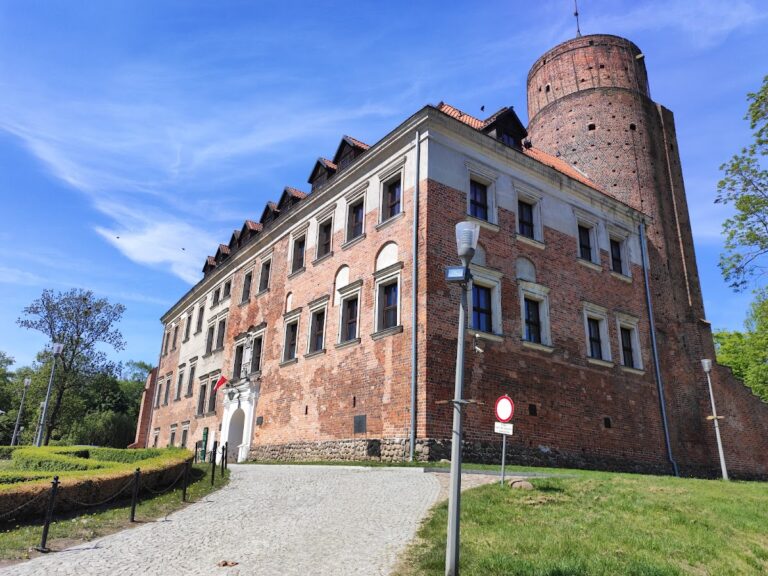
The castle stands on an artificial mound surrounded by a moat supplied by the nearby Bzura River. Almost the entire complex was built of red brick on stone foundations. Its original quadrilateral plan had sides measuring approximately 43, 44, 59, and 66 metres, enclosing an area of about 2,600 square metres. A wall approximately 10 metres high surrounded the fortress.
Szlachecka Tower
The south-west corner contained the Szlachecka Tower, a powerful octagonal structure crowned with crenellations. The tower formed part of the original defensive circuit and is included in the reconstruction programme that restored the principal towered elements of the castle.
Gate tower
A four-sided gate tower stood in the western wall. Its lower level contained a prison, while a guardroom occupied the space above the gateway. The reconstructed New House was later connected to a new gate tower measuring 8 by 16 metres and approximately 18 metres high.
Residential and military buildings
Old House
The original residential building was the three-storey Old House, positioned in the courtyard against the eastern and southern sections of the perimeter walls. Its lower halls hosted meetings of the Royal Council and later sessions of the grodzki court, a local noble court operating in a royal administrative district. The upper floor contained a granary and an armoury.
Powder Magazine
The Old House was later replaced on its foundations by the brick Powder Magazine, built at the end of the eighteenth century. A powder laboratory was subsequently installed there, giving the building its name. The magazine remains part of the castle complex.
New House
The New House was added around 1563 north of the gate tower, along the western defensive wall. It began as a residential building and later contained an engineers’ captain’s quarters and storage rooms. The 1964 reconstruction secured the building and added another storey with an attic in its north-western section. The rebuilt New House now houses the Łęczyca Museum.