Winchester Castle: A Norman Royal Fortress in England


Site at a Glance
- Rating
- 4.4
- Popularity
- Medium
- Country
- United Kingdom
- Primary era
- Medieval
- External website
- Open
- Eras represented
- Classical, Medieval
- Civilizations
- English, Norman, Roman
- Site type
- Military
- Remains
- Castle
On this page12 sections
History
Winchester Castle is a Norman castle in Winchester, United Kingdom, founded by William the Conqueror in 1067 on the site of an early Norman stronghold. Built during the Norman period, it became a royal residence and, for more than a century, the seat of government of the Norman kings. Its position also continued an earlier military tradition, since the Romans had established a fort and a large earth rampart there around AD 70 to protect Venta Belgarum.
Roman foundations and Norman government
The Roman defenses formed a substantial earthwork approximately 800 feet long and 200 feet wide, with a fort constructed on the rampart. William the Conqueror later selected this established defensive site for his castle. Winchester’s new fortress developed into a centre of royal administration as well as a residence, linking the city with the government of Norman England.
During the Anarchy, the twelfth-century civil war between supporters of Empress Matilda and King Stephen, forces loyal to Matilda were besieged at Winchester by Stephen’s army in 1141. Henry II later built a stone keep, the castle’s principal fortified stronghold, to house the royal treasury and the Domesday Book, William the Conqueror’s survey of landholdings and resources commissioned in 1085 and 1086. Edward II added further extensions.
Royal residence and medieval community
Henry III, who was born at Winchester Castle, added the Great Hall between 1222 and 1235. The castle remained a royal residence, and its history also intersected with the experiences of Winchester’s medieval Jewish community. In 1287, Asher, the son of Licoricia of Winchester, wrote a Hebrew inscription on the ruins of the Jews’ Tower. The inscription relates to his imprisonment with members of the wider Jewish community on 2 May 1287, before Edward I imposed a major tax on Jews. Jews were expelled from England in 1290.
In 1302, Edward I and his second wife, Margaret of France, narrowly escaped when a fire destroyed the royal apartments. Edmund of Woodstock, 1st Earl of Kent, was beheaded outside the castle walls on 19 March 1330 in the Despenser plot against Edward III. The castle continued to have royal associations, and Margaret of York, daughter of Edward IV, was born there on 10 April 1472.
Religious conflict and royal trials
After Elizabeth I came to the throne in 1558, Winchester Castle ceased to be a royal residence and passed to Winchester’s city authorities. In 1580, the Bridgettine nun Elizabeth Sander was imprisoned there with other Catholics. She escaped, then returned to demonstrate that Catholics were law-abiding.
The converted Great Hall continued to serve judicial purposes. Sir Walter Raleigh was tried there for treason on 17 November 1603 over his alleged involvement in the Main Plot. Following the Monmouth Rebellion, an uprising against James II, Judge Jeffreys held the Bloody Assizes at the hall on 27 August 1685. These proceedings harshly punished people accused of supporting the rebellion, including Alice Lisle, who was condemned to death for sheltering fugitives.
Civil war, demolition, and later investigation
Royalist forces used Winchester Castle during the English Civil War. Parliamentarian troops captured it in 1646, and Oliver Cromwell ordered its demolition in 1649. Much of the castle was subsequently lost. In the later seventeenth century, Charles II commissioned the architect Christopher Wren to design a royal palace beside the castle site, intended to rival Versailles, but James II abandoned the project.
The Great Hall retained its judicial function into the modern period. In 1954, Edward Montagu, Michael Pitt-Rivers, and Peter Wildeblood were tried and convicted there for specific acts of homosexual indecency. In 1973, six members of the Provisional IRA, a republican paramilitary organization involved in the conflict in Northern Ireland and bombing campaigns in Britain, were tried and convicted in the hall for the Old Bailey bombing. Criminal trials ended after Winchester Law Courts were built immediately east of the Great Hall in 1974.
In 1963, the Winchester Excavation Committee began a rescue excavation in part of the castle site before court buildings and associated car parks were constructed. The surviving Great Hall is a Grade I listed building, a designation for structures of exceptional architectural or historic interest. A medieval-style garden known as Queen Eleanor’s Garden was created behind the hall in 1986. Hampshire County Council owns the castle.
Remains
The surviving castle is primarily built of stone and is represented by the Great Hall, the Westgate, fragments of defensive structures, and the ruins of the Jews’ Tower. Westgate stands close to the Great Hall as part of the surviving city wall, while the other remains preserve elements of the castle’s defensive and administrative history.
The Great Hall
The Great Hall was built between 1222 and 1235 for Henry III. Its proportions follow a double-cube design, with a length of 110 feet and a width and height of 55 feet. A double-cube building is approximately twice as long as it is wide and high. The hall was constructed from flint with stone dressings. Its original lower walls and roof with dormer windows were later altered, and tall two-light windows with early plate tracery were installed. Plate tracery is an early window design in which openings are cut through broad areas of masonry.
The hall contains the large wooden tabletop traditionally known as the Round Table of Arthur. The table was originally made in the thirteenth century and was repainted in its present form for Henry VIII. The names of Arthur’s knights were painted around its edge, while the image of Arthur is recognizably a depiction of the young Henry VIII. The hall also contained the Winchester Panels, a series of pictorial epigrams illuminated in a medieval monastic style. They are thought to portray the twenty-five Knights of the Round Table and the challenges faced by a developing character while progressing around the Wheel of Life. The hall now houses a museum of Winchester’s history.
Defensive and medieval remains
Westgate
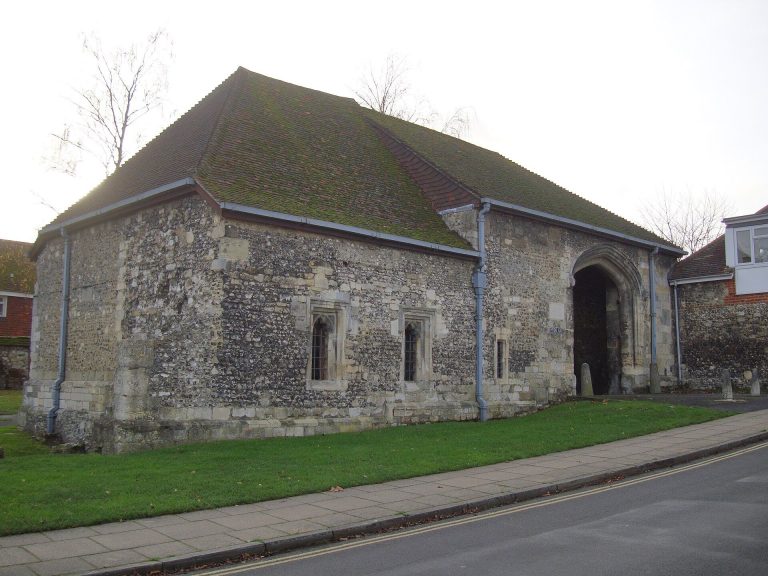
Westgate was once the castle’s principal defensive gateway. It forms part of the remaining city wall and survives close to the Great Hall, preserving the connection between the castle’s inner buildings and Winchester’s wider defenses.
Round tower
The remains of a thirteenth-century round tower are still visible. Its surviving sally ports, small defensible openings or passageways in a fortification, retain evidence of the castle’s defensive arrangements.
Jews’ Tower
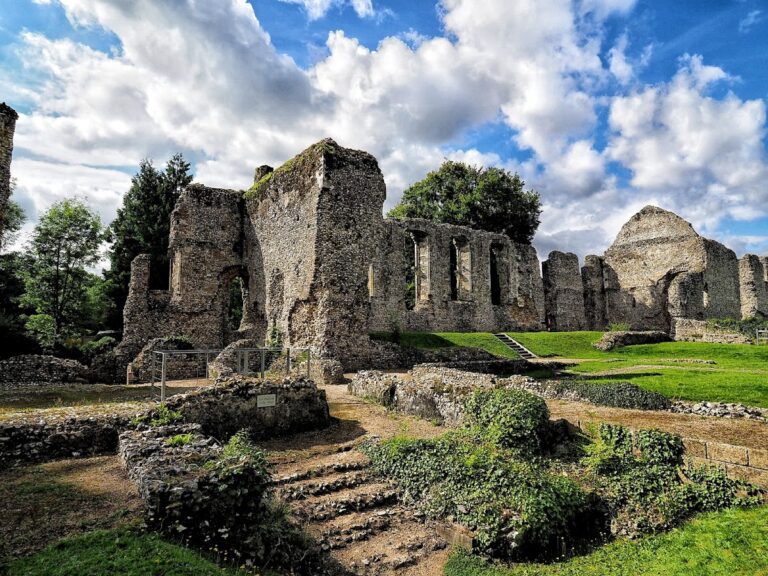
The ruins of the Jews’ Tower form part of the castle remains. They preserve the Hebrew inscription written by Asher in 1287, linking the surviving structure with the imprisonment of members of Winchester’s medieval Jewish community.
Queen Eleanor’s Garden
Queen Eleanor’s Garden was laid out behind the Great Hall in 1986 in a medieval style. Its position and design form part of the later presentation of the surviving castle site, alongside the hall and the remaining defensive structures.