Old Minster: The Anglo-Saxon Cathedral of Winchester
Site at a Glance
- Rating
- 4.2
- Popularity
- Very Low
- Country
- United Kingdom
- Primary era
- Unclassified
- Eras represented
- Unclassified
- Civilizations
- Unclassified
- Site type
- Religious
- Remains
- Cathedral
On this page7 sections
History
The Old Minster in Winchester, United Kingdom, was an Anglo-Saxon cathedral serving the West Saxon and later Winchester dioceses from about 660 until 1093. Wessex was the Anglo-Saxon kingdom whose political and religious centre eventually became Winchester, while a minster was a major church serving a religious community and, here, functioning as a cathedral.
Foundation and early development
A later tradition placed the church’s foundation in 648, during the reign of Cenwalh, king of Wessex, and described it as a dedication to Saints Peter and Paul. That tradition is considered unreliable. A more probable date is about 660, when the West Saxon bishopric moved from Dorchester-on-Thames to Winchester for Wine, its first bishop.
The minster was enlarged and redecorated over the following centuries. Saint Swithun, a ninth-century bishop of Winchester, was buried outside the church in 862. By the tenth century, the building served as the priory church of St Swithun’s Priory, whose monks followed the Rule of St Benedict, a sixth-century framework governing communal worship, discipline, and daily work.
Monastic reform and royal ceremonies
The New Minster was constructed immediately beside the Old Minster in 901. Their closeness was so pronounced that the monks’ singing was said to have become confused between the two churches.
During the monastic reforms of the 970s, Saint Æthelwold of Winchester and his successor Saint Alphege almost completely rebuilt the Old Minster on a much larger scale. The renewed church was dedicated in 980 and rededicated in 993. After the rebuilding, Saint Swithun’s body was moved from its external grave to an indoor shrine.
The church hosted major events in English royal and ecclesiastical history. King Edgar the Peaceable signed the Regularis Concordia there in 973, an agreement that standardized monastic observance in England. Edward the Confessor was crowned at the minster in 1043 and married Edith there in 1045. In 1068, Matilda of Flanders was crowned queen consort there after her marriage to William the Conqueror.
Burials and demolition
The minster received the burials of many kings of Wessex and England, as well as bishops. Those buried there included Æthelstan Ætheling, Ælfgifu, the wife of Eadwig, Cnut the Great, Harthacnut, Emma of Normandy, and Godwin, Earl of Wessex, who died in 1053. Emma of Normandy was queen consort through her marriages to Æthelred the Unready and Cnut the Great.
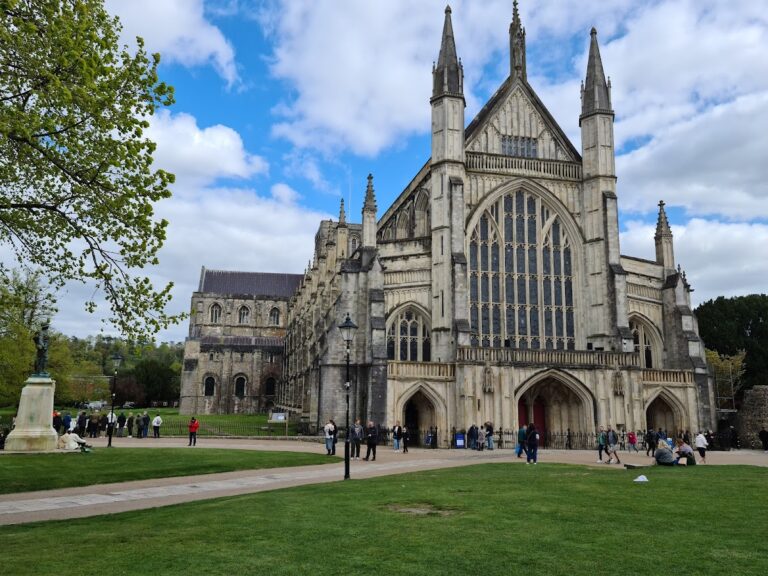
After the Norman Conquest, Walkelin, the Norman bishop of Winchester, began a new cathedral immediately beside the Old Minster. The older church was demolished in 1093. The monarchs buried within it were then exhumed and reinterred in the new cathedral, where their bones remain in mortuary chests around the cathedral choir.
Archaeological excavation in the 1960s clarified the site’s remains. Finds from the excavation are displayed in Winchester City Museum.
Remains
The Old Minster stood immediately north of, and partly beneath, its successor, Winchester Cathedral. The rebuilt church had a central tower, aisles along its north and south sides, a crypt within an eastern apse, and a western forecourt. A crypt is a partly or wholly underground chamber associated with burial or worship, while an apse is the usually semicircular end of a church.
Church outline and shrine
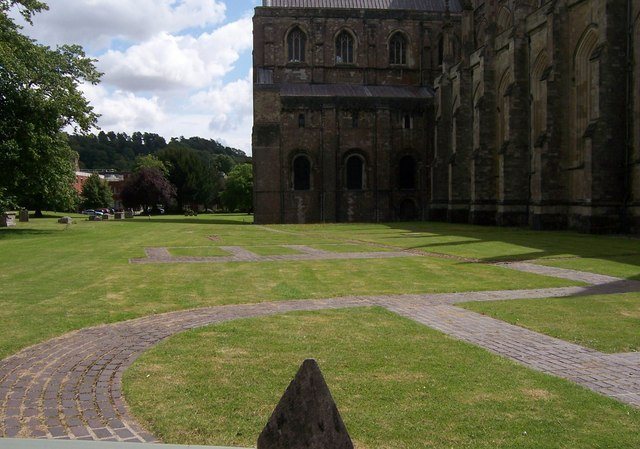
The outline of the demolished church is marked in brickwork in the churchyard adjoining Winchester Cathedral. Saint Swithun’s first grave is also clearly marked there, linking the surviving ground plan with the early history of his burial and later shrine inside the rebuilt minster.
Royal burials
The bones of monarchs transferred from the Old Minster are preserved in mortuary chests positioned around the choir of Winchester Cathedral. These remains reflect the movement of the royal burials after the older church was demolished and its successor took over the cathedral’s role.