Nanstein Castle: A Medieval Fortress and Renaissance Palace in Germany


Site at a Glance
- Rating
- 4.5
- Popularity
- Medium
- Country
- Germany
- Primary era
- Early Modern
- External website
- Open
- Eras represented
- Medieval, Early Modern
- Civilizations
- Holy Roman Empire
- Site type
- Military
- Remains
- Castle
On this page12 sections
History
Nanstein Castle is a 12th-century hilltop fortress in Germany, above the town of Landstuhl. Construction dates to about 1152, while the castle is first mentioned in 1189. It formed part of the Hohenstaufen defensive system established in the southwestern imperial territory from about 1160 under Emperor Frederick I Barbarossa, the 12th-century Holy Roman Emperor associated with the Hohenstaufen dynasty and its imperial fortification program.
Hohenstaufen Fortress and Shared Lordship
Under feudal law, Nanstein was assigned as the seat of an imperial ministerial, a non-free administrative or military official serving the emperor. The fief later became hereditary. In time, successive inheritances divided ownership among several families, creating a Ganerbschaft, a form of shared hereditary ownership in which several families held portions of the same castle or estate. The co-owners expanded the residential accommodation irregularly, and these additions weakened the castle’s defensive capacity.
The Sickingen Stronghold
In 1482, the knight Schweickhardt von Sickingen became a co-owner. His son Franz von Sickingen, born in 1481, gradually acquired the other families’ shares and had brought the entire castle into his ownership by 1518. Franz, a prominent imperial knight and military leader, then sought to turn Nanstein into a modern artillery fortress capable of resisting heavy guns.
After his attack on the Archbishopric of Trier was repulsed in September 1522, Franz von Sickingen withdrew to Nanstein. In spring 1523, the combined forces of the Archbishop of Trier, Louis V, Elector Palatine, and Philip, Landgrave of Hesse, attacked the castle. Nanstein fell after two days of bombardment around the turn of April and May. Sickingen suffered a severe wound during the siege and died from its effects on 7 May 1523. His possessions were confiscated and partly destroyed.
Rebuilding and Destruction
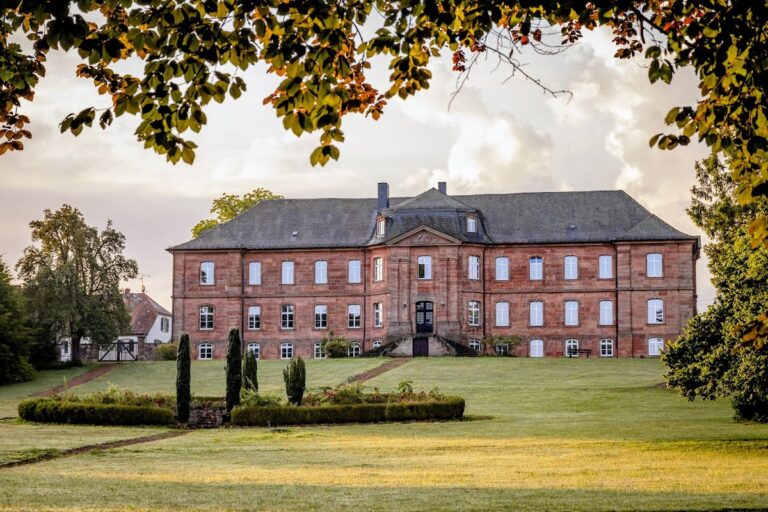
Sickingen’s sons regained the noble family’s rights in 1542, and they and his grandsons rebuilt the partially destroyed castle from 1543. By about 1600, Nanstein had become a magnificent Renaissance palace.
After the Thirty Years’ War ended in 1648, Duke Charles IV of Lorraine and Bar occupied Homburg, Landstuhl, and Hammerstein Castle because of outstanding claims against the Empire. In 1668, Charles I Louis, Elector Palatine, recaptured Landstuhl and Nanstein. He ordered the palace to be blown up, arguing that the 1542 enfeoffment prohibited military use, and then re-enfeoffed the Sickingen family with the lordship of Landstuhl.
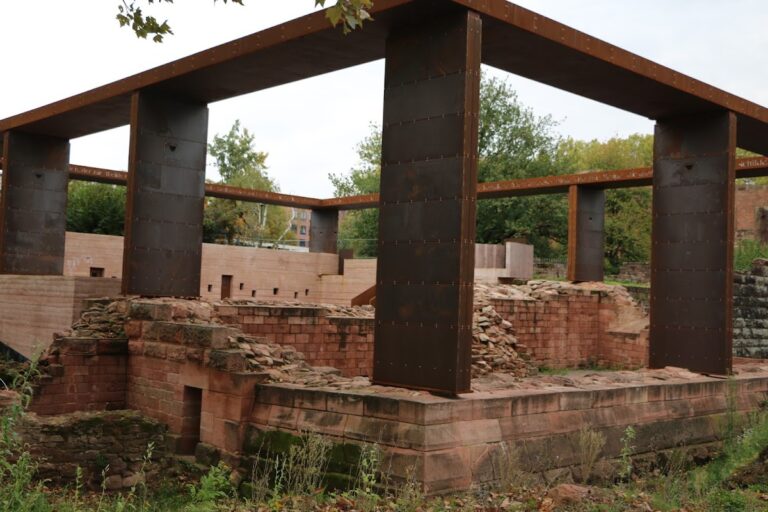
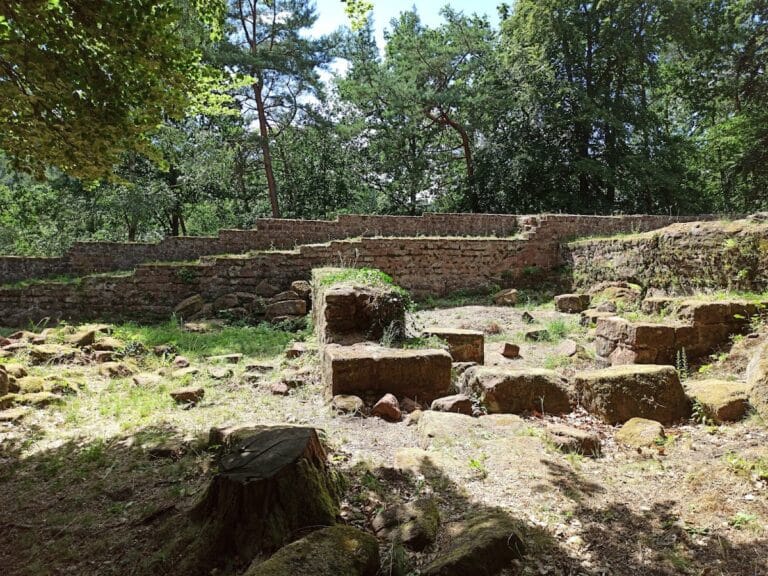
The complex was provisionally rebuilt, but French troops destroyed it in 1689 during the War of the Palatine Succession. Later repairs did not restore the castle fully, and it remained a ruin. Since the mid-19th century, local heritage and historical associations have cleared, preserved, and partly restored Nanstein. The site remains a partially reconstructed ruin. Annual castle performances have taken place in the inner courtyard since 1963, often presenting historical subjects, and Landstuhl held a commemorative ceremony there in 1998 for the 475th anniversary of Franz von Sickingen’s death.
Remains
Nanstein is a red-sandstone spur castle on the summit of a 330-meter-high foothill at the northwestern steep edge of the Sickinger Höhe. The castle hill rises about 80 meters above Landstuhl’s town center and overlooks the West Palatinate Moor Basin and the North Palatinate Uplands. A 15-meter-high red sandstone outcrop on the summit is itself called Nanstein, and parts of the castle were built directly into the rock.
Layout and Water Supply
A central inner castle is surrounded by a multi-part outer bailey. Around 1600, the complex measured approximately 125 meters in length and almost 100 meters in width. The present ruin is nearly 100 meters long and 50 meters wide. Its surviving fabric reflects several centuries of construction, including medieval and Renaissance phases.
Nineteen well shafts supplied water to the inhabitants. They descended approximately 120 meters to the groundwater level, giving the castle a deep internal water supply within its hilltop setting.
Outer Defenses
Southern Outer Bailey
The southern outer bailey retains the main gate, the lower curtain wall, a defensive wall enclosing the castle, and a star-shaped work. The town wall branches from this area, together with part of the outer defensive wall. The town and castle were formerly linked by a shared town and ring wall, whose two sections ran approximately 250 meters uphill from opposite ends of the historic town center.
Northern Outer Bailey
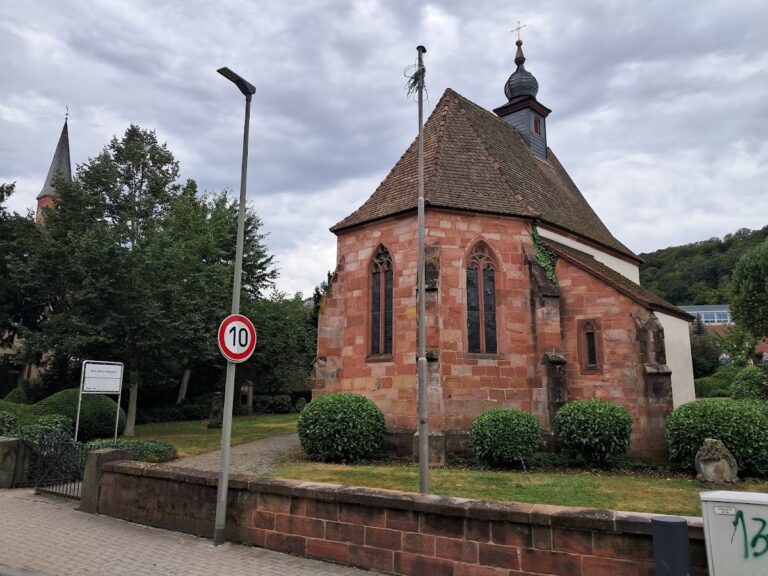
The northern outer bailey contains remains of the guardhouse and castle chapel. A newer staircase approaches the inner castle from this direction.
Inner Castle
Courtyard and Stair Tower
From the courtyard, the former knights’ hall lies to the left. On the right, a vaulted passage leads to a stair tower marked with the date 1518. The tower leads to the chamber traditionally identified as Franz von Sickingen’s death chamber, which was cut deeply into the Nanstein rock. Water continually drips from its ceiling. The staircase continues to a platform with extensive views, particularly toward the north.
Kitchen and Artillery Works
The kitchen contains heraldic stones. The Great Rondel is the surviving part of the former battery tower, a fortified tower designed to house artillery. The Small Rondel, a rounded artillery fortification adapted to the use of guns, contains a heraldic well basin dated 1560 and bearing the arms of the Kranich von Kirchheim family.
The Small Rondel also holds a statue of Franz von Sickingen dating from 1900. Tradition identifies this area as the place where Sickingen, standing behind a loophole, received the wounds that proved fatal on 1 May 1523. The battery tower from his period has been partly rebuilt.