Steckelberg Castle: Imperial Route Fortress and Hutten Family Seat in Germany
Site at a Glance
- Rating
- 4.6
- Popularity
- Low
- Country
- Germany
- Primary era
- Medieval
- External website
- Open
- Eras represented
- Medieval, Early Modern
- Civilizations
- Holy Roman Empire
- Site type
- Military
- Remains
- Castle
On this page10 sections
History
Steckelberg Castle is a ruined hill castle in Germany, near Ramholz in the municipality of Schlüchtern, Hesse. The present fortress was established by Ulrich von Hutten in 1388 on a new site above an earlier castle, and served as an imperial castle guarding routes through the Bergwinkel region. Its name comes from the Middle High German term Stechelnberc, meaning “steep hill.”
The earlier Steckelberg Castle
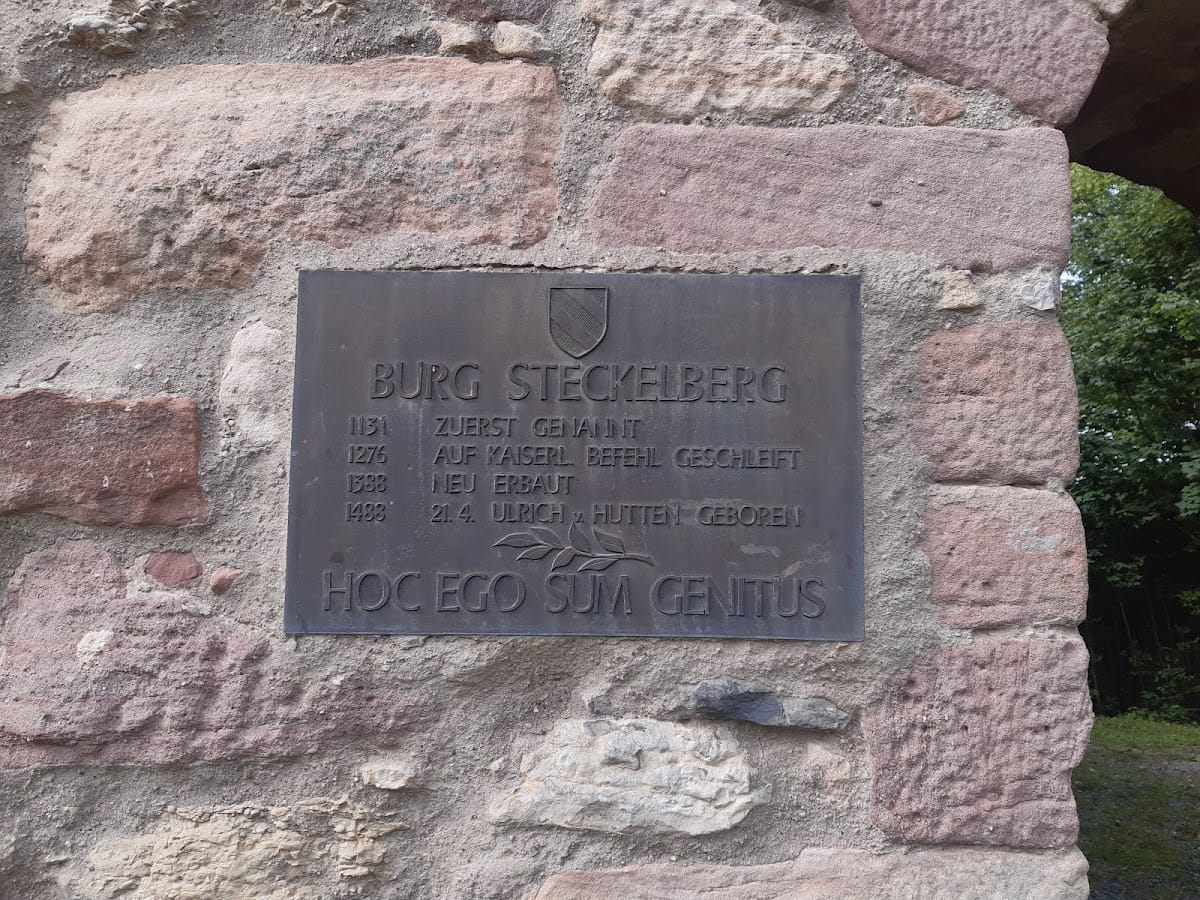
An earlier Steckelberg Castle stood several hundred metres northeast of the present ruins, on a spur of the Breite First now known as Alteburgberg or Nickus. Dated to 1131, it was the family seat of the Lords of Steckelberg until 1391. Hermann von Steckelberg, a member of the baronial line, is mentioned around 1167.
The castle was probably held by the Bishopric of Würzburg between about 1240 and 1276. In 1274, Bishop Berthold II pledged it to Count Reinhard I of Hanau, whose support he needed as an ally. Two years later, the fortress was occupied, apparently without legal authority, and used as a robber-baron stronghold.
King Rudolf I ordered the castle destroyed in 1276. His decree of 14 October required the Steckelburg to be demolished and prohibited reconstruction without imperial permission. The stated reason was a threat to the Landfrieden, the medieval principle of public peace that restricted private violence, feuding, and unauthorized warfare. The measure also probably strengthened the territorial position of the Count of Hanau. The Lords of Steckelberg retained administrative and usage rights after the destruction.
The Hutten rebuilding
After the male line of the Steckelberg family died out in the mid-fourteenth century, estates and hereditary fiefs passed through daughters and their husbands. One heir was Frowin von Hutten, who died in 1377 and held fields and pasture at Steckelberg. His son Ulrich von Hutten re-fortified the hill in 1388 and founded the present castle a few hundred metres from the site destroyed in 1276.
The new location allowed the rebuilding prohibition to be circumvented. The breach was not punished after Ulrich transferred the castle’s ownership rights back to the Bishop of Würzburg. This removed it from the control of the regional rulers, especially the Counts of Hanau. After Ulrich’s death, the wider Hutten family held the castle jointly through enfeoffment, the granting of property or rights by a feudal lord in return for recognized obligations and allegiance.
In 1452, Lorenz von Hutten reached a Burgfrieden, or castle-peace agreement, with the other co-heirs. It governed shared maintenance costs, supplies during a siege, residence, and the circumstances in which the fortress could be used as a base for feuds. The same year, a dispute developed between the Hutten-Steckelberg family and Würzburg after the family sought to admit 32 outside co-heirs.
Bishop Johann besieged and captured Steckelberg Castle in 1458. An agreement led to its return in 1459. The partly destroyed buildings were then rebuilt or renovated and occupied again.
Ulrich von Hutten and later use
Ulrich von Hutten, the German knight, humanist, and writer associated with the religious and intellectual conflicts of the early sixteenth century, was born at Steckelberg Castle on 21 April 1488. In a letter to Willibald Pirckheimer written in 1518, he described conditions at his home castle in vivid terms that were probably exaggerated.
Rebel peasants attacked the castle during the Peasants’ War in 1525 but failed to capture it. From the middle of the sixteenth century, the Hutten residence at Ramholz, below the castle hill, became more important to its owners. Steckelberg nevertheless retained a defensive function into the later seventeenth century. Enfeoffments during the Thirty Years’ War, the European conflict of 1618 to 1648 that brought extensive military disruption, damage, and population loss to the German territories, indicate that the fortress still had a military role.
Philipp Daniel von Hutten, who died in 1687, was the last aristocratic resident of the castle. A hand drawing from his period shows the fortress in its final building phase, which had probably remained largely unchanged since 1509. By about 1700, the ruins were being used as a quarry, and the castle probably became uninhabitable during the Thirty Years’ War.
Protection and conservation
Baron Hugo Rudolf von Stumm purchased the ruins in 1883, protecting them from further decay. He also acquired the Hutten estate at Ramholz and developed it into the historicist Ramholz Castle complex.
In 2004, the current owner renovated the east wall and cleared the moat. Parts of the north wall collapsed in mid-2007, and the ruins were closed in early 2008. Following renovation, the castle officially reopened on 26 May 2013. Steckelberg Castle is designated as a cultural heritage monument in Hesse.
Remains
Hilltop layout and defensive works
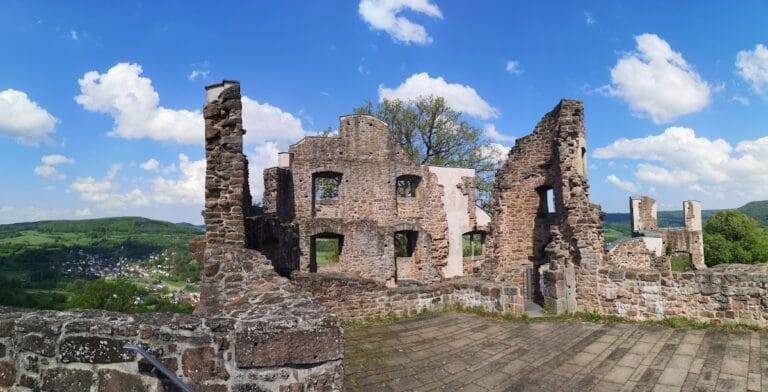
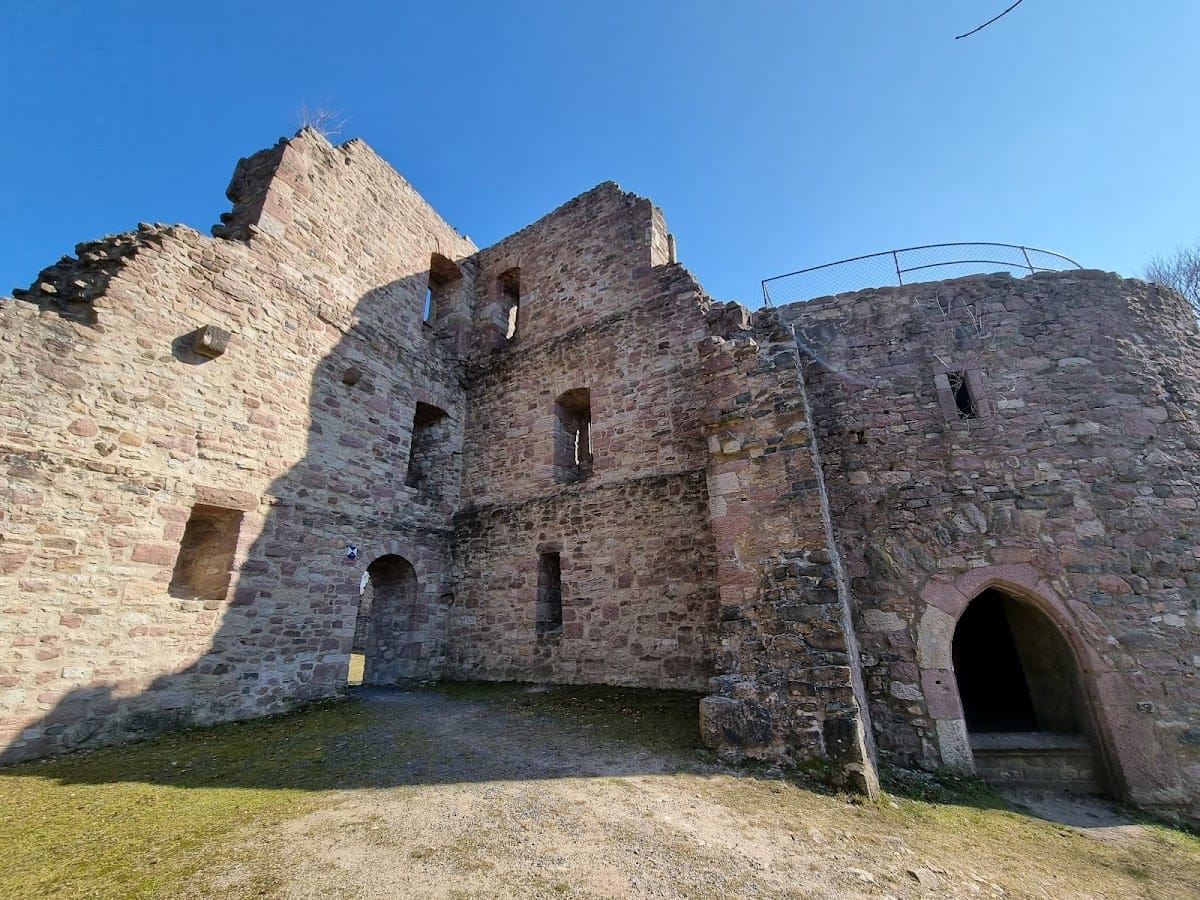
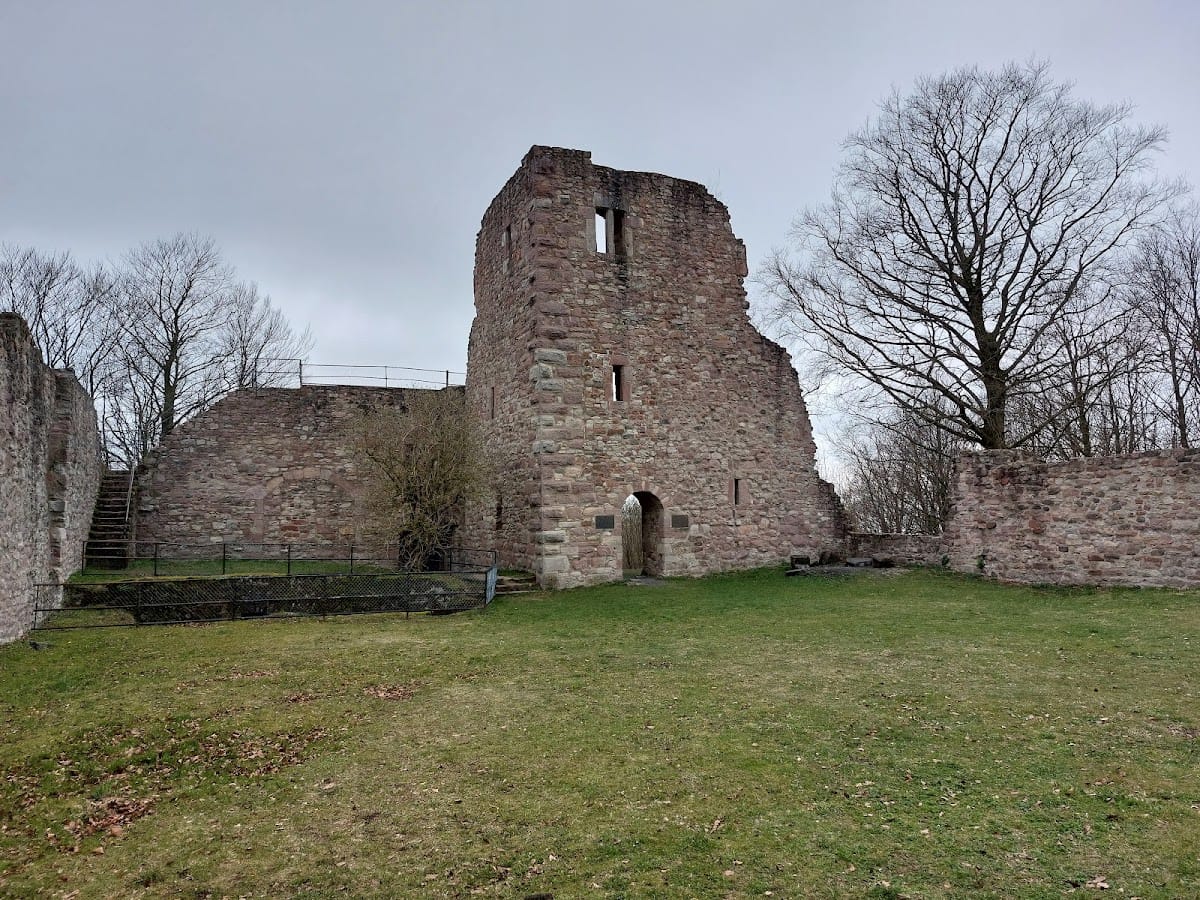
The present ruins occupy a hilltop or domed crest on a spur of the Steckelberg, east of Vollmerz and northeast of Ramholz. The surviving complex is arranged within parts of a rectangular curtain wall, the enclosing defensive wall of a castle. A west-side entrance turret, a three-storey residential building in the northwest, and a cellar form the principal surviving elements. Large sections of the walls collapsed in mid-2007, while the east wall later underwent renovation.
Entrance turret and cellar
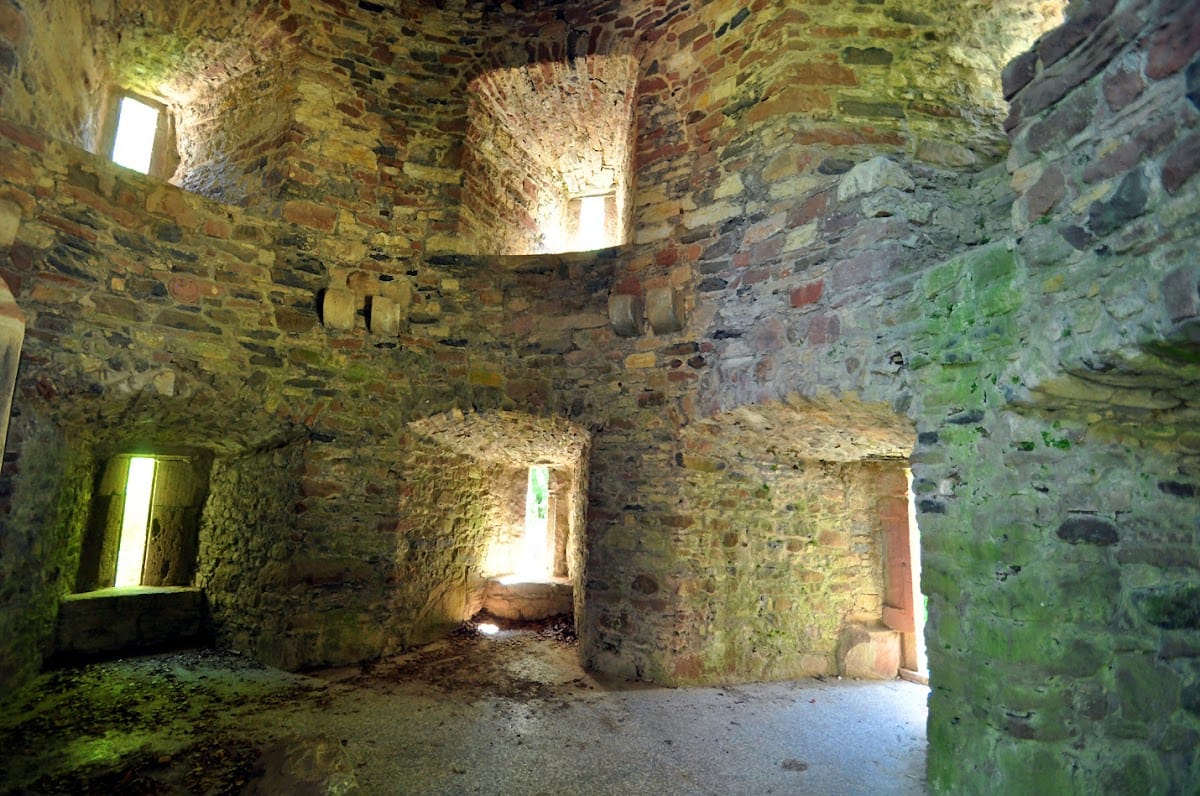
The western entrance turret contains a modern built-in chimney. The surviving cellar is an open vaulted cellar, providing one of the clearest preserved interior spaces within the ruin. Together, these features reflect the combination of defensive and domestic use that characterized the later castle.
Battery tower
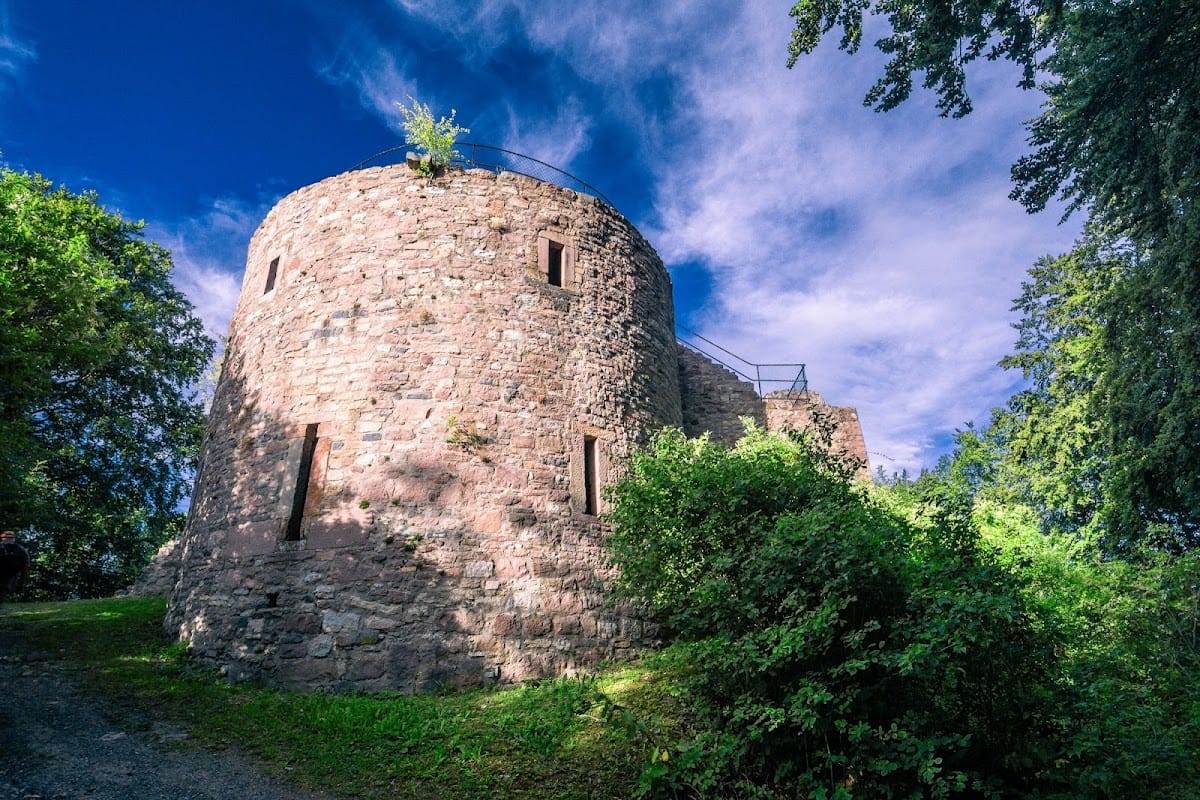
The structure known as the Batterieturm, or battery tower, controls the approach to the castle. Its masonry and embrasures, openings in a defensive wall for weapons or firearms, belong to the construction phase of 1388 to 1389. The tower’s traditional identification as a powerful gun tower built in 1509 is considered incorrect.
A door dated 1509 was inserted into the tower at a later stage. The date probably marks the conversion of the structure, after it had become functionally obsolete, into additional domestic accommodation. The door, chimney, and other architectural details support this interpretation. The late seventeenth-century hand drawing records the castle’s final known appearance and probably shows a building phase that had changed little since 1509.
Earlier defensive installations
The wider hilltop contains evidence of defensive activity predating both the earlier medieval castle and the present ruins. In 1969, an Early Medieval circular rampart covering approximately 0.4 hectares was discovered about 225 metres east of the old castle. A separate neck ditch, a defensive ditch cut across a narrow approach or connecting ridge, lies roughly 125 metres farther east on the high plateau and probably belonged to the oldest defensive installation. Its northern course was destroyed during the construction of a wind turbine.
These earthworks occupy the same broader ridge landscape as the two Steckelberg castles. The earlier castle stood on the Alteburgberg or Nickus spur, while the surviving ruins occupy the later hilltop established by Ulrich von Hutten in 1388. Their positions preserve the sequence of changing defensive sites around Steckelberg.