Volmarstein Castle: A Medieval Hilltop Fortress in Germany


Site at a Glance
- Rating
- 4.5
- Popularity
- Low
- Country
- Germany
- Primary era
- Medieval
- External website
- Open
- Eras represented
- Medieval, Modern
- Civilizations
- Holy Roman Empire
- Site type
- Military
- Remains
- Castle
On this page9 sections
History
Volmarstein Castle is a medieval hilltop fortress ruin in Germany, built around 1100 by Friedrich I, Archbishop of Cologne, in Volmarstein, now a district of Wetter in North Rhine-Westphalia. The castle strengthened Cologne’s territorial claims in Westphalia and was granted as a fief to the noble lords of Volmestein, also known as the lords of Volmarstein.
Foundation and the lords of Volmarstein
The castle guarded the archiepiscopal escort road between Ennepetal and Soest. It stood on the boundary between the Archbishopric of Cologne and the County of Mark, giving it a defensive and administrative role on Cologne’s northern and eastern frontier. Until the fourteenth century, it served as the administrative center of the lordship of Volmarstein, whose territory included Hagen.
Heinrich I was the first documented representative of the family, appearing in 1134. The lords of Volmestein were ministeriales, members of the medieval service nobility who performed military, administrative, and courtly duties for a superior lord. In this case, they served the archbishops of Cologne, who were both senior churchmen and major territorial rulers in the Rhineland and Westphalia.
Wars and changing lordship
Volmarstein was drawn into the struggle between Cologne and the County of Mark after the Battle of Worringen in 1288. This major conflict over the succession to the Duchy of Limburg ended with the defeat of the Archbishop of Cologne and changed the balance of power in the region. Count Eberhard I of the Mark besieged and partly destroyed the castle after the battle. Reconciliation followed, and the fortress was restored in 1289.
During the early fourteenth century, Cologne, Münster, and the County of Mark contested regional rights connected with Volmarstein. Gottfried of Sayn became lord of the castle in 1314, although political changes repeatedly returned the fief to Cologne.
In 1324, Engelbert II of the Mark captured and destroyed Volmarstein after a siege lasting two months. The garrison reportedly surrendered because it lacked water. Engelbert also captured the bishop at Methler. A later reconciliation led to the rebuilding of the castle, but the conflict demonstrated the vulnerability of the site to the competing territorial powers of the region.
The counts of the Mark used Volmarstein intermittently during the fourteenth and fifteenth centuries and into the early sixteenth century. The castle later came under the counts of Cleves and, from 1417, the dukes of Cleves. Its active use then ended, and the fortress gradually fell into decay.
The Volmarstein inheritance
After Johann of Volmestein, the last male heir of the family, died sometime after 1430, the family’s Volmarstein and Rinkerode properties, together with the Volmarstein feudal chamber, passed through his sister Agnes’s marriage to Goddert of der Recke. These holdings thereby entered the von der Recke family’s possession.
Fire, restoration, and remembrance
A major fire in 1754 destroyed both the village of Volmarstein and the castle. Local inhabitants dismantled stones from the ruined fortress and reused them to rebuild their houses, leaving the castle in its present ruined condition.
By the early nineteenth century, the ruin was known beyond the immediate region. The Prussian Romantic poet Friedrich de la Motte Fouqué, whose work often treated medieval and chivalric subjects, devoted a substantial poem to Volmarstein in 1813. The castle hill returned to Count Philipp von der Recke-Volmarstein in 1817 through an act by King Friedrich Wilhelm III of Prussia, and the count acquired possession of the ruin in 1819. He financed extensive repairs between 1822 and 1854.
On 24 June 1830, a severe storm destroyed half of the eastern tower. A retaining wall was later built at the split tower and became a prominent feature of the castle hill. Volmarstein Castle is now listed as monument no. 51 in Wetter’s heritage register and lies within the landscape-protection area In der Bach/Am Vorberg. The ruin remains owned by the von der Recke family.
The castle is the landmark of the former independent municipality of Volmarstein and is also used as a symbol by the company Burg-Wächter. A plaque commemorates Count Siegfried von der Recke-Volmarstein, a descendant of the Volmarstein family who was killed at Saint-Privat on 18 August 1870 while serving as a lieutenant in the 3rd Guards Grenadier Regiment Queen Elisabeth.
Remains
Hilltop setting and castle plan
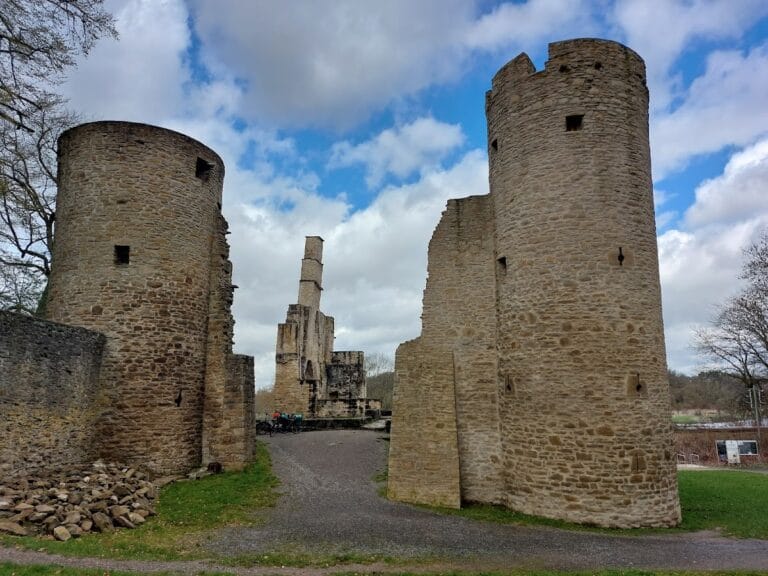
The ruin occupies a ridge rising about 100 metres above the Ruhr. Its elevated position overlooks the Ruhr Valley, Wetter, Volmarstein, and the Harkort Reservoir. The elongated plan follows the ridge and is organized around a central castle with two outer baileys, subsidiary enclosed areas placed beyond the principal fortified core, at opposite ends.
Central castle and surviving towers
Three towers of the central castle survive in partial form, together with associated masonry. The eastern tower was divided by the storm damage of 1830, and the retaining wall later constructed at the split tower forms part of the surviving ruin. Stones taken from the castle after the 1754 fire remain incorporated into houses in the village, while the fortress itself consists chiefly of the three damaged towers and related wall remains.
Inscriptions and commemorative plaques
Stone plaques attached to the surviving tower preserve several stages of the site’s history. One records the castle’s construction around 1100 by the Archbishop of Cologne, its occupation by the lords of Volmarstein, and its capture and destruction in 1324. Another describes its construction, enfeoffment to the Volmarstein family, destruction after the two-month siege, and the return of the castle hill to the von der Recke family. A third plaque commemorates Siegfried von der Recke-Volmarstein and records his death at Saint-Privat in 1870.